Chinese Battery Passport Software Market Size & Share Analysis - Trends, Drivers, Competitive Landscape, and Forecasts (2026 - 2032)
This Report Provides In-Depth Analysis of the Chinese Battery Passport Software Market Report Prepared by P&S Intelligence, Segmented by Solution Type (Digital Product Passport (DPP) Solutions, Supply Chain Traceability Platforms, Compliance Management Systems, Lifecycle Management Solutions, Carbon Footprint Tracking Tools, Due Diligence & Sourcing Tools), Deployment Mode (Cloud, On-Premises, Hybrid), Application (Automotive, Energy Storage Systems (ESS), Consumer Electronics, Industrial), End User (Battery Manufacturers, Original Equipment Manufacturers (OEMs), Regulatory Bodies, Recyclers), and Geographical Outlook for the Period of 2021 to 2032
Chinese Battery Passport Software Market Growth Potential
Key Highlights
Study Period
2021 - 2032
Market Size in 2025
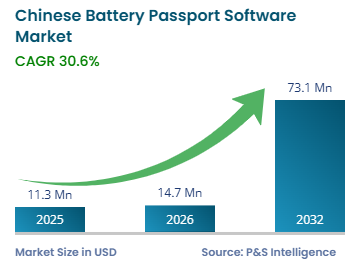
USD 11.3 Million
Market Size in 2026
USD 14.7 Million
Market Size by 2032
USD 73.1 Million
Projected CAGR
30.6%
Largest Province
Guangdong
Fastest-Growing Province
Jiangsu
Market Structure
Fragmented
Market Size
Explore the market potential with our data-driven report
Chinese Battery Passport Software Market Analysis
The Chinese battery passport software market value stood at USD 11.3 million in 2026, and it is poised to grow at a CAGR of 30.6% from 2026 to 2032, reaching USD 73.1 million by 2032. The market is driven by rising regulatory compliance needs to meet upcoming EU battery passport requirements, increasing demand for supply chain transparency and ESG reporting across the battery lifecycle, and initiatives and pilots by major producers to establish traceability standards.
Key Market Insights
Digital product passport solutions held the largest share in 2025, of 35%.
Energy storage systems have the highest CAGR during 2026–2032, of 40.0%.
Cloud is the largest and fastest-growing deployment mode with 60% share and 30.8% CAGR.
Battery manufacturers dominated the market in 2025 with 40% share.
Guangdong holds the largest provincial share of the market, of 40%.
Jiangsu is projected to register the fastest growth during 2026–2032, of 30.9%.
In January 2026, China's Ministry of Industry and Information Technology (MIIT) jointly issued Interim Measures for the Recycling and Comprehensive Utilization of Retired NEV Power Batteries alongside five other ministries. It mandated that every NEV power battery receive a unique digital identity effective April 1, 2026, under a full-channel, full-chain, full-lifecycle management framework. This regulatory catalyst has transformed battery passport software from an export-compliance tool into a domestic compliance imperative. In turn, this directly expands the software's addressable market across every battery manufacturer, OEM, and licensed recycler operating in China's NEV ecosystem.
Chinese Battery Passport Software Market Emerging Trends
Blockchain and Carbon Footprint Reporting Integration Are Trending
A defining technological trend reshaping the competitive landscape is the convergence of blockchain-based distributed ledger technology, IoT telemetry, carbon footprint calculation engines, and lifecycle analytics into unified passport software ecosystems. Standalone traceability platforms are progressively giving way to integrated compliance suites capable of generating independently verifiable carbon declarations, which are required under both Chinese and EU frameworks. MIIT launched a mandatory carbon footprint pilot for NEV power batteries in 2026, requiring manufacturers to calculate and report cradle-to-gate emissions across material acquisition, manufacturing, distribution, and recycling. China Automotive Data Company's Battery ID platform now incorporates carbon footprint data acquisition workflows alongside identity generation, cross-border data circulation, and certification modules.
Government Regulations and Export Compliance Pressure Drive Market
A dual-regulatory imperative is the single most powerful driver of battery passport software adoption in China. The MIIT's January 2026 interim measures require that every NEV power battery be assigned a unique digital identity, enforcing a full-channel, full-chain, full-lifecycle traceability obligation on all manufacturers, OEMs, and licensed recyclers. Simultaneously, the EU Battery Regulation 2023/1542 mandates digital passports for industrial and EV batteries entering the European Union from 2027, compelling Chinese exporters to implement compliant passport platforms years in advance to secure and maintain market access.
In 2025, China's NEV production and sales both exceeded 16 million units—surpassing 50% of domestic new vehicle sales—while China exported batteries worth USD 48.3 billion in the January–August 2025 period alone. Software platforms that satisfy both China's Battery ID requirements and EU data format standards now constitute a competitive prerequisite for export-oriented manufacturers.
Data Interoperability Gaps and Fragmented Standards Are Key Restraints
The absence of harmonized data standards between China's Battery ID system and the EU's digital product passport framework poses a material constraint on cross-border platform scalability. The two systems operate on distinct data models, governance architectures, and verification protocols, creating dual-compliance engineering requirements for software vendors seeking to serve both markets simultaneously.
A deeper structural challenge lies in upstream data quality. Most manufacturers lack verified visibility beyond tier-two suppliers, and blockchain infrastructure cannot resolve the foundational problem of unreliable or incomplete data inputs at point of entry. Cross-border pilot initiatives are advancing, including China Automotive Data Company's data circulation pilot with the Tianjin Dongjiang Free Trade Zone, Geely, and CATL. Still, standards harmonization between the Chinese and EU frameworks is expected to persist till at least 2027. The competitive landscape will favor platforms that can serve as bilateral bridges, absorbing the technical complexity of dual-system compliance on behalf of their enterprise customers.
Chinese Battery Passport Software Market Segmentation Analysis
Solution Type Analysis
Digital product passport (DPP) solutions held the largest share of the Chinese battery passport software market in 2025, of 35%. The MIIT's national Battery ID mandate has established DPP platforms as the foundational compliance infrastructure for China's traceability ecosystem. Battery manufacturers are legally obligated to assign unique digital identifiers to each battery, to track production, performance, installation, replacement, and recycling. DPP solutions serve as the core data management layer that integrates with upstream ERP systems, manufacturing execution systems, and MIIT's national traceability platform. China's interim provisions have standardized lifecycle tracking systems for all battery manufacturers, vehicle producers, and recycling operators, establishing DPP software as a non-negotiable operational requirement.
Due diligence & sourcing tools are expected to register the fastest growth during 2026–2032, at 30.7% CAGR. This category is driven by the approaching EU Battery Regulation enforcement deadlines, which require Chinese exporters to document responsible material sourcing across cobalt, lithium, nickel, and graphite supply chains.
The market segments into the following solution types:
Digital Product Passport (DPP) Solutions (Largest Category)
Supply Chain Traceability Platforms
Compliance Management Systems
Lifecycle Management Solutions
Carbon Footprint Tracking Tools
Due Diligence & Sourcing Tools (Fastest Growing Category)
Deployment Mode Analysis
Cloud deployment commanded the largest share of the Chinese battery passport software market in 2025, of 60%, and it is projected to demonstrate the fastest growth through 2026–2032, of 30.8%. Cloud architecture enables battery manufacturers and OEMs operating across China's geographically distributed production hubs to consolidate traceability data from disparate factory sites into unified compliance dashboards. Cloud platforms also facilitate the cross-border data circulation pilots mandated by China Automotive Data Company, where verified battery information must be transmitted to international markets in standardized formats. MIIT's national NEV power battery traceability platform is itself cloud-hosted, making cloud-compatible software the natural integration pathway for all regulated entities.
The market segments into the following deployment modes:
Cloud (Largest and Fastest Growing Category)
On-Premises
Hybrid
Application Analysis
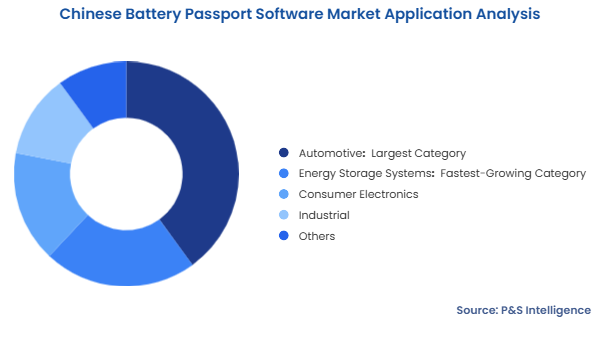
The automotive category captured the largest share of the Chinese battery passport software market in 2025, of 40%, as this sector is the primary driver of both battery production volume and regulatory compliance obligations. China's NEV production and sales surpassed 16 million units in 2025—exceeding half of all domestic new vehicle sales. From April 2026, every vehicle battery is now subject to digital ID assignment requirements. Automotive OEMs and battery suppliers collectively represent the highest-volume deployers of passport software, including at CATL's Ningde facilities, BYD's Shenzhen operations, and CALB's Changzhou lines.
The Energy Storage Systems (ESS) category is anticipated to experience the fastest growth during 2026–2032. China's Battery ID program has expanded scope to energy storage batteries in 2025, creating a new traceability compliance wave across grid-scale and commercial ESS deployments. By the end of 2025, China’s total cumulative energy storage capacity reached approximately 213.3 GW.
New-type (battery) systems now account for around 67.9% (about 144.7 GW) of total storage capacity. In the first half of 2025, China added 66.43 GW (189.48 GWh) of new-type storage capacity, driven by standalone and renewables-paired systems, with average storage duration rising to about 2.58 hours. The 12.8-GWh Envision Jingyi Chagan Hada energy storage cluster is set to be connected to the grid in early 2026.
The market segments into the following applications:
Automotive (Largest Category)
Energy Storage Systems (ESS) (Fastest Growing Category)
Consumer Electronics
Industrial
Others
End User Analysis
Battery manufacturers dominated the market in 2025 with 40% share, driven by their primary compliance obligations under MIIT's lifecycle traceability framework. Designated responsible parties under China's interim battery recycling measures, they are required to implement unique coding systems, upload traceability data to MIIT's national platform, and document the full production-to-recycling journey. That is why battery manufacturers are investing in integrated platforms that link manufacturing execution data with carbon footprint reporting and cross-border certification modules.
Recyclers are projected to register the fastest growth during 2026–2032. China is entering a period of accelerating large-scale battery retirement. In 2025, over 400,000 tonnes of retired NEV batteries were comprehensively reused—up 32.9% year-on-year. Retired battery volumes are projected to exceed 1 million tonnes annually by 2030, compelling recyclers entering licensed channels to adopt digital passport systems for material verification and compliance documentation. The MIIT mandates that automakers and battery manufacturers establish full-coverage recycling networks, with digital traceability reported through MIIT's national platform. These obligations flow down to licensed recyclers. Affordable, modular passport solutions designed for mid-tier and emerging recyclers, who lack the in-house development capacity of enterprise-scale operators, offers market opportunities.
The market segments into the following end users:
Battery Manufacturers (Largest Category)
Original Equipment Manufacturers (OEMs)
Regulatory Bodies
Recyclers (Fastest Growing Category)
Others
Drive strategic growth with comprehensive market analysis
Chinese Battery Passport Software Market Regional Outlook
Guangdong Battery Passport Market Analysis
Guangdong holds the largest provincial share of the market, of 40%, driven by its established battery manufacturing ecosystem. BYD's Shenzhen headquarters and large-scale production complex, EVE Energy's Huizhou operations, and Gotion High-Tech's Guangdong gigafactory are all located here. Guangdong's battery producers face the most immediate EU Battery Regulation compliance pressure due to their high share of lithium-ion battery exports. This makes investment in passport software platforms a competitive necessity rather than a strategic option.
Jiangsu Battery Passport Market Forecast
Jiangsu is projected to register the fastest provincial growth in battery passport software adoption during 2026–2032, at 39.9% CAGR. The province is rapidly evolving from a traditional automotive component base into a major energy storage systems hub. CALB's Changzhou complex is one of the fastest-scaling gigafactories in eastern China, and over 340 Megawatts of grid-scale ESS projects have been announced or are underway across the province. This ESS expansion places Jiangsu at the forefront of the second wave of Battery ID program compliance, as MIIT extended its digital tracking mandate beyond NEV power batteries to cover stationary energy storage batteries in 2025.
The provinces and municipalities analyzed in this report include:
Guangdong (Largest Province Market)
Fujian
Jiangsu (Fastest-Growing Province Market)
Shanghai
Beijing
Rest of China
Chinese Battery Passport Software Market Share Analysis
China's battery passport software market exhibits a fragmented competitive structure. This is due to the early stage of the regulatory compliance ecosystem and the diversity of deployment use cases spanning digital product passport generation, supply chain traceability, carbon footprint reporting, and lifecycle management. No single commercial vendor has a dominant share as the software landscape is shaped by three distinct competitive clusters.
These are state-designated platform operators anchoring national compliance infrastructure, vertically integrated battery manufacturers deploying proprietary in-house systems, and specialist technology providers competing on blockchain-based traceability and data verification capabilities. This fragmentation is sustained by the absence of a unified commercial procurement process. MIIT's national Battery ID platform is operated by a state-affiliated entity, while enterprise-scale battery producers have the technical capacity and regulatory incentive to build proprietary passport solutions over licensing third-party software.
Chinese Battery Passport Software Producers:
China Automotive Data Company
Contemporary Amperex Technology Co. Limited
BYD Co. Ltd.
CALB Group Co. Ltd.
Sunwoda Electronic Co. Ltd.
EVE Energy Co. Ltd.
Shenzhen Dianlian Technology Co. Ltd.
Siemens AG
Minespider GmbH
Circularise B.V.
Circulor Ltd.
Batrix
Circunomics
IBM Corporation
Accenture PLC
SAP SE
Everledger Ltd.
RCS Global Group
Catena-X
Chinese Battery Passport Software Market News & Updates
In December 2025, China Automotive Data Company launched a cross-border battery data circulation pilot in collaboration with the Tianjin Dongjiang Free Trade Zone, Geely Auto, and CATL. This expanded the Battery ID program's scope to cover energy storage batteries and introduced the first Battery ID certification rules co-developed with TUV South covering data accuracy, integration processes, and transmission security.
In January 2025, China Automotive Data Company operationalized the Battery ID digital ecosystem, covering the full battery supply chain from raw materials to final production. It assigned unique identity codes to power batteries and enabling cross-company data exchange via the Data Interaction Connector.
In November 2024, Contemporary Amperex Technology Co. Limited completed two Global Battery Alliance Wave Two Battery Passport pilots for its Shenxing and CTP batteries.
In November 2024, Sunwoda Electronic Co. Ltd. partnered with Siemens AG to launch a battery passport platform at the 7th China International Import Expo in Shanghai. The platform delivers an end-to-end lifecycle carbon tracking solution with standardized carbon accounting templates aligned to EU Battery Regulation requirements.
Frequently Asked Questions About This Report
What was China battery passport software market size in 2025?+
In 2025, the battery passport software market in China size was USD 11.3 million.
Which solutions type has largest China battery passport software industry share?+
DPP solutions have the largest China battery passport software industry share, of 35%.
Which end user has the highest China battery passport software market CAGR?+
Recyclers have the highest CAGR in battery passport software market of China, of 40.1%.
What are the key China battery passport software industry drivers?+
The major drivers for China battery passport software market are the rising regulatory compliance needs, increasing demand for supply chain transparency and ESG reporting across the battery lifecycle, and initiatives and pilots by major producers to establish traceability standards.
What is China battery passport software market nature?+
The battery passport software market in China is fragmented.
Want a report tailored exactly to your business need?
Leading companies across industries trust us to deliver data-driven insights and innovative solutions for their most critical decisions. From data-driven strategies to actionable insights, we empower the decision-makers who shape industries and define the future. From Fortune 500 companies to innovative startups, we are proud to partner with organisations that drive progress in their industries.
Client Testimonials
Working with P&S Intelligence and their team was an absolute pleasure – their awareness of timelines and commitment to value greatly contributed to our project's success. Eagerly anticipating future collaborations.
McKinsey & Company
India
Unmatched Standards
Our insights into the minutest levels of the markets, including the latest trends and competitive landscape, give you all the answers you need to take your business to new heights
Complete Data Security
We take a cautious approach to protecting your personal and confidential information. Trust is the strongest bond that connects us and our clients, and trust we build by complying with all international and domestic data protection and privacy laws