This Report Provides In-Depth Analysis of the China Rare Earth Minerals Market Report Prepared by P&S Intelligence, Segmented by Element (Cerium, Neodymium, Praseodymium, Lanthanum, Dysprosium, Terbium, Promethium, Yttrium, Scandium), Application (Catalysts, Ceramics, Phosphors, Glass and Polishing, Metallurgy, Magnets), and Geographical Outlook for the Period of 2021 to 2032
Explore the market potential with our data-driven report
China Rare Earth Minerals Market Outlook
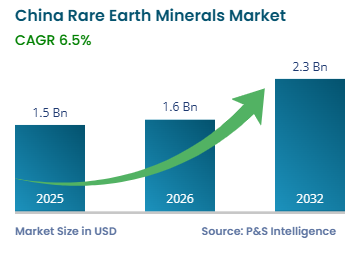
The Chinese rare earth minerals market size will be an estimated USD 1.5 billion for 2025, and it will grow by 6.5% during 2026–2032, to reach USD 2.3 billion by 2032.
China maintains its position as the global leader in rare earth production, controlling approximately 70% of global rare earth mine production and over 80% of global refining capacity. The country's dominance extends across the entire value chain, from mining and separation to processing and magnet manufacturing. The market is experiencing robust growth driven by accelerating demand from electric vehicle production, renewable energy infrastructure, and advanced electronics manufacturing.
Government policy frameworks are strengthening market infrastructure through production quotas, export controls, and industrial consolidation initiatives. For instance, in April 2025, China imposed export controls on selected strategic rare earth elements, including terbium, dysprosium, gadolinium, samarium, yttrium, scandium, and lutetium. The formation of China Rare Earth Group in December 2021, which controls approximately 70% of the nation's production, demonstrates ongoing consolidation efforts to enhance operational efficiency and global competitiveness.
Moreover, China's commitment to carbon neutrality by 2060 drives massive investments in wind and solar energy infrastructure, both requiring substantial rare earth inputs. Wind turbines utilize high-performance permanent magnets containing neodymium and dysprosium for direct-drive generators, with each large turbine requiring several hundred kilograms of rare earth materials. Solar panel manufacturing, electronics for grid management systems, and energy storage technologies all incorporate rare earth elements in various applications. Government mandates for renewable energy capacity additions create predictable, growing demand trajectories independent of economic cycles.
China Rare Earth Minerals Market Emerging Trends
Strategic Export Control Is Key Trend
China's implementation of export licensing requirements marks a pivotal shift in rare earth market governance.
The April 2025 export controls introduced mandatory licensing for selected strategic rare earth elements and all related compounds, metals, and magnets.
These measures caused significant supply chain disruptions, with carmakers in the United States and Europe struggling to obtain permanent magnets, forcing some to temporarily shut down factories.
Export volumes fell sharply in April and May 2025 following initial restrictions, though trade subsequently recovered with substantial price differentials.
Rare earth prices in European markets reached up to six times the Chinese domestic prices, fundamentally altering cost structures for international manufacturers.
Despite recovery, export controls maintain strategic leverage, while generating upstream price inflation across global supply chains.
The controls apply specifically to materials with dual-use military applications, aligning with international export control precedents, while leveraging China's dominant market position.
Booming Electric Vehicle Production Is Biggest Driver
China's electric vehicle boom stands as the primary driver accelerating rare earth consumption across the market.
As per the International Energy Agency (IEA), in 2024, 17.3 million electric vehicles were manufactured globally, representing an increase of approximately one-quarter compared to 2023.
This surge is primarily attributed to the heightened production levels in China, reaching 12.4 million electric cars.
China continues to be the leading hub for electric vehicle manufacturing, contributing over 70% of the world's total production in 2024.
In the first half of 2025, China’s new-energy vehicle sales grew about 33 % year-on-year to approximately 5.46 million units, driven by strong demand for electrified models, according to industry data.
China’s NEV sales in the same period included significant gains in passenger electric vehicle demand, outpacing internal combustion engine (ICE) sales in growth rate during H1 2025.
This transformation is reshaping transportation, with EVs accounting for 47.9% of total passenger car sales in 2024 compared to just 6.3% in 2020.
The International Energy Agency reported global electric car sales reached 14.2 million in 2023, up from 10.5 million in 2022, with China representing the dominant share.
Rising EV penetration directly translates to proportional increases in rare earth magnet demand, creating sustained market momentum through 2032.
Government subsidies and policy support continue amplifying growth trajectories.
The vehicle trade-in subsidy program is expected to boost 2025 demand by 3 million units, according to Deutsche Bank analysis.
Regional incentives include easier license plate access in major cities, tax exemptions, and mandatory charging infrastructure in new developments.
China aims for 100% of new light-duty vehicle sales to be zero-emission by 2035, ensuring long-term rare earth demand escalation.
China Rare Earth Minerals Market Segmentation Analysis
Element Analysis
The neodymium category holds the largest market share, of 25%, in 2025, due to its critical role in high-performance permanent magnets. Neodymium-iron-boron magnets represent the strongest commercially available permanent magnets, essential for electric vehicle motors, wind turbine generators, and industrial applications. The explosive growth in China's EV production directly drives neodymium consumption, as each electric vehicle contains several kilograms of neodymium in traction motors.
The scandium category will have the highest CAGR during 2026–2032, driven by emerging aluminum-scandium alloy applications in aerospace and advanced manufacturing. Adding small quantities of scandium to aluminum alloys dramatically improves strength, weldability, and corrosion resistance. The aerospace industry is increasingly adopting scandium-aluminum alloys for weight reduction in aircraft structures and components. Limited global production and high prices historically constrained adoption, but expanding applications and production capacity are enabling market growth.
The elements analyzed in this report are:
Cerium
Neodymium (Largest Category)
Praseodymium
Lanthanum
Dysprosium
Terbium
Promethium
Yttrium
Scandium (Fastest-Growing Category)
Others
Application Analysis
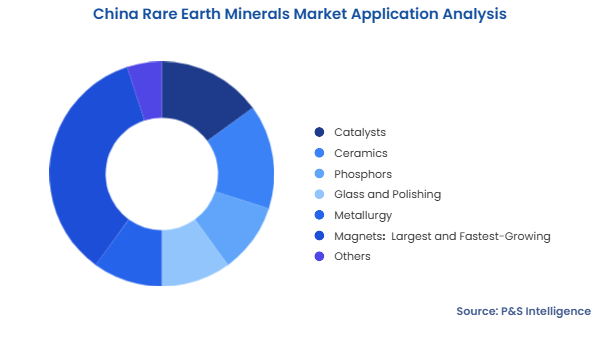
The magnets category holds the largest market share, of 35%, in 2025, and it will have the highest CAGR, of 6.6%, driven by the rising electric vehicle production and increasing use of high-performance permanent-magnet motors. Permanent magnet production, particularly neodymium–iron–boron magnets, consumes the largest volume of rare earth materials globally. China's control of 94% of global rare earth permanent magnet manufacturing creates enormous domestic demand for neodymium, praseodymium, and dysprosium. Electric vehicle traction motors require high-performance magnets offering superior power density and efficiency, with each EV containing several kilograms of rare earth permanent magnets.
The applications analyzed in this report are:
Catalysts
Ceramics
Phosphors
Glass and Polishing
Metallurgy
Magnets (Largest and Fastest-Growing Category)
Others
Drive strategic growth with comprehensive market analysis
China Rare Earth Minerals Market Regional Outlook
North China Rare Earth Minerals Market Size
Northern China holds the largest market share, of 45%, in 2025, as the massive polymetallic deposit produce light rare earth elements, including lanthanum, cerium, and neodymium, as by-products of the iron ore mining operations conducted by Baotou Iron and Steel Group. The region supplies more than 83% of China's total light rare earth production, establishing Inner Mongolia as the uncontested leader in the rare earth industry.
Regional infrastructure supporting separation, refining, and processing creates an integrated industrial cluster around Baotou city. Inner Mongolia Baotou Steel Rare-Earth Hi-Tech Company dominates northern production as the largest state-owned enterprise in the sector. Government policies designating Inner Mongolia as a primary light rare earth production base under the 2016–2020 Rare Earth Industry Development Plan ensure continued investment and capacity expansion.
Shandong province contributes additional light rare earth production from the Weishan bastnaesite deposit, though volumes remain substantially smaller than Inner Mongolia operations. The northern region benefits from established mining infrastructure, favorable geology for extraction, and proximity to industrial consumers in coastal manufacturing zones.
Southwest China Rare Earth Minerals Market Size
South-western China will have the highest CAGR, of 6.7%, driven by the region’s dominance in heavy rare earth elements sourced from ion-adsorption clay deposits and rising demand for dysprosium and terbium used in high-performance permanent magnets. Bastnaesite deposits in mountainous regions provide accessible resources supporting regional processing industries. Regional infrastructure development connects mining operations with separation facilities and downstream manufacturing in provincial industrial zones.
The southwestern region benefits from abundant hydroelectric power resources, reducing energy costs for processing operations. Rare earth separation and refining require substantial electricity consumption, making renewable energy availability a competitive advantage. Provincial policies support industry development through infrastructure investment and regulatory streamlining.
The regions of the market are as follows:
North (Largest Regional Market)
East
South Central
Southwest (Fastest-Growing Regional Market)
Northwest
Northeast
China Rare Earth Minerals Market Share
The market is consolidated due to the extensive government-led industry reforms. The market concentration reflects strategic policy objectives prioritizing operational efficiency, environmental compliance, and global competitiveness through integrated state-owned enterprises. State-owned enterprises dominate through vertical integration spanning mining, separation, processing, and magnet manufacturing.
The regulatory framework channels production through designated enterprises, ensuring compliance with environmental standards, export controls, and strategic industry policies. The integrated approach combining exploration, processing, and manufacturing capabilities under coordinated state direction creates competitive advantages difficult for international competitors to replicate within comparable timeframes. Regional specialization optimizes extraction techniques specific to geological formations, with Inner Mongolia focusing on bastnaesite processing while southern provinces employ in-situ leaching for ion-adsorption clays.
Key China Rare Earth Minerals Companies:
China Northern Rare Earth High-Tech Co., Ltd.
China Rare Earth Group Co., Ltd.
Shenghe Resources Holding Co., Ltd.
Xiamen Tungsten Co., Ltd.
China Minmetals Rare Earth Co., Ltd.
Inner Mongolia Baotou Steel Union Co., Ltd.
Ganzhou Rare Earth Group Co., Ltd.
Guangdong Rare Earth Group Co., Ltd.
China Southern Rare Earth Group Co., Ltd.
Chinalco Rare Earth & Metals Co., Ltd.
China Nonferrous Metal Mining Group Co., Ltd.
Jiangxi Rare Earth & Rare Metals Tungsten Group Co., Ltd.
China Rare Earth Minerals Market News
In October 2024, the Chinese government continued to enforce annual mining and smelting limits on rare earth elements, requiring producers to follow centralized production plans and strict regulatory oversight to control illegal mining and prevent excess supply.
In July 2024, Shenghe Resources Holding Co. Ltd. agreed to acquire a 50% stake in the UK-based company that holds an 84% interest in the Ngualla rare-earth project in Tanzania, of the Australia-based Peak Rare Earths, securing downstream supply access for strategic REE feedstock.
In December 2023, the Ministry of Commerce of China imposed export controls on rare earth extraction, separation, and processing technologies, aiming to protect strategic resources and maintain China’s dominance in high-value rare earth manufacturing.
In September 2023, Xiamen Tungsten Co. Ltd. and China Rare Earth Co. Ltd. signed a cooperation framework agreement and planned joint ventures to operate rare-earth mines and smelting/separation assets in Fujian province.
Frequently Asked Questions About This Report
What is the size of the China rare earth minerals market in 2025?+
The China rare earth minerals market is estimated at USD 1.5 billion in 2025.
What is the industry nature of the China rare earth minerals market?+
The China rare earth minerals market is consolidated, dominated by state-controlled enterprises under government regulation.
Why does China dominate the global rare earth minerals market?+
China dominates the global market due to abundant rare earth reserves, vertically integrated mining-to-processing capabilities, and strong policy control over production and exports.
Which companies dominate the China rare earth minerals market?+
The market is dominated by six major state-backed groups, including China Northern Rare Earth, China Rare Earth Group, China Minmetals Rare Earth, and other leading SOEs.
What is the future outlook of the China rare earth minerals market?+
The market is expected to grow steadily, driven by EV penetration, renewable energy expansion, advanced manufacturing, and downstream value-chain integration.
Want a report tailored exactly to your business need?
Leading companies across industries trust us to deliver data-driven insights and innovative solutions for their most critical decisions. From data-driven strategies to actionable insights, we empower the decision-makers who shape industries and define the future. From Fortune 500 companies to innovative startups, we are proud to partner with organisations that drive progress in their industries.
Client Testimonials
Working with P&S Intelligence and their team was an absolute pleasure – their awareness of timelines and commitment to value greatly contributed to our project's success. Eagerly anticipating future collaborations.
McKinsey & Company
India
Unmatched Standards
Our insights into the minutest levels of the markets, including the latest trends and competitive landscape, give you all the answers you need to take your business to new heights
Complete Data Security
We take a cautious approach to protecting your personal and confidential information. Trust is the strongest bond that connects us and our clients, and trust we build by complying with all international and domestic data protection and privacy laws