Carboxymethylcellulose Calcium Market Outlook (2027 - 2033)
This Report Provides In-Depth Analysis of the Carboxymethylcellulose Calcium Market Report Prepared by P&S Intelligence, Segmented by Grade (Pharmaceutical Grade, Food Grade, Cosmetic & Industrial Grade), Form (Fine Powder, Standard Powder, Granular / Coarse Powder), Application (Pharmaceutical Excipients (Oral Solid Dosage & Topical), Medical Devices & Advanced Wound Care, Nutraceuticals & Dietary Supplements, Food & Beverages, Cosmetics & Personal Care), Function (Disintegrant & Superdisintegrant, Binder & Matrix Former, Hemostatic & Absorbent Agent, Stabilizer & Suspending Agent), and Geographical Outlook for the Period of 2022 to 2033
Explore the market potential with our data-driven report
Carboxymethylcellulose Calcium Market Overview
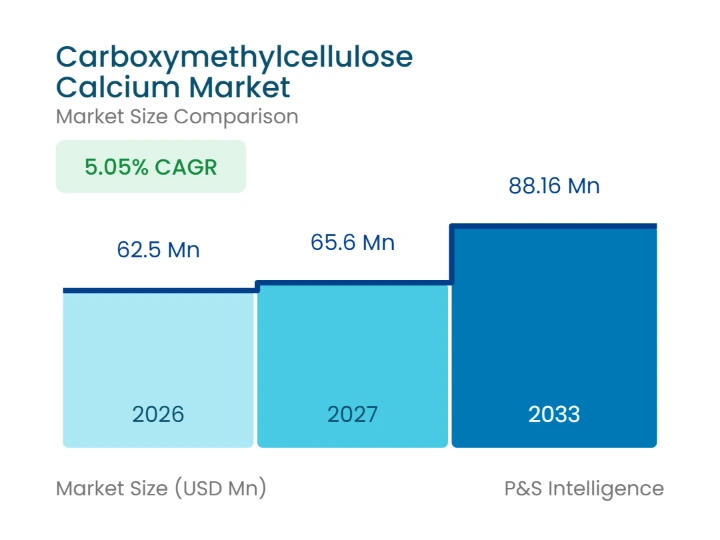
The global carboxymethylcellulose calcium market size is estimated at USD 62.50 Million in 2026 and is expected to reach USD 65.60 Million in 2027. Revenue is projected to climb to USD 88.16 Million by 2033, advancing at a CAGR of 5.05% during 2027-2033. Most of that spending comes from tablet and capsule manufacturers, which buy the calcium salt because it swells quickly without forming a gel and contains calcium in place of sodium. For excipient producers, volume rises with each oral solid dosage launch that writes the material into its registered formula.
Generic drug developers rely on regulatory precedent when they choose a disintegrant, and the calcium salt already has a documented record in approved U.S. products. The FDA Inactive Ingredient Database, updated with data through September 2026, lists it in five oral dosage forms, including capsules, film-coated tablets, and orally disintegrating tablets, with a maximum of 967 mg per unit in conventional tablets. An ingredient already used in an approved product for the same route is not treated as new, so sponsors working within those levels may face a lighter excipient review, which steadies repeat orders for compendial grades.
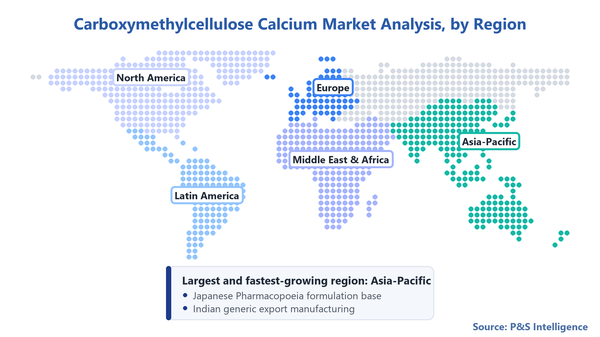
Asia-Pacific accounts for the largest portion of the carboxymethylcellulose calcium market and is also forecast to grow fastest, at a 5.45% CAGR during 2027-2033. Japan gives the region its depth, since the excipient has long been a Japanese Pharmacopoeia material used across domestic tablet lines, while India and China add volume through multi-compendial production for generic exporters. North America ranks next, with demand that depends more on life-cycle reformulation of established prescription brands and on regulated distribution channels than on new manufacturing capacity.
Key market insights
By grade, pharmaceutical grade accounts for 72.5% of 2026 revenue and is also projected to grow fastest, at a 5.3% CAGR during 2027-2033.
By form, fine powder holds a 58.0% share in 2026 and is projected to post the quickest growth, at a 5.45% CAGR during 2027-2033.
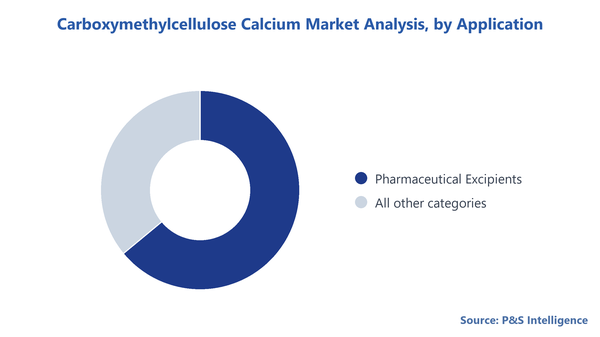
By application, pharmaceutical excipients (oral solid dosage & topical) account for 64.0% in 2026, while medical devices & advanced wound care is set to post the highest growth, a 5.8% CAGR during 2027-2033.
By function, disintegrant & superdisintegrant holds 56.0% in 2026, while hemostatic & absorbent agent is projected to expand at a 5.75% CAGR during 2027-2033.
By geography, Asia-Pacific accounts for 41.6% in 2026 and is also projected to grow fastest, at a 5.45% CAGR during 2027-2033.
Patient-friendly oral formats are redefining disintegrant grade requirements
Pediatric and geriatric product lines are moving formulators toward tablets that break apart in the mouth or in a spoonful of water, and that shift is changing which disintegrant grades they buy. A swelling, non-gelling excipient suits these formats because it draws water into the tablet core without building a viscous layer that slows break-up. Formulation teams therefore specify finer, faster-wetting lots, test them against tighter disintegration targets, and tend to keep one qualified grade across a product family once stability data are on file.
A 2020 pilot study in the journal Pharmaceutics notes that the European Pharmacopoeia classes a tablet as orodispersible only when it disintegrates in under three minutes, a pass-or-fail threshold that any tablet sold under that label in Europe has to clear. Producers that hold particle size and swelling volume steady from lot to lot are better positioned when developers screen candidate disintegrants. Once a grade is registered, the cost of changing it rises, which tends to lengthen supply relationships between tablet makers and their excipient sources.
Sodium limits for cardiovascular and kidney patients are fueling salt-free disintegrant selection
Developers of antihypertensive, cardiac, and renal tablets serve patients who are told to cut salt, so the sodium carried by each excipient becomes a formulation question. Carboxymethylcellulose calcium delivers disintegration with calcium as its counter-ion, whereas croscarmellose sodium and sodium starch glycolate are sodium salts that add to a patient's daily sodium load. Although each tablet carries little excipient sodium, that difference can lead formulators to prefer the calcium form in once-daily and fixed-dose combination products for long-term therapy, which supports pharmaceutical-grade orders in these drug classes.
According to the World Health Organization, adults should consume less than 2,000 mg of sodium a day, while global mean adult intake stood at 4,278 mg in 2021. That gap keeps sodium reduction on the agenda of prescribers and health systems, and it gives makers of chronic-therapy tablets a formulation argument for sodium-free excipients. Excipient producers that document sodium content clearly in their technical files gain an opening with sponsors developing combination therapies for patients on lifelong treatment.
Bleeding-control research is opening a device-grade outlet beyond tablets
Hemostat and wound-dressing developers represent the newest outlet for the material, because the calcium salt absorbs fluid quickly and releases calcium ions, which take part in blood clotting. Device makers that adopt it as a powder or absorbent layer would buy smaller lots than tablet manufacturers, but at device-grade specifications backed by biocompatibility data and longer qualification work. That outlet could help producers spread fixed compliance costs across a second customer base whose purchases follow procedure and trauma volumes instead of drug launch cycles.
Researchers writing in the journal Polymers in 2024 described a self-gelling powder built on carboxymethylcellulose calcium that absorbed liquid up to 30 times its weight and completed blood coagulation within three minutes in vitro, with testing so far limited to laboratory and animal models. Commercial volumes therefore depend on such formulations passing clinical evaluation and device clearance. If they do, producers already supplying low-bioburden grades with documented calcium content would be better placed to sign early supply agreements with dressing manufacturers.
Established sodium-based superdisintegrants are limiting conversion of approved products
Many tablet formulators already have croscarmellose sodium, crospovidone, or sodium starch glycolate qualified in their development libraries, and these alternatives compete directly for the disintegrant slot in each formula. Replacing the disintegrant in a registered product generally triggers new stability and bioequivalence work, so the calcium salt competes mainly for new launches and planned reformulations, while the installed base of approved products stays largely closed to it. That limits how fast pharmaceutical orders can grow even where the sodium-free argument applies.
Multi-pharmacopoeia compliance adds a second cost. Gotoku Chemical's product page for its E.C.G-505 grade guarantees the Japanese Pharmacopoeia standard and says the grade can meet the USP-NF, European, and Chinese pharmacopoeias, while cautioning that those guarantees may change when the compendia are revised. Each revision can require retesting and customer notification by every exporting producer, a fixed cost that has to be recovered from small volumes in a niche excipient. Producers running single-compendia lines face the highest catch-up costs when they try to sell into new regions.
Segmentation Analysis
Grade
Pharmaceutical grade accounts for 72.5% of carboxymethylcellulose calcium market revenue in 2026, because tablet and capsule manufacturers buy only lots certified to a pharmacopoeial monograph. Those lots arrive with certificates of analysis, elemental impurity and residual solvent statements, and audit access, which raises their price per kilogram relative to food or technical material. Food Grade and Cosmetic & Industrial Grade compete with cheaper hydrocolloids such as sodium carboxymethylcellulose, so they remain a smaller part of revenue even though their safety profile supports use in foods and personal care products.
Pharmaceutical grade is also projected to post the fastest growth, at a 5.3% CAGR during 2027-2033, as generic drug production expands. The Association for Accessible Medicines puts generics at 90% of U.S. prescriptions filled in 2024, about 3.9 billion prescriptions, and generic sponsors often mirror reference-product excipient choices to simplify bioequivalence work. Each new generic of a product formulated with the calcium salt therefore adds a compendial-grade customer. Exporters in India and China could supply a growing share of that volume, because their documentation already covers several pharmacopoeias.
Form
Fine powder holds 58.0% of 2026 revenue, since particles in the 200-325 mesh range wet and swell faster and spread evenly through direct-compression blends at low addition levels. Tablet makers running high-speed presses favor these grades because uniform distribution keeps disintegration times consistent from batch to batch, which can reduce release-testing failures. The extra milling and classification steps are also likely to raise value per kilogram. Standard powder and granular / coarse powder serve formulations where flow and handling matter more than the speed of wetting.
Fine powder is projected to grow fastest, at a 5.45% CAGR during 2027-2033, because orally disintegrating and easy-to-swallow tablets depend on near-instant moisture uptake without a gritty feel. Ageing populations widen the patient pool for these formats. Japan's Ministry of Internal Affairs and Communications estimated that people aged 65 and over reached a record 29.6% of the population in September 2026, an age group in which swallowing difficulty is more common. Producers able to hold tight particle-size distributions at scale are likely to see more qualification requests as tablet makers extend these product lines.
Application
Pharmaceutical excipients (oral solid dosage & topical) represent 64.0% of 2026 revenue, because the calcium salt fills the disintegrant and binder positions in immediate-release tablets and capsules that are produced continuously at commercial scale. Once a product is approved, its formula generally fixes the excipient for the life of the registration, so orders recur with each batch campaign. Topical creams and suspensions use smaller quantities as a stabilizer. Nutraceuticals & dietary supplements, food & beverages, and cosmetics & personal care buy less, often weighing the material against cheaper cellulose gums.
Among applications, medical devices & advanced wound care is expected to grow at the highest rate, a 5.8% CAGR during 2027-2033, as hemostat and dressing developers evaluate the material. These developers value its fluid uptake and local calcium release, and each product that reaches clearance adds a customer that buys device-grade lots under separate quality agreements. Growth in this outlet depends on product introductions more than on existing volume, which makes its timing uneven. Producers with biocompatibility files and controlled bioburden could benefit early when developers move from evaluation to commercial supply.
Copyright P&S Intelligence. Reuse requires attribution under CC BY 4.0.
Function
Disintegrant & superdisintegrant use accounts for 56.0% of 2026 revenue, because breaking tablets apart quickly is the main reason formulators buy the calcium salt. It swells several-fold and wicks water into dense, high-compression tablets without forming a gel barrier, which keeps disintegration fast even at high tablet hardness. Disintegration performance is also what tablet makers test incoming lots against, so producers compete on swelling volume and lot consistency in this role. Binder & Matrix Former and Stabilizer & Suspending Agent uses draw on the same compendial grades in smaller amounts.
Hemostatic & absorbent agent use is projected to grow fastest, at a 5.75% CAGR during 2027-2033, as the same swelling behavior moves into fluid management for advanced wound care products. In this role, buyers specify absorption capacity and calcium content instead of disintegration time, and they test lots against device standards. That shifts value toward producers that can run separate device-grade lines and supply sterilization-compatible material. For excipient makers, the function offers a way to sell one chemistry into a second regulatory channel with its own qualification path and customer base.
The following segments are analyzed in this report.
Asia-Pacific carboxymethylcellulose calcium market outlook
Asia-Pacific holds 41.6% of global revenue in 2026, the largest regional share, and its revenue is projected to rise faster than any other region's, at a 5.45% CAGR during 2027-2033. Japan contributes a deep base of registered formulations, because the calcium salt has long been a standard Japanese Pharmacopoeia disintegrant and domestic producers such as Gotoku Chemical supply tablet makers directly. India and China add capacity built for export, with producers documenting grades against several pharmacopoeias at once so that one lot can ship to different regulatory markets.
The export channel helps explain the region's faster growth. Official trade data from India's Directorate General of Commercial Intelligence and Statistics show the country's pharmaceutical exports passed USD 31 billion in FY2025-26, a record for the sector. Those exports measure finished pharmaceuticals, not excipient use, but each generic dossier filed for an export market fixes an excipient specification that regional producers can fill. Because Asia-Pacific grows faster than every other region, its share of global revenue rises over the forecast period, which raises the value of regional qualification for producers based elsewhere.
Copyright P&S Intelligence. Reuse requires attribution under CC BY 4.0.
North America market analysis
North America ranks behind Asia-Pacific in revenue, with demand built on a mature base of approved prescription products and a regulated distribution network. U.S. tablet manufacturers buy through direct contracts with qualified producers and through compliance-focused distributors such as Spectrum Chemical, which catalogs an NF grade for regulated manufacturing alongside ungraded material for research use. Growth here comes mainly from reformulations, new generic entries, and higher-value documentation packages, so revenue per kilogram matters more to suppliers in this region than added tonnage.
Hypertension keeps the sodium-free argument relevant to North American formulators. According to the National Center for Health Statistics, 47.7% of U.S. adults had hypertension during August 2021 to August 2023, a patient base that relies heavily on long-term oral therapy. Formulators developing new generics and combination products for these patients have a documented reason to consider the calcium salt. Suppliers holding Drug Master File references and North American stock can turn that interest into qualified supply contracts.
Europe market analysis
Europe maintains a steady, compliance-led share of global demand, anchored by generic and branded tablet producers in Germany, Italy, Spain, and the wider EU. Purchases here depend less on new capacity and more on supplier qualification, because manufacturing authorization holders must document why each excipient source is fit for its intended use. Conformity with the European Pharmacopoeia is the entry requirement, and an approved source is rarely changed without a documented risk review, which keeps established suppliers in place.
The European Commission's 2015 guidelines on the formalized risk assessment of excipients direct manufacturing authorization holders to set the appropriate level of good manufacturing practice for each excipient, weighing its source, intended use, supply-chain complexity, and the supplier's quality history. For producers outside Europe, this turns a first sale into an audit and documentation exercise before any order is placed. Suppliers that already document European Pharmacopoeia conformity and hold excipient GMP certification are likely to face shorter qualification cycles, which supports steady, value-led growth in the region.
Latin America market analysis
Latin America holds a smaller but expanding position, with Brazil and Mexico as the main tablet manufacturing centers. Demand grows as domestic generic producers widen their portfolios in chronic-disease classes, and the calcium salt typically reaches these plants through importers and regional distributors, since its main producers are based in Asia. That import dependence makes delivered cost, currency movements, and documentation lead times important purchase criteria for local formulators.
Brazil shows the scale of the generic channel. PróGenéricos, the Brazilian generic and biosimilar medicines industry association, recorded 2.36 billion units of generic medicines sold in 2025, 8.33% more than in 2024, with the antihypertensive losartan as the best-selling molecule. Those units measure finished generics, not excipient use, but they point to a growing formulation base in the drug classes where a sodium-free disintegrant has a clinical argument. Distributors that hold local stock and Portuguese and Spanish documentation gain an edge in formulation trials.
Middle East & Africa market analysis
Middle East & Africa contributes a small share of global revenue, with demand tied to newer pharmaceutical plants in the Gulf and established generic production in South Africa, Egypt, and Morocco. Government localization programs are moving more tablet manufacturing into the region, and each new plant needs a qualified excipient supply chain from its first registration batch. Because the calcium salt is not produced locally at scale, buyers rely on imports from Asian and European sources.
Saudi Arabia illustrates the localization push. Saudipedia, the Saudi national encyclopedia, states that the number of registered pharmaceutical factories in the Kingdom exceeds 40 and that local factories cover 36% of Saudi demand for medicines. Raising that local share means more domestic tablet production, which would expand the region's excipient purchases from a low base. Suppliers that register products with Gulf regulators early and support technology transfer for new plants could secure positions in formulations that stay fixed for years.
The following geographies are analysed in this report.
The carboxymethylcellulose calcium market has a moderately fragmented structure, with producers spread across Japan, India, China, and South Korea and no single supplier controlling global supply. Fragmentation persists because the chemistry is established, regional pharmacopoeias let local producers qualify with nearby customers, and the market's small size likely discourages large cellulose ether makers from building dedicated capacity. Switching costs are highest at the customer level, since a registered tablet formula ties each buyer to its qualified source, which keeps the structure stable even as new producers enter.
Producers cluster by origin and documentation strategy. Japanese suppliers Gotoku Chemical and Nichirin Chemical Industries draw on a long formulation history and Japanese Pharmacopoeia pedigree with domestic tablet makers. Indian exporters such as Patel Chem Specialities and Anmol Chemicals compete on multi-compendial documentation and price for generic manufacturers, while Korean producer BOLAK sells the calcium salt within a broader pharmaceutical excipient and food ingredient catalog. Distributors such as Spectrum Chemical and Merck KGaA serve laboratory, compounding, and development buyers that need small, fully documented lots.
Documentation packages and landed cost carry the most weight at the development stage, when sponsors compare candidate sources before locking a formula. That spread of qualified sources keeps prices competitive while a product is in development, although the cost of changing a supplier after registration limits a tablet maker's leverage over the product's life. Producers that already hold Drug Master File references and multi-pharmacopoeia documentation therefore reach more qualification shortlists, which favors established exporters over new entrants seeking their first registrations.
Major Companies in Carboxymethylcellulose Calcium Market:
Gotoku Chemical Co. Ltd.
Nichirin Chemical Industries Ltd.
Patel Chem Specialities Limited
Anmol Chemicals Private Limited
Muby Chemicals
BOLAK Co. Ltd.
Anhui Sunhere Pharmaceutical Excipients Co. Ltd.
Jiangxi Alpha Hi-Tech Pharmaceutical Co. Ltd.
Spectrum Chemical Mfg. Corp.
Maple Biotech Pvt. Ltd.
Merck KGaA
Avantor Inc.
Last Updated: October 2026
Frequently Asked Questions About This Report
How big is the carboxymethylcellulose calcium market?+
The global carboxymethylcellulose calcium market size is estimated at USD 62.50 Million in 2026 and is expected to reach USD 65.60 Million in 2027.
Which region dominates the carboxymethylcellulose calcium market?+
Asia-Pacific accounts for the largest portion of the carboxymethylcellulose calcium market and is also forecast to grow fastest, at a 5.45% CAGR during 2027-2033.
What is the difference between carmellose calcium and croscarmellose sodium?+
Carboxymethylcellulose calcium delivers disintegration with calcium as its counter-ion, whereas croscarmellose sodium and sodium starch glycolate are sodium salts that add to a patient's daily sodium load.
What is carmellose calcium used for in tablets?+
Disintegrant & superdisintegrant use accounts for 56.0% of 2026 revenue, because breaking tablets apart quickly is the main reason formulators buy the calcium salt.
Which application of calcium carboxymethylcellulose is growing fastest?+
Among applications, medical devices & advanced wound care is expected to grow at the highest rate, a 5.8% CAGR during 2027-2033, as hemostat and dressing developers evaluate the material.
Who manufactures carboxymethylcellulose calcium?+
Japanese suppliers Gotoku Chemical and Nichirin Chemical Industries draw on a long formulation history and Japanese Pharmacopoeia pedigree with domestic tablet makers.
Want a report tailored exactly to your business need?
Leading companies across industries trust us to deliver data-driven insights and innovative solutions for their most critical decisions. From data-driven strategies to actionable insights, we empower the decision-makers who shape industries and define the future. From Fortune 500 companies to innovative startups, we are proud to partner with organisations that drive progress in their industries.
Client Testimonials
Working with P&S Intelligence and their team was an absolute pleasure – their awareness of timelines and commitment to value greatly contributed to our project's success. Eagerly anticipating future collaborations.
McKinsey & Company
India
Unmatched Standards
Our insights into the minutest levels of the markets, including the latest trends and competitive landscape, give you all the answers you need to take your business to new heights
Complete Data Security
We take a cautious approach to protecting your personal and confidential information. Trust is the strongest bond that connects us and our clients, and trust we build by complying with all international and domestic data protection and privacy laws