This Report Provides In-Depth Analysis of the Carbon Steel Market Report Prepared by P&S Intelligence, Segmented by Type (Low-Carbon, Medium-Carbon, High-Carbon), Application (Automotive & Transportation, Aerospace Components, Industrial Machinery Parts, Consumer Electronics, Medical Equipment, Marine, Industrial Manufacturing, Electronics & Electrical), Product Form (Flat, Long, Tubular, Semi-finished), and Geographical Outlook for the Period of 2019 to 2032
Explore the market potential with our data-driven report
Carbon Steel Market Future Outlook
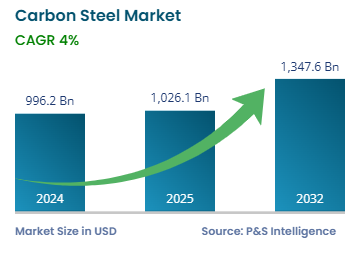
The global carbon steel market size was USD 996.2 billion in 2024, which is predicted to reach USD 1347.6 billion by 2032, growing at a CAGR of 4.0% during 2025–2032.
The growth of the market is primarily driven by rapid infrastructure development across emerging economies, increasing demand from the automotive sector for lightweight yet strong materials, and the ongoing industrial expansion in Asia-Pacific regions. Carbon steel continues to dominate the global steel market due to its cost-effectiveness, versatility, and excellent mechanical properties that make it suitable for diverse applications ranging from construction beams to automotive components.
The construction and infrastructure sector remains the cornerstone of carbon steel demand, accounting for the largest consumption globally. With governments worldwide announcing massive infrastructure stimulus packages and urbanization continuing at unprecedented rates in developing nations, the demand for carbon steel in structural applications shows no signs of slowing.
According to the World Steel Association, global crude steel production in 2024 reached approximately 1,881 million tonnes, and carbon steel made up about 90% of that production. This was owing to its strength, ductility, and affordability, which make it indispensable in modern construction, from skyscrapers to bridges.
The carbon steel industry is witnessing significant technological advancements in production processes, with manufacturers increasingly adopting the electric arc furnace (EAF) technology to reduce carbon emissions and improve energy efficiency. This shift towards sustainable production methods is reshaping the industry landscape, as steel producers invest billions in green steel technologies. The transition to low-carbon steel production has become particularly prominent in Europe and North America, where stringent environmental regulations are driving innovation in steel manufacturing processes.
Carbon Steel Market Trends & Drivers
Technological Advancements in Steel Production Are Key Trend
The rapid technological innovations are transforming the carbon steel manufacturing landscape, driving improvements in efficiency, sustainability, and product quality.
Electrification and hydrogen-based technologies are being adopted to replace traditional coke-based blast furnaces with direct reduced iron (DRI) and EAF technologies, reducing carbon emissions significantly.
The European Union has committed more than EUR 3 billion under its Innovation Fund to support low-carbon steel projects, including hydrogen-based Direct Reduced Iron (DRI) plants and carbon capture initiatives, accelerating technological upgrades in carbon steel production.
Carbon capture, utilization, and storage (CCUS) systems are being integrated into steel plants to trap COâ‚‚ emissions and align with global decarbonization goals.
The U.S. Department of Energy (DoE) announced USD 6 billion in funding under the Industrial Demonstrations Program (2023), with a major share directed toward steel decarbonization technologies.
The AI and IoT technologies are enabling automation, real-time monitoring, and predictive maintenance, leading to higher productivity and reduced downtime.
Advanced thermomechanical control processes and modern quenching technologies are enhancing the strength and toughness of carbon steel products.
The use of recycled scrap steel in EAFs is growing, offering both environmental and economic advantages by reducing energy consumption.
The Japanese government, through its Green Innovation Fund, allocated approximately USD 15 billion (JPY 2 trillion) for industrial decarbonization, with significant investment in steelmaking technologies like hydrogen-based furnaces and energy-efficient carbon steel production.
The ongoing research in high-strength low-alloy and ultra-low-carbon steel is supporting the development of lighter and stronger materials for structural and automotive applications.
Secondary metallurgy innovations, such as vacuum degassing and ladle refining, are improving steel quality for demanding end-use sectors.
The digital twin technology is being adopted to simulate and optimize furnace operations, resulting in reduced waste and more consistent output.
Rising Infrastructure Development and Urbanization Are Major Growth Drivers
The accelerating urban expansion in developing countries is leading to the increasing construction of residential and commercial buildings, boosting demand for carbon steel in structural components.
As per the United Nations, as of 2022, approximately 55% of the world’s population lives in urban areas, and this share is expected to rise to around 70% by 2050.
National infrastructure development programs—such as India’s PM Gati Shakti, China’s Belt and Road Initiative, and the U.S. Infrastructure Investment and Jobs Act—are significantly increasing steel consumption.
The Indian government has allocated over USD 1.4 trillion (INR 116 lakh crore) under the National Infrastructure Pipeline (NIP) through 2025, covering roads, railways, ports, and housing projects—sectors that are highly carbon-steel-intensive.
In January 2025, the Indian Ministry of Steel launched PLI Scheme 1.1 with a USD 733.40 million (INR 6,322 crore) outlay, to boost specialty steel production, covering five key product categories to reduce imports and enhance domestic manufacturing capabilities.
The development of transportation infrastructure, including highways, railways, ports, and airports, requires large volumes of carbon steel for bridges, tunnels, and load-bearing structures.
The estimated combined spending of the Indian Railways on new lines, gauge conversion, and doubling for FY 2025–26 is approximately INR 80,000 crore.
Indian Railways primarily uses R260 for general-purpose rails and R350HT for modern, high-performance applications. The R350HT grade is heat-treated to enhance strength and wear resistance, making it suitable for high-speed trains and heavy freight corridors.
All the steel grades mandated by Indian Railways for rail tracks are high-carbon or carbon–manganese steel grades.
Urban redevelopment projects and the renovation of aging infrastructure in developed regions are creating a steady replacement demand for carbon steel materials.
The Middle East, led by Saudi Arabia’s Vision 2030, is investing over USD 1 trillion in mega infrastructure projects such as NEOM City, high-speed rail, and smart cities—initiatives requiring vast amounts of carbon steel for construction frameworks.
Rising investment in industrial zones and logistics hubs is increasing the use of carbon steel in warehouses, industrial sheds, and transportation equipment.
Expansion of water supply systems, sewage treatment plants, and energy distribution networks is contributing to the demand for carbon steel pipes and fittings.
The rapid growth in population and urban migration is driving the need for high-rise buildings and public amenities, which rely heavily on carbon steel for structural integrity and cost-efficiency.
Japan has continued investing in urban redevelopment and resilient infrastructure, with stimulus packages exceeding USD 500 billion since 2020, aimed at modernizing urban areas, transport networks, and disaster-resilient structures, thereby increasing carbon steel usage.
Carbon Steel Market Segmentation Analysis
Type Analysis
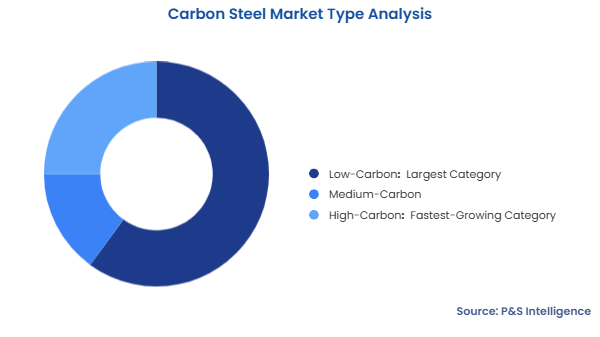
The low-carbon category held the largest share in the carbon steel market in 2024, of approximately 60%, and it is expected to maintain its dominance throughout the forecast period. This is primarily attributed to its widespread use in construction applications, automotive body panels, and general manufacturing, where high ductility and weldability are essential. Low-carbon steel's cost-effectiveness and versatility make it the preferred choice for large-scale infrastructure projects and mass production applications. Its excellent formability allows manufacturers to create complex shapes without compromising structural integrity, making it indispensable in industries ranging from construction to consumer goods manufacturing.
High-carbon steel is expected to witness the highest CAGR during 2025–2032, driven by increasing demand from the industrial machinery and tool manufacturing sectors. The superior hardness and wear resistance of high-carbon steel make it ideal for cutting tools, springs, and high-strength wire applications. The growing automation in manufacturing and the expansion of precision engineering applications are creating new opportunities for specialized high carbon steel grades. Additionally, the railway industry's expansion, particularly in Asia-Pacific, is driving demand for high carbon steel in rail tracks and related infrastructure components.
These types are covered:
Low-Carbon (Largest Category)
Medium-Carbon
High-Carbon (Fastest-Growing Category)
Application Analysis
The industrial manufacturing category dominated the carbon steel market in 2024, capturing 30% share. It is driven by the construction and infrastructure sector. Carbon steel is widely used in the development of structural frameworks for residential, commercial, and industrial buildings, as well as in bridges, pipelines, rail tracks, and heavy machinery. Its high strength, durability, and cost-effectiveness make it the preferred material for large-scale infrastructure projects across both developed and emerging economies.
The rapid urbanization, industrial expansion, and government investments in smart cities and transportation networks further boost demand. With construction alone accounting for more than 40% of total carbon steel consumption, industrial manufacturing continues to dominate the global market, making it the most significant contributor to overall growth.
The automotive & transportation category is projected to grow at the highest CAGR during the forecast period, emerging as the fastest-growing category. This growth is fueled by the global automotive production recovery, the expansion of electric vehicle manufacturing, and the increasing use of advanced high-strength steels in vehicle design. Despite the shift towards alternative materials, carbon steel remains crucial for automotive applications due to its cost-effectiveness and the development of new steel grades that offer improved strength-to-weight ratios.
As per OICA, global automotive production stood at 92,504,338 units in 2024. The transportation infrastructure expansion, including railways and shipbuilding, further contributes to this category's growth trajectory. As per estimates, depending on tensile weight, laying 1 kilometer of railway track requires 90 to 130 metric tonnes of steel.
Flat products held the largest market share, of 45%, in 2024, driven by their extensive use in automotive manufacturing, construction, and appliance industries. The versatility of flat carbon steel products in forming, stamping, and fabrication processes makes them essential for numerous applications. The category benefits from technological advancements in rolling mill technology that enable the production of thinner, stronger sheets with improved surface quality. The growing demand for coated and galvanized flat products for corrosion resistance applications further strengthens this category's market position.
Long products are experiencing the fastest growth through 2032, primarily due to the boom in construction activities and infrastructure development worldwide. The demand for rebar, structural beams, and wire products is surging with the expansion of urban construction projects and the need for seismic-resistant structures. The category is also benefiting from the growth in manufacturing and industrial applications where bars, rods, and sections are essential components. Innovation in long product manufacturing, including the development of high-strength rebar grades and improved production efficiency, is supporting market expansion.
These product forms are covered:
Flat (Largest Category)
Long (Fastest-Growing Category)
Tubular
Semi-finished
Drive strategic growth with comprehensive market analysis
Carbon Steel Market Geographical Analysis
Asia-Pacific Carbon Steel Market Size
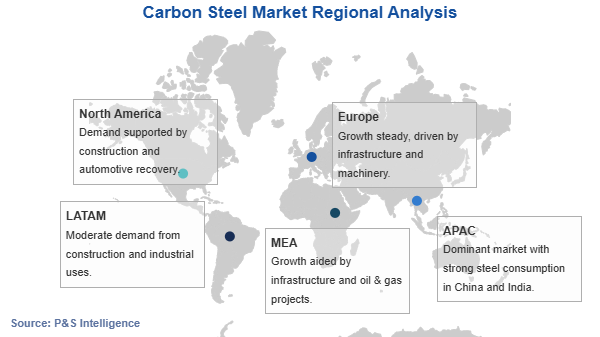
The Asia-Pacific region dominated the global carbon steel market in 2024, accounting for 40% of the total market share, and it is expected to maintain its lead throughout the forecast period. This dominance is primarily driven by China's massive infrastructure development and industrial production capacity. the Chinese government indeed planned to allocate CNY 1.2 trillion (approx. USD 173 billion) to transportation infrastructure by the end of 2024, under the 2024 budget framework. The region's rapidly growing economies, including India, Southeast Asian nations, and Australia, are experiencing robust construction activity and industrial expansion that continues to drive carbon steel consumption.
India Carbon Steel Market Size
India, as the world's second-largest steel producer, is experiencing remarkable growth in steel consumption, primarily driven by the ongoing infrastructure development. The country's ambitious infrastructure plans and rapid industrialization are creating sustained demand for carbon steel across construction, automotive, and manufacturing sectors. Japan and South Korea continue to be significant markets for high-quality carbon steel products, particularly in automotive and shipbuilding applications, maintaining their position as technology leaders in advanced steel production.
As of early 2024, Indian Railways has approximately 488 ongoing infrastructure projects totaling around 44,488 kilometers in route length, covering new line construction, gauge conversion, and track doubling. These projects include 187 new lines, 40-gauge conversions, and 261 doubling initiatives, collectively valued at about INR 7.44 lakh crore. By March 2024, around 12,045 kilometers of this infrastructure had been commissioned, with expenditures reaching approximately INR 2.92 lakh crore. These efforts are part of the broader PM Gati Shakti National Master Plan aimed at improving multimodal connectivity and logistics efficiency nationwide.
As of early 2025, India’s new metro construction and existing metro expansion projects encompass a combined route length of approximately 675 kilometers currently under construction or planned across multiple cities, including major projects in Bhopal, Bhubaneswar, Meerut, Patna, Surat, and Coimbatore. This expanding network aims to enhance urban mobility, reduce congestion, and promote sustainable transportation throughout the country.
North America Carbon Steel Market Value
North America held the second-largest value share of the global carbon steel market in 2024, of 20%. The region's market is primarily driven by infrastructure modernization initiatives and the reshoring of manufacturing activities. Infrastructure spending continues to ramp up in 2024 as approximately USD 1.8 trillion in federal grants, loans, incentives, tax credits, and other financial assistance works its way into the U.S. economy. This massive infrastructure investment is creating substantial demand for carbon steel products across bridges, highways, and public utilities.
Europe Carbon Steel Market Share
The European carbon steel market is experiencing growth at a CAGR of approx. 4.5% during the forecast period, with demand driven by the region's focus on sustainable construction and the transition to green steel production. European steel producers are leading the global shift towards low-carbon steel manufacturing, investing heavily in hydrogen-based direct reduction and electric arc furnace technologies.
Germany Carbon Steel Market Share
Germany remains the largest consumer of carbon steel in the region, particularly for automotive and machinery applications. The European Green Deal and carbon border adjustment mechanisms are reshaping the competitive landscape, favoring producers with lower carbon footprints. The region's circular economy initiatives are also promoting the use of recycled steel content, with electric arc furnace production gaining market share. Eastern European countries are experiencing faster growth rates as they modernize their infrastructure and industrial base with EU structural funds support.
The regions and countries analyzed in this report are:
North America
U.S. (Larger Country Market)
Canada (Faster-Growing Country Market)
Europe (Fastest-Growing Regional Market)
Germany (Largest Country Market)
U.K. (Fastest-Growing Country Market)
France
Italy
Spain
Rest of Europe
Asia-Pacific (Largest Regional Market)
Japan
China (Largest Country Market)
India (Fastest-Growing Country Market)
South Korea
Australia
Rest of APAC
Latin America
Brazil (Largest Country Market)
Mexico (Fastest-Growing Country Market)
Rest of LATAM
Middle East and Africa
Saudi Arabia (Largest Country Market)
South Africa
U.A.E. (Fastest-Growing Country Market)
Rest of MEA
Carbon Steel Market Share Analysis
The carbon steel market is generally fragmented, meaning it consists of a large number of producers spread across different regions, with no single company controlling a dominant share globally. This structure results from the widespread availability of raw materials, localized demand, and the presence of both integrated steel plants and mini-mills in various countries. In certain regions, such as parts of Asia, the market may appear more consolidated due to a few large producers having significant capacity. However, in most other regions, including Southeast Asia, Latin America, and Eastern Europe, the market includes many small to mid-sized players, leading to a highly competitive and decentralized environment.
Carbon steel products are often standardized and undifferentiated, which makes it easier for smaller manufacturers to enter the market and compete, mainly on the basis of price and regional supply capabilities. This further reinforces the fragmented nature of the industry. While there are efforts in some regions to consolidate operations through mergers and acquisitions, these moves have not significantly altered the overall market structure. As a result, despite some pockets of consolidation, the global carbon steel market remains fragmented, especially when viewed from a production and supply chain perspective.
Key Carbon Steel Companies:
ArcelorMittal S.A.
HBIS Group Co., Ltd.
Baoshan Iron & Steel Co., Ltd.
Nippon Steel Corporation
POSCO Holdings Inc.
AK Steel Holding Corporation
EVRAZ plc
Curtis Steel Company, Inc.
Omega Steel Company
JFE Steel Corporation
Hitachi, Ltd.
Ansteel Group Corporation Limited
Tata Steel Limited
thyssenkrupp AG
Hyundai Steel Company
Carbon Steel Market News
In March 2025, JSW Group announced a USD-11.60 billion (INR 1,00,000 crore) investment to establish a 25-million-tonne steel plant in Maharashtra's Gadchiroli district over seven to eight years.
In May 2024, ArcelorMittal S.A. commenced construction of a new electric arc furnace with a capacity of 1.1 million tonnes per annum at its Gijón long-products plant in Spain.
In March 2024, Tata Steel Limited announced plans to replace the blast furnaces at its Port Talbot facility in the U.K. with electric arc furnaces, representing a GBP 1.25-billion investment in green steel production.
Want a report tailored exactly to your business need?
Leading companies across industries trust us to deliver data-driven insights and innovative solutions for their most critical decisions. From data-driven strategies to actionable insights, we empower the decision-makers who shape industries and define the future. From Fortune 500 companies to innovative startups, we are proud to partner with organisations that drive progress in their industries.
Client Testimonials
Working with P&S Intelligence and their team was an absolute pleasure – their awareness of timelines and commitment to value greatly contributed to our project's success. Eagerly anticipating future collaborations.
McKinsey & Company
India
Unmatched Standards
Our insights into the minutest levels of the markets, including the latest trends and competitive landscape, give you all the answers you need to take your business to new heights
Complete Data Security
We take a cautious approach to protecting your personal and confidential information. Trust is the strongest bond that connects us and our clients, and trust we build by complying with all international and domestic data protection and privacy laws