This Report Provides In-Depth Analysis of the Carbon Accounting Software Market Report Prepared by P&S Intelligence, Segmented by Component (Software, Services), Deployment (Cloud, On-Premise), Organization Size (Large Enterprises, Small & Medium Enterprises), End User (Energy & Utilities, Transportation & Logistics, Manufacturing, IT & Telecom, Retail, Healthcare, Construction & Infrastructure, Food & Beverage, Chemicals, Government), and Geographical Outlook for the Period of 2021 to 2032
Explore the market potential with our data-driven report
Carbon Accounting Software Market Overview
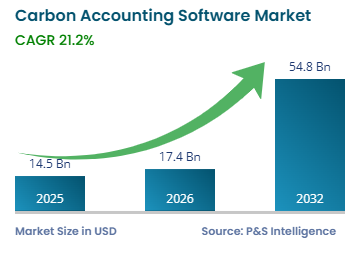
The carbon accounting software market size was USD 14.5 billion for 2025, and it will grow by 21.2% during 2026-2032, to reach USD 54.8 billion by 2032.
The market is expanding due to the increasing need among organizations to monitor, manage, and disclose greenhouse gas emissions as sustainability reporting becomes an integral part of business operations. Enterprises across industries are replacing manual spreadsheets and fragmented reporting methods with centralized carbon accounting platforms that enable real-time emissions monitoring across facilities, suppliers, logistics networks, and energy consumption systems. The growing adoption of ESG frameworks, climate disclosure regulations, and net-zero commitments is driving investment in software solutions that enhance transparency, improve reporting accuracy, and simplify regulatory compliance. According to the IFRS Foundation, 36 jurisdictions had adopted, used, or were taking steps to introduce the ISSB Sustainability Disclosure Standards in 2025, highlighting the increasing global emphasis on standardized sustainability reporting and strengthening demand for carbon accounting software.
Digital transformation across industrial, commercial, and public sectors is accelerating the adoption of carbon accounting software. Organizations are integrating these platforms with enterprise resource planning (ERP) systems, supply chain software, IoT-enabled monitoring infrastructure, and sustainability management tools to improve operational visibility and reporting accuracy. Demand for Scope 3 emissions management is increasing as businesses are expected to assess environmental impacts across their entire value chains rather than only direct operations. Industries such as energy, manufacturing, transportation, retail, and technology are adopting carbon accounting solutions to support decarbonization initiatives, improve energy efficiency, and strengthen long-term sustainability strategies. Furthermore, the growing adoption of AI-driven analytics, automated reporting capabilities, and audit-ready ESG data management solutions is accelerating enterprise investment in scalable carbon accounting software across global operations.
Key Market Insights
Software is the larger component, holding a market share of 75.5%, due to rising enterprise demand for centralized emissions monitoring and ESG reporting systems.
On-Premise is the faster-growing deployment, registering a CAGR of 21.3%, driven by increasing enterprise focus on internal control over sustainability and compliance data.
Large Enterprises are the larger organization size, holding a market share of 80.5%, due to complex multinational emissions reporting and climate disclosure requirements.
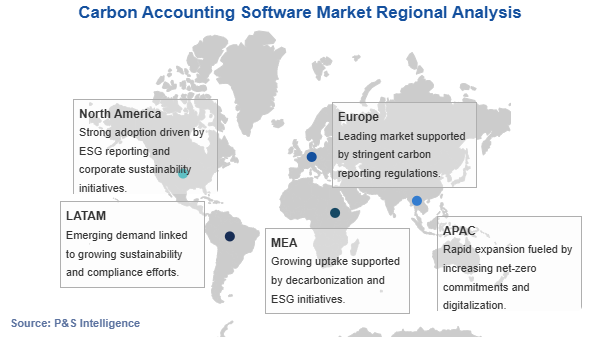
North America holds the largest share of 45.0%, due to early adoption of ESG reporting frameworks and advanced enterprise software infrastructure.
Asia-Pacific is the fastest-growing region, registering a CAGR of 30.5%, driven by industrial expansion and rising adoption of sustainability reporting technologies.
Carbon Accounting Software Market Trends and Drivers
AI-Driven Scope 3 Emissions Automation Is a Major Trend
Artificial intelligence is transforming carbon accounting by enabling automated Scope 3 emissions tracking across supplier networks, operational systems, and enterprise workflows. Organizations are replacing traditional reporting tools with intelligent carbon accounting platforms that integrate with procurement systems, enterprise resource planning (ERP) software, logistics databases, and energy management infrastructure to improve real-time emissions visibility, reporting accuracy, and audit readiness. Growing emphasis on Scope 3 emissions management is encouraging businesses to measure environmental impacts across their entire value chains rather than focusing solely on direct operations.
In 2025, SAP introduced AI-assisted carbon emission analysis in SAP Green Ledger, enabling users to analyze emissions data alongside financial information through natural-language queries. In the same year, Microsoft expanded the Sustainability Management capabilities of Dynamics 365 Business Central by introducing Scope 3 value chain automation and integrated ESG reporting features, strengthening enterprise carbon accounting and sustainability reporting processes. These advancements are encouraging organizations to adopt unified sustainability platforms that connect emissions reporting with procurement, finance, supplier management, and operational planning systems. Increasing investment in AI-powered analytics, automated reporting, and intelligent data management solutions is further improving operational efficiency while supporting accurate, transparent, and scalable carbon accounting across global enterprises.
Expansion of Mandatory ESG and Climate Disclosure Regulations Drives Market
The increasing implementation of mandatory ESG and climate disclosure regulations is driving the growth of the carbon accounting software market. Governments, financial regulators, and stock exchanges across the world are strengthening sustainability reporting requirements, compelling organizations to accurately measure, verify, and disclose greenhouse gas emissions. As climate-related reporting becomes more integrated with financial and corporate governance frameworks, enterprises are investing in carbon accounting software to improve reporting accuracy, ensure regulatory compliance, and enhance transparency across business operations.
According to the Financial Stability Board (FSB), 19 out of 24 member jurisdictions had implemented or introduced regulations, guidelines, or strategic roadmaps for climate-related disclosures by 2024. In addition, the Organisation for Economic Co-operation and Development (OECD) reported that 4,857 listed companies globally adopted the Task Force on Climate-related Financial Disclosures (TCFD) recommendations in their 2024 sustainability reporting, demonstrating the growing adoption of standardized climate reporting practices. Growing regulatory expectations are encouraging organizations to replace manual emissions tracking with centralized carbon accounting platforms that automate data collection, emissions calculations, compliance reporting, and audit preparation. Businesses are also integrating these solutions with enterprise systems to improve data consistency, strengthen governance, and streamline sustainability reporting across global operations.
Complexity of Collecting Accurate Scope 3 Emissions Data Limits Market Adoption
The complexity of collecting accurate Scope 3 emissions data remains a key challenge for the carbon accounting software market. Organizations rely on emissions data from suppliers, logistics providers, manufacturing facilities, and other external partners to generate comprehensive carbon inventories. However, differences in data collection methods, reporting standards, and digital capabilities across supply chains often result in incomplete, inconsistent, or difficult-to-verify emissions data, reducing the accuracy of carbon accounting processes.
According to CDP, only one in four disclosing companies incorporated supply chain climate risks into their risk management processes in 2024, highlighting the continued difficulty of obtaining standardized supplier-level emissions data. Organizations operating across multiple countries and business units also face challenges integrating emissions data from diverse enterprise systems, making data validation and reporting more complex. Small and medium-sized enterprises frequently lack dedicated sustainability teams and technical expertise to manage advanced carbon accounting platforms or coordinate emissions reporting across extensive supplier networks.
Expansion of Carbon Management Adoption Among Small and Mid-Sized Businesses Creates Growth Opportunities
Growing adoption of carbon management practices among small and medium-sized enterprises (SMEs) is creating significant growth opportunities for the carbon accounting software market. Increasing sustainability expectations from enterprise customers, investors, regulators, and supply chain partners are encouraging SMEs to measure, monitor, and disclose their greenhouse gas emissions. As environmental reporting becomes an important requirement for supplier qualification and business partnerships, demand for affordable and easy-to-deploy carbon accounting solutions is rising across small and mid-sized organizations.
According to the Organisation for Economic Co-operation and Development (OECD), small and medium-sized enterprises accounted for more than 90% of businesses globally in 2025, representing a substantial untapped market for carbon accounting software providers. This large business base is encouraging software vendors to develop cost-effective, cloud-based solutions that simplify emissions tracking, regulatory reporting, and sustainability management without requiring extensive technical expertise. Subscription-based pricing models, intuitive dashboards, automated emissions calculations, and seamless integration with enterprise resource planning (ERP) and procurement systems are making carbon accounting platforms more accessible to SMEs. Growing awareness of decarbonization strategies and expanding sustainability initiatives across emerging economies are further supporting software adoption among smaller businesses.
Software is the larger category, holding a market share of 75.5%, as organizations across industries are increasingly investing in dedicated carbon accounting platforms to streamline emissions management, strengthen sustainability reporting, and ensure regulatory compliance. These solutions enable enterprises to automate emissions data collection, monitor carbon footprints across operations and supply chains, generate audit-ready ESG reports, and integrate sustainability metrics with enterprise resource planning (ERP) and procurement systems. According to CDP, more than 22,100 companies disclosed environmental data through CDP in 2025, reflecting the growing adoption of structured emissions reporting and increasing demand for comprehensive carbon accounting software.
Services are the faster-growing category, registering a CAGR of 21.9%, as organizations increasingly require specialized expertise to implement, customize, and optimize carbon accounting platforms. Many enterprises face challenges integrating emissions data from multiple business systems, suppliers, and operational facilities while ensuring compliance with evolving sustainability regulations. This has increased demand for consulting, system integration, deployment, training, and ongoing support services that enable organizations to maximize software performance and maintain accurate emissions reporting.
The component analyzed in this report is:
Software (Larger Category)
Emissions Management
Carbon Footprint Tracking
ESG & Sustainability Reporting
Scope 3 Emissions Management
Audit & Compliance Management
Services (Faster-growing Category)
Consulting Services
Integration & Deployment Services
Support & Maintenance Services
Deployment Analysis
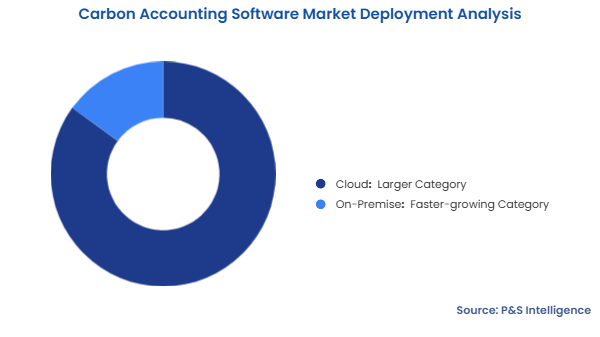
Cloud is the larger category, holding a market share of 85.0%, as organizations increasingly prefer scalable, flexible, and cost-effective deployment models for managing enterprise-wide carbon accounting and sustainability reporting. Cloud-based platforms enable businesses to collect and analyze emissions data from multiple facilities, suppliers, and operational systems through a centralized environment while supporting real-time monitoring and automated reporting. Their ability to integrate seamlessly with enterprise resource planning (ERP) systems, supply chain management platforms, and IoT-enabled monitoring infrastructure improves operational efficiency and simplifies regulatory compliance.
On-Premise is the faster-growing category, registering a CAGR of 21.3%, as organizations operating in highly regulated industries increasingly prioritize greater control over sensitive sustainability data, internal reporting systems, and compliance processes. Sectors such as government, financial services, energy, and critical infrastructure often require customized deployments that align with internal security policies and data governance requirements. According to the International Association of Privacy Professionals (IAPP), data protection and privacy laws were in effect across 144 countries in 2025, highlighting the growing importance of secure data management and regulatory compliance.
The deployment analyzed in this report is:
Cloud (Larger Category)
On-Premise (Faster-growing Category)
Organisation Size Analysis
Large Enterprises are the larger category, holding a market share of 80.5%, as multinational organizations generate vast amounts of emissions data across manufacturing facilities, supply chains, logistics networks, and business operations. These enterprises face increasing pressure from regulators, investors, and stakeholders to maintain transparent and standardized sustainability reporting while meeting evolving climate disclosure requirements. According to the IFRS Foundation, 36 jurisdictions had adopted, used, or were taking steps to introduce the ISSB Sustainability Disclosure Standards in 2025, increasing the need for large enterprises to strengthen their carbon accounting and ESG reporting capabilities.
Small & Medium Enterprises (SMEs) are the faster-growing category, registering a CAGR of 21.5%, as sustainability reporting expectations are increasingly extending across supply chains and business ecosystems. Many SMEs are adopting carbon accounting software to meet supplier requirements, strengthen ESG performance, and improve environmental transparency for customers, investors, and business partners. Cloud-based deployment models, subscription-based pricing, and user-friendly reporting tools have made carbon accounting solutions more affordable and easier to implement for smaller organizations.
The organization size analyzed in this report is:
Large Enterprises (Larger Category)
Small & Medium Enterprises (SMEs) (Faster-growing Category)
End User Analysis
Energy & Utilities are the largest category, holding a market share of 25.0%, as the sector generates significant greenhouse gas emissions across power generation, transmission, distribution, and energy-intensive operations. Organizations require continuous monitoring of emissions, fuel consumption, and operational efficiency to comply with evolving environmental regulations and corporate sustainability commitments. Growing investments in renewable energy, decarbonization initiatives, and enterprise-wide sustainability strategies are further accelerating the adoption of carbon accounting solutions across the sector.
Transportation & Logistics are the fastest-growing category, registering a CAGR of 30.2%, as organizations increasingly focus on reducing emissions across freight transportation, fleet operations, warehousing, and distribution networks. Rising pressure from regulators, customers, and supply chain partners is encouraging logistics providers to strengthen emissions monitoring and improve environmental transparency. According to the International Energy Agency (IEA), the transport sector accounted for around 23% of global energy-related CO₂ emissions in 2024, highlighting the growing need for comprehensive emissions management across transportation activities. Carbon accounting software helps organizations measure fuel consumption, monitor fleet emissions, support Scope 3 reporting, and optimize operational efficiency, making it an essential tool for achieving corporate decarbonization goals.
North America Carbon Accounting Software Market Analysis
North America holds the largest share, of 45.0, due to the early adoption of ESG reporting frameworks, well-established sustainability regulations, and advanced digital infrastructure across the region. Organizations in the U.S. and Canada are increasingly integrating carbon accounting software with enterprise resource planning (ERP), supply chain management, and sustainability management platforms to improve emissions visibility, automate compliance reporting, and strengthen environmental governance. Growing investor focus on ESG performance, expanding corporate net-zero commitments, and increasing regulatory scrutiny are encouraging enterprises to modernize their carbon management capabilities. The region is also home to several leading sustainability software providers, which continues to accelerate product innovation and enterprise adoption. Furthermore, increasing demand for AI-powered analytics, automated Scope 3 emissions management, and audit-ready ESG reporting solutions is strengthening the adoption of carbon accounting software across industries, including energy, manufacturing, transportation, financial services, and technology.
U.S. Carbon Accounting Software Market Analysis
The U.S. represents the leading market in North America driven by the widespread adoption of ESG reporting, climate disclosure practices, and corporate sustainability initiatives across industries. Organizations in sectors such as manufacturing, financial services, technology, energy, and retail are increasingly implementing carbon accounting software to automate greenhouse gas emissions tracking, improve reporting accuracy, and strengthen environmental governance. Integration of carbon accounting platforms with enterprise resource planning (ERP), procurement, and financial management systems is further enhancing operational efficiency and supporting enterprise-wide sustainability strategies. According to the U.S. Securities and Exchange Commission (SEC), nearly 60% of Russell 1000 companies disclosed Scope 1 and Scope 2 greenhouse gas emissions in 2024, reflecting the growing adoption of structured climate reporting among large enterprises.
Canada Carbon Accounting Software Market Analysis
Canada is witnessing steady growth in carbon accounting software adoption because driven by increasing corporate sustainability initiatives, expanding climate disclosure requirements, and growing investments in emissions management across energy, mining, transportation, and manufacturing industries. Organizations are adopting carbon accounting software to improve greenhouse gas emissions monitoring, automate sustainability reporting, and strengthen compliance with evolving environmental regulations. The integration of carbon accounting platforms with enterprise resource planning (ERP) systems and sustainability management solutions is further enhancing operational efficiency and supporting long-term decarbonization strategies. According to the Government of Canada, 1,879 facilities reported greenhouse gas emissions under the federal Greenhouse Gas Reporting Program (GHGRP) in 2024, reflecting the increasing emphasis on structured emissions monitoring and transparent environmental reporting across industrial sectors.
Asia-Pacific has the highest CAGR, of 30.5%, driven by rapid industrialization, expanding manufacturing activities, and increasing adoption of sustainability reporting across the region. Organizations are strengthening their carbon management capabilities to meet evolving environmental regulations, corporate ESG commitments, and the growing expectations of global customers and investors. The widespread adoption of cloud-based carbon accounting platforms is enabling enterprises to automate emissions monitoring, improve reporting accuracy, and integrate sustainability data with enterprise management systems. Governments across the region are promoting decarbonization, renewable energy development, and digital sustainability initiatives, encouraging businesses to implement advanced carbon accounting solutions.
China Carbon Accounting Software Market Analysis
China remains the largest market in Asia-Pacific driven by its extensive manufacturing base, large-scale industrial operations, and increasing focus on carbon emissions management. Organizations across industries, including manufacturing, energy, chemicals, transportation, and heavy industry, are adopting carbon accounting software to improve emissions monitoring, strengthen ESG reporting, and support corporate decarbonization strategies. The growing integration of carbon accounting platforms with enterprise resource planning (ERP), energy management, and sustainability management systems is enabling businesses to enhance operational efficiency and improve environmental reporting. According to the National Bureau of Statistics of China, China's total energy consumption reached 5.96 billion tonnes of standard coal equivalent in 2024, highlighting the significant scale of industrial activity and the increasing need for robust emissions monitoring and carbon management solutions.
India Carbon Accounting Software Market Analysis
India is emerging as the fastest-growing market in Asia-Pacific driven by rapid industrialization, increasing corporate sustainability initiatives, and the growing adoption of ESG reporting across industries. Organizations in sectors such as manufacturing, energy, information technology, transportation, and infrastructure are increasingly implementing carbon accounting software to strengthen emissions monitoring, improve sustainability reporting, and support corporate decarbonization strategies. Cloud-based deployment models and digital transformation initiatives are further accelerating software adoption by providing scalable and cost-effective carbon management solutions. According to the Press Information Bureau (PIB), India's installed renewable energy capacity reached 220.10 GW in 2025, reflecting the country's accelerating clean energy transition and increasing focus on sustainable business practices.
Europe Carbon Accounting Software Market Analysis
Europe maintains a strong position in the market supported by its well-established climate policies, stringent sustainability regulations, and widespread adoption of ESG reporting practices. Organizations across manufacturing, automotive, energy, transportation, retail, and financial services are increasingly deploying carbon accounting software to improve emissions monitoring, strengthen regulatory compliance, and enhance corporate sustainability reporting. The region continues to witness strong demand for integrated carbon management platforms that enable organizations to automate emissions tracking, manage Scope 3 emissions, and generate audit-ready ESG reports.
According to the European Commission, the Corporate Sustainability Reporting Directive (CSRD) came into effect to expand mandatory sustainability reporting requirements for thousands of companies across the European Union, significantly increasing the need for standardized environmental data management and transparent climate disclosures. Growing investments in renewable energy, circular economy initiatives, and enterprise-wide decarbonization strategies are further encouraging organizations to adopt advanced carbon accounting software that improves reporting accuracy, supports regulatory compliance, and strengthens long-term sustainability performance.
The regions and countries analyzed in this report are:
The market is fragmented characterized by the presence of global enterprise software companies, dedicated carbon accounting solution providers, ESG reporting platform developers, and emerging climate technology firms. Competition is primarily based on product innovation, regulatory compliance capabilities, AI-driven analytics, Scope 3 emissions management, integration with enterprise resource planning (ERP) systems, and the ability to deliver accurate, audit-ready sustainability reporting across complex business operations. Software vendors are continuously expanding their platforms by incorporating artificial intelligence, automated emissions calculations, real-time carbon monitoring, supplier emissions management, and advanced ESG reporting capabilities to address evolving customer requirements. Strategic partnerships, product launches, acquisitions, and integration with enterprise business applications are further strengthening competitive positioning, while cloud-based deployment models are enabling vendors to expand their presence among both large enterprises and small and medium-sized businesses.
Leading Companies in the Carbon Accounting Software Market:
IBM Corporation
SAP SE
Salesforce, Inc.
Microsoft Corporation
Persefoni AI, Inc.
Sphera Solutions, Inc.
Wolters Kluwer N.V.
Intelex Technologies ULC
Benchmark Digital Partners LLC
Greenly, Inc.
SINAI Technologies, Inc.
Diligent Corporation
Carbon Accounting Software Market News
In October 2025, Diligent Corporation entered into a strategic partnership with Persefoni AI, Inc. to strengthen its carbon accounting and sustainability reporting capabilities. As part of the partnership, Diligent transitioned its carbon accounting customers to Persefoni's AI-powered platform to enhance emissions management and ESG reporting.
In June 2025, Wolters Kluwer N.V. expanded its CCH Tagetik ESG & Sustainability platform with new Carbon Border Adjustment Mechanism (CBAM) and Planning & Analytics capabilities. The enhancement enables organizations to automate embedded carbon emissions calculations, streamline CBAM compliance, and integrate sustainability planning with financial decision-making.
In January 2024, Sphera Solutions, Inc. acquired SupplyShift, a supply chain sustainability software provider, to strengthen its carbon accounting and ESG capabilities. The acquisition enhanced Sphera's ability to collect Scope 3 emissions data, improve supplier transparency, and support enterprise sustainability reporting and regulatory compliance.
Frequently Asked Questions About This Report
What does the carbon accounting software market include for organizations?+
It includes software that measures, calculates, tracks, and reports greenhouse gas emissions across operations, energy use, and value chains.
What factors are driving demand in the carbon accounting software market?+
Growth is driven by climate disclosure, supplier reporting, investor expectations, net zero commitments, and demand for auditable emissions data.
Why are organizations adopting carbon accounting software solutions across operations?+
Organizations adopt carbon accounting software to build emissions inventories, manage scopes, collect activity data, and prepare sustainability reports.
How do carbon accounting software solutions improve decision making and efficiency?+
These solutions improve operations by automating calculations, centralizing evidence, tracking reduction actions, and supporting more transparent climate reporting.
What challenges affect adoption of carbon accounting software solutions today?+
Adoption is affected by data availability, emission factor selection, supplier participation, methodology changes, audit needs, and integration with business systems.
Want a report tailored exactly to your business need?
Leading companies across industries trust us to deliver data-driven insights and innovative solutions for their most critical decisions. From data-driven strategies to actionable insights, we empower the decision-makers who shape industries and define the future. From Fortune 500 companies to innovative startups, we are proud to partner with organisations that drive progress in their industries.
Client Testimonials
Working with P&S Intelligence and their team was an absolute pleasure – their awareness of timelines and commitment to value greatly contributed to our project's success. Eagerly anticipating future collaborations.
McKinsey & Company
India
Unmatched Standards
Our insights into the minutest levels of the markets, including the latest trends and competitive landscape, give you all the answers you need to take your business to new heights
Complete Data Security
We take a cautious approach to protecting your personal and confidential information. Trust is the strongest bond that connects us and our clients, and trust we build by complying with all international and domestic data protection and privacy laws