Black Mass Recycling Market Size & Share Analysis - Emerging Trends, Growth Opportunities, Competitive Landscape, and Forecasts (2025 - 2032)
This Report Provides In-Depth Analysis of the Black Mass Recycling Market Report Prepared by P&S Intelligence, Segmented by Battery Type (Lithium-Ion, Lead-Acid, Nickel-Cadmium), Technology (Hydrometallurgy, Pyrometallurgy, Direct Recycling/Mechanical Processing), Battery Source (Automotive, Consumer Electronics, Industrial Equipment, Energy Storage Systems), and Geographical Outlook for the Period of 2019 to 2032
Explore the market potential with our data-driven report
Black Mass Recycling Market Outlook
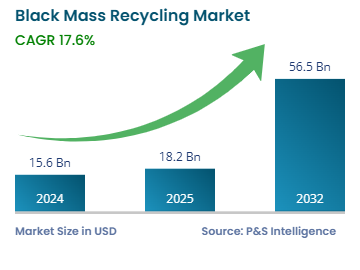
The global black mass recycling market size was USD 15.6 billion. in 2024, which is predicted to reach USD 56.5 billion by 2032, growing at a CAGR of 17.6% during 2025–2032.
The significant growth trajectory is primarily driven by the exponential rise in electric vehicle adoption, stringent environmental regulations promoting circular economy principles, and increasing demand for critical battery materials amidst supply chain constraints. The market expansion reflects the growing necessity to recover valuable metals, such as lithium, cobalt, nickel, and manganese, from end-of-life batteries, supporting sustainable resource management while reducing dependency on virgin material mining.
The surging adoption of electric vehicles globally represents a transformative force in the black mass recycling market landscape. According to the International Energy Agency (IEA), almost 14 million new electric cars were registered globally in 2023, marking a 35% year-on-year increase. Sales further reach 17 million units in 2024.
This unprecedented growth in EV deployment creates a substantial pipeline of lithium-ion batteries that will eventually require recycling, establishing black mass recycling as a critical component of the sustainable mobility ecosystem. The automotive sector's transition toward electrification, coupled with the finite lifespan of EV batteries typically ranging from 8 to 15 years, ensures a steady stream of feedstock for recycling facilities in the coming decades.
Black Mass Recycling Market Growth Factors
Technological Advancements in Hydrometallurgical Processing Are Key Trend
The increasing adoption of automated and sensor-based monitoring systems is improving precision and control in leaching, solvent extraction, and precipitation steps of hydrometallurgy.
The development of bio-hydrometallurgical methods, such as bioleaching using microbes, is gaining traction for eco-friendly extraction of metals from low-grade ores and e-waste.
The advancements in ion-exchange resins and membrane technologies are enhancing the efficiency and selectivity of metal recovery processes.
The use of machine learning and AI-driven process optimization is helping reduce energy consumption and improve metal yield across complex ore bodies.
The integration of modular and mobile hydrometallurgical plants is enabling on-site metal recovery from small or remote mining locations.
The ongoing research on green lixiviants, such as glycine and thiosulfate, is reducing reliance on toxic chemicals such as cyanide and sulfuric acid.
The U.S. Department of Energy (DoE) has allocated substantial funding via the USD 3-billion Battery Manufacturing and Recycling Grants Program to demonstration projects, commercial-scale facilities, and retrofits for battery recycling infrastructure, which includes hydrometallurgical technologies.
The deployment of closed-loop water management systems is improving sustainability by reducing water consumption and waste generation.
Enhanced recycling processes for critical metals, such as lithium, cobalt, and rare earth elements, are supporting the circular economy and battery supply chain.
Rising Electric Vehicle Battery Demand Is Accelerating Market Growth
The surging global adoption of electric vehicles is directly increasing the need for large-scale production of lithium-ion and other advanced batteries.
Government incentives, subsidies, and stringent emission norms are pushing automakers toward electrification, driving battery consumption upward.
The expansion of gigafactories by major battery manufacturers is creating robust demand for raw materials such as lithium, nickel, cobalt, and graphite.
The growing interest in extended-range electric vehicles is leading to higher energy density requirements, thereby boosting innovation in battery chemistry.
The increasing investments in battery recycling infrastructure are aimed at securing long-term material supply and meeting sustainability goals.
According to the IEA’s Global EV Outlook 2024, China accounted for around 80% of global battery cell production and approximately 85% of global battery manufacturing capacity in 2023.
The country produces nearly 90% of the cathode active materials and over 97% of the anode active materials globally.
The strategic collaborations between automakers, mining companies, and technology providers are accelerating vertical integration across the EV battery value chain.
The shift toward solid-state and next-gen battery technologies is enhancing performance and safety, further stimulating market demand.
The Rising demand from commercial EV fleets and public transportation electrification is contributing to the large-volume consumption of battery packs.
Black Mass Recycling Market Segmentation Analysis
Battery Type Analysis
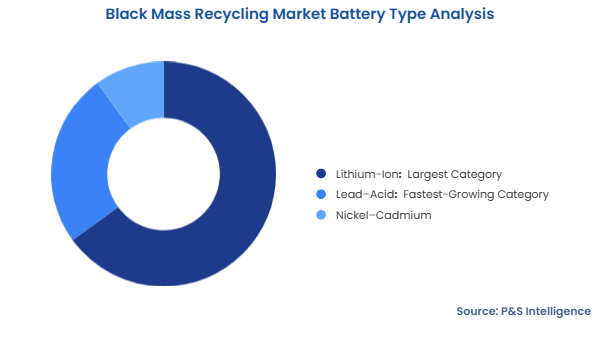
The lithium-ion batteries category dominated the black mass recycling market in 2024, capturing 65% share, driven by their widespread adoption across electric vehicles, consumer electronics, and energy storage systems. The popularity of lithium-ion technology stems from superior energy density, longer cycle life, and declining production costs.
These batteries contain high concentrations of valuable metals, including lithium, cobalt, nickel, and manganese, making their recycling economically attractive despite technical complexities. The category's dominance reflects the battery chemistry's central role in global decarbonization efforts, with electric vehicle manufacturers exclusively adopting lithium-ion variants for their superior performance characteristics. As per studies, the lithium-ion battery metals market could value USD 68.83 billion by 2032, with USD 58.8 billion coming from recycled ones.
Lead–acid batteries represent the fastest-growing category, during 2025–2032, paradoxically driven by their mature recycling ecosystem and established collection networks achieving recycling rates exceeding 95% in developed markets. The category benefits from simpler recycling processes, well-established reverse logistics, and consistent demand from automotive starter batteries and industrial backup power applications. While technologically mature, lead-acid battery recycling continues evolving through process optimization and environmental compliance improvements, maintaining relevance despite lithium-ion market expansion.
These battery types are covered:
Lithium-Ion (Largest Category)
Lead–Acid (Fastest-Growing Category)
Nickel–Cadmium
Technology Analysis
The hydrometallurgy technology commanded the largest market share in 2024, of 45%,
attributed to superior recovery rates and environmental advantages compared to alternative methods. Hydrometallurgical processes achieve selective metal extraction through chemical leaching, enabling recovery of lithium alongside other valuable materials—a capability particularly crucial given lithium's strategic importance and price volatility. The technology's lower operating temperatures reduce energy consumption compared to pyrometallurgical alternatives, while modular design possibilities facilitate capacity scaling to match feedstock availability. Advanced hydrometallurgical facilities now incorporate closed-loop water systems and reagent recycling, minimizing environmental impacts while improving process economics through reduced chemical consumption.
Pyrometallurgy maintains the highest growth trajectory, through 2032. This is driven by its effectiveness in processing mixed battery streams and recovering high-value metals, such as cobalt and nickel. Despite the limitations in lithium recovery, pyrometallurgical smelting offers advantages in handling large volumes efficiently while destroying organic components and producing valuable alloy products. The technology's maturity and proven scalability attract investments from established metallurgical companies leveraging existing infrastructure, particularly in regions with strong mining and smelting traditions.
These technologies are covered:
Hydrometallurgy (Largest Category)
Pyrometallurgy (Fastest-Growing Category)
Direct Recycling/Mechanical Processing
Others
Battery Source Analysis
The automotive category dominated with 45% market share in 2024, reflecting the electric vehicle revolution's central role in driving black mass generation. The automotive sector's transition toward electrification, supported by government mandates and consumer adoption, creates unprecedented volumes of large-format battery packs requiring specialized recycling infrastructure. EV batteries, typically weighing 400-600 kg and containing 4–8 kg of lithium, 10–20 kg of cobalt, and 40–60 kg of nickel, represent high-value recycling opportunities that justify dedicated processing facilities. The category benefits from regulatory frameworks mandating automotive battery collection and recycling, ensuring feedstock security for recycling operations.
Consumer electronics is the fastest-growing source category, during the forecast period, driven by the accelerating device proliferation and shortening replacement cycles. The category's growth reflects not only increasing device ownership but also improving collection systems for small-format batteries previously lost to municipal waste streams. Retailer take-back programs, producer responsibility schemes, and consumer awareness campaigns enhance collection rates, directing valuable battery materials toward formal recycling channels rather than landfills.
These battery sources are covered:
Automotive (Largest Category)
Consumer Electronics (Fastest-Growing Category)
Industrial Equipment
Energy Storage Systems
Drive strategic growth with comprehensive market analysis
Black Mass Recycling Market Regional Outlook
Asia-Pacific Black Mass Recycling Market Size
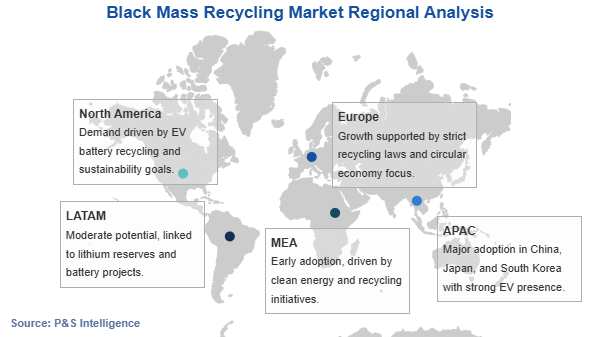
Geographically, Asia-Pacific held the largest global black mass recycling market share in 2024, of 40%, primarily driven by China's dominance in battery manufacturing and recycling infrastructure development. The region processes over 80% of global battery recycling volume, leveraging established supply chains, technological expertise, and supportive government policies promoting circular economy principles. China's integrated approach linking battery production, electric vehicle manufacturing, and recycling creates synergies that reduce costs while ensuring material security for domestic industries.
The presence of major battery manufacturers, including CATL, BYD, and recycling specialists, such as Brunp Recycling (CATL subsidiary), positions the region as the global hub for battery material recovery. According to the International Energy Agency (IEA), global battery recycling capacity exceeded 300 GWh in 2023, with over 80% of this capacity located in China. If all announced projects materialize, global capacity could surpass 1,500 GWh by 2030, with China expected to maintain a dominant share of around 70%.
The country's regulatory framework, including manufacturer responsibility for battery traceability and recycling introduced in December 2023, ensures systematic collection and processing of end-of-life batteries.
Additionally, favorable economics for lithium iron phosphate (LFP) battery recycling in China, despite lower material values compared to nickel-rich chemistries, demonstrate the market's maturity and operational efficiency achieved through scale and technological optimization.
North America Black Mass Recycling Market Forecast
North America represents the fastest-growing regional market, with an expected CAGR of approx. 18.0% during 2025–2032, propelled by massive infrastructure investments and regulatory support for domestic battery supply chain development. The U.S. government's allocation of USD 2.91 billion for clean energy battery initiatives and USD 74 million specifically for next-generation recycling projects under the Infrastructure Investment and Jobs Act catalyzes market expansion. These investments, combined with the Inflation Reduction Act's incentives for domestic battery material processing, create powerful economic drivers for recycling capacity development.
The North American market benefits from strategic partnerships between automakers and recycling companies, exemplified by collaborations such as Ford with Redwood Materials and General Motors with Lithion Recycling.
Europe Black Mass Recycling Market Growth
Europe maintains strong market positioning, with sophisticated regulatory frameworks and ambitious sustainability targets driving systematic market development. The EU's Batteries Regulation establishes world-leading recycling requirements, including mandatory recycled content targets for new batteries—16% cobalt, 6% lithium, and 6% nickel by 2031, increasing to 26% cobalt, 12% lithium, and 15% nickel by 2036. These requirements create guaranteed demand for recycled materials, providing market certainty that encourages long-term investments in recycling infrastructure. European recycling capacity, while currently representing less than 10% of global capacity, is projected to expand rapidly with over 30 facilities announced or under construction.
The regions and countries analyzed in this report are:
North America (Fastest-Growing Regional Market)
U.S. (Larger Country Market)
Canada (Faster-Growing Country Market)
Europe
Germany (Largest Country Market)
U.K. (Fastest-Growing Country Market)
France
Italy
Spain
Rest of Europe
Asia-Pacific (Largest Regional Market)
Japan
China (Largest Country Market)
India (Fastest-Growing Country Market)
South Korea
Australia
Rest of APAC
Latin America
Brazil (Largest Country Market)
Mexico (Fastest-Growing Country Market)
Rest of LATAM
Middle East and Africa
Saudi Arabia (Largest Country Market)
South Africa
U.A.E. (Fastest-Growing Country Market)
Rest of MEA
Black Mass Recycling Market Share
The global black mass recycling market exhibits a slightly fragmented structure, characterized by the presence of established metallurgical companies, specialized recycling firms, and emerging technology providers competing across different process technologies and regional markets. The market fragmentation stems from diverse technological approaches, varying regulatory requirements across jurisdictions, and the relatively nascent stage of the industry outside China. This fragmentation partly results from the diverse nature of battery waste streams, with some companies specializing in automotive batteries while others focus on consumer electronics or specific battery chemistries. The market's rapid growth and evolving technology landscape prevent excessive consolidation, as continuous innovation and regional market dynamics create niches for specialized operators.
Recent strategic activities highlight intensifying competition and market maturation. Companies increasingly pursue vertical integration strategies, expanding from collection and pre-processing into hydrometallurgical refining to capture greater value chain margins. Technology differentiation emerges as a key competitive factor, with Redwood Materials and Li-Cycle developing proprietary processes claiming superior recovery rates or lower environmental impacts. The market also witnesses growing involvement from traditional mining companies, such as Glencore, viewing battery recycling as a strategic complement to primary metal production.
Key Black Mass Recycling Companies:
Anglo American
Aqua Metals
BASF SE
Boliden AB
Epiroc AB
Fortum Oyj
Glencore International AG
Heraeus Holding GmbH
Redwood Materials Inc.
Tenova S.p.A.
Umicore N.V.
Li-Cycle Holdings Corp.
Contemporary Amperex Technology Co., Limited
Cirba Solutions
RecycLiCo Battery Materials Inc.
Black Mass Recycling Market News & Updates
In June 2025, BASF SE began commercial operations at its black mass recycling facility in Schwarzheide, Germany. It is capable of processing up to 15,000 tonnes of end-of-life lithium‑ion batteries and production scrap per year (equivalent to around 40,000 EV batteries annually), producing metal-rich black mass containing lithium, nickel, cobalt, and manganese.
In April 2024, AB Volvo and Contemporary Amperex Technology Co. Limited (CATL) announced a strategic partnership for EV battery recycling. As per the contract, Volvo will collect used batteries from certified suppliers to extract critical materials for reintegration into new battery production.
In March 2024, Cylib GmbH completed a EUR 55-million Series A funding round co-led by World Fund and Porsche Ventures, to industrialize Cylib’s proprietary recycling technology at an already-secured brownfield facility in Germany.
In February 2024, Cirba Solutions and EcoPro Co. Ltd. signed a memorandum of understanding to enhance lithium-ion battery recycling capabilities in North America. They aim to address the growing demand for battery materials while supporting clean energy production through advanced hydrometallurgical processing technologies.
In December 2023, Toyota Motor Corporation expanded its U.S. battery recycling program through a collaboration with Cirba Solutions. Toyota aims to enhance the collection, transportation, dismantling, and processing of end-of-life batteries—including hybrid, plug-in hybrid, and electric vehicle batteries. The initiative targets a closed‑loop ecosystem, with processing taking place at Cirba’s Lancaster, Ohio, facility, which employs advanced technologies capable of recovering up to 95% of critical minerals for reintegration into the supply chain.
Want a report tailored exactly to your business need?
Leading companies across industries trust us to deliver data-driven insights and innovative solutions for their most critical decisions. From data-driven strategies to actionable insights, we empower the decision-makers who shape industries and define the future. From Fortune 500 companies to innovative startups, we are proud to partner with organisations that drive progress in their industries.
Client Testimonials
Working with P&S Intelligence and their team was an absolute pleasure – their awareness of timelines and commitment to value greatly contributed to our project's success. Eagerly anticipating future collaborations.
McKinsey & Company
India
Unmatched Standards
Our insights into the minutest levels of the markets, including the latest trends and competitive landscape, give you all the answers you need to take your business to new heights
Complete Data Security
We take a cautious approach to protecting your personal and confidential information. Trust is the strongest bond that connects us and our clients, and trust we build by complying with all international and domestic data protection and privacy laws