This Report Provides In-Depth Analysis of the Bioprocess Containers Market Report Prepared by P&S Intelligence, Segmented by Product (2D Bioprocess Containers, 3D bioprocess Containers, Tank Linkers, Other Containers & Accessories), Capacity (Small Volume, Large Volume), Application (Upstream Processes, Downstream Processes, Process Developments), End Use (Pharmaecuetical & Biopharmceutical Companies, CROs & CMOs, Academic & Research Institutes), and Geographical Outlook for the Period of 2019 to 2032
Explore the market potential with our data-driven report
Bioprocess Containers Market Overview
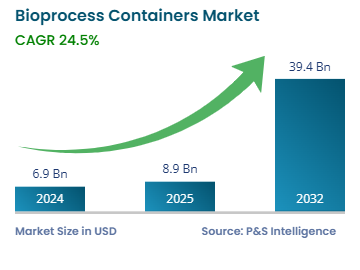
The bioprocess containers market size was USD 6.9 billion in 2024, and it will grow by 24.5% during 2025–2032, to reach USD 39.4 billion by 2032.
The market growth is driven by the increasing demand for biologics, such as monoclonal antibodies, mRNA vaccines, and gene and cell therapies. There is a shift toward bioprocess containers due to their better aseptic conditions, affordability, and operational efficiency. These systems reduce the need for disinfection and certification and are, thus, ideal for rapid production facilities.
Regulatory bodies, such as the FDA and EMA, support the use of disposable container systems. The FDA has guidelines to minimize contamination risks during manufacturing, while the EMA accepts the adoption of single-use systems under GMP validation for better safety and efficiency.
Bioprocess Containers Market Trends & Drivers
Advancements in Materials and Smart Container Design Are Key Trend
The development of advanced polymer films, 3D biocontainers, and user-friendly designs is a key trend transforming bioprocess containers.
These developments reduce contamination risks from leachables, handle large volumes, and maintain sterility, even in harsh environments.
The advanced polymer films are used to improve barrier protection and chemical stability.
3D biocontainer design can handle 3,000–5,000 liters, supporting scalable and adaptable manufacturing.
Advanced features, such as sterile connectors, RFID tagging, and smart monitoring systems, further enhance product quality, boost safety, and enable regulatory compliance.
MilliporeSigma has created an advanced system integrated with software and sensors that boosts productivity and support immediate tracking and management.
The company produces more than 12,000 disposable systems weekly, highlighting the strong demand for advanced and large-scale bioproduction methods.
Rapid Facility Deployment and Scaling of Life Sciences Infrastructure Are Biggest Drivers
The growing biologics pipeline and global health threats are increasing the demand for proper infrastructure for biopharma and life science processes.
Compared to USD 448.1 billion in 2023, sales of biologics could reach USD 745.1 billion by the year 2030 around the world.
Governments around the world are investing in fast-track facilities, preparing for any future pandemics.
In 2025, the U.S. announced a biomanufacturing initiative of USD 2 billion to improve local vaccine and biologics output.
Canada’s Biomanufacturing and Life Sciences Strategy will invest CAD 2.2 billion by 2027 to improve local production capacity, enhance pandemic preparedness, and minimize reliance on global manufacturing.
Companies are using disposable bioprocess containers to boost infrastructure development, minimize validation durations, and facilitate localized adaptability.
During the COVID-19 pandemic, more than 87% of new vaccine facilities used disposable systems for rapid production.
Single-use systems take 50% less time to create medicines than traditional setups and reduce capital investment due to limited infrastructure requirements, such as CIP systems.
G-Con provides modular plug-and-play cleanroom systems with built-in single-use setups for efficient and scalable production.
Measles, rubella, mumps, tetanus, polio, pertussis, diphtheria, hepatitis A and B, and influenza are the common infections for which people are generally immunized during infancy itself.
As per the World Health Organization, more than 1 billion cases of seasonal flu, including up to 5 million severe cases, are registered around the world each year.
Moreover, due to proper immunization, global polio incidence has shrunk by more than 99% since 1988.
Bioprocess Containers Market Segmentation and Category Analysis
Product Analysis
The 2D category held the largest market share, of 45%, in 2024. This is because they are widely used in upstream processes, such as media preparation and cell culturing; downstream processes, including storage and filtration; and process development. This is due to their affordability, scalability, pre-sterilized, and disposable format. Moreover, these containers are made from multi-layer polymer films to offer chemical resistance and compatibility with sensitive materials.
The 3D category will have the highest CAGR, of approx. 25%, due to the growing demand for customized therapies, rapid innovation in material science, and large volume scalability in high cell density. As per studies, the worldwide spending on personalized medicine could reach USD 740 billion by 2030. Cuboidal or rectangular, these containers are widely used for buffer preparation, storage, and transportation. They are well suited for harvest collection, bioreactor feed, and intermediate product handling. Additionally, the rising biosimilar production and commercialization of biologics are increasing the demand for 3D containers.
The products analyzed in this report are:
2D Bioprocess Containers (Largest Category)
3D Bioprocess Containers (Fastest-Growing Category)
Tank Linkers
Other Containers & Accessories
Capacity Analysis
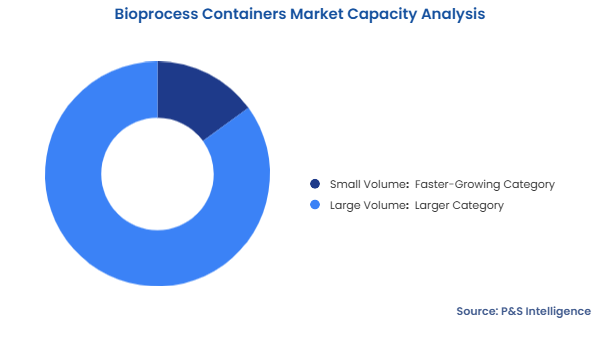
The large volume category held the larger market share, of 85%, in 2024, as these containers are used for commercial-scale biopharmaceutical production, mass media holding, and buffering demands. According to studies, containers up to 10,000 liters in capacity are an affordable and convenient option, especially in commercial operations.
The small volume category will have the higher CAGR, because of the rising need for small containers in lab research, clinical testing, and customized treatments. They are also used in early-stage drug development.
The capacities analyzed in this report are:
Small Volume (Faster-Growing Category)
Large Volume (Larger Category)
Application Analysis
The upstream processes category held the largest market share, of 50%, in 2024. These processes include cell culturing, fermentation, and media preparation, which demand aseptic, large-volume containers for single uses, such as mAbs and gene therapies. Moreover, the rising demand for flexible bioproduction and the need to speed up drug delivery promote the use of disposable systems in these processes.
The downstream processes category will have the highest CAGR, of approx. 25.5%, because of the growing demand to purify biopharmaceutical products after cell culture. This stage includes chromatography, filtration, and clarification, during which bioprocess containers are used to store buffers, partially made, and final drug products.
The applications analyzed in this report are:
Upstream Processes (Largest Category)
Downstream Processes (Fastest-Growing Category)
Process Development
End User Analysis
The pharmaceutical & biopharmaceutical companies category held the largest market share, of 55% in 2024, because they are the primary producers of single-use technologies. This is why they procure bioprocess containers in large numbers to boost versatility, minimize contamination risks, and ensure improved production downtime. The rising demand for personalized medicine and the growing biosimilar R&D pipeline for autoimmune diseases also increase the need for aseptic, single-use processing systems.
The CROs & CMOs category will have the highest CAGR, due to the rapid shift in the manufacturing approach in the biopharma sector. These third-party researchers and producers are affordable, provide flexible production, boost efficiency, and are widely used by emerging, niche, and even some established pharma companies. CMOs are switching to flexible, single-use bioprocess containers from stainless steel setups to boost efficiency and scalability. As per estimates, pharmaceutical and biopharmaceutical companies could spend up to USD 142.56 billion on CRO services and USD 31.8 billion on CDMO services by 2030.
Drive strategic growth with comprehensive market analysis
Bioprocess Containers Market Regional Outlook
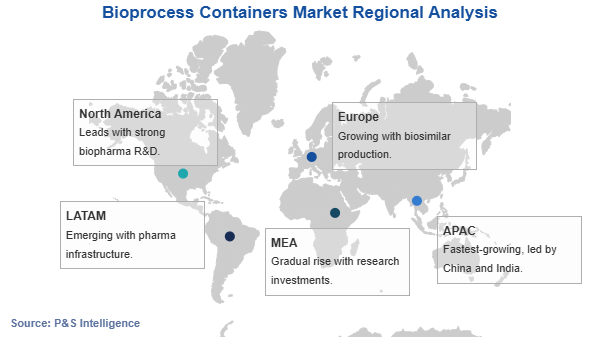
North America held the largest market share, of 40%, in 2024, because of the advanced biopharmaceutical research and single-use technologies, especially in the U.S. The U.S. is a global biotech hub working on mRNA vaccines, cell, and gene therapies, and monoclonal antibodies. The supportive FDA regulations make it easier for companies to adopt bioprocess containers. In Canada, the government’s Biomanufacturing Strategies help in propelling the market growth. As per the EFPIA, pharma/biotech R&D spending is the highest in the U.S., reaching EUR 71,549 million in 2022.
Asia-Pacific will have the highest CAGR, of 26.5%, due to the rising drug production, strong government support, and the rising demand for biosimilars and biologics. India, South Korea, and China are enhancing their healthcare infrastructure with pro-industry policies. For instance, the Made in China 2025 plans to promote modern drug production. Similarly, Biocon is increasing its procurement of disposable bioprocess containers to meet the global demand for biopharmaceuticals. Moreover, the manufacturing cost is lower in this region, and many companies are outsourcing production, which increases the market growth potential.
As per the IBEF, India possesses the highest number of FDA-compliant pharmaceutical manufacturing plants outside the U.S. and more than 2,000 facilities approved by WHO-GMP. With more than 10,500 manufacturing facilities in total, India caters to the demand for pharmaceuticals and biologics from over 150 countries globally. The government’s PLI scheme has sanctioned USD 2.04 billion (INR 15,000 crore) from 2020 to 2029 to boost pharma and biopharma production in the country.
The geographical breakdown of the market is as follows:
North America (Largest Regional Market)
U.S. (Larger Country)
Canada (Faster-Growing Country)
Europe
Germany (Largest Country)
U.K. (Fastest-Growing Country)
France
Italy
Spain
Rest of Europe
Asia-Pacific (Fastest-Growing Regional Market)
China (Largest Country)
India
Japan
South Korea (Fastest-Growing Country)
Australia
Rest of APAC
Latin America
Brazil (Largest Country)
Mexico (Fastest-Growing Country)
Rest of LATAM
Middle East and Africa
Saudi Arabia (Fastest-Growing Country)
South Africa (Largest Country)
U.A.E.
Rest of MEA
Bioprocess Containers Market Share
The market is moderately fragmented due to the presence of large regional and global players competing across various product lines, such as 2D, 3D, and tank linkers. Thermo Fisher and Cytiva have a significant presence, but no single company dominates all segments of the market. Many niche and emerging markets providing new and customized products also contribute to the market fragmentation.
Key Bioprocess Containers Companies:
Thermo Fisher Scientific Inc.
Compagnie de Saint-Gobain S.A.
Lonza Group AG
Avantor, Inc.
Cytiva
Merck KGaA
Sartorius AG
GE Healthcare Technologies Inc.
Entegris, Inc.
Meissner Filtration Products, Inc.
CellBios Healthcare and Lifesciences Pvt Ltd
Cole-Parmer Instrument Co.
Bioprocess Containers Market News & Updates
In April 2025, Regeneron Pharmaceuticals Inc. and Fujifilm Diosynth Biotechnologies signed a 10-year, USD 3-billion deal to produce Regeneron’s biopharmaceuticals in the U.S. as a CDMO
In July 2024, Sartorius AG acquired kSep Systems to advance downstream separation.
In April 2023, Cytiva, a subsidiary of Danaher Corporation, acquired Vanrx Pharmasystems to expand its bioprocessing capabilities for aseptic pharmaceutical packaging.
In April 2023 Merck KgaA launched the Ultimus single-use film for bioprocess containers for enhanced durability and leak protection.
Want a report tailored exactly to your business need?
Leading companies across industries trust us to deliver data-driven insights and innovative solutions for their most critical decisions. From data-driven strategies to actionable insights, we empower the decision-makers who shape industries and define the future. From Fortune 500 companies to innovative startups, we are proud to partner with organisations that drive progress in their industries.
Client Testimonials
Working with P&S Intelligence and their team was an absolute pleasure – their awareness of timelines and commitment to value greatly contributed to our project's success. Eagerly anticipating future collaborations.
McKinsey & Company
India
Unmatched Standards
Our insights into the minutest levels of the markets, including the latest trends and competitive landscape, give you all the answers you need to take your business to new heights
Complete Data Security
We take a cautious approach to protecting your personal and confidential information. Trust is the strongest bond that connects us and our clients, and trust we build by complying with all international and domestic data protection and privacy laws