This Report Provides In-Depth Analysis of the Biopesticides Market Report Prepared by P&S Intelligence, Segmented by Product Type (Microbial-based biopesticides, Biochemical biopesticides, Plant-derived biopesticides, Beneficial organisms), Formulation (Liquid formulations, Dry/solid formulations), Application Method (Seed treatment, Post-harvest application, Foliar spray, Soil treatment), Crop Type (Fruits & vegetables, Turf & ornamentals, Cereals & grains, Oilseeds & pulses, Plantation crops), End User (Farmers, Commercial growers, Agricultural cooperatives & distributors, Research & institutional users), Mode of Action (Bioinsecticides, Biofungicides, Bionematicides, Bioherbicides), and Geographical Outlook for the Period of 2021 to 2032
Explore the market potential with our data-driven report
Biopesticides Market Overview
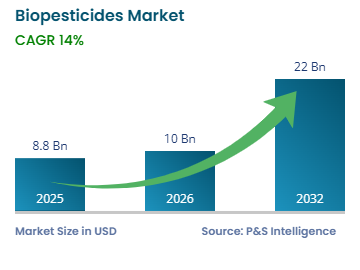
The biopesticides market size was USD 8.8 billion for 2025, and it will grow by 14.0% during 2026-2032, to reach USD 22.0 billion by 2032.
The market is expanding because biopesticides are moving from niche biological inputs to practical crop protection tools across wider farming systems. Farmers, food processors, and retailers are paying closer attention to residue limits, soil health, and safer production practices, which is improving acceptance of microbial, biochemical, and plant-based products. Better formulation stability, targeted pest action, and compatibility with integrated pest management programmes are also making these products easier to include in routine farm operations. According to the Food and Agriculture Organisation, global cereal production reached approximately 3.1 billion tonnes in 2024. This large production base is increasing the need for crop protection options that support productivity without adding pressure from conventional chemical use.
Commercial adoption is also improving as input companies, distributors, and grower networks bring biopesticides into mainstream crop protection portfolios. These products are no longer limited to organic farms; they are being positioned for conventional fields, high-value horticulture, seed treatment, post-harvest handling, and residue-sensitive export supply chains. Moreover, food companies and organised retailers are encouraging suppliers to manage pest pressure with lower chemical load, which is creating steadier demand for biological solutions. This is strengthening product availability, farmer confidence, and repeat use across commercial farming systems, especially where buyers require consistent residue management and crop quality.
Key Market Insights
Microbial-based biopesticides are the largest type, holding a market share of 40%, due to strong field reliability across conventional and organic crop protection systems.
Dry/solid formulations are the faster-growing formulation, registering a CAGR of approximately 14.7%, driven by better storage stability and easier movement across agricultural supply chains.
Seed treatment is the largest application, holding a market share of 40%, due to effective early-stage protection and efficient lower-volume product use.
The United States holds the largest country share of 70%, due to strong regulatory control and large-scale adoption across major soybean-growing areas.
India is the fastest-growing country, registering a CAGR of 35%, driven by rising smallholder demand and expanding organic farming support.
Biopesticides Market Dynamics
Shift Toward Integrated Biological Crop Protection Solutions Is a Major Trend
The market is increasingly shifting toward integrated biological crop protection because growers need biopesticides that can work inside existing spray, seed, fertiliser, and low-dose chemical programmes rather than replace every input at once. This trend is strongest in broadacre and oilseed systems, where pest pressure, soil health needs, and residue management must be handled without disrupting established farm routines. Companies are responding with ready-to-use microbial and plant-based formulations that offer better shelf life, tank-mix compatibility, and easier distribution through regular agri-input channels.
According to the Food and Agriculture Organisation of the United Nations, the global fertiliser trade, measured in gross product tonnes, exceeded 170 million tonnes in 2024, and global oilseed production is projected to reach 695.9 million tonnes in 2024/25. This scale is widening commercial placement for biopesticides across crop input programmes. It also helps suppliers position biological products as repeat-use tools rather than seasonal trial products.
Rising Regulatory Pressure on Chemical Pesticides Drives Market
The market is growing as tighter pesticide rules and residue limits push farmers, exporters, and food suppliers toward crop protection products that can meet compliance requirements without weakening yield protection. Chemical pesticide scrutiny is rising because regulators and buyers are focusing on environmental exposure, worker safety, residue testing, and access to premium food supply chains. This makes biopesticides more useful in integrated pest management, especially for staple and export crops that face frequent pest and disease pressure.
According to the Food and Agriculture Organisation of the United Nations, global rice production is estimated to reach a record 543.6 million tonnes in 2024/25, while global wheat production reached nearly 795 million tonnes in 2024. These high-volume crops create a wider operating base for compliant biological products and support stronger adoption among growers serving regulated domestic and international markets.
Limited Shelf Life and Inconsistent Field Performance
The market faces restraint because many biopesticides contain living microorganisms or natural active compounds that can weaken when storage, transport, or field handling conditions are not controlled properly. Temperature changes, moisture exposure, short shelf life, and poor compatibility with some tank mixes can reduce product reliability before application. Farmers also remain cautious when biological products perform differently across soil types, humidity levels, pest pressure, and crop stages.
According to the Food and Agriculture Organisation of the United Nations, approximately 13.3% of food produced globally was lost between harvest, storage, transport, and distribution stages in 2023. This highlights why stable agricultural inputs are commercially important across supply chains. If biopesticides cannot maintain quality from manufacturing to farm use, distributors face higher wastage risk, and growers may delay adoption until product performance becomes more consistent.
Expansion into Organic Farming and Residue-Free Food Supply Chains
The market has a strong opportunity because organic farming and residue-sensitive food supply chains are expanding the commercial role of biopesticides beyond limited speciality crops. Food companies, exporters, and retailers are encouraging growers to reduce chemical residues while maintaining crop appearance, shelf life, and yield quality. This is increasing the use of biological crop protection in fruits, vegetables, cereals, and other crops supplied to premium domestic and export markets.
According to the Research Institute of Organic Agriculture FiBL, the number of organic producers worldwide reached approximately 4.8 million in 2024. This producer base supports wider demand for inputs that fit organic certification, low-residue sourcing, and sustainability-focused procurement rules. Biopesticide suppliers can benefit through stronger placement in certified farms, contract farming networks, and retailer-led sourcing programmes where residue control is treated as a commercial requirement.
Biopesticides Market Segmentation Analysis
Product Type Analysis
Microbial-based biopesticides are the largest category, holding a market share of 40%, because they offer targeted pest control while fitting both conventional and certified organic farming systems. Their commercial strength comes from wider product registration, stronger field familiarity, and use across seed treatment, foliar spray, and soil application programmes. According to the Food and Agriculture Organisation of the United Nations, more than 96 million hectares of agricultural land were managed organically by at least 4.5 million farmers worldwide. This scale gives microbial products a stronger commercial base, as growers need residue-sensitive crop protection that can be used repeatedly across organic, conventional, seed treatment, foliar, and soil application programmes.
Biochemical biopesticides are the fastest-growing category, registering a CAGR of approximately 14.2%, because they support preventive pest control through pheromones, plant extracts, attractants, repellents, and other naturally derived compounds. These products are gaining traction with commercial growers who need residue-friendly tools for fruits, vegetables, and export-oriented crops. Their growth is also linked to better formulation work, easier integration with monitoring systems, and use in integrated pest management programmes. The segment is therefore moving into higher-value crop programmes where suppliers can sell biochemical products as precision-led pest management tools with clear value in residue control, monitoring-based application, and export crop protection.
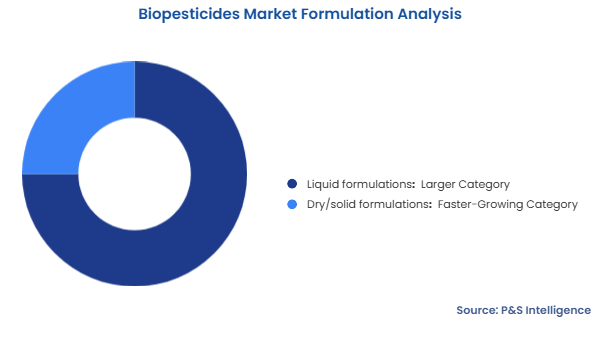
Liquid formulations are the larger category, holding a market share of 75%, because they match the spraying practices already used across commercial farms, orchards, greenhouses, and vegetable fields. Their main advantage is application convenience, as growers can mix, dilute, and apply them through existing equipment without major changes in labour or field operations. Liquid products also support better surface coverage, which is important for foliar bioinsecticides and biofungicides. Their commercial value remains strong because large users need biological products that can be prepared quickly, sprayed evenly, and fitted into existing crop protection schedules without increasing field complexity.
Dry/solid formulations are the faster-growing category, registering a CAGR of approximately 14.7%, because they offer better storage stability, easier transport, and lower handling risk across long agricultural supply chains. These formats are useful for microbial products that must retain activity during distribution and farm-level storage. According to the Food and Agriculture Organisation of the United Nations, the constant-value volume of global agrifood exports increased by 2.5% between 2023 and 2024. The growth of agricultural trade makes these formats more relevant for suppliers and distributors that need biological products with stronger shelf stability, lower spoilage risk, and dependable movement across wider farming networks.
The formulation analysed in this report are:
Liquid formulations (Larger Category)
Dry/solid formulations (Faster-Growing Category)
Application Method Analysis
Seed treatment is the largest category, because it places biological protection directly around the seed and early root zone, where crop establishment risks are highest. This method is commercially attractive because it uses lower product volumes, reduces repeated field applications, and works well with microbial inputs that support early pest and disease defence. According to the Food and Agriculture Organisation of the United Nations, global cereal production is projected to reach approximately 3,036 million tonnes in 2025. The scale of cereal cultivation makes seed treatment commercially important because growers need early-stage protection that uses lower product volumes while improving crop establishment across large and input-intensive grain systems.
Post-harvest application is the fastest-growing category, registering a CAGR of approximately 14.3%, because growers, packers, and exporters need safer ways to protect stored crops, fresh produce, and high-value perishables after harvest. Biological products are becoming useful where chemical residues can affect market access, retailer acceptance, and shelf-life claims. Their adoption is linked with fruits and vegetables, where appearance, microbial spoilage control, and residue compliance are commercially important. The segment is becoming more commercially relevant as packers, exporters, and food suppliers need biological protection that preserves produce quality after harvest while reducing residue concerns in domestic and export channels.
The application methods analysed in this report are:
Fruits and vegetables are the largest category, holding a market share of 35%, because these crops carry higher residue sensitivity, stricter buyer specifications, and greater quality requirements than many broadacre crops. Growers need crop protection products that manage insects, fungal diseases, and spoilage risks while protecting appearance, taste, and export eligibility. Biopesticides fit this need because they can be used within integrated pest management and low-residue production systems. This makes fruits and vegetables a priority segment for biopesticide suppliers, as growers need products that protect marketable quality, meet retailer residue expectations, and support repeat sales across high-value crop cycles.
Turf and ornamentals are the fastest-growing category, because golf courses, landscaping firms, nurseries, parks, and decorative plant growers are shifting toward safer pest and disease control in public and high-visibility spaces. Chemical pesticide use in these areas faces closer scrutiny because applications may occur near people, pets, water bodies, and urban ecosystems. Biopesticides are gaining commercial relevance because they help maintain plant health while supporting sustainability targets. The segment is expanding beyond food agriculture because professional green-space managers need pest control options that protect plant appearance, reduce public exposure concerns, and align with sustainability-led maintenance standards.
The crop type analysed in this report are:
Fruits & vegetables (Largest Category)
Turf & ornamentals (Fastest-Growing Category)
Cereals & grains
Oilseeds & pulses
Plantation crops
Others
End User Analysis
Farmers are the largest category, holding a market share of 40%, because they remain the main decision-makers and users of crop protection products across field-level agriculture. Their adoption is supported by rising awareness of soil health, residue control, and integrated pest management, particularly among small and medium growers. According to global agricultural studies supported by the Food and Agriculture Organisation of the United Nations, approximately 85% of the world’s 570 million farms are smallholdings of less than 2 hectares. This large farmer base creates steady commercial demand for affordable biological inputs that are easy to apply, available through local distribution channels, and practical for routine crop protection decisions.
Commercial growers are the fastest-growing category, because greenhouse operators, large horticulture farms, and export-oriented producers require precise pest management with predictable crop quality. These users are more likely to adopt biopesticides when products support residue compliance, scheduled applications, and compatibility with monitoring-based pest control. Their demand is also connected with fruits, vegetables, and post-harvest handling, where crop appearance and shelf life directly affect selling value. Their faster adoption gives suppliers a premium customer base where biological products can be positioned around residue compliance, crop consistency, scheduled pest control, and higher-value output protection.
The end users analysed in this report are:
Farmers (Largest Category)
Commercial growers (Fastest-Growing Category)
Agricultural cooperatives & distributors
Research & institutional users
Others
Mode of Action Analysis
Bioinsecticides are the largest category, because insect pressure remains a frequent and commercially damaging issue across cereals, fruits, vegetables, oilseeds, and plantation crops. These products are valued for targeted pest control, lower impact on beneficial insects, and compatibility with integrated pest management programmes. Their position is also supported by broad application routes, including foliar spray, seed treatment, and soil application. This gives bioinsecticides a wider commercial base because suppliers can target multiple crops and application routes while helping growers reduce chemical dependency without weakening planned pest control programmes.
Biofungicides are the fastest-growing category, registering a CAGR of approximately 14.5%, because fungal diseases are becoming harder to control under changing weather patterns, humid production conditions, and rising resistance concerns. Growers are using preventive biological disease control to protect fruits, vegetables, cereals, and post-harvest produce without increasing residue pressure. According to a University of Exeter commentary published in Nature, fungal infections cause global crop losses of approximately 10% to 23% annually. This level of crop loss makes biofungicides commercially important for growers who need preventive disease control to protect yield quality, storage value, and marketable output across field and post-harvest systems.
The mode of action analysed in this report are:
Bioinsecticides (Largest Category)
Biofungicides (Fastest-Growing Category)
Bionematicides
Bioherbicides
Drive strategic growth with comprehensive market analysis
Biopesticides Market Regional Outlook
North America Biopesticides Market Analysis
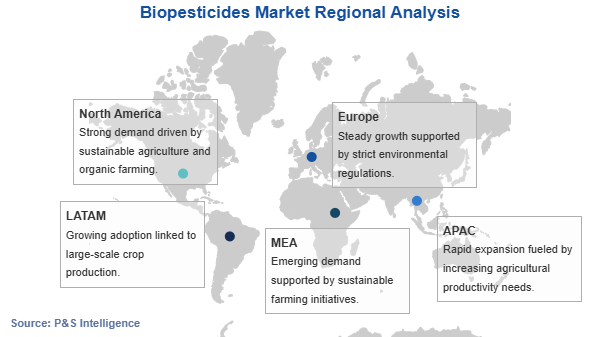
North America holds the largest share, of 40%, because strong regulatory enforcement and early adoption of sustainable farming practices have pushed growers toward biological solutions. The region has a well-established agricultural system where farmers are more aware of residue limits and environmental impact. Large agribusiness firms are actively investing in biopesticide development and partnerships, which support product availability. In addition, advanced distribution networks and advisory services make it easier for farmers to adopt these products. The presence of organised retail and export-oriented farming further strengthens demand for safer crop protection inputs.
U.S. Biopesticides Market Analysis
The United States market is driven by strong regulatory oversight and wider farmer awareness of sustainable crop protection practices. Moreover, growers increasingly use biopesticides within integrated pest management programs supported by ongoing product innovation. According to the United States Department of Agriculture, domestic soybean production reached 4.37 billion bushels in 2024, which reflects the large crop base where advanced biological pest management solutions are becoming increasingly important across commercial farming systems.
Canada Biopesticides Market Analysis
Canada is growing steadily due to a stronger focus on environmentally safe farming practices and supportive sustainability policies across the agricultural sector. Moreover, farmers are adopting biological crop protection to meet both domestic and export quality requirements. According to Statistics Canada, total wheat production rose 6.1% year over year to 35.0 million tonnes in 2024, which is supporting continued demand for practical crop protection solutions across major producing regions.
Asia-Pacific Biopesticides Market Analysis
Asia-Pacific has the highest CAGR, of approximately 14.9%, because farming practices are rapidly changing due to rising food demand and increasing awareness about sustainable agriculture. Many countries in this region are promoting reduced chemical usage to improve soil quality and long-term productivity. Small and medium farmers are gradually adopting biopesticides as they become more accessible and affordable. The region also sees strong government support through training programs and subsidies. In addition, growing export activities are pushing farmers to meet international residue standards, which is accelerating the shift toward biological crop protection.
China Biopesticides Market Analysis
China is supported by strong government efforts to reduce chemical pesticide use and improve food safety standards across large farming regions. Moreover, policy-led training and expanding domestic manufacturing are making biological products more accessible to farmers. According to the State Council of the People's Republic of China, national grain output reached a record 706.5 million tonnes in 2024, which continues to strengthen demand for scalable crop protection solutions across major agricultural provinces.
India Biopesticides Market Analysis
India is growing quickly due to rising farmer awareness of soil health and stronger adoption of low-residue crop protection practices. Moreover, government support for organic farming and the presence of many small-scale growers are expanding demand for affordable biological inputs. According to the Press Information Bureau, foodgrain production reached a record 357.73 million metric tonnes in 2024, which supports continued biopesticide use across large and diverse cropping systems.
Europe Biopesticides Market Analysis
Europe’s biopesticides market is shaped by strict environmental policies and a strong push to reduce chemical pesticide usage. Farmers in this region are under continuous pressure to follow sustainability standards, especially under regional agricultural frameworks. This has led to steady demand for biological alternatives across different crops. The market also benefits from high consumer awareness regarding food safety and organic produce. However, complex approval processes and varying regulations across countries can slow down product launches. Even with these challenges, the shift toward eco-friendly farming continues to support consistent market development.
The regions and countries analysed in this report are:
North America (Largest Regional Market)
U.S. (Larger Country)
Canada (Faster-Growing Country)
Europe
Germany (Largest Country)
U.K. (Fastest-Growing Country)
France
Italy
Spain
Rest of Europe
Asia-Pacific (Fastest-Growing Regional Market)
China (Largest Country)
India (Fastest-Growing Country)
Japan
South Korea
Australia
Rest of APAC
Latin America
Brazil (Largest Country)
Mexico (Fastest-Growing Country)
Rest of LATAM
Middle East and Africa
Saudi Arabia (Largest Country)
U.A.E. (Fastest-Growing Country)
South Africa
Rest of MEA
Biopesticides Market Competitive Landscape
The market is fragmented, with multinational crop protection companies, biological input specialists, and regional manufacturers competing across microbial, biochemical, botanical, and beneficial organism portfolios. The structure remains open because product performance depends heavily on crop type, pest profile, climate, formulation stability, and local registration requirements. Large agricultural input firms have advantages in research capability, regulatory experience, and distribution reach, while smaller companies compete through specialised strains, local agronomy support, and niche crop solutions. This fragmentation is strengthening competition around product reliability, shelf life, field demonstration, and farmer education, as buyers prefer suppliers that can prove consistent performance across commercial farming conditions and integrate biological products into existing crop protection programmes.
Key Players in the Biopesticides Market:
BASF SE
Bayer AG
Syngenta Group Co., Ltd.
Corteva Agriscience
UPL Limited
FMC Corporation
Nufarm Limited
Sumitomo Chemical Co., Ltd.
Bioceres Crop Solutions Corp.
Novonesis A/S
Koppert Biological Systems
Biobest Group NV
Gowan Company LLC
Lallemand Inc.
Andermatt Group AG
Biopesticides Market News
In March 2026, PI AgSciences received U.S. EPA registration for its novel biochemical pesticide PHC68949, a foliar-applied peptide-based solution targeting parasitic nematodes, enabling its introduction to the U.S. market and expanding biological crop protection options.
In February 2026, Seipasa S.A. launched a new biofungicide product designed for foliar application across multiple crops. The product was introduced with fungicidal action based on biological inputs and made available for commercial agricultural use.
In December 2025, Biotalys NV introduced a protein-based biofungicide product after receiving regulatory approval in the United States. The product entered commercial use as part of biological disease control solutions for crops.
Frequently Asked Questions About This Report
What is driving growth in the global biopesticides market?+
The market is growing as farmers adopt biological crop protection to reduce chemical residues, meet sustainability targets, and support integrated pest management programmes.
Which product type holds the largest share in biopesticides market?+
Microbial biopesticides hold a strong position because they offer targeted pest control, broad crop compatibility, and wider commercial use across farming systems.
Why are biochemical biopesticides gaining faster commercial adoption?+
Biochemical biopesticides are growing quickly because they support preventive pest control through pheromones, plant extracts, repellents, and residue-friendly crop protection methods.
Which formulation is most commonly used in biopesticides market?+
Liquid formulations are widely used because they fit existing spraying equipment, allow easier dilution, and support uniform field application across commercial farms.
Why are dry formulations becoming more important for suppliers?+
Dry formulations are gaining demand because they improve shelf stability, reduce spoilage risk, and make biological products easier to transport across distribution networks.
Want a report tailored exactly to your business need?
Leading companies across industries trust us to deliver data-driven insights and innovative solutions for their most critical decisions. From data-driven strategies to actionable insights, we empower the decision-makers who shape industries and define the future. From Fortune 500 companies to innovative startups, we are proud to partner with organisations that drive progress in their industries.
Client Testimonials
Working with P&S Intelligence and their team was an absolute pleasure – their awareness of timelines and commitment to value greatly contributed to our project's success. Eagerly anticipating future collaborations.
McKinsey & Company
India
Unmatched Standards
Our insights into the minutest levels of the markets, including the latest trends and competitive landscape, give you all the answers you need to take your business to new heights
Complete Data Security
We take a cautious approach to protecting your personal and confidential information. Trust is the strongest bond that connects us and our clients, and trust we build by complying with all international and domestic data protection and privacy laws