This Report Provides In-Depth Analysis of the Biofuels Market Report Prepared by P&S Intelligence, Segmented by Form (Solid, Liquid, Gaseous), Product (Biodiesel, Bioethanol, Biogas, Advanced Biofuels, Wood Pellets), Application (Transportation, Aviation, Energy Generation, Heating, Industrial), Feedstock (Food Crops, Non-Food Crops, Vegetable Oils, Waste Material, Algae), and Geographical Outlook for the Period of 2019 to 2032
Explore the market potential with our data-driven report
Biofuels Market Outlook
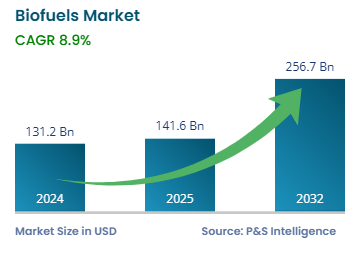
The biofuels market size was USD 131.2 billion in 2024, and it will grow by 8.9% during 2025–2032, to reach USD 256.7 billion by 2032.
The market growth is primarily driven by the rising need to reduce the emission of greenhouse gases and raise energy supply and the rapid shift toward clean energy, particularly in aviation. The market is also influenced by the advances in second-generation and waste-based biofuels, such as algae and agriculture-waste-based biofuels.
As per the International Energy Agency, GHG emissions reached a record high of 37.8 GtCOâ‚‚e in 2024, rising by 0.8% YoY. Emissions from natural gas rose by 80 MtCOâ‚‚e, while those from coal increased by 135 MtCOâ‚‚e. Moreover, as per the EU’s Emissions Database for Global Atmospheric Research, emissions from the transport sector rose the fastest in 2023 from 2022.
The Paris Climate Agreement envisions decreasing global emissions by half by 2030, to restrict global warming to just 1.5 degrees Celsius above pre-industrial levels. Hence, governments across the world are increasing their focus on cleaner sources of energy to limit the consumption of crude oil and natural gas derivatives. Various government initiatives also boost biofuel production. For example, the Renewable Energy Directives II of the EU supply have increased credits for renewable waste fuel usage. Furthermore, the E20 Policy of India targets 20% ethanol blending by 2025. As per the U.S. Department of Energy, the B100 blend could reduce the lifetime CO2 emissions from the transportation sector by 78.3%.
Biofuels Market Emerging Trends
Integration of Biofuels into Carbon Credit and Trading Systems Is Key Trend
The integration of biofuels with national and regional carbon credit systems is the leading trend in the market, as it promotes low-carbon fuel production and usage.
The worldwide market for carbon credit trading platforms was valued at USD 78 billion in 2024, and it is projected to reach USD 362.8 billion by 2030.
Firms produce and trade carbon units, generating new carbon trading avenues that enable faster market penetration.
Brazil's RenovaBio program supplies carbon credits to biofuel producers, depending on the GHG mitigation of their fuels.
Moreover, Brazil is the second-largest producer of ethanol due to the extensive availability of sugarcane and RenovaBio policies.
California's Low Carbon Fuel Standard provides credits for renewable fuel adoption, including biodiesel and SAF, with producers awarded tradable value for decarbonization.
A key way to utilize carbon credits is to capture carbon emissions from industrial processes or directly from the atmosphere, store them temporarily, and use them to produce biofuels.
Increasing Environmental Awareness and Stricter Emission Regulations Are Biggest Drivers
The rising awareness of climate change and ecological degradation is driving both government and consumers towards clean energy options.
This shift has led to strong emission policies in various areas, such as transportation and power generation, many of which focus on the use of biofuels as eco-friendly and low-carbon fuels.
Regulatory bodies are applying carbon reduction targets, vehicle emission standards, and clean fuel policies, which boost biofuel demand.
Various awareness campaigns and decarbonization goals, such as net-zero, are driving industries to switch towards biodiesel, SAF, ethanol, and other low-emission fuels.
The EU's Fit-for-55 climate package aims to minimize GHG emissions by 55% by 2030 and directs higher renewable energy use in transportation.
The U.S. state-level zero-emission vehicle standards and global airline pledges toward net-zero flights also drive the market.
According to reports, more than 130 countries have now committed to reach net-zero emissions by 2050, which boosts the demand for sustainable fuels.
More than 70% of the consumers in Europe support the use of green fuels in transportation due to the rising environmental concerns.
Biofuels Market Segmentation and Category Analysis
Form Analysis
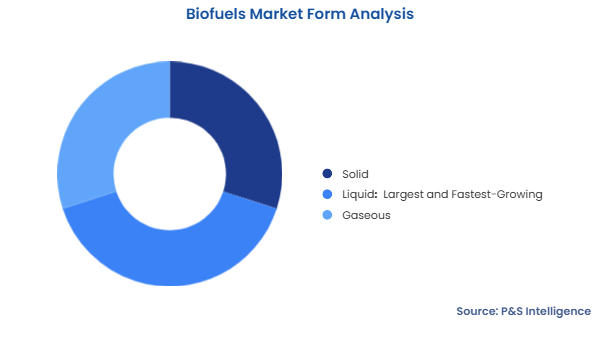
The liquid category held the largest market share, of 40%, in 2024, and it will have the highest CAGR, of approx. 9.5%. This is due to the increasing ethanol and biodiesel requirement in the chemical and mobility sectors and ample availability of infrastructure, such as fuel distribution systems. Biofuels are compatible, i.e., they work better with fuel stations, promoting them as a solution for lower carbon emissions. Additionally, the key application of biofuels currently in transportation, which majorly requires liquid fuels.
The forms analyzed in this report are:
Solid
Liquid (Largest and Fastest-Growing Category)
Gaseous
Product Analysis
The bioethanol category held the largest market share, of 35%, in 2024, due to its broad usage in gasoline blending, especially in the U.S. and India, most prominently the E10 and E20 blends. Major producers include the U.S. and Brazil, using corn and sugarcane, respectively. Ethanol reduces greenhouse gases and enhances energy security, playing a key role in transportation decarbonization, especially in countries with strong agricultural sectors.
The biodiesel category will have the highest CAGR, because of the growing demand for low-emission diesel alternatives and strong government support, including the U.S. Renewable Fuel Standards and Indonesia’s B35 program. Hydrotreated vegetable oil, a type of advanced biodiesel, is gaining popularity due to its engine compatibility and clean emissions. As per studies, over 1,300 gas stations in the U.S. offer biodiesel. Moreover, Indian Railways has already tested and is using various biodiesel blends, such as B10, B5, B50, B20, and B100, in its locomotives.
The products analyzed in this report are:
Biodiesel (Fastest-Growing Category)
Bioethanol (Largest Category)
Biogas
Advanced Biofuel
Wood Pellets
Others
Application Analysis
The transportation category held the largest market share, of 45%, in 2024, due to biofuels' high energy content and smooth integration with conventional engines and logistics systems. This promotes the usage of biofuels in buses, trucks, road vehicles, trains, and shipping. The category is majorly driven by the rising demand for fuel-efficient vehicles, rapid urbanization, and extensive usage of hybrid and alternative fuel vehicles. The strong government support for biofuel blends, such as B20, high-volume production of versatile-fuel vehicles, and rising need to minimize the use of fossil fuels also propels the market.
The aviation category will have the highest CAGR, due to the strict environmental regulations and rising low-carbon footprint goals, such as global SAF initiatives and ICAO’s CORSIA rules. Global airlines, such as Lufthansa and Air France, are partnering for SAF procurement to meet eco-friendly goals. As per the IEA, emissions from the global aviation sector grew faster than those from road, rail, and marine transportation between 2000 and 2019 and quickly reached 90% of their pre-COVID levels.
The applications analyzed in this report are:
Transportation (Largest Category)
Aviation (Fastest-Growing Category)
Energy Generation
Heating
Industrial
Others
Feedstock Analysis
The food crops category held the largest market share, of 50% in 2024, because these crops are widely cultivated, have affordable prices, and are supported by the existing bioethanol network. Corn is the largest producer of ethanol, especially in the U.S., because of its abundant starch, while sugarcane is the key feedstock in Brazil due to its rising export to E27+.
The waste material category will have the highest CAGR, due to the growing sustainability concerns, waste reduction initiatives, and supportive eco-friendly policies, such as the EU’s RED II boosts credit for waste biofuels. These waste materials include cooking oil, animal fats, agricultural residue, and municipal solid waste. Moreover, California’s Low Carbon Fuel Standards support the use of low-carbon fuels obtained from waste materials.
The feedstocks analyzed in this report are:
Food Crops (Largest Category)
Corn
Sugarcane
Non-Food Crops
Dedicated energy crops
Non-food oilseeds
Vegetable Oils
Waste Material (Fastest-Growing Category)
Algae
Others
Drive strategic growth with comprehensive market analysis
Biofuels Market Regional Growth Dynamics
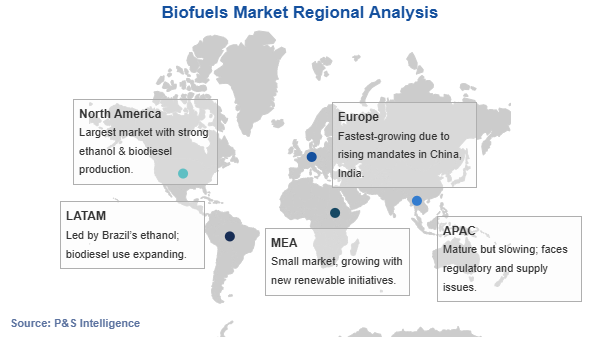
North America held the largest market share, of 35%, in 2024, due to the established biofuel factories in the U.S., high-tech blending systems, and robust policies, such as the Renewable Fuel Standard. The rising biodiesel usage in the transportation and industrial sectors also drive the market. In Canada, approximately 26.3 million vehicles were registered in 2022. As per the International Organization of Motor Vehicle Manufacturers, in the U.S., automotive production increased from 10.47 million units in 2022 to 10.8 million units in 2023.
Asia-Pacific will have the highest CAGR, of 9.5%, due to the rising power consumption, fast urban growth, and strong government support in developing economies. China and India are investing in biofuel production to reduce the reliance on oil imports. Moreover, South Korea and Australia are implementing advanced biofuel policies and encouraging renewable energy consumption. India plans to use 5% biodiesel blends in 2030, which reflects a demand for 5.4 billion liters.
The geographical breakdown of the market is as follows:
North America (Largest Regional Market)
U.S. (Larger Country)
Canada (Fastest-Growing Country)
Europe
Germany (Larger Country)
U.K. (Fastest-Growing Country)
France
Italy
Spain
Rest of Europe
Asia-Pacific (Fastest Regional Market)
China (Largest Country)
India (Fastest-Growing Country)
Japan
South Korea
Australia
Rest of APAC
Latin America
Brazil (Largest and Fastest-Growing Country)
Mexico
Rest of LATAM
Middle East and Africa
Saudi Arabia (Fastest-Growing Country)
South Africa (Larger Country)
U.A.E.
Rest of MEA
Biofuels Market Competitive Landscape
The market is fragmented because of the presence of large regional and global players targeting individual fuel categories and resources. Players such as POET, Valero, and Neste hold a significant share, but no single company dominates the market. Additionally, the rising number of government initiatives worldwide promotes niche and emerging players to take up biofuel production.
Key Biofuel Companies:
Neste Oyj
Archer Daniels Midland Company
POET, LLC
Green Plains Inc.
LanzaJet, Inc.
SkyNRG B.V.
VERBIO Vereinigte BioEnergie AG
Enerkem Inc.
Algenol Biotech, LLC
Gevo, Inc.
GranBio Investimentos S.A.
Delta Fuel Company, L.L.C.
Biofuels Market News
In July 2025, the King Salman International Airport Development Company entered into a memorandum of understanding with Biofuel Company to use B100 biodiesel during the construction of the airport.
In July 2025, QNB Metals Inc. entered into an agreement to acquire ReSolve Energie Inc., which deals in advanced biofuel technologies.
In July 2025, the National Energy Policy Council of Brazil raised the minimum biofuel blending percentage in gasoline to 30% from 27% and in diesel from 14% to 15%.
In October 2024, the U.S. Department of Energy issued a USD 1.46-billion loan for Gevo Inc.’s Net Zero 1 SAG plant in South Dakota, to convert corn starch into carbon-captured jet fuel.
In November 2023, Neste Oyj and PTL Marine collaborated to provide Neste MY renewable diesel to California marine fleets.
In May 2023, Neste Oyj and ITOCHU Corporation signed a licensing agreement to become the official distributor of Neste MY renewable diesel in Japan.
In February 2023, LanzaJet Inc. and Indian Oil Corporation Limited signed an MoU to produce high volumes of SAF using the alcohol-to-jet technology production in India.
Want a report tailored exactly to your business need?
Leading companies across industries trust us to deliver data-driven insights and innovative solutions for their most critical decisions. From data-driven strategies to actionable insights, we empower the decision-makers who shape industries and define the future. From Fortune 500 companies to innovative startups, we are proud to partner with organisations that drive progress in their industries.
Client Testimonials
Working with P&S Intelligence and their team was an absolute pleasure – their awareness of timelines and commitment to value greatly contributed to our project's success. Eagerly anticipating future collaborations.
McKinsey & Company
India
Unmatched Standards
Our insights into the minutest levels of the markets, including the latest trends and competitive landscape, give you all the answers you need to take your business to new heights
Complete Data Security
We take a cautious approach to protecting your personal and confidential information. Trust is the strongest bond that connects us and our clients, and trust we build by complying with all international and domestic data protection and privacy laws