This Report Provides In-Depth Analysis of the Biodiesel Market Report Prepared by P&S Intelligence, Segmented by Feedstock (Vegetable Oils, Animal Oils), Blend (B100, B20, B10, B5), Production Technology (Pyrolysis, Transesterification), Application (Fuel, Power Generation), and Geographical Outlook for the Period of 2021 to 2032
Explore the market potential with our data-driven report
Biodiesel Market Future Prospects
Biodiesel Market Key Insights
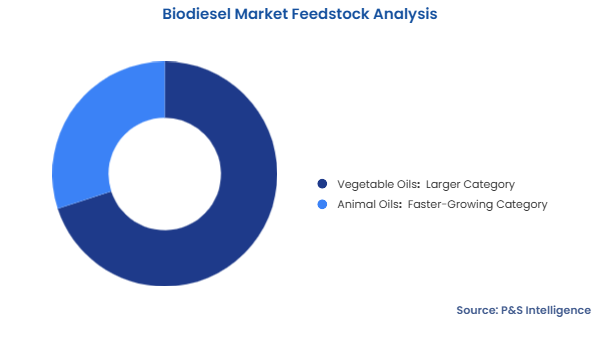
Vegetable oils accounted for the larger share, of 70%, in 2025.
B100 is the fastest-growing category over 2026–2032, registering a CAGR of approximately 8.6%.
Transesterification accounted for the largest share, of 60%, in 2025.
Power generation has the highest CAGR over 2026–2032, of approximately 8.8%.
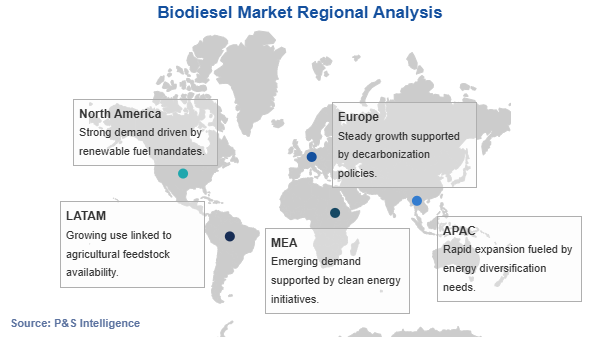
Europe held the largest share, of 40%, in the global biodiesel market in 2025.
Asia-Pacific is the fastest-growing region over 2026–2032, at a CAGR of approximately 8.9%.
Biodiesel Market Overview
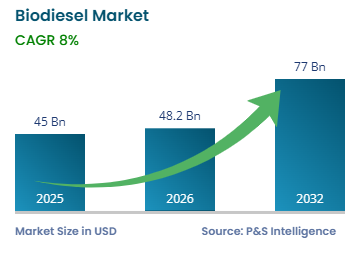
The global biodiesel market stood at USD 45.0 billion in 2025 and is projected to reach USD 77.0 billion by 2032, expanding at a CAGR of 8.0% over 2026–2032. Major market drivers for biodiesel and renewable diesel include government mandates and incentives, rising demand for low-carbon fuels, increasing crude oil prices, growth in transportation and industrial sectors, and sustainability commitments from corporations and fleet operators. Mandatory blending policies and tightening greenhouse gas emission regulations are accelerating demand for low-carbon fuel alternatives in transportation and power generation across both developed and developing economies. The global transition away from fossil-fuel dependence is reinforcing this structural shift.
Biodiesel's viability as a drop-in fuel for compression-ignition engines and its compatibility with existing distribution infrastructure have positioned it as a near-term decarbonization instrument across transport, marine, and power generation sectors. Its capacity to reduce lifecycle greenhouse gas emissions by 50–90% strengthens this case further. Performance-based standards and greenhouse gas thresholds now cover 80% of global biofuel demand, underpinning long-term investment in biodiesel production capacity. Feedstock diversity spanning vegetable oils, animal fats, and waste cooking oils continues to broaden the market's supply base. This broadening supply base also supports circular economy objectives.
Biodiesel Market Emerging Trends & Growth Drivers
Shift toward Waste-Based Feedstocks Is Trending Worldwide
Producers are accelerating their transition from crop-based vegetable oils toward waste-derived inputs, including used cooking oil (UCO) and animal fats. The EU's RED III and the U.S. Renewable Fuel Standard (RFS) both assign enhanced credit multipliers and lower carbon intensity scores to waste-based feedstocks, creating direct financial incentives for producers to prioritize these materials. UCO-derived biodiesel achieves up to 85% lifecycle greenhouse gas savings over fossil diesel, compared to 50–60% for soybean-based alternatives. This makes waste feedstocks the preferred compliance pathway in stringent carbon markets.
The International Energy Agency (IEA) projects that wastes and residues will account for 13% of global biofuel production by 2027, up from 9% in 2021. It also projects that demand for vegetable oil, waste and residue oils and fats will increase by 56% to 79 million tonnes by 2027. Producers with established waste collection infrastructure — particularly in densely populated markets with well-organized food service industries — are gaining structural cost and compliance advantages over crop-dependent competitors. RED III's tightening of crop-based feedstock caps and SAF mandates diverting UCO and animal fats toward aviation will tighten supply and elevate the strategic value of secured waste feedstock networks.
Blending Mandates and Renewable Fuel Standards Drive Market
Mandatory blending regulations legally obligate fuel distributors, refiners, and importers to incorporate specific volumes of biodiesel into conventional diesel supplies each year. These mandates translate directly into guaranteed offtake that underpins production investment, feedstock procurement, and refinery capacity expansion. The RFS administered by the U.S. Environmental Protection Agency (EPA) established biomass-based diesel obligations of 2.76 billion gallons in 2023.
In the European Union, RED III sets a 29% renewable energy target for transport by 2030 with a 14.5% greenhouse gas intensity reduction. National frameworks in Germany, France, and Spain primarily implement greenhouse gas reduction targets and energy-based renewable obligations rather than fixed blending mandates, adding additional compliance requirements for fuel suppliers. Indonesia implemented the B40 biodiesel mandate in 2025, with further expansion toward higher blends such as B50 under policy consideration. International trade measures are also influencing global biodiesel flows, with the European Union imposing anti-dumping duties on biodiesel imports from China in August 2024, tightening access for exporters and reshaping competitive dynamics in international biofuel trade.As blending obligations escalate across the world, biodiesel consumption will continue to surge.
Marine and Aviation Decarbonization Opening New Opportunities
Escalating decarbonization pressure on maritime shipping and aviation is generating significant demand for biodiesel. The International Maritime Organization (IMO)'s 2023 revised greenhouse gas strategy targets net-zero emissions from international shipping by 2050, with interim milestones requiring at least 20% emissions reduction by 2030. This creates an immediate compliance demand for biodiesel blends as the only commercially available drop-in fuel for existing marine diesel engines at scale. The EU's FuelEU Maritime regulation mandates a 2% greenhouse gas intensity reduction from shipping fuel, rising to 80% by 2050.
The EU ReFuelEU mandates require 2% sustainable aviation fuel by 2025, rising to 70% by 2050. The HEFA-pathway biodiesel represents the most commercially scalable near-term SAF production route. International Maritime Organization sulfur regulations 0.5% cap 2020 accelerated the shift to low sulfur marine fuels while biofuels are being gradually explored for decarbonization. These emerging applications command premium pricing relative to road transport biodiesel, creating margin improvement potential for producers capable of meeting marine and aviation fuel specifications. As these hard-to-abate sectors face escalating regulatory timelines, demand from marine and aviation applications is projected to surge further.
Feedstock Price Volatility and Supply Constraints Limit Market Growth
Feedstock costs represent 60–80% of total biodiesel production expenses. This makes the market acutely vulnerable to agricultural commodity price cycles, geopolitical supply disruptions, and escalating competition for limited waste oil and fat supplies from multiple biofuel production pathways. Vegetable oil feedstocks — soybean oil, rapeseed oil, and palm oil — are subject to weather-related crop yield variability, export policy changes, and competing demand from the food industry. These conditions create recurring periods where biodiesel production economics deteriorate significantly against conventional diesel.
Rapidly scaling HVO and sustainable aviation fuel industries are driving up UCO and tallow prices and compressing biodiesel production margins in markets without policy support. These structural cost pressures moderate market growth and push marginal producers toward consolidation or exit. This dynamic is particularly pronounced in markets lacking stable long-term policy frameworks that offset feedstock cost volatility through guaranteed demand economics.
Biodiesel Market Segmentation Analysis
Feedstock Analysis
Vegetable oils accounted for the larger share, of 70%, in the global biodiesel market in 2025. Agronomic, economic, and infrastructural advantages that no competing feedstock category has yet replicated at comparable scale underpin this position. Soybean oil leads production in the United States and Brazil, rapeseed oil dominates European supply chains, and palm oil anchors output across Indonesia, Malaysia, and Thailand. U.S. Energy Information Administration (EIA) data confirms that vegetable oils comprise three-quarters of total biodiesel feedstock in the United States, with established crushing infrastructure enabling consistent supply.
High lipid content and superior conversion efficiency during transesterification make edible vegetable oils the default choice among mainstream biodiesel producers operating under volume-driven mandate compliance frameworks. Their compatibility with existing production equipment reinforces this preference. Non-edible oils, including jatropha and Pongamia, are used in India and select Southeast Asian markets, but consumption is constrained by agronomic yield limitations and underdeveloped collection infrastructure.
Animal oils are the faster-growing category over 2026–2032, registering a CAGR of approximately 8.3%. Their superior emission reduction profile and regulatory preference under advanced biofuel classification frameworks are driving this trajectory. European Union Annex IX Part B feedstocks such as tallow, poultry fat, and lard, can contribute to renewable transport targets, with incentives like double counting depending on national implementation.
EU-based producers are accelerating the shift away from palm oil under RED III sustainability requirements. Poultry fat is gaining traction in North America and the UK, where high-volume poultry processing provides sufficient feedstock for commercial-scale refining. Tallow remains the most widely used animal fat globally due to its established rendering infrastructure and predictable fatty acid methyl ester conversion yields.
The market segments into the following feedstocks:
Vegetable Oils (Larger Category)
Edible
Non-edible
Animal Oils (Faster-Growing Category)
Poultry
Tallow
Lard & White Greases
Blend Analysis
B20 accounted for the largest share, of 45%, in the global biodiesel market in 2025. Its optimal environmental performance, engine compatibility, and regulatory mandate alignment underpin this position. The blend delivers measurable reductions in particulate matter, carbon monoxide, and unburned hydrocarbons compared to conventional diesel, while remaining within OEM-approved specifications for most commercial diesel engines without modification. California Air Resources Board assigns credits under the Low Carbon Fuel Standard based on carbon intensity reduction, while Brazil National Agency of Petroleum Natural Gas and Biofuels sets decarbonization targets for fuel distributors through carbon intensity–based CBIO credits, with biodiesel blending levels regulated separately under national fuel policy. Fleet operators across road transport, construction, and agriculture favor B20 for its compatibility with existing fuel management systems and predictable performance across seasonal temperature ranges.
B100 is the fastest-growing category over 2026–2032, registering a CAGR of approximately 8.6%. Stringent climate mandates, improving cold-flow additive technology, and growing deployment in dedicated fleet operations where engine modification economics are favorable are driving this trajectory. B100 eliminates petroleum diesel content entirely, delivering the maximum lifecycle carbon reduction available under current biodiesel technology. It can achieve up to about 86% lifecycle greenhouse gas savings compared to fossil diesel depending on feedstock and production pathway.
Several Nordic countries have implemented B100-compatible fleet policies for public transport, while the UK's Renewable Transport Fuel Obligation increasingly rewards high-percentage blends. U.S. EPA data confirms that B100 achieves the highest GHG reduction coefficient of all biomass-based diesel pathways. This positions it as the strategic growth segment as corporate net-zero commitments translate into procurement specifications requiring maximum carbon intensity reductions from fleet fuel suppliers.
The market segments into the following blends:
B100 (Fastest-Growing Category)
B20 (Largest Category)
B10
B5
Production Technology Analysis
Transesterification accounted for the largest share, of 60%, in the global biodiesel market in 2025. Decades of commercial deployment, well-understood process chemistry, lower capital requirements than hydrotreating alternatives, and universal feedstock compatibility across vegetable oils and animal fats underpin this position. The transesterification process converts triglycerides with methanol in the presence of a base catalyst — typically sodium or potassium hydroxide — to yield fatty acid methyl esters (FAME), alongside glycerol as a value-added co-product. Advancements in heterogeneous catalysts, enzymatic transesterification, and process intensification technologies are improving yields and reducing methanol consumption, extending the competitive lifespan of this pathway against emerging alternatives.
Recent research developments are further enhancing process efficiency. A study by the University of California, Santa Cruz demonstrated a novel method for producing biodiesel from waste oil under milder heat conditions, significantly reducing energy consumption and production costs. Such innovations are expected to improve the economic viability of waste-based biodiesel production.
Pyrolysis is the fastest-growing category over 2026–2032. Thermal cracking of organic materials via pyrolysis produces bio-oil intermediates that can be upgraded into biodiesel and co-products, including biochar and syngas. This process accepts lignocellulosic biomass, municipal solid waste, and low-grade agricultural residues that transesterification cannot process directly. This feedstock flexibility addresses the supply constraint facing the biodiesel industry as competition for premium waste oils and fats intensifies. As waste feedstock supply approaches utilization limits and sustainability certification costs for conventional feedstocks rise, demand for pyrolysis-derived biodiesel will rise.
The market segments into the following production technologies:
Pyrolysis (Fastest-Growing Category)
Transesterification (Largest Category)
Others
Application Analysis
Fuel accounted for the largest share in the global biodiesel market in 2025. Virtually every national blending mandate and renewable fuel standard is designed to deliver biodiesel into the road transport diesel pool, making fuel the structurally dominant application. Automobile applications represent the largest sub-application within fuel, sustained by mandatory blending obligations in the EU, U.S., Brazil, Indonesia, and India that make biodiesel a non-discretionary component of the diesel supply chain. Road transport blending mandates constitute the primary policy instrument driving biodiesel offtake across all major producing regions.
Marine applications are gaining traction as IMO's sulfur cap and GHG reduction targets drive vessel operators toward biodiesel blends as compliant, drop-in low-sulfur alternatives. Agricultural applications benefit from off-road diesel mandates and farm equipment operator interest in domestic fuel alternatives that reduce exposure to fossil diesel price volatility.
Power generation is the fastest-growing category over 2026–2032, registering a CAGR of approximately 8.8%. Electricity grid reliability constraints in emerging markets across Asia-Pacific, Africa, and Latin America are creating sustained demand for alternative fuels with lower carbon intensity, expanding biodiesel's deployment in off-grid and backup power systems. Biodiesel-fired generators running B20 and B100 are deployed in remote industrial operations, telecommunications infrastructure, hospital backup systems, and mining sites where grid connectivity is unreliable or absent. As governments in high-growth markets integrate renewable energy mandates into off-grid and distributed generation policy frameworks, biodiesel is positioned alongside solar and battery storage as a complementary dispatchable generation technology.
As per the World Resources Institute, the energy sector is the largest source of global greenhouse gas emissions, accounting for about 75.7% of total emissions, with electricity and heat production contributing approximately 29.7% of global emissions. Studies on oil‑fired power plants in Indonesia showed that switching to a 30 % biodiesel mix reduced SO₂, CO, and particulate emissions compared with pure diesel combustion.
The market segments into the following applications:
Fuel (Largest Category)
Automobile
Marine
Agricultural
Others
Power Generation (Fastest-Growing Category)
Others
Drive strategic growth with comprehensive market analysis
Biodiesel Market Geographical Analysis
Europe Biodiesel Market Outlook
Europe held the largest share, of 40%, in the global biodiesel market in 2025. A multi-decade policy architecture underpins this position. The EU's RED III mandates increasing renewable content in transport fuels, while individual member states enforce national blending obligations that create guaranteed offtake volumes for biodiesel producers. Germany, France, and Spain collectively account for more than half of EU biodiesel production, benefiting from extensive rapeseed cultivation that supplies the region's primary feedstock.
RED III sustainability certification requirements are driving a structural shift toward used cooking oil and animal fats, which carry double-counting status and superior carbon intensity profiles. The European Environment Agency reports that the transport sector accounts for around one-quarter of the EU’s total greenhouse gas emissions, making it a key focus area for decarbonisation efforts, including the adoption of low-carbon fuels such as biodiesel.
Germany Biodiesel Market Growth
Germany leads the European market, anchored by the highest biodiesel production capacity on the continent and a well-integrated supply chain linking domestic rapeseed cultivation with large-scale refining operations. The country exported 1.7 million tonnes of biodiesel in the first half of 2024 alone, reflecting both production scale and export competitiveness. Germany's blending mandate and carbon pricing framework provide producers with revenue certainty, while ongoing investment in HVO infrastructure expands availability.
United Kingdom Biodiesel Market Forecast
The United Kingdom is the fastest-growing market in Europe over 2026–2032. Used cooking oil comprises 75% of domestic biodiesel production, aligning with the UK's advanced biofuel policy framework that double-counts waste-derived fuels toward renewable transport targets. The Renewable Transport Fuel Obligation (RTFO) mandates increasing renewable fuel content annually, creating a reliable demand signal for producers. Post-Brexit, the UK has tightened its biofuel blending requirements with specific provisions supporting waste and residue feedstocks. The UK Department for Energy Security and Net Zero has reinforced biofuel support through carbon budgets and continues to treat biodiesel as a critical near-term decarbonization tool for heavy transport.
Asia-Pacific Biodiesel Market Expansion
Asia-Pacific is the fastest-growing regional market over 2026–2032, registering a CAGR of approximately 8.9%. Government-led blending mandates and production support are the primary structural drivers. India’s biodiesel ecosystem is supported by the FSSAI-led RUCO initiative for used cooking oil collection, while oil marketing companies are expanding biodiesel procurement under national biofuel blending mandates.
Southeast Asia's abundant palm oil production infrastructure creates a structural low-cost feedstock advantage that accelerates production economics across the region. Indonesia and Malaysia together account for around 80–85% of global palm oil production, making them the dominant global producers. The IEA identifies Indonesia, India, and China as the primary drivers of global biofuel demand projections through 2030. The global palm methyl ester derivatives market is projected to grow from approximately USD 2.1 billion in 2025 to about USD 3.3 billion by 2032, driven, in part, by the rising biodiesel consumption in APAC.
China Biodiesel Market Trends
China is the largest market within Asia-Pacific. The government's dual-carbon policy framework targeting carbon neutrality by 2060 directs investment toward biodiesel from waste cooking oil and animal fat feedstocks. In 2023, the Chinese government introduced tax incentives specifically for biodiesel produced from recycled sources. This has accelerated capacity development in Tier 1 and Tier 2 cities, where waste cooking oil collection infrastructure is most mature.
Biofuel companies are investing in large-scale facilities to convert used cooking oil into biodiesel and sustainable aviation fuel (SAF), driven by tightening decarbonisation mandates and rising demand for low-carbon fuels. The National Development and Reform Commission (NDRC) has incorporated biodiesel into China's 14th Five-Year energy plan, confirming long-term institutional support for renewable fuel expansion in the world's second-largest transport fuel market.
India Biodiesel Market Dynamics
India is the fastest-growing market in Asia-Pacific over 2026–2032. The government's National Biofuel Policy targets 5% biodiesel blending with diesel by 2030, using locally available non-edible oils, used cooking oil, and short-rotation energy crops. The state-run Indian Oil Corporation has launched large-scale biodiesel procurement tenders, targeting 200 million liters per quarter to supply freight transport networks. The Government of India, under the National Policy on Biofuels, is promoting biodiesel production through blending targets, procurement guidelines, and financial support mechanisms, with oil marketing companies facilitating biodiesel integration into the transport fuel pool.
North America Biodiesel Market Analysis
North America's biodiesel market is anchored by government blending mandates and tax incentives across the U.S. and Canada. The U.S. RFS and provincial standards in Canada create stable consumption requirements and encourage producers and fleets to adopt biodiesel blends. Regulatory pressure to reduce emissions is driving uptake in heavy-duty trucking, municipal fleets, and logistics, where biodiesel's lower carbon intensity over fossil diesel is a direct compliance advantage. Agricultural feedstock availability across soybean, canola, and waste oils, combined with rising corporate ESG commitments, is broadening biodiesel use across road transport and industrial applications.
The report covers the following regions and countries:
North America
U.S. (Largest Country Market)
Canada (Fastest-Growing Country Market)
Europe (Largest Region)
Germany (Largest Country Market)
U.K. (Fastest-Growing Country Market)
France
Italy
Spain
Rest of Europe
Asia-Pacific (Fastest-Growing Region)
China (Largest Country Market)
India (Fastest-Growing Country Market)
Japan
South Korea
Australia
Rest of APAC
Latin America
Brazil (Largest Country Market)
Mexico (Fastest-Growing Country Market)
Rest of LATAM
Middle East & Africa
Saudi Arabia (Largest Country Market)
South Africa
U.A.E. (Fastest-Growing Country Market)
Rest of MEA
Biodiesel Market Competitive Landscape
The global biodiesel market exhibits a moderately fragmented competitive structure, with a large number of regional and national producers operating alongside a smaller tier of multinational integrated players with cross-border production and distribution capabilities. Feedstock availability is geographically concentrated, blending mandates are nationally defined, and production infrastructure can be established at relatively modest capital thresholds compared to petroleum refining. These conditions enable a diverse producer base to coexist across markets, and no single company commands a globally dominant share.
The competitive landscape divides into two structural tiers. Commodity-oriented producers optimize for feedstock cost and volume, while sustainability-differentiated players target premium regulatory credit markets through low-carbon intensity waste and residue feedstocks. The European market's structure is distinguished by policy-driven producers operating under national mandate frameworks. SAF mandates diverting waste feedstocks from biodiesel will intensify competitive dynamics, forcing producers to either secure long-term supply agreements or develop capabilities in alternative advanced feedstock pathways to maintain production economics.
Key Players in the Biodiesel Market:
Neste Corporation
Renewable Energy Group Inc.
Archer-Daniels-Midland Company
Cargill Incorporated
Louis Dreyfus Company B.V.
Bunge Limited
TotalEnergies SE
BP p.l.c.
Wilmar International Limited
Verbio Vereinigte BioEnergie AG
Eni S.p.A.
Glencore plc
Chevron Corporation
Shell plc
Valero Energy Corporation
Marathon Petroleum Corporation
Greenergy International Ltd.
World Energy LLC
China Petrochemical Corporation
Indian Oil Corporation Ltd.
Phillips 66
Petroliam Nasional Berhad (PETRONAS)
ConocoPhillips
Exxon Mobil Corporation
Muenzer Bioindustrie GmbH
Delta American Fuel LLC
Biodiesel Market News
In April 2025, Neste Corporation raised its renewable aviation fuel production capacity to 1.5 million tonnes per annum and announced the planned expansion of its Rotterdam renewable diesel and sustainable aviation fuel facility by 2027, targeting total renewable product output exceeding 5.5 million tonnes per year. The Rotterdam expansion positions Neste to supply high-volume waste-based HEFA and biodiesel into European compliance markets under RED III advanced biofuel sub-targets.
In April 2025, Vast Infraestrutura and Be8 signed a memorandum of understanding to develop a biodiesel supply hub for the maritime industry at the Port of Açu in Rio de Janeiro, which handled over 7,300 ship calls in 2024. The partnership targets IMO-compliant marine biodiesel bunkering services, responding to escalating sulfur cap and GHG intensity regulations governing international shipping.
Frequently Asked Questions About This Report
What will be the biodiesel market 2032 size?+
In 2032, the market for biodiesel will value USD 77.0 billion.
Which application leads the biodiesel industry?+
Fuel dominates the biodiesel industry with 60% revenue.
Which is the largest region in the biodiesel market?+
Europe is the largest biodiesel market, with 40% share.
What are the key biodiesel industry drivers?+
The global biodiesel industry is driven by government mandates and incentives, rising demand for low-carbon fuels, increasing crude oil prices, growing transportation and industrial sectors, and sustainability commitments from corporations and fleet operators.
What is the biodiesel market nature?+
The market for biodiesel is moderately fragmented.
Want a report tailored exactly to your business need?
Leading companies across industries trust us to deliver data-driven insights and innovative solutions for their most critical decisions. From data-driven strategies to actionable insights, we empower the decision-makers who shape industries and define the future. From Fortune 500 companies to innovative startups, we are proud to partner with organisations that drive progress in their industries.
Client Testimonials
Working with P&S Intelligence and their team was an absolute pleasure – their awareness of timelines and commitment to value greatly contributed to our project's success. Eagerly anticipating future collaborations.
McKinsey & Company
India
Unmatched Standards
Our insights into the minutest levels of the markets, including the latest trends and competitive landscape, give you all the answers you need to take your business to new heights
Complete Data Security
We take a cautious approach to protecting your personal and confidential information. Trust is the strongest bond that connects us and our clients, and trust we build by complying with all international and domestic data protection and privacy laws