This Report Provides In-Depth Analysis of the Biodegradable Plastics Market Report Prepared by P&S Intelligence, Segmented by Resin Type (Polylactic Acid, Polyhydroxyalkanoate, Polybutylene Adipate Terephthalate, Polybutylene Succinate), End Use (Packaging, Agriculture, Consumer Goods, Textiles), Source (Corn, Microbial/Fermentation, Sugarcane, Cassava, Cellulose, Vegetable Oil), and Geographical Outlook for the Period of 2021 to 2032
Explore the market potential with our data-driven report
Biodegradable Plastics Market Outlook
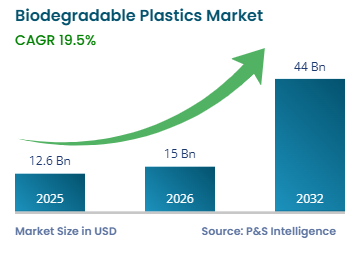
The biodegradable plastics market size was USD 12.6 billion for 2025, and it will grow by 19.5% during 2026–2032, to reach USD 44.0 billion by 2032.
The increased use of biodegradable materials is attributed to the establishment of new regulatory frameworks banning the use of non-biodegradable materials and an increase in commitment by companies to sustainable packaging practices. Further, the increased availability of facilities for industrial composting and organic waste treatment allows for a safe end-of-life for biodegradable materials.
The UNEP has estimated that over 400 million tonnes of plastic waste are generated globally every year. The organization further emphasizes urgency in policy development to drive consumers’ switch to biodegradable materials to replace conventional plastics in regulated markets. This shift in the regulatory and commercial environment has led to an increase in the production capacity of bioplastics. The European Bioplastics Association reports that the global bioplastic production capacity reached 2.3 million tonnes in 2025, and it is expected to double to around 4.7 million tonnes by 2030.
However, the availability of industrial composting and organic waste processing infrastructure remains uneven across regions, which continues to influence adoption rates and effective end-of-life outcomes for biodegradable plastics in emerging markets.
Key Market Insights
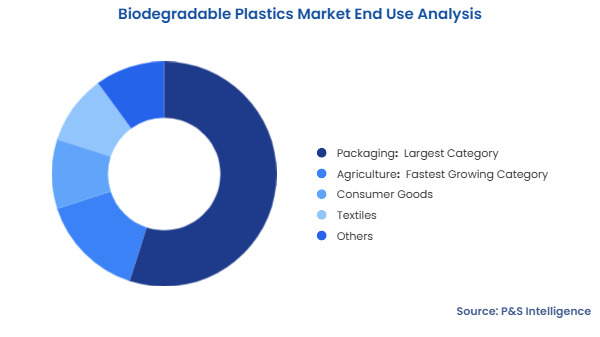
Packaging is the largest end-use segment, driven by demand for compostable films, bags, and rigid packaging.
Polylactic acid (PLA) represents the largest resin type with a share of 45%, supported by large-scale commercial production and broad application suitability.
Corn and sugarcane remain the dominant feedstock sources, reflecting strong availability and established fermentation infrastructure.
Asia-Pacific is the fastest-growing regional market, with a CAGR of 19.6%, during the forecast period.
Germany is the largest country in Europe biodegradable market.
Biodegradable Plastics Market Emerging Trends
Material Innovation and Performance Enhancement Are Key Trends
Advances in material sciences have dramatically improved the physical properties of biodegradable plastics, allowing them to be substituted for traditional petroleum-based plastics across applications, including those requiring barriers, mechanical or thermal requirements. Biodegradable PHA has shown marine biodegradation, as well as equivalent barrier properties to LDPE films. Thus, it is suitable for fresh produce packaging applications where shelf-life is dependent on moisture control and respiration management.
PBAT formulations resistant to heat above 80°C will maintain their dimensional stability. Therefore, these bioplastics can be used in hot-fill beverage applications and microwave-safe food service containers, which were previously beyond the capability of other biodegradable materials, without significant loss of performance. Biodegradable catalysts and compatibilizers made from enzymes will enable formulators to create multi-biopolymer blends, thereby reducing cost through the blending of less-expensive starch carrier materials with high-performance PLA or PHA modifiers. This will provide both mechanical strength and hydrophobicity.
The Indian government banned certain single-use plastic items in July of 2022, which led to a significant increase in the development of innovative materials. The Central Pollution Control Board (CPCB) reported that single-use plastic products have received certification from IS/ISO 17088. This increases the demand for biodegradable products that will provide enhanced performance characteristics, such as higher heat resistance, greater strength, and compliance with food contact requirements, in high-volume food service and packaging applications.
Moreover, regulatory actions throughout the Middle East and Africa are leading to an increasing number of certifications of biodegradable and compostable plastics for packaging and consumer goods. Most prominent among them are the regulations in the UAE and the SASO Technical Regulations in Saudi Arabia. These regulations are also driving the development of biodegradable formulations that can withstand high ambient temperature and prolonged outdoor exposure, especially in food service packaging and agricultural applications. Countries in Latin America, including Brazil, Chile, and Colombia, have imposed national and local level bans on plastic bags and packaging and therefore have rapidly increased the use of biodegradable plastics in retail and agricultural uses.
Regulatory Frameworks and Plastic Restrictions Are Biggest Drivers
Legislations prohibiting the use of conventional plastics create an immediate need for alternative products in grocery stores, restaurants, and institutions as long as they are priced competitively. This is why the European Union Single-Use Plastics Directive has already prohibited all retailers from selling single-use plastic plates, cups, straws, knives, forks, spoons, and expanded polystyrene food containers and use affordable substitutes since July 2021. The EU targets to eliminate petroleum-based products from hundreds of thousands of restaurants, cafes, take-away shops, as well as schools and other institutions serving approximately 450 million people in the EU.
Extended producer responsibility (EPR) regulations and/or mandates accompanying these bans require the manufacturers of beverage bottles and other packaging types to pay for recycling programs and public education programs. This provides economic advantages to those manufacturing packaging that can be processed in standard municipal composting programs versus those made from petroleum, which must be recycled through specialized mechanical processes.
The National Development and Reform Commission of China has established a series of regulations and updated those from 2020 to 2025 banning single-use plastic bags in large cities, prohibiting national plastic straw and cotton swab use, and limiting urban food service establishments’ non-biodegradable plastic tableware. This affected the purchasing decisions of over 300 million people in tier-1 and tier-2 municipalities.
The SB 1383 organic waste regulation of California requires jurisdictions to purchase compostable products for public events and public facilities. It also mandates separate collection for organic waste, which includes certified compostable packaging, providing structure for off-take in the Los Angeles, San Francisco, and San Diego metropolitan areas. These regulatory interventions serve as market-making functions, creating minimum demand floors outside of voluntary corporate sustainability commitments. This also provides revenue certainty to justify capital expenditures for fermentation capacity, polymerization infrastructure, and converting equipment for materials providers and packaging manufacturers.
Regulatory alignment is similarly developing in Japan, South Korea, and other parts of Southeast Asia, with the government procurement and municipal waste policies increasingly favoring certified compostable materials for food service and public-use applications.
The polylactic acid category holds the largest market share, of 45%, in 2025, due to well-established commercial scale production facilities in Nebraska (NatureWorks, 150,000 tonnes per year) and Thailand (Total Corbion PLA, 75,000 tonnes per year). These plants provide a stable volume of raw materials not available in newer polymers and capability to produce high quantities to meet the growing demand. The ability of PLA to be processed on conventional polyethylene and polypropylene processing lines eliminates the need for new converting equipment for manufacturers wanting to introduce biodegradable products into their product line. This removes one of the most significant barriers to adopting biodegradable alternatives to petrochemical based plastics.
Regulatory approvals, such as U.S. FDA GRAS designation and European Union Regulation 10/2011 listing, assure compliance for material used to package foods that generate over 50% of all PLA consumed. Further, clear visual properties similar to PET enable transparent packaging (e.g., clamshells and bottles), which influences consumer purchase decisions. According to the U.S. FDA Food Contact Substance Notifications (FCNs) issued since 2002, PLA has retained its Generally Recognized as Safe (GRAS) status for food packaging applications. This allows for large-scale commercialization of PLA-based packaging solutions without additional regulatory approval processes.
The polyhydroxyalkanoate category will have the highest CAGR, of 19.7%, as marine biodegradability certification expands its application from terrestrial composting to fishing nets, agricultural mulches, and one-time use products discarded in waterbodies. Bioreactor production processes of microbial fermentation utilizing waste vegetable oils or other industrial wastes as a source of carbon are consistent with circular economy requirements. They also do not compete with food crop production for starch-based polymer development in areas that prioritize their agricultural lands for nutritional security.
The expansion of commercial-scale PHA production in China, Southeast Asia and North America is targeted at disposable containers used by the food service industry and flexible packaging. Here, compostable certification provides a competitive advantage over mechanically recycled products without end-of-life recycling facilities in most markets.
The resin types analyzed in this report are:
Polylactic Acid (Largest Category)
Polyhydroxyalkanoate (Fastest Growing Category)
Polybutylene Adipate Terephthalate
Polybutylene Succinate
Others
End Use Analysis
The packaging category holds the largest market share, of 55%, in 2025, due to the substitution of petroleum-based films, containers, and protective materials with compostable products. This helps food service operators, e-commerce retailers, and consumer packaged food companies meet the requirements for participation in municipal organic waste collection programs. The quick-service industry’s transition from disposable items, such as cutlery, straws, and clamshell containers in non-compostable formats, to certified compostable formats creates continuous market growth in North America.
Retailers in Europe are switching to compostable produce bags and fresh food trays to address EPR regulations that allocate costs associated with disposal at end-of-life to suppliers of packaging. According to the European Commission, packaging is the main driver of plastic demand in Europe, accounting for approximately 40% of all plastic demand. Therefore, packaging is the primary target of regulatory actions and material substitution efforts within food, retail, and e-commerce value chains.
The agriculture category will have the highest CAGR, of 19.8%, because of the increasing demand for biodegradable mulch films in APAC, as well as the Mediterranean region's vegetable and fruit growers that are experiencing high enough manual post-harvest labor costs relative to conventional polyethylene films to make them economically unfeasible. Biodegradable twine, plant clips, and irrigation tubing in greenhouses reduce the amount of sorting labor required, while allowing crop residue and plastic materials to be co-composted. This addresses the waste management issues associated with protected cultivation systems that produce tomatoes, cucumbers, and peppers across the Netherlands, Spain, and Turkey.
The end uses analyzed in this report are:
Packaging (Largest Category)
Agriculture (Fastest Growing Category)
Consumer Goods
Textiles
Others
Source Analysis
The corn category holds the largest market share in 2025, due to an established wet-mill infrastructure in the Midwestern United States and Northeastern China. It produces a steady stream of dextrose at a price equivalent to commodity prices from facilities originally built for the food and industrial starch market. U.S.-based producers have access to large quantities of domestic corn production, around 378.27 Million metric tonnes in 2024–25, as per the USDA. This ensures feedstock availability with no reliance on imports.
The microbial/fermentation category will have the highest CAGR. PHA production from wastes, e.g., vegetable oils, industrial glycerol, methane, and lignocellulosic hydrolysate, eliminates the food versus fuel controversy, limiting first-generation bio-polymer products. Microbial strains developed through genetic engineering can convert methane from landfill gases, biogas digestors, and natural gas into PHA. This reduces greenhouse gas emissions through carbon sequestration while providing biodegradable polymers, thereby linking PHA manufacturing with climate change abatement strategies.
The sources analyzed in this report are:
Corn (Largest Category)
Microbial/Fermentation (Fastest Growing Category)
Sugarcane
Cassava
Cellulose
Vegetable Oil
Others
Drive strategic growth with comprehensive market analysis
Biodegradable Plastics Market Regional Outlook
Europe Biodegradable Plastics Market Size
Europe holds the largest market share, of 40%, in 2025, as a result of its comprehensive regulatory structure designed to address plastic waste and promote biodegradable alternatives. By July 2021, all EU member states had passed legislation implementing the European Union Single-Use Plastics Directive, which restricts the use of single-use disposable plastic products, such as cutlery, plates, straws, and expanded polystyrene food containers when there is an available sustainable alternative. Through the use of lifecycle assessments and certified compostability labels, Europe provides clarity and a reduced risk for companies transitioning from non-biodegradable packaging materials to biodegradable materials.
Germany Biodegradable Plastics Market Size
Germany leads the European biodegradable plastics market through its well-developed recycling and organic waste treatment infrastructure, combined with strict packaging regulations. Additionally, a significant amount of government funding is supporting circular production technology in manufacturing. Also, Germany leads in the enzymatic breakdown of polymers. A law in Germany called VerpackG dictates that packaging must be made with a certain percentage of post-consumer recycled material. It also mandates the payment of a fee to participate in an Extended Producer Responsibility program for companies that do business in Germany.
This fee structure penalizes products that are non-recyclable and/or non-compostable as compared to recyclable/compostable products, thereby forcing buyers into purchasing those products that can fit into current waste management processes. In 2022, there were 818 composting facilities located in Germany, which processed green and biowaste; and 286 anaerobic digestion plants in Germany that treated biowaste streams. The strong base of composting and anaerobic digestion facilities in Germany provides the framework to process large amounts of biodegradable organic waste and support a pathway to the end of life of certified industrially compostable materials.
Asia-Pacific Biodegradable Plastics Market Size
Asia-Pacific will have the highest CAGR, of 19.6%, driven by the Chinese Government's broad restrictions on non-biodegradable single use plastics, expansion of China's manufacturing base, and government contracts requiring the use of bio-based products by the public sector. Beginning in 2020 and continuing through 2025, the National Development and Reform Commission has banned single-use plastic bags and tableware in many Chinese cities, and prohibited the national use of disposable plastic straws and cotton swabs. This creates an immediate need for replacement product across packaging, food service, and personal care.
China-based manufacturers, such as China BBCA Group, Zhejiang Hisun Biomaterials, and Anhui Fengyuan Group, are increasing their combined fermentation and polymerization capacity to supply both domestic and other regional Asia-Pacific countries. The growing e-commerce sector in India, Indonesia, Thailand, and Vietnam is also leading to increased usage of biodegradable mailer envelopes, protective packing materials, e.g., bubble wrap, and insulated shipping containers for the delivery of fresh and frozen foods. Online grocery and meal kit companies are now requiring their suppliers to utilize compostable materials in order to enhance their "green" image.
China Biodegradable Plastics Market Size
China has the highest growth rate in the Asia-Pacific biodegradable plastics market, due to the government action to reduce plastic use at a national level, state-supported development of manufacturing infrastructure for bio-based materials, and large-scale expansion of manufacturing capacity for bioplastics. In 2020, the National Development and Reform Commission and Ministry of Ecology and Environment banned single-use plastic items, starting with larger municipalities and gradually increasing to counties and municipalities. The banned items that include, but are not limited to, retail shopping bags, tableware, hotel amenities, and express delivery packaging.
Luckin Coffee, Haidilao, and Meituan-Dianping have made their disposable cups, cutlery and delivery containers out of compostable products to meet Chinese national standards for compostable products (GB/T 20197 & GB/T 19277). This is a response to government regulation and consumer preferences that were influenced by environmental campaigns via social media.
The regions and countries of the market are as follows:
North America
U.S. (Larger and Faster-Growing Country Market)
Canada
Europe (Largest Regional Market)
Germany (Largest Country Market)
U.K. (Fastest-Growing Country Market)
France
Italy
Spain
Rest of Europe
Asia-Pacific (Fastest-Growing Regional Market)
China (Largest and Fastest-Growing Country Market)
India
Japan
South Korea
Australia
Rest of APAC
Latin America
Brazil (Largest and Fastest-Growing Country Market)
Mexico
Rest of LATAM
Middle East and Africa
Saudi Arabia (Largest Country Market)
South Africa
U.A.E. (Fastest-Growing Country Market)
Rest of MEA
Biodegradable Plastics Market Share
The market is moderately fragmented due to numerous regional suppliers and international producers serving various applications and geographic areas. The largest producers of biodegradable plastics include BASF SE, NatureWorks LLC, Total Corbion PLA and Novamont S.p.A. They have achieved economies of scale through their vertically-integrated production processes to manufacture both polylactic acid and polyhydroxyalkanoates, while also providing the quality control for resin specifications required by brand owners to automate packaging processes.
Although fragmentation still exists within the global biodegradable plastics market, this is largely attributed to the diversification of applications for biodegradable plastics into rigid packaging, flexible films, agricultural products, and consumer goods, which enables smaller players to successfully position themselves in specific end use segments or regions where larger producers lack a local distribution system or technical support capabilities.
Key Biodegradable Plastics Companies:
NatureWorks LLC
TotalEnergies Corbion
BASF SE
Novamont S.p.A.
Mitsubishi Chemical Group
Danimer Scientific
CJ Biomaterials
Kaneka Corporation
RWDC Industries
Plantic Technologies
Biome Bioplastics
BIOTEC GmbH
Biodegradable Plastics Market News
In May 2024, NatureWorks LLC was granted a USD 350-million loan by Krungthai Bank PCL to build a full-scale Ingeo PLA production facility in Nakhon Sawan Province, Thailand. The facility is expected to have an annual production capability of 75,000 metric tonnes. The facility will be the first bio-based complex built in Thailand under the country’s Bio-Circular-Green Economic Model, which has been implemented by the Thai Government.
In April 2024, BASF SE extended the range of uses for its ecovio compostable biopolymer from primarily as a compost bag material, enabling the use of black twine for commercial greenhouses that grow tomatoes and cucumbers.
Frequently Asked Questions About This Report
What is the current market size of the biodegradable plastics market?+
The biodegradable plastics market was valued at USD 12.6 billion in 2025.
Which end user segment holds the largest share in the biodegradable plastics market?+
The packaging represents the largest end user segment.
Which region is driving the fastest growth in the biodegradable plastics market?+
The Asia-Pacific is the fastest-growing region in the biodegradable plastics market.
Which resin type dominates demand in the biodegradable plastics market?+
The polylactic acid dominates the demand for the biodegradable plastics market.
What is the biodegradable plastics market nature?+
The biodegradable plastics market is moderately fragmented.
Want a report tailored exactly to your business need?
Leading companies across industries trust us to deliver data-driven insights and innovative solutions for their most critical decisions. From data-driven strategies to actionable insights, we empower the decision-makers who shape industries and define the future. From Fortune 500 companies to innovative startups, we are proud to partner with organisations that drive progress in their industries.
Client Testimonials
Working with P&S Intelligence and their team was an absolute pleasure – their awareness of timelines and commitment to value greatly contributed to our project's success. Eagerly anticipating future collaborations.
McKinsey & Company
India
Unmatched Standards
Our insights into the minutest levels of the markets, including the latest trends and competitive landscape, give you all the answers you need to take your business to new heights
Complete Data Security
We take a cautious approach to protecting your personal and confidential information. Trust is the strongest bond that connects us and our clients, and trust we build by complying with all international and domestic data protection and privacy laws