Key Highlights
| Study Period | 2021 - 2032 |
| Market Size in 2025 | USD 95.8 Billion |
| Market Size in 2026 | USD 102.5 Billion |
| Market Size by 2032 | USD 161.3 Billion |
| Projected CAGR | 8% |
| Largest Region | APAC |
| Fastest-Growing Region | APAC |
| Market Structure | Fragmented |

| Study Period | 2021 - 2032 |
| Market Size in 2025 | USD 95.8 Billion |
| Market Size in 2026 | USD 102.5 Billion |
| Market Size by 2032 | USD 161.3 Billion |
| Projected CAGR | 8% |
| Largest Region | APAC |
| Fastest-Growing Region | APAC |
| Market Structure | Fragmented |
Explore the market potential with our data-driven report
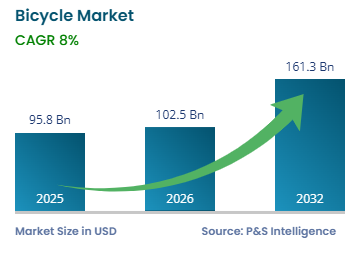
The global bicycle market stood at USD 95.8 billion in 2025 and is projected to reach USD 161.3 billion by 2032, expanding at a compound annual growth rate of 8.0% over 2026–2032.
Cycling's accelerating adoption as a sustainable mobility solution is reshaping demand across both commuter and recreational segments. Rising health consciousness among urban populations is reinforcing this shift, and the expanding integration of electric propulsion systems is extending riding range while removing the physical exertion barriers that previously limited commuter uptake.
The shift toward active transportation is reinforced by coordinated policy action at national and supranational levels. The World Health Organization (WHO) includes cycling as a key action in its Global Action Plan on Physical Activity 2018–2030. WHO data indicates that physical inactivity costs global health systems USD 27 billion annually, and that increased cycling participation can help prevent deaths attributed to sedentary lifestyles.
Government investments in dedicated cycling infrastructure, protected lane networks, and bike-sharing systems are enabling safer riding environments and broadening accessibility across developed and developing economies alike. The European Commission confirmed in its first progress report on the European Declaration on Cycling that EUR 4.5 billion has been earmarked for cycling from 2021–2027. This allocation includes funding to deliver over 12,000 kilometers of new or upgraded cycle paths across member states.
The rapid integration of electric propulsion systems into bicycle design is fundamentally reshaping product architecture, pricing strategies, and consumer adoption patterns across the global market. E-bikes have transitioned from a niche category to a mainstream mobility solution. Lithium-ion battery packs with improving energy density, mid-drive and hub motor configurations, and increasingly sophisticated pedal-assist algorithms are now standard architecture across the category. These algorithms optimize power delivery by terrain and rider behavior, extending accessible riding range beyond 100 kilometers per charge on premium models. Distance limitations that historically confined cycling to short-distance applications have effectively been eliminated.
Connected features including GPS navigation, app-enabled performance diagnostics, anti-theft tracking, and over-the-air firmware updates are positioning modern bicycles as integrated digital mobility platforms rather than purely mechanical vehicles. Shimano's development of automatic-shift drivetrains and Bosch's investment in smart motor controllers illustrate how component suppliers are bundling intelligence into drivetrain systems. This creates value-added differentiation that supports premium price positioning across both brands' product lines. The convergence of electrification and digital connectivity is accelerating product replacement cycles and attracting first-time adult riders who previously considered cycling impractical for daily commuting, broadening the addressable market beyond traditional cycling demographics. The global e-bike market will grow from USD 25.6 billion in 2024 to USD 61.5 billion by 2030, at a 15.7% CAGR.
Coordinated government investment in cycling infrastructure and policy frameworks promoting low-emission mobility are creating structural demand conditions that extend well beyond discretionary consumer spending. Dedicated cycling lanes, protected intersections, and multimodal transit connections reduce safety barriers, shorten commute times, and normalize cycling as a primary transportation mode. Infrastructure availability translates directly into sustained bicycle purchasing activity. The United Nations Environment Programme (UNEP) identifies cycling and walking infrastructure as central to its sustainable transport strategy. UNEP data indicates that the transport sector accounts for 15% of total global greenhouse gas emissions and is the fastest-growing emitting sector, necessitating urgent modal shifts toward active mobility.
At the national level, policy commitments are translating into measurable capital allocation. China's national e-bike trade-in program catalyzed 8.47 million replacement bicycle purchases in the first half of 2025 alone. In Europe, the European Declaration on Cycling has mobilized EUR 4.5 billion in cycling investment through 2027. India's Smart Cities Mission has developed over 713 kilometers of dedicated cycle tracks across participating cities. In addition, the Government of India allocated over INR 1.4 trillion (USD 17 billion) under the Faster Adoption and Manufacturing of Electric Vehicles (FAME) scheme and associated clean mobility initiatives, which include incentives and ecosystem support for electric two-wheelers such as e-bikes.
These coordinated infrastructure and policy commitments are creating predictable, sustained demand foundations that reduce cyclicality and support long-term market growth projections. The United Nations Economic Commission for Europe (UNECE) adopted a landmark strategy giving priority to public transport in combination with cycling and walking as a core pathway toward achieving net-zero greenhouse gas emissions from inland transport by 2050.
The global last-mile delivery market is projected to reach USD 117.5 billion by 2030. The expansion of e-commerce delivery volumes and urban logistics complexity is creating substantial commercial demand pathways for cargo bicycles and electric utility cycling platforms. Last-mile delivery costs represent the single largest share of total logistics expenditure in urban environments. Businesses are deploying cargo bicycles to navigate congestion, access restricted traffic zones, and reduce delivery emissions in dense metropolitan cores. The International Transport Forum (ITF) at the OECD has documented that cargo bikes can replace up to 25% of commercial vehicle deliveries in urban areas. This cost and emission advantage is most pronounced in high-density corridors where motorized vehicles face increasing access restrictions and congestion pricing.
Major logistics operators, food delivery platforms, and postal services are incorporating electric cargo bicycles into fleet operations. Municipal regulations in European cities including Paris, Amsterdam, and Berlin that restrict combustion vehicle access to central districts are accelerating this transition. This commercial demand stream is relatively price-inelastic compared to consumer discretionary purchases, providing more stable revenue foundations for manufacturers. The cargo segment also drives higher average selling prices. Larger frame architectures, higher-capacity battery systems, and specialized loading configurations contribute disproportionately to market revenue growth relative to unit volumes.
Product Type Analysis
Road bicycles accounted for the largest share, of 85%, in 2025. Road bicycles serve as the primary category for daily commuting, recreational riding, and fitness applications. Their broad utility requires no specialized accessories or terrain-specific configurations, making them accessible across income levels and riding contexts. Simplicity and affordability have cemented this position across urban and suburban environments over decades, making it structurally resilient rather than trend-dependent. The European Cyclists' Federation (ECF) estimates that commuter cycling accounts for more than 25% of all daily trips in leading European cycling nations such as the Netherlands and Denmark. Road bicycles serve as the primary vehicle category for these journeys.
Hybrid bicycles are the fastest-growing category during 2026–2032. Versatility across both paved and unpaved surfaces is the primary commercial driver, making hybrid models increasingly attractive to urban commuters and recreational riders who require multi-terrain capability from a single bicycle. Comfort-oriented geometry combined with performance features positions the category as an adaptable solution for consumers unwilling to compromise between urban practicality and recreational range. The U.S. Department of Transportation's Bureau of Transportation Statistics reports that over 47 million Americans aged six and older participate in bicycling annually. Hybrid models are capturing growing share among the commuter segment, where practicality and adaptability outweigh category-specific performance considerations.
The market segments into the following product types:
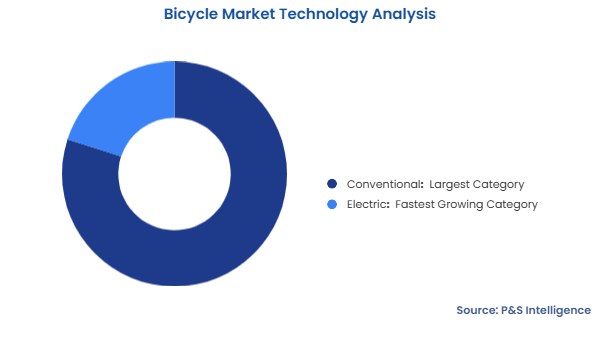
Conventional bicycles accounted for the largest share, of 80%, in 2025. Lower purchase prices, minimal maintenance requirements, and universal accessibility have cemented this position across both developed and developing economies. Conventional designs require no battery charging infrastructure and carry no range limitations. Mechanical simplicity reduces total ownership costs over the bicycle's lifetime, making the category structurally resilient to competition from electrified alternatives at current price differentials.
Electric bicycles are the fastest-growing category during 2026–2032. Advances in lithium-ion battery energy density are lowering the cost and weight penalties that previously constrained e-bike adoption. Declining battery production costs are making mid-range models accessible to commuters, older adults, and riders in hilly terrain who previously found conventional cycling impractical. Intelligent pedal-assist systems are further expanding the addressable rider base by reducing physical exertion demands. The International Energy Agency (IEA) reports that global battery manufacturing capacity reached 2.5 Terawatt-hours in 2023.
Cell and pack ecosystem expansion is directly benefiting e-bike manufacturers through improved cell availability and declining unit costs. The U.S. Department of Energy (DOE) confirms that lithium-ion battery prices have declined by over 89% in the past decade. This cost reduction is enabling manufacturers to deliver e-bikes with 100-plus kilometer ranges at increasingly accessible price points.
The market segments into the following technologies:
The offline category accounted for the largest share, of 85%, in 2025. The tactile, fit-dependent nature of bicycle purchasing underpins this position. Consumers rely on test rides, professional sizing, and in-person consultation on component selection considerations that digital channels cannot fully replicate at the point of purchase. Specialty bicycle retailers, sporting goods chains, and mass-market outlets provide immediate product availability alongside after-sales service capabilities including assembly, tuning, and warranty support. These service dependencies create structural retention within physical retail that insulates the channel from the substitution pressures affecting less service-intensive product categories.
Online is the fastest-growing category during 2026–2032. Expanding e-commerce penetration is broadening the accessible consumer base for bicycle brands operating direct-to-consumer strategies. Improved logistics capabilities for oversized product shipping are removing the fulfillment barriers that previously made online bicycle retail operationally impractical at scale. The United Nations Conference on Trade and Development (UNCTAD) estimates that global e-commerce spending reached USD 5.8 trillion in 2023. Enhanced digital product visualization, virtual sizing tools, and competitive pricing transparency are converting browsing activity into purchase decisions at increasing rates across the forecast period.
The market segments into the following distribution channels:
Men accounted for the largest share, of 65%, in 2025. Higher participation rates among men across commuting, competitive cycling, fitness, and recreational riding applications underpin this position. Cycling infrastructure familiarity and historically stronger marketing orientation toward male consumers have reinforced this demographic concentration, particularly in professional and performance cycling categories.
Children are the fastest-growing category during 2026–2032. Increasing parental emphasis on outdoor physical activity is expanding demand for entry-level and youth-specific bicycle formats. School-based cycling programs are creating structured first-contact with the category, building ridership habits at an age that research consistently links to lifelong mobility preferences. Growing awareness of cycling as a foundational skill is reinforcing purchase decisions among parents across both developed and developing markets. The World Health Organization (WHO) recommends that children and adolescents engage in at least 60 minutes of moderate-to-vigorous physical activity daily, with cycling explicitly identified as a key activity for meeting these targets.
The World Health Organization (WHO) reports that over 80% of adolescents aged 11–17 are insufficiently physically active, increasing vulnerability to obesity and metabolic disorders. WHO data indicates that 39 million children under age 5 were overweight or obese in 2022. The Centers for Disease Control and Prevention (CDC) reports that 19.7% of children aged 2–19 in the United States — approximately 14.7 million individuals — have obesity, raising clinical risks of cardiovascular disease and type 2 diabetes. The International Diabetes Federation (IDF) notes that type 2 diabetes among children and adolescents is increasing globally. Low physical activity and rising obesity prevalence among younger age cohorts are the primary drivers of this trend.
The market segments into the following end users:
Regular design bicycles accounted for the largest share, of 85%, in 2025. Mass-produced geometries, broad compatibility with existing infrastructure, and cost-effective manufacturing processes make regular frame designs the default choice across all product categories and price points. Established supply chain depth and standardized componentry ensure competitive pricing and wide retail availability, cementing this position across both developed and developing markets.
Folding bicycles are the fastest-growing category during 2026–2032. Increasing urban population density is the primary structural driver, reducing residential storage space and creating demand for compact mobility solutions that conventional frame geometries cannot address. The need for multimodal transport integration combining cycling with public transit across daily commutes is positioning folding bicycles as a practical solution for urban riders navigating mixed-infrastructure environments. The United Nations Department of Economic and Social Affairs (UNDESA) projects that 68% of the global population will live in urban areas by 2050. This demographic concentration is intensifying demand for space-efficient mobility solutions that folding bicycle designs are uniquely positioned to address.
The market segments into the following designs:
Drive strategic growth with comprehensive market analysis
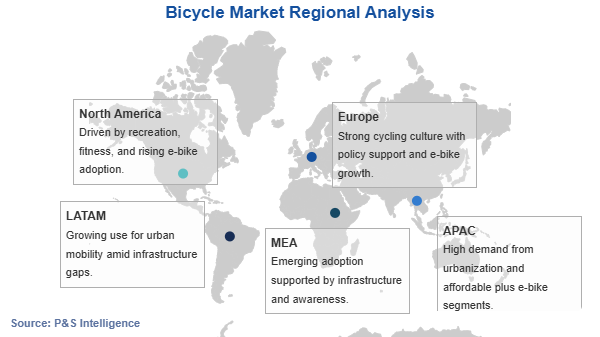
Strong consumer spending on premium road and mountain bicycles, an expanding e-bike segment, and robust cycling participation across fitness and recreational categories underpin this position. Established retail distribution networks and corporate wellness programs that incentivize cycling provide the commercial infrastructure. The U.S. Department of Transportation allocated USD 44.5 million for active transportation projects through the Safe Streets and Roads for All program, reinforcing federal commitment to cycling safety and infrastructure expansion.
Urban congestion is driving alternative mobility adoption across major metropolitan corridors, and e-bike subsidies are gaining traction at state and local levels. Cycling tourism is expanding across trail networks, adding a demand stream that extends beyond urban commuter applications. Canada is the fastest-growing country market within the region. Municipal cycling programs and federal funding for green transportation infrastructure are providing the structural foundation for this trajectory.
The U.S. represents the largest country market within North America. Cycling participation has broadened beyond traditional recreation into daily commuting, fitness, and last-mile delivery applications. Bike-sharing programs in metropolitan areas are lowering barriers to first-time adoption. Expanding protected lane networks in cities including New York, Portland, and San Francisco are reinforcing this shift by improving perceived safety among new riders. The U.S. Census Bureau's American Community Survey indicates that bicycle commuting has grown steadily in major metropolitan statistical areas. Cities are investing in multimodal transit connectivity that integrates cycling into broader public transportation systems, further normalizing the bicycle as a primary commuter vehicle.
E-bike demand is accelerating, with state-level purchase incentive programs in Colorado, California, and Vermont driving consumer uptake. Direct-to-consumer brands and online retail channels are complementing traditional specialty bike shop networks, expanding market accessibility across price points.
Deeply embedded cycling cultures in the Netherlands, Denmark, and Germany provide the demand foundation, alongside comprehensive regulatory frameworks promoting active mobility. The European Parliament, Council, and Commission adopted the European Declaration on Cycling in April 2024, elevating cycling to a strategic transport priority. The Declaration carries 36 binding commitments across member states covering infrastructure expansion, safety improvements, and industrial policy support for the European cycling sector.
Germany held the largest country market share within Europe in 2025. EUR 1.46 billion in federal cycling funding and strong e-bike penetration account for a growing share of new bicycle sales in the market. The European Commission's progress report confirmed that more than 270 cycling measures have been identified across 26 member states, demonstrating the breadth of policy implementation since the Declaration's adoption.
Spain is the fastest-growing country market within Europe. Expanding cycling infrastructure investments in metropolitan areas including Madrid and Barcelona are providing the physical network that underpins adoption growth. Favorable climate conditions support year-round riding, and rising e-bike adoption among urban commuters is accelerating fleet renewal. Cargo bikes are gaining traction in urban logistics across the broader European market. Subscription and leasing models are expanding accessibility, and e-bike technology is continuing to lower adoption barriers for older adults and less physically active populations.
Asia-Pacific accounted for the largest share, of 40%, in 2025, and it is also the fastest-growing region, with 8.5% CAGR. China's position as the world's largest bicycle producer and consumer underpins the region's dominance. Manufacturing concentration in China and Taiwan provides cost advantages and supply chain depth that support both domestic consumption and global exports. Rapidly growing adoption across India, Japan, South Korea, and Southeast Asian economies is broadening the regional demand base beyond China's established market.
E-bike adoption across the region has accelerated with China's fleet exceeding 420 million electric bicycles according to the Institute for Transportation and Development Policy (ITDP), making e-bikes the single most prevalent form of electric mobility globally. Cities including Guangzhou, Beijing, and Shanghai have invested heavily in dedicated cycling infrastructure. Guangzhou alone renovated 968 kilometers of bike lanes between 2021 and 2023.
Japan and South Korea contribute substantial premium bicycle demand. Aging populations seeking low-impact exercise and growing recreational cycling cultures are the primary demand drivers in both markets. Australia's expanding urban cycling networks further reinforce regional market strength.
China represents the largest country market within Asia-Pacific and globally. The world's most extensive e-bike ecosystem, massive manufacturing capacity, and government policies actively promoting two-wheeled electric mobility collectively underpin this position. China's Ministry of Commerce reported that under the national e-bike trade-in program, 8.47 million new electric bicycles were sold in the first half of 2025 alone, representing a 6.1-fold increase over the same period in 2024, with total sales value reaching CNY 24.77 billion (USD 3.46 billion).
The implementation of the mandatory national standard for electric bicycles (GB 17761-2024) in September 2025 is driving a comprehensive fleet renewal cycle. Stricter safety requirements are accelerating replacement demand and pushing manufacturers toward higher-specification compliant models. Dedicated bike lane networks in Beijing and Shanghai now exceed 1,200 kilometers, providing the infrastructure backbone that supports sustained urban cycling growth.
India is the fastest-growing country market within Asia-Pacific. Rising urbanization and growing health and fitness consciousness among the country's young demographic base are providing the demand foundation. Government investment in cycling infrastructure is translating into measurable physical network expansion. India's Ministry of Housing and Urban Affairs, through the Smart Cities Mission, has developed over 713 kilometers of cycle tracks across participating cities and procured 23,000 bicycles to support public bike-sharing programs.
The India Cycles4Change Challenge engaged over 100 cities in piloting cycling infrastructure, with 33 cities developing more than 220 kilometers of dedicated cycle tracks by 2024. Electric bicycle adoption is gaining momentum in metropolitan centers as battery costs decline and urban congestion intensifies. Favorable demographics, government-backed infrastructure development, and an expanding cycling culture position India as a high-growth opportunity within the global bicycle market through 2032.
The regions and countries analyzed in this report include:
The global bicycle market exhibits a moderately fragmented competitive structure, reflecting the diversity of product categories spanning conventional road and mountain bicycles, hybrid models, cargo configurations, and the rapidly expanding electric bicycle segment. Low barriers to entry in conventional bicycle manufacturing allow both large-scale producers and specialized niche manufacturers to maintain viable competitive positions.
Geographic market diversity requires localized product adaptation, and the coexistence of mass-market and premium performance segments creates fundamentally different cost structures across the competitive field. Regional manufacturing advantages in Taiwan, China, and South Asia reinforce this fragmentation by enabling a broad range of producers to compete across price points simultaneously. No single manufacturer controls a dominant share of the global market, although a cluster of established players collectively shapes competitive dynamics through scale, vertical integration, and brand equity.
Want a report tailored exactly to your business need?
Request CustomizationLeading companies across industries trust us to deliver data-driven insights and innovative solutions for their most critical decisions. From data-driven strategies to actionable insights, we empower the decision-makers who shape industries and define the future. From Fortune 500 companies to innovative startups, we are proud to partner with organisations that drive progress in their industries.

Working with P&S Intelligence and their team was an absolute pleasure – their awareness of timelines and commitment to value greatly contributed to our project's success. Eagerly anticipating future collaborations.
McKinsey & Company
India
Our insights into the minutest levels of the markets, including the latest trends and competitive landscape, give you all the answers you need to take your business to new heights

We take a cautious approach to protecting your personal and confidential information. Trust is the strongest bond that connects us and our clients, and trust we build by complying with all international and domestic data protection and privacy laws


Customize the Report to Align with Your Business Objectives

Request the Free Sample Pages