Explore the market potential with our data-driven report
Beauty Tech Sensors Market Overview
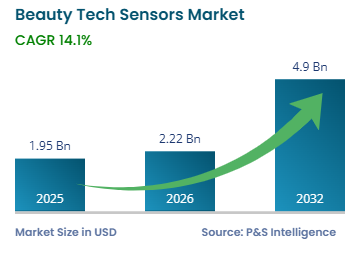
The beauty tech sensors market size was USD 1.95 billion in 2025 and is projected to rise to USD 2.22 billion in 2026 and USD 4.90 billion by 2032, advancing at a 14.1% CAGR during 2026–2032. Commercial value is shifting toward sensing systems that turn a beauty consultation or device session into a measurable baseline, recommendation, and follow-up record.
Growth reflects broader use of standardized imaging, hydration and sebum probes, hair and scalp cameras, environmental sensors, and early biochemical platforms. Professional systems remain important because controlled lighting and repeatable positioning improve comparisons over time. Embedded modules and wearable formats widen access by moving measurement into home routines and continuous exposure tracking.
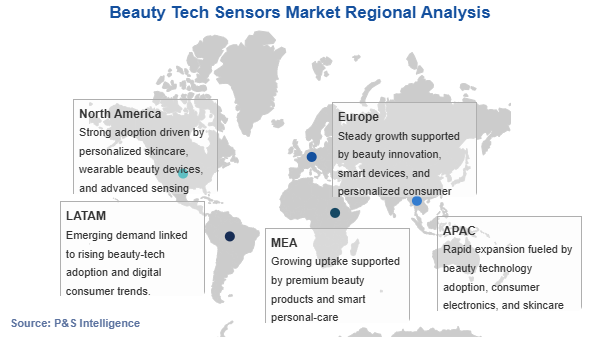
North America held 36.0% of the Beauty Tech Sensors Market share in 2025, supported by professional aesthetic systems and enterprise beauty-technology adoption. Asia-Pacific is forecast to grow fastest at a 16.0% CAGR during 2026–2032 as beauty retail networks, local device ecosystems, and sensor-enabled consultation formats expand across major markets.
Suppliers face a demanding commercialization path. A useful system must combine reliable capture, clear consumer guidance, channel integration, and appropriate handling of sensitive facial or skin information. Vendors that can validate performance across varied skin tones, hair types, environments, and use conditions are better positioned to convert technical capability into repeat purchases and long-term platform use.
Key Market Insights
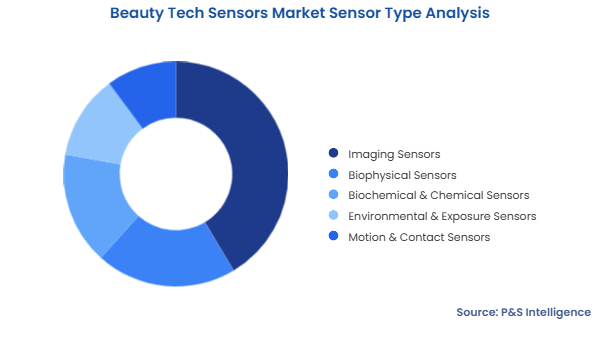
By sensor type, imaging sensors held 41.5% in 2025, while biochemical & chemical sensors are forecast to grow at an 18.3% CAGR during 2026–2032.
By technology, optical & photonic sensing held 46.8% in 2025, while electrochemical & biosensing is forecast to grow at a 19.0% CAGR during 2026–2032.
By form factor, tabletop & kiosk systems held 34.2% in 2025, while wearable patches & skin-conformal sensors are forecast to grow at a 20.4% CAGR during 2026–2032.
By application, skin analysis & personalized skincare held 55.6% in 2025, while hair & scalp analysis is forecast to grow at a 17.6% CAGR during 2026–2032.
By end user, beauty brands & retailers held 34.8% in 2025, while individual consumers are forecast to grow at a 17.8% CAGR during 2026–2032.
By geography, North America held 36.0% in 2025, while Asia-Pacific is forecast to grow at a 16.0% CAGR during 2026–2032.
Beauty Tech Sensors Market Trends and Growth Drivers
Repeatable imaging turns consultation into measurable follow-up
Beauty brands, clinics, and salons increasingly use sensor readings to establish a baseline that can be revisited after a product or service cycle. Canfield Scientific reports that its systems have processed more than 20 million images, providing a commercial-scale indicator of how standardized capture can accumulate across professional workflows. This does not establish treatment efficacy or vendor share, but it shows that image-based assessment is supporting repeat use rather than isolated demonstrations.
This repeatability is a central driver of Beauty Tech Sensors Market growth. Comparable captures help advisors explain visible change, document a consultation, and adjust a recommendation using the same measurement framework. The resulting record can increase system utilization and make replacement hardware, upgraded illumination, and integrated analysis more valuable to the channel.
Within the beauty tech sensors industry, conformal patches create an opportunity to observe skin conditions beyond a counter or clinic appointment. Amorepacific’s development-stage Skinsight platform combines an ultra-thin sensor patch, a Bluetooth module, and an app in a system designed to collect readings during daily activity. The architecture shows how wearable measurement can remain tied to beauty recommendations outside a fixed consultation.
Longitudinal measurement could support exposure tracking, product testing, and routines that respond to changing conditions. It also creates demand for low-power sensing, comfortable materials, secure data transfer, and interpretable outputs. The opportunity remains early because a demonstrated platform does not establish mass production, retail availability, or consumer willingness to wear a patch regularly.
Beauty tech sensors industry trends increasingly favor sensing that distinguishes surface features from information associated with deeper skin structures. In January 2026, Shiseido Company Limited reported a depth-aware optical method based on a nine-layer model and measurements from approximately 150 women, extending its non-invasive analysis of subsurface scattering light. The research links wavelength and penetration depth to more specific interpretation of optical signals.
This direction can raise the value of specialized cameras, illumination, calibration, and analysis models because buyers gain information that ordinary photographs cannot isolate. It may also support more discriminating product research and consultation. The work is research evidence, however, and does not by itself establish a commercially available consumer device or diagnostic claim.
Validation and governance raise the commercialization threshold
Beauty sensing sits close to health-adjacent decisions because it may process facial images, skin attributes, and individualized recommendations. The European Commission states that AI transparency provisions became applicable on August 2, 2026, while selected high-risk obligations follow later. Applicability depends on intended use, but the timetable reinforces the need for documented claims, clear user communication, and disciplined data handling.
Validation across skin tones, ages, lighting conditions, and device configurations adds cost before and after launch. Suppliers must also prevent cosmetic guidance from drifting into unsupported medical interpretation. Larger firms can spread governance and testing expenses across brands or channels, while smaller vendors may face longer sales cycles and narrower deployments. These requirements can restrain adoption even as they improve buyer confidence.
Beauty Tech Sensors Market Segmentation Analysis
Sensor Type
The beauty tech sensors market analysis identifies imaging sensors as the largest sensor type, with a 41.5% share in 2025. Their position reflects broad utility across pores, texture, pigmentation, wrinkles, redness, and progress tracking. Canfield Scientific’s VISIA platform produces eight named complexion feature outputs, illustrating how one controlled capture system can support several consultation questions without changing the core hardware.
BIOCHEMICAL & CHEMICAL SENSORS are forecast to grow fastest at an 18.3% CAGR during 2026–2032. Their advantage is access to molecular or analyte information that visible imaging cannot directly measure. Kao Corporation’s commercial skin-analysis workflow combines sebum-RNA and corneospectral measurement across 12 skin markers, showing how beauty assessment can extend from appearance toward molecular condition. Adoption will depend on sampling simplicity, consumable economics, and claim validation.
Technology
Optical & photonic sensing held the largest technology share at 46.8% in 2025. Its lead comes from versatile, non-contact capture that can be installed in analyzers, mirrors, kiosks, and portable systems. VISIA combines standard, cross-polarized, UV, and 3D imaging, demonstrating how multiple optical modes can separate surface color, fluorescence, and structural information within a single professional workflow.
Electrochemical & biosensing is projected to expand fastest at a 19.0% CAGR during 2026–2032. These methods can translate tactile, ionic, or molecular responses into measurements that complement photographs. A Singapore partnership involving The Procter & Gamble Company, A*STAR, and NTU reported that the HapSense wearable tactile sensor could make cosmetic-product analysis up to ten times faster. The result supports testing efficiency, though it remains an R&D comparison rather than proof of broad commercial adoption.
Form Factor
Tabletop & kiosk systems accounted for the largest form-factor share at 34.2% in 2025. Controlled lighting, fixed distance, and guided positioning make these systems useful where advisors need consistent images and a clear consultation display. EveLab Insight reports that its fixed-analyzer product matrix reaches more than 6,000 stores, demonstrating commercial scale for in-store imaging systems. The figure covers the company's product range and is not an installed-base count for Eve Muse alone.
Wearable patches & skin-conformal sensors are forecast to grow fastest at a 20.4% CAGR during 2026–2032. Their value lies in collecting signals while conditions change outside a fixed station. Amorepacific’s Skinsight patch simultaneously tracks four aging-related factors, giving the format a multi-parameter basis for exposure and routine monitoring. The category’s trajectory still depends on comfort, durability, reusable electronics, consumable cost, and conversion of prototypes into scalable services.
Application
Skin analysis & personalized skincare led applications with a 55.6% share in 2025. The category benefits from a direct link between measured concerns, advisor interpretation, and routine selection. L’Oréal reports more than 120 million uses of its Beauty Tech services across 66 countries, showing the engagement scale available to analysis-led beauty experiences. The figure covers a broader service portfolio and is not treated as sensor revenue.
Hair & scalp analysis is projected to grow fastest at a 17.6% CAGR during 2026–2032. The application extends familiar imaging workflows into density, fiber, frizz, scalp oil, and related concerns. HautAI OÜ says its system assesses 19 hair concerns and returns results in under one minute, a response profile suited to consultations with limited time. Growth depends on representative training data and recommendations that work across diverse hair and scalp characteristics.
End User
Beauty brands & retailers held the largest end-user share at 34.8% in 2025. These buyers can deploy sensing across counters, websites, stores, and brand portfolios, then connect results to product education and follow-up. L’Oréal’s Beauty Tech services span 31 brands, illustrating how a large portfolio can reuse measurement capabilities across different consumer propositions. That breadth supports enterprise procurement without establishing sensor-only revenue or share.
Individual consumers are forecast to grow fastest at a 17.8% CAGR during 2026–2032 as sensors become easier to embed in familiar routines. FOREO’s LUNA fofo manual states that its integrated hydration sensors take 1,000 readings per second and save a personalized routine, showing how high-frequency measurement can operate inside an at-home device. The disclosure establishes capability, while current sales contribution and continued model prominence remain unreported.
The complete segmentation hierarchy is as follows:
Sensor Type
Imaging Sensors
Biophysical Sensors
Biochemical & Chemical Sensors
Environmental & Exposure Sensors
Motion & Contact Sensors
Technology
Optical & Photonic Sensing
Electrical & Capacitive Sensing
Electrochemical & Biosensing
Mechanical & Acoustic Sensing
Thermal Sensing
Form Factor
Tabletop & Kiosk Systems
Handheld & Portable Devices
Embedded Sensor Modules
Wearable Patches & Skin-Conformal Sensors
Modular Probes & Research Instruments
Application
Skin Analysis & Personalized Skincare
Treatment Feedback & Adaptive Device Control
Hair & Scalp Analysis
Cosmetics Matching & Application
UV & Environmental Exposure Monitoring
End User
Beauty Brands & Retailers
Clinics, Medspas, Salons & Aesthetic Centers
Individual Consumers
Cosmetic R&D, Testing & Claims Laboratories
Beauty Device OEMs & Integrators
Drive strategic growth with comprehensive market analysis
Beauty Tech Sensors Market Geographical Analysis
North America held the largest regional position with 36.0% in 2025. Professional aesthetic systems, established medspa and clinic channels, and enterprise beauty programs support demand for controlled imaging and modular probes. Clarins Group’s deployment of its AI Skin Observer at Macy’s Herald Square illustrates how sensor-assisted consultation is being integrated into a premium U.S. retail setting. The example supports the channel mechanism, not the regional total. Replacement of aging systems, wider 3D capture, and links between store and digital records should sustain growth. Asia-Pacific could narrow the gap if its consumer-device volumes and local analyzer ecosystems scale faster than North American professional spending.
Beauty Tech Sensors Market growth is forecast to be fastest in Asia-Pacific at a 16.0% CAGR during 2026–2032. The region combines major beauty research organizations, electronics manufacturing, dense retail networks, and consumers accustomed to digitally assisted shopping. DFI Retail Group and Becon announced a phased deployment of AI skin and scalp assessment across more than 400 Guardian and Mannings stores in Hong Kong, Indonesia, Macau, Malaysia, and Singapore, together with lighter mobile-app access. The multi-market program shows how specialized scanners and digital entry points can reinforce each other. Growth should broaden from in-store imaging toward wearables and molecular sensing, although data localization, validation costs, and weaker discretionary spending could slow installations.
China accounted for 31.0% of Asia-Pacific revenue in 2025, making it the region’s largest country market. Scale comes from a large beauty retail base, local equipment supply, and the use of analysis to support premium consultation. In January 2026, Clarins Group documented deployment of its AI Skin Observer at the Clarins Boutique & Spa in Shanghai Jing An Kerry Center. The mirror-format system combines biophysical sensors with facial images captured under several lighting modes, providing a current example of sensor-assisted retail adoption in China. This single location does not establish national penetration, yet it demonstrates that advanced analysis is moving into live premium-store workflows. China should retain scale leadership if store investment and domestic analyzer availability continue, while Japan or South Korea could narrow the premium-revenue gap if that investment weakens.
India is projected to be Asia-Pacific’s fastest-growing country market at an 18.2% CAGR during 2026–2032. Expansion starts from a lower installed base and is supported by mobile-first beauty discovery and the gradual digitization of salons and professional consultation. Kérastase India presents K-Scan as an in-salon camera using white LED, cross-polarized, and UV light to analyze hair and scalp characteristics, connect results to hairdresser recommendations, and track progress. The official India page states that the system was trained on more than 12,000 images, but it gives no national installation count. The offer nevertheless shows a practical route for sensor-assisted analysis through professional beauty services. India’s trajectory will depend on equipment affordability, validation across diverse hair and scalp characteristics, and consistent staff training.
The complete geographic hierarchy follows.
North America
U.S.
Canada
Europe
Germany
France
U.K.
Italy
Spain
Netherlands
Rest of Europe
Asia-Pacific
China
Japan
South Korea
India
Australia
Rest of Asia-Pacific
Latin America
Brazil
Mexico
Rest of Latin America
Middle East & Africa
Saudi Arabia
U.A.E.
South Africa
Rest of Middle East & Africa
Beauty Tech Sensors Market Competitive Landscape
The beauty tech sensors industry has a fragmented competitive structure because no single sensing architecture or route to market serves every buyer. Professional imaging specialists compete on controlled capture and repeatability. Probe suppliers emphasize modular measurement breadth. Beauty groups connect proprietary science with retail and brand portfolios. Software-led firms build analysis around cameras, kiosks, and omnichannel interfaces, while device companies integrate sensing into mirrors, handheld products, and home routines.
L’Oréal S.A. spans exposure sensing and tabletop biomarker analysis, while Shiseido Company, Limited differentiates through contact-free measurement and visualization. Panasonic Holdings Corporation contributes mirror-integrated consultation concepts. Courage + Khazaka electronic GmbH competes through configurable professional probes, and EveLab Insight Inc. focuses on 3D systems for brands and service providers. Revieve Oy emphasizes integration across digital and in-store touchpoints, while Callegari S.r.l. covers skin, scalp, and hair analysis in professional equipment.
Competition is shifting from the number of detectable concerns toward measurement consistency, workflow fit, validation breadth, and the ability to maintain a useful record across channels. Buyers benefit from a wide choice of specialized systems, but comparing claims can be difficult when vendors use different capture conditions and scoring methods. Entrants can address a narrow application without matching the full portfolios of diversified groups, although calibration, representative datasets, privacy controls, and channel training create meaningful barriers to scaled deployment.
Leading Companies in the Beauty Tech Sensors Market:
L’Oréal S.A.
Shiseido Company Limited
The Procter & Gamble Company
Kao Corporation
Amorepacific Corporation
Panasonic Holdings Corporation
Perfect Corp.
Canfield Scientific Inc.
Courage + Khazaka electronic GmbH
EveLab Insight Inc.
Revieve Oy
HautAI OÜ
Callegari S.r.l.
FOREO AB
Beauty Tech Sensors Market Developments
In June 2026, L’Oréal S.A. showcased patented high-resolution imaging that produces real-time 3D views of living skin at VivaTech 2026. The demonstration points toward more detailed non-invasive skin-structure analysis, while commercial availability and medical-device status were not established.
In June 2026, Amorepacific Corporation and Samsung Electronics completed a VivaTech demonstration of the AI Beauty Screen. The smart mirror captured wrinkles, pigmentation, pores, redness, and skin tone, linking sensor-based assessment with personalized product and device recommendations.
In March 2026, Perfect Corp. released an upgraded AI skin-analysis suite with HD and SD modes, multi-platform configurations, and rapid assessment across 15 skin dimensions. The update broadens deployment options around existing cameras and kiosks without adding software-only value to market revenue.
Frequently Asked Questions About This Report
How is commercial value shifting in the beauty tech sensors market?+
Commercial value is shifting toward sensing systems that turn a beauty consultation or device session into a measurable baseline, recommendation, and follow-up record.
What technologies are supporting market growth?+
Growth reflects broader use of standardized imaging, hydration and sebum probes, hair and scalp cameras, environmental sensors, and early biochemical platforms.
Which region held the largest market share in 2025?+
North America held 36.0% of the beauty tech sensors market share in 2025, supported by professional aesthetic systems and enterprise beauty-technology adoption.
Which region is forecast to grow fastest?+
Asia-Pacific is forecast to grow fastest at a 16.0% CAGR during 2026-2032 as beauty retail networks, local device ecosystems, and sensor-enabled consultation formats expand across major markets.
What must suppliers combine in a commercially useful system?+
A useful system must combine reliable capture, clear consumer guidance, channel integration, and appropriate handling of sensitive facial or skin information.
Want a report tailored exactly to your business need?
Leading companies across industries trust us to deliver data-driven insights and innovative solutions for their most critical decisions. From data-driven strategies to actionable insights, we empower the decision-makers who shape industries and define the future. From Fortune 500 companies to innovative startups, we are proud to partner with organisations that drive progress in their industries.
Client Testimonials
Working with P&S Intelligence and their team was an absolute pleasure – their awareness of timelines and commitment to value greatly contributed to our project's success. Eagerly anticipating future collaborations.
McKinsey & Company
India
Unmatched Standards
Our insights into the minutest levels of the markets, including the latest trends and competitive landscape, give you all the answers you need to take your business to new heights
Complete Data Security
We take a cautious approach to protecting your personal and confidential information. Trust is the strongest bond that connects us and our clients, and trust we build by complying with all international and domestic data protection and privacy laws