This Report Provides In-Depth Analysis of the Battery Formation and End-of-Line Testing Equipment Market Report Prepared by P&S Intelligence, Segmented by Equipment Type (Formation & Aging Systems, Grading & Cell Test Systems, Module & Pack End-of-Line Test Systems), Application (Electric Vehicles, Energy Storage Systems, Consumer Electronics), Battery Chemistry (Lithium-Ion, Solid-State), Automation Level (Fully-Automated, Semi-Automated, Manual), and Geographical Outlook for the Period of 2022 to 2033
Battery Formation and End-of-Line Testing Equipment Market Statistics
Key Highlights
Study Period
2022 - 2033
Market Size in 2026
USD 6.19 Billion
Market Size in 2027
USD 6.96 Billion
Market Size by 2033
USD 14.11 Billion
Projected CAGR
12.5%
Largest Region
Asia-Pacific
Fastest Growing Region
North America
Market Structure
Moderately Fragmented
Market Size
Explore the market potential with our data-driven report
Battery Formation and End-of-Line Testing Equipment Market Overview
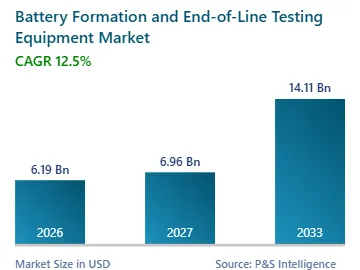
The global battery formation and end-of-line testing equipment market size is estimated at USD 6.19 Billion in 2026 and is projected to reach USD 6.96 Billion in 2027. By 2033, revenue is expected to climb to USD 14.11 Billion, which represents a CAGR of 12.5% over 2027-2033 as new cell plants come online. Cell makers building capacity for electric vehicles and grid storage place most orders, since every line must form, age, grade, and test its output before shipping. Battery formation and end-of-line testing equipment market growth is paced by plant commissioning more than by quarterly battery sales.
Automotive cell producers remain the largest source of formation and test line orders, since each new vehicle platform brings cell formats and pack designs that need their own fixtures, test programs, and grading limits. According to the International Energy Agency, global electric car sales rose 20% in 2025 to more than 20 million, one in four new cars sold. That count sizes the vehicle base that battery plants serve, not the equipment installed for it, yet it helps explain why automotive cell makers keep adding finishing capacity. Energy storage cell producers are the second, faster-rising buyer group.
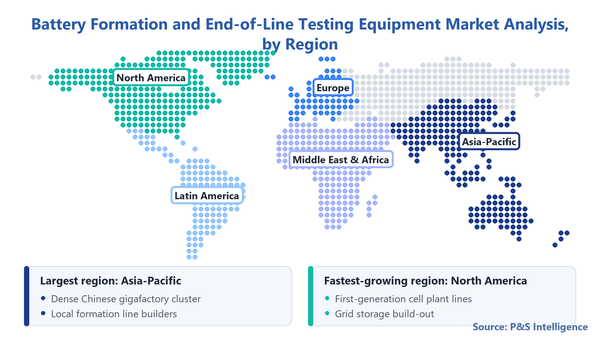
Asia-Pacific accounted for 55% of 2026 revenue, anchored by cell producers in China, South Korea, and Japan that keep adding lines at established sites, with newer cell projects in India, Malaysia, Vietnam, and Indonesia. North America is projected to post the fastest growth, a 19.3% CAGR during 2027-2033, as new cell plants in the U.S. and Canada install their first finishing and pack test lines. The two regions buy differently, with Asian plants pressing for low cost per channel and short delivery and North American projects weighing supplier origin and local service more heavily.
Key market insights
By equipment type, formation & aging systems held 40% in 2026, while grading & cell test systems is projected to post a 16.8% CAGR during 2027-2033.
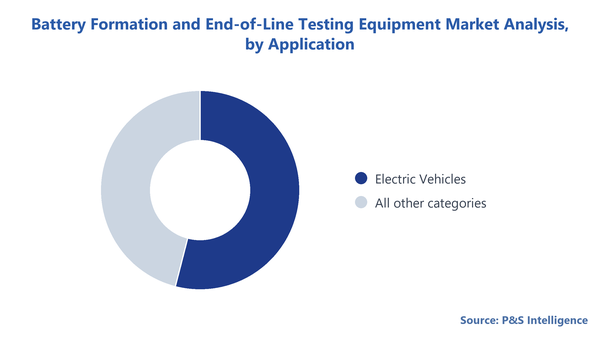
By application, electric vehicles held 54% in 2026, while energy storage systems is set to advance at a 17.9% CAGR during 2027-2033.
By battery chemistry, lithium-ion held 72% in 2026, while solid-state is forecast to rise at a 17.3% CAGR during 2027-2033.
By automation level, fully-automated held 48% in 2026 and is also projected to post the fastest growth during 2027-2033.
By geography, Asia-Pacific held 55% in 2026, while North America is expected to record a 19.3% CAGR during 2027-2033.
Digital battery passports are reshaping the data role of end-of-line test stations
Pack and module makers selling into the EU face a new data obligation that lands on the last stations of their lines. Performance and durability information is among the data a digital battery passport can require, and the end-of-line tester is often where capacity, resistance, and insulation results are first logged against a serial number. Traceability software, links to manufacturing execution systems, and data-logging accuracy are therefore becoming specification items when plants buy test stations, next to cycle time and channel count.
As per the European Commission, the battery passport becomes mandatory from February 18, 2027 for relevant battery categories placed on the EU market, including electric vehicle, light-transport, home storage, and industrial batteries. The rule sets information duties at battery level and does not require any particular test equipment, but plants that already store serialized end-of-line results can fill the passport without adding measurement steps. Test-system vendors offering open data interfaces could find European tenders tilting in their favor as the deadline nears.
Gigawatt-scale cell plant additions are driving bulk orders for formation and aging capacity
Cell makers adding gigawatt-scale capacity must size formation and aging equipment to each new line's full output, because no cell can leave the plant until its first charge cycles and rest period are complete. Assembly machines handle a part in seconds, while formation racks and aging chambers hold each cell for days, so the number of channels, chambers, and storage positions grows almost in step with planned output. A plant that doubles its gigawatt-hours generally has to double its finishing floor as well.
Oak Ridge National Laboratory researchers found, in a Joule study, that wetting and formation may take 3-7 days and aging up to two more weeks, with these steps using up to 25% of floor space. That residence time makes finishing one of the largest equipment budgets in a new cell plant. Suppliers that can shorten formation protocols or fit more channels into each rack offer cell makers a direct saving on floor space and building cost, which strengthens the purchase case for fast-formation hardware and software.
Grid storage cell plants are opening a second order stream for formation and grading lines
Energy storage cell producers are building dedicated LFP lines for large prismatic cells, and each of those lines needs its own formation, capacity grading, and OCV/IR sorting before cells are matched into racks. Storage integrators tend to set tight cell-to-cell consistency limits, since a weak cell can cap the output of a whole string, which pushes plants toward grading and sorting equipment with finer measurement resolution. This buyer group follows utility and commercial project pipelines, giving equipment vendors an order cycle that does not depend on car model launches.
Figures from China's National Energy Administration put the country's installed new-type energy storage capacity at 153 GW at the end of June 2026, 61% higher than a year earlier, with lithium-ion batteries the dominant technology. That count measures deployed storage systems, not the equipment that made their cells, yet it shows how fast the end market for storage cells has grown. Equipment suppliers with experience in large-format LFP cells and high-current formation channels are better positioned to win orders as storage cell plants add lines.
Export licensing uncertainty is constraining cross-border sourcing of finishing lines
Chinese suppliers are among the largest builders of formation and grading systems, so cell makers setting up plants in Europe, Southeast Asia, and the Americas often rely on equipment shipped from China. Any licensing requirement on that equipment adds approval time and schedule risk to projects tied to customer start-of-production dates. Project owners can respond by holding back final orders, splitting packages across suppliers from several countries, or stocking more spare modules, and each of those choices slows or fragments line purchases, though mainly by shifting order timing and supplier mix rather than reducing the finishing capacity each plant needs.
China's Ministry of Commerce listed formation and grading systems and capacity grading cabinets among controlled lithium-battery manufacturing equipment in Announcement No. 58 of 2025, effective November 8, 2025, then suspended the measure until November 10, 2026 through Announcement No. 70. Unless the suspension is extended, the licensing requirement returns within the purchasing windows of overseas plants now in planning. Some Chinese line builders are expanding production capacity outside China, while non-Chinese suppliers in South Korea, Japan, Taiwan, and Europe gain an opening with plant owners seeking a second qualified source.
Segmentation Analysis
Equipment Type
Formation & aging systems accounted for 40% of battery formation and end-of-line testing equipment market revenue in 2026. Every cell spends far longer in formation racks and aging chambers than at any grading or pack test station, so plants buy many more formation positions per gigawatt-hour. Hot-press formation for pouch and large prismatic cells adds pressure fixtures and temperature control to each channel, raising rack value. Fraunhofer ISE notes that formation followed by aging takes a long time and is therefore expensive, which helps explain why this stage draws the largest finishing budget.
Grading & cell test systems are expected to post the fastest growth, a 16.8% CAGR during 2027-2033. Running OCV and internal-resistance checks inside the formation and aging stages adds measurement points per cell, and pack builders tend to ask for tighter cell matching before assembly. Hioki positions its BT6065 tester for formation process monitoring and its BT6075 for end-of-line cell grading. Such instruments count toward this segment only when sold for production lines, which favors models that run in parallel across many channels without interference.
Application
Electric Vehicles held 54% of 2026 revenue, since automotive cell plants account for a large share of new capacity and every pack must pass end-of-line validation before it reaches vehicle assembly. Each new platform brings its own cell format and pack architecture, which means fresh fixtures, contact tooling, and end-of-line test programs even at plants that already run formation lines. Data from the China Association of Automobile Manufacturers show that the country's production and sales of new energy vehicles each passed 16 million units in 2025, totals that include exported vehicles and size the platform base, not equipment adoption.
Energy Storage Systems are projected to grow fastest, at a 17.9% CAGR over 2027-2033. Storage cell producers are opening large-format LFP lines for utility and commercial projects, and those lines need high-current formation channels and grading capacity sized for much larger cells. The China Energy Storage Alliance counted 66.43 GW (189.48 GWh) of new-type energy storage commissioned in China during 2025, a deployment figure that indicates end demand for storage cells. For equipment vendors, storage adds a second order book tied to power-sector project pipelines, which can soften the impact of slower automotive programs.
Copyright P&S Intelligence. Reuse requires attribution under CC BY 4.0.
Battery Chemistry
Lithium-ion accounted for 72% of 2026 revenue, covering LFP lines for storage and mass-market vehicles and NMC lines for longer-range models. Most gigafactory capacity built in recent years makes one of these two chemistries, so formation protocols, grading software, and pack test programs are tuned to their voltage windows and interphase behavior. The Others category, which spans sodium-ion, lead-acid, and nickel-based cells, relies on smaller dedicated lines, and established products such as Digatron Power Electronics' formation rectifiers for lead batteries continue to serve lead-acid plants.
Solid-state is set to record the fastest growth, a 17.3% CAGR during 2027-2033, from a very small base of pilot and preproduction lines. Solid-state cells need densification and formation under higher stack pressure, so their finishing stage generally cannot reuse liquid-electrolyte racks unchanged and calls for new fixtures and process control. Chinese line builders have begun offering high-voltage formation and capacity grading as part of turnkey all-solid-state lines. Early orders are likely to come from cell makers and carmakers running qualification lines ahead of volume plants.
Automation Level
Fully-automated systems held 48% of 2026 revenue. Gigafactories running thousands of formation channels depend on automatic tray handling, stacker cranes, and probe contacting, because manual loading struggles to keep pace with cell throughput and adds handling variation. PEC describes its automated cell finishing lines as combining every step after cell assembly, from electrolyte filling and soaking through formation, grading, degassing, aging, sorting, and final inspection. That integration lets plant owners buy finishing as one package with a single software layer, which shifts orders toward line builders able to guarantee throughput.
Fully-automated systems are also expected to grow fastest over the forecast period. Plants built in high-wage locations, or where experienced line operators are scarce, lean toward lights-out finishing with automated transport and software-led fault handling. Semi-Automated and Manual equipment keeps a role in pilot lines, smaller module and pack plants, and specialty chemistries whose volumes do not justify full material handling. For vendors, rising automation raises the value of each order and gives software and integration more weight in supplier selection.
The following segments are analyzed in this report:
Equipment Type
Formation & Aging Systems
Formation Chargers/Dischargers & Racks
Aging & Conditioning Systems
Grading & Cell Test Systems
Capacity Grading & Sorting Systems
OCV/IR Testers
Module & Pack End-of-Line Test Systems
Application
Electric Vehicles
Energy Storage Systems
Consumer Electronics
Industrial & Others
Battery Chemistry
Lithium-Ion
LFP
NMC
Solid-State
Others
Automation Level
Fully-Automated
Semi-Automated
Manual
Geographical Outlook
Asia-Pacific battery formation and end-of-line testing equipment market outlook
Asia-Pacific held 55% of market revenue in 2026, and China is the region's largest market. Chinese cell makers operate the world's densest cluster of gigafactories, and domestic equipment builders supply them with formation, grading, and pack test lines on short delivery lead times. South Korea and Japan add demand for high-precision grading and in-line OCV/IR testing, which their cell producers specify for lines at home and abroad. India, Malaysia, Vietnam, and Indonesia sit earlier in the cycle, with new cell and pack plants buying their first finishing lines.
The China Automotive Battery Innovation Alliance recorded 1,523.9 GWh of power and storage battery output in China during January-August 2026, up 57.0% year on year, with 259.0 GWh exported over the same months. Production growth at that pace, combined with the move to larger cell formats, supports repeat orders for formation racks and grading systems as cell makers add lines. The region's share is likely to ease slowly as plants open elsewhere, although Chinese line builders that follow their customers abroad keep part of that spending within Asian supply chains.
North America battery formation and end-of-line testing equipment market growth
North America is set to expand fastest, at a 19.3% CAGR during 2027-2033, and the U.S. is its fastest-growing market. Cell plants in the U.S. and Canada are still installing first-generation finishing lines, so most regional spending goes into complete formation, grading, and pack test packages for new sites. Tariffs and sourcing rules on Chinese content can steer project owners toward Korean, Japanese, Taiwanese, and European equipment suppliers and toward vendors with local installation and service teams.
Operators added 8.3 GW of battery storage capacity in the U.S. during the first half of 2026 and plan 14 GW more for the second half and 26 GW for 2027, according to the U.S. Energy Information Administration. Those projects measure grid deployment, not domestic cell output, but they give U.S. storage cell plants a nearby customer base and support investment in local LFP lines. Suppliers without Chinese ownership and with field service teams in the region are likely to find North American plant owners receptive, although plant ramp-up timing remains uncertain.
Copyright P&S Intelligence. Reuse requires attribution under CC BY 4.0.
Europe market analysis
Europe holds a mid-sized share of global spending, concentrated in cell and pack plants in Germany, Hungary, Poland, France, Sweden, and Spain. Carmakers there tend to keep pack assembly close to vehicle plants, which makes module and pack end-of-line test stations a prominent part of regional orders. Asian cell makers with European sites often bring formation lines from suppliers in their home markets, while local suppliers compete on turnkey integration and after-sales support.
The European Automobile Manufacturers' Association puts EU battery-electric car registrations at 1,880,370 in 2025, a 17.4% share of new car registrations. Registrations measure domestic vehicle demand, not pack or cell output, yet they indicate the volume that European pack lines are built to serve. Upcoming battery passport duties add a traceability layer to these orders, which favors test-system suppliers with strong data integration and engineering staff in the region.
Latin America market analysis
Latin America contributes a small share of global spending, centered on pack assembly and a few cell projects instead of large gigafactories. Vehicle plants in Mexico and Brazil assemble electrified models, Argentina and Chile supply lithium raw materials, and none of the four yet hosts cell output at Asian scale. Equipment purchases therefore lean toward module and pack end-of-line test stations, which suit lower-volume assembly better than full formation lines.
The Brazilian Electric Vehicle Association tallied 223,912 electrified light-vehicle registrations in Brazil in 2025, up 26% on 2024. Those registrations size local vehicle demand, not battery production in the country. If carmakers move pack assembly into Brazil to meet local-content goals, demand for pack test stations would follow well before any investment in cell formation lines, and test-system vendors with Brazilian service partners could benefit from that sequence.
Middle East & Africa market analysis
Middle East & Africa holds a small share of global spending, and its equipment orders depend on whether announced cell and pack projects reach production. Morocco is furthest along, with a Chinese-backed LFP gigafactory in Kenitra preparing to start its first cell lines. Most other regional demand comes from pack assembly and storage integration in Saudi Arabia, the U.A.E., and South Africa, where plants typically need module and pack end-of-line test stations before they need cell formation lines.
The African Development Bank approved a loan in July 2026 for Gotion Power Morocco's integrated cathode-to-cell plant, planned to make 10 GWh of cells and packs for electric vehicles in Phase 1, with expansion to 100 GWh envisaged. A project of that kind buys formation, grading, and pack test lines as one turnkey package, so regional revenue arrives in large, irregular blocks tied to commissioning dates. Chinese line builders that equip their cell-making customers' plants are better positioned in Morocco, while Gulf storage and assembly projects could open room for European and Asian test-system suppliers.
The following geographies are analysed in this report.
Asia-Pacific
China
South Korea
Japan
India
Malaysia
Vietnam
Indonesia
Rest of Asia-Pacific
North America
U.S.
Canada
Europe
Germany
Hungary
Poland
France
Sweden
Spain
U.K.
Italy
Rest of Europe
Latin America
Mexico
Brazil
Argentina
Chile
Rest of Latin America
Middle East & Africa
Saudi Arabia
U.A.E.
Morocco
South Africa
Rest of Middle East & Africa
Battery Formation and End-of-Line Testing Equipment Market Competition Analysis
The battery formation and end-of-line testing equipment market is moderately fragmented, with more than a dozen established suppliers and few covering cell formation, grading, and pack validation equally well. Formation and grading lines are capital-heavy and sold through long qualification cycles with each cell maker, which ties suppliers to particular customers and home markets. Pack end-of-line testing draws on different skills, such as high-voltage safety testing and BMS communication, so instrument makers can compete there without building formation racks. The structure is shifting slowly as Chinese line builders follow customers overseas and export licensing complicates cross-border supply.
Suppliers fall into three groups. Chinese line builders such as Zhejiang HangKe Technology, Wuxi Lead Intelligent Equipment, and Fujian Nebula Electronics sell formation, grading, and test equipment in volume, with Wonik PNE in a similar role for Korean producers. Instrument and test-system specialists such as Chroma ATE, Hioki, and Keysight Technologies compete on measurement accuracy, channel density, and data integration at grading and end-of-line stations. European suppliers Digatron Power Electronics, PEC, and AVL concentrate on turnkey finishing lines, formation systems, and pack testbeds.
For cell makers, this structure brings competitive bidding on instruments and pack test stations, where several qualified vendors compete, and fewer practical alternatives on large formation contracts, where switching suppliers means requalifying process recipes and software. Plants that want to limit dependence on one country of origin can split finishing lines between an Asian formation supplier and a separate test-system vendor, a choice that adds integration work but spreads supply risk.
Major Companies in Battery Formation and End-of-Line Testing Equipment Market:
Zhejiang HangKe Technology Incorporated Company
Wuxi Lead Intelligent Equipment Co. Ltd.
Chroma ATE Inc.
HIOKI E.E. CORPORATION
Wonik PNE Co., Ltd.
Fujian Nebula Electronics Co. Ltd.
Digatron Power Electronics GmbH
PEC NV
Keysight Technologies Inc.
AVL List GmbH
Neware Technology Limited
Maccor Inc.
KIKUSUI HOLDINGS CORPORATION
Battery Formation and End-of-Line Testing Equipment Market News & Developments
In June 2026, HIOKI E.E. CORPORATION launched the ST5680A DC hipot tester for EV battery cell, module, and pack production lines, with a maximum output of 8 kV/20 mA and up to 128 seconds of waveform recording. The built-in capture gives pack plants a way to trace insulation failures during end-of-line safety testing.
In April 2026, Zhejiang HangKe Technology Incorporated Company announced a USD 26.69 Million (CNY 179 million) capital increase giving it a 51% controlling stake in Zhejiang HangKe Instruments, a maker of semiconductor reliability test equipment, which shareholders approved in May 2026. The second business line could ease the company's exposure to battery plant investment cycles.
In January 2026, Wuxi Lead Intelligent Equipment Co. Ltd. unveiled a stacking solution for all-solid-state battery mass production rated at 0.35 seconds per piece, offered within a turnkey line that ends in high-voltage formation and capacity grading. The package gives cell makers trialing solid-state designs one supplier through the finishing stage.
Last Updated: October 2026
Frequently Asked Questions About This Report
What is the size of the battery formation and testing equipment market?+
The global battery formation and end-of-line testing equipment market size is estimated at USD 6.19 Billion in 2026 and is projected to reach USD 6.96 Billion in 2027.
How big will the battery formation and end-of-line testing equipment market be by 2033?+
By 2033, revenue is expected to climb to USD 14.11 Billion, which represents a CAGR of 12.5% over 2027-2033 as new cell plants come online.
What is driving demand for battery formation and testing equipment?+
Cell makers building capacity for electric vehicles and grid storage place most orders, since every line must form, age, grade, and test its output before shipping.
Which region dominates the battery formation and testing equipment market?+
Asia-Pacific accounted for 55% of 2026 revenue, anchored by cell producers in China, South Korea, and Japan that keep adding lines at established sites, with newer cell projects in India, Malaysia, Vietnam, and Indonesia.
Which region is growing fastest in battery formation and testing equipment?+
North America is projected to post the fastest growth, a 19.3% CAGR during 2027-2033, as new cell plants in the U.S. and Canada install their first finishing and pack test lines.
How long does battery formation and aging take?+
Oak Ridge National Laboratory researchers found, in a Joule study, that wetting and formation may take 3-7 days and aging up to two more weeks, with these steps using up to 25% of floor space.
Which battery chemistry is growing fastest in formation and testing equipment demand?+
Solid-State is set to record the fastest growth, a 37.3% CAGR during 2027-2033, from a very small base of pilot and preproduction lines.
Who are the key players in the battery formation and testing equipment market?+
Chinese line builders such as Zhejiang HangKe Technology, Wuxi Lead Intelligent Equipment, and Fujian Nebula Electronics sell formation, grading, and test equipment in volume, with Wonik PNE in a similar role for Korean producers.
Want a report tailored exactly to your business need?
Leading companies across industries trust us to deliver data-driven insights and innovative solutions for their most critical decisions. From data-driven strategies to actionable insights, we empower the decision-makers who shape industries and define the future. From Fortune 500 companies to innovative startups, we are proud to partner with organisations that drive progress in their industries.
Client Testimonials
Working with P&S Intelligence and their team was an absolute pleasure – their awareness of timelines and commitment to value greatly contributed to our project's success. Eagerly anticipating future collaborations.
McKinsey & Company
India
Unmatched Standards
Our insights into the minutest levels of the markets, including the latest trends and competitive landscape, give you all the answers you need to take your business to new heights
Complete Data Security
We take a cautious approach to protecting your personal and confidential information. Trust is the strongest bond that connects us and our clients, and trust we build by complying with all international and domestic data protection and privacy laws