This Report Provides In-Depth Analysis of the Battery Electrode Binder Market Report Prepared by P&S Intelligence, Segmented by Chemistry (Polyvinylidene fluoride (PVDF), Styrene-butadiene rubber/carboxymethyl cellulose (SBR/CMC), Polytetrafluoroethylene (PTFE), Other chemistries), Electrode Type (Cathode binders, Anode binders), Battery Chemistry (Nickel-manganese-cobalt (NMC) / nickel-cobalt-aluminum (NCA), Lithium iron phosphate (LFP), Sodium-ion, Lithium titanate (LTO), Other rechargeable chemistries), Application (Electric vehicles, Consumer electronics, Stationary energy storage, Industrial and other mobility batteries), and Geographical Outlook for the Period of 2021 to 2032
Explore the market potential with our data-driven report
Battery Electrode Binder Market Overview
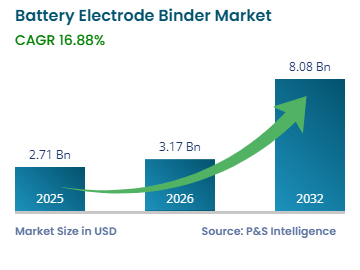
The global Battery Electrode Binder Market size was USD 2.71 billion in 2025 and is estimated at USD 3.17 billion in 2026. It is projected to reach USD 8.08 billion by 2032, advancing at a CAGR of 16.88% during 2026–2032. Demand is moving beyond standard adhesion toward formulations engineered for water-based coating, silicon-containing anodes, high-voltage cathodes, and emerging dry-electrode processes. These requirements raise the commercial value of qualification support and formulation consistency alongside production capacity.
Battery deployment provides a strong volume foundation. Global EV battery deployment reached 1.2 TWh in 2025, almost 30% more than in 2024, while EVs represented more than 70% of total battery deployment, according to the International Energy Agency’s Global EV Outlook 2026. Higher cell output expands the addressable electrode area, but binder revenue still depends on chemistry mix, loading rates, qualification timing, and supplier pricing.
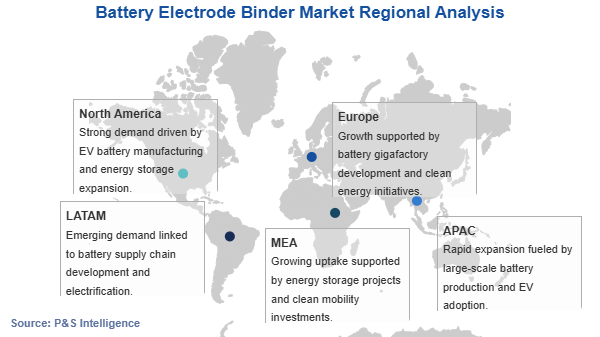
Asia-Pacific accounted for the largest Battery Electrode Binder Market share, at 62% in 2025, reflecting its concentration of battery-cell and electrode manufacturing. Europe is expected to record the fastest regional CAGR, at 18.8% during 2026–2032, as localized cell production and traceability requirements reshape material sourcing. This outlook remains sensitive to plant utilization, project delays, and changes in regional EV demand.
Key Market Insights
By chemistry, PVDF held a 42.00% share in 2025, while SBR/CMC is forecast to expand at an 18.21% CAGR through 2031.
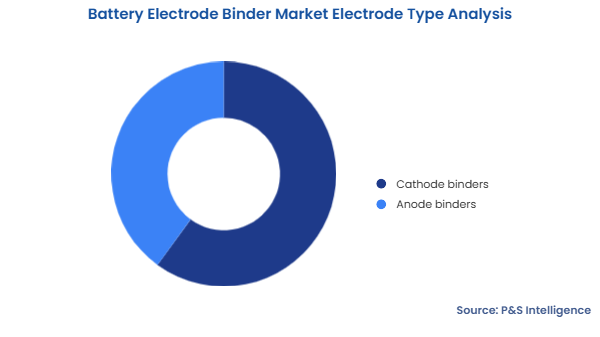
By electrode type, cathode binders accounted for a 60.00% share in 2025, while anode binders are projected to grow at an 18.33% CAGR through 2031.
By battery chemistry, NMC/NCA held a 49.00% share in 2025, while sodium-ion is projected to grow at a 17.89% CAGR through 2031.
By application, electric vehicles represented a 59.00% share in 2025, while stationary energy storage is projected to advance at a 19.05% CAGR through 2031.
By geography, Asia-Pacific held a 62% share in 2025, while Europe is projected to grow at an 18.8% CAGR during 2026–2032.
Battery Electrode Binder Market Trends and Growth Drivers
Rising cell output expands demand for qualified binder systems
Electric-vehicle and storage-cell production is the principal demand driver. Global EV battery deployment reached 1.2 TWh in 2025 and is projected to approach 3 TWh by 2030 under both the Current Policies and Stated Policies scenarios in the International Energy Agency’s Global EV Outlook 2026. Each additional production program requires binders that can maintain active-material cohesion, current-collector adhesion, and coating uniformity across repeated charge and discharge cycles.
The resulting Battery Electrode Binder Market growth is linked to qualified cell output rather than announced factory capacity alone. Binder suppliers must pass formulation trials and reliability testing before entering commercial production. Vendors with repeatable product specifications, application laboratories, and support near cell plants are better positioned to convert battery expansion into recurring material sales. Slower-than-planned factory ramp-ups remain a qualification on this demand relationship.
Water-based processing widens the supplier opportunity
The battery electrode binder industry can capture additional value as manufacturers adopt water-based electrode processing. SBR/CMC systems already support graphite anodes, while newer aqueous formulations target silicon-containing anodes and LFP cathodes. Zeon Corporation identifies electrode-expansion control and uniform LFP dispersion as development targets for its water-based binder portfolio, showing how process conversion creates requirements beyond basic bonding.
Silicon-rich anodes and dry coating redirect formulation development
Battery electrode binder industry trends increasingly center on mechanical resilience and manufacturing efficiency. Silicon-containing anodes can impose greater dimensional change during cycling than conventional graphite systems, increasing the need for binders that maintain particle contact and electrode integrity. BASF SE markets waterborne Licity binders for graphite and silicon-containing anodes, including grades designed for high substrate adhesion and stress management.
Dry-electrode development is also changing supplier priorities. Removing liquid solvent can reduce drying and solvent-recovery requirements, but commercial use still depends on compatibility with high-throughput coating and cell performance. Arkema S.A. has disclosed work on dry-process-capable PVDF binders and a dry-coating laboratory in France. Commercial timing remains uncertain because performance demonstrated in development equipment must still translate to high-throughput cell lines.
Qualification burdens slow material switching
Long validation cycles restrain rapid adoption of new binder systems. A formulation change can alter slurry rheology, drying behavior, electrode porosity, adhesion, impedance, and cycle life. Cell producers therefore evaluate a binder within the complete electrode process, which raises switching costs and favors materials with an established production record.
A proposed formulation can change more than one production variable at once, extending the test matrix across coating behavior and cell performance. Repeatable specifications, application testing, and support during customer trials can reduce implementation uncertainty, but they do not replace the cell maker’s validation process. Commercial adoption therefore follows verified electrode performance rather than laboratory compatibility alone.
PVDF held the largest chemistry share, at 42.00% in 2025. Its established position is supported by qualified cathode processes and performance under demanding electrochemical conditions. Kynar HSV 900 has been used in more than 10 million electric vehicles, according to Arkema S.A., providing a distinct scale indicator for the installed base of PVDF electrode-binder technology. The figure demonstrates commercial use, although it does not represent the entire PVDF segment.
SBR/CMC is forecast to record the fastest chemistry CAGR, at 18.21% through 2031. Growth is associated with water-based anode processing and compatibility with graphite and silicon-graphite designs. Adoption will depend on a formulation’s ability to balance elasticity, adhesion, dispersion, and electrode resistance rather than on its water-based carrier alone.
Electrode Type
Cathode binders accounted for the largest electrode-type share, at 60.00% in 2025. Their value position reflects established PVDF use and stringent stability requirements in high-voltage cathodes. A 2024 Argonne National Laboratory and National Renewable Energy Laboratory study used an NMC811 cathode containing 90 wt% NMC811, 5 wt% conductive carbon, and 5 wt% PVDF binder in cycle-life tests. This research formulation is not a market-average loading rate, but it provides a quantified example of binder use in a high-nickel cathode design.
Anode binders are projected to expand at the fastest CAGR, at 18.33% through 2031. Silicon addition, higher electrode density, and fast-charging targets increase mechanical and interfacial demands on the binder. Supplier development therefore focuses on limiting expansion, preserving electrical contact, and maintaining coating integrity after repeated cycling.
Battery Chemistry
NMC/NCA batteries held the largest battery-chemistry share, at 49.00% in 2025. NMC721, NMC811, and NCA accounted for roughly 80% of 2025 EV battery deployment using cobalt-containing chemistries, according to the International Energy Agency’s Global EV Outlook 2026. This deployment-mix statistic supports the installed-base mechanism for qualified cathode formulations, but it does not measure binder-market share.
Sodium-ion is projected to record the fastest battery-chemistry CAGR, at 17.89% through 2031. The sodium-ion scale-up phase described in the International Energy Agency’s Global EV Outlook 2026 includes prospective use in short-range vehicles, industrial equipment, and stationary storage. Commercial growth creates demand for binder systems matched to sodium-ion electrode materials, but adoption still depends on cell performance, manufacturing qualification, and lithium-ion price competition.
Application
Electric vehicles represented the largest application share, at 59.00% in 2025. EV battery deployment increased by almost 30% in 2025 to reach 1.2 TWh in the International Energy Agency’s Global EV Outlook 2026. This creates the largest commercial base for binder demand because traction cells require high-volume electrode coating and extended qualification, though actual binder value also varies with chemistry and formulation.
Stationary energy storage is projected to record the fastest application CAGR, at 19.05% through 2031. Battery storage was the fastest-growing power-sector technology in 2025, with roughly 110 GW added globally, according to the International Energy Agency’s Global Energy Review 2026. The expansion increases the cell-production base for storage-oriented electrodes and the qualified binder systems used in them.
The complete segmentation hierarchy is as follows:
Drive strategic growth with comprehensive market analysis
Battery Electrode Binder Market Regional Analysis
Asia-Pacific accounted for 62% of global revenue in 2025 and is projected to advance at an 18.0% CAGR during 2026–2032. Its position reflects the concentration of cell, electrode, and battery-material manufacturing across China, Japan, and South Korea. China represented 60% of global EV battery deployment in 2025, according to the International Energy Agency’s Global EV Outlook 2026. This manufacturing concentration supports a large regional demand base, while binder sales remain conditional on customer qualification and cell-line utilization.
The regional trajectory depends on both output growth and chemistry mix. Additional cell output can expand demand for qualified binder materials, but overcapacity can pressure utilization and delay material orders. Asia-Pacific would lose part of its relative advantage if Europe and North America convert announced plants into sustained production faster than expected, but the approved outlook retains regional leadership.
China represented an approved 48% of global demand in 2025. Its scale is supported by the country’s battery-cell production, integrated materials supply chain, and large domestic EV market. China recorded more than 13 million electric-car sales in 2025, accounting for six out of ten global electric-car sales in the International Energy Agency’s Global EV Outlook 2026. High cell output supports a large addressable base for qualified electrode binders without determining supplier-level sales.
China’s trajectory remains positive under the approved country outlook, with growth conditional on cell output and binder qualification across electric-vehicle and storage programs. Its global share could ease if export barriers increase, EV growth slows, or overseas cell plants localize more electrode-material sourcing.
Europe is expected to deliver the fastest Battery Electrode Binder Market growth, at a CAGR of 18.8% during 2026–2032. The region’s opportunity is tied to localized battery production, automotive electrification, and closer documentation of material origin and performance. Battery passports are scheduled to become mandatory on February 18, 2027, for specified EV, light-mobility, and industrial batteries under the European Commission’s current indicative implementation timeline. Although the obligation rests with the economic operator placing the finished battery on the market, component suppliers may face additional data requests from customers.
European growth is not assured by regulation or announced capacity. Binder sales depend on operating cell lines, customer qualification, and competitive production economics. Local technical service and traceable product data can improve supplier access, while weak utilization or project cancellations would reduce the expected demand ramp. A slower EV transition or prolonged reliance on imported cells would also weaken Europe’s forecast advantage.
Germany is projected to record a 19.5% CAGR during 2026–2032 under the approved country outlook. Its distinct mechanism is a local pilot-to-industrial qualification route for electrode and cell-production processes. In December 2025, FFB PreFab in Münster produced its first electrically functional lithium-ion cell through an end-to-end process from electrode production to the charged cell, according to Fraunhofer FFB. The operating pilot environment gives companies a place to test electrode-process compatibility, but it does not measure commercial binder sales or plant utilization.
The country’s trajectory depends on transferring pilot work into repeatable industrial production. The larger FFB Fab research building is scheduled for construction completion at the end of 2027, followed by commissioning, and is intended to let companies test production steps under industrial conditions, according to Fraunhofer FFB. The facility’s role as a bridge between research, production, and industrial manufacturing was independently described in a September 2025 German Federal Government record. Germany’s position could weaken if construction or commissioning slips, companies do not use the infrastructure at scale, or research programs fail to convert into sustained commercial cell output.
The battery electrode binder industry has a gray-zone competitive structure. A limited set of established fluoropolymer and functional-polymer suppliers serves globally qualified battery programs, while regional specialists compete in water-based, silicon-compatible, and application-specific formulations. Public reporting rarely isolates electrode-binder revenue from broader polymer portfolios, which prevents a defensible company-by-company revenue ranking within the approved scope.
Competition is intense around qualification history, lot consistency, application support, intellectual property, and regional supply. Arkema S.A. competes through its Kynar PVDF platform, LFP-oriented grades, and dry-electrode development. Zeon Corporation differentiates through water-based anode and cathode binders, including formulations aimed at silicon-related expansion and LFP dispersion. BASF SE addresses graphite and silicon-containing anodes through its waterborne Licity portfolio.
Market evolution is widening the basis of competition. Incumbent PVDF suppliers are adapting grades for lower loading and new cathode designs, while SBR/CMC and acrylic-system suppliers target solvent reduction and mechanically demanding anodes. Dry-electrode processes could create another route for fluoropolymer and specialty-binder differentiation, but their commercial effect depends on scale-up and cell-maker qualification.
Entry barriers remain material. A new supplier must demonstrate electrochemical stability, mechanical performance, slurry or dry-process compatibility, and consistent manufacturing quality across customer trials. Buyers benefit from more chemistry options and regional supply, yet switching an approved binder can require electrode redesign and reliability validation. This favors suppliers that combine polymer production with cell-testing capability and technical support near customer plants.
Top Companies in Battery Electrode Binder Market:
Arkema S.A.
Solvay S.A.
Kureha Corporation
Zeon Corporation
JSR Corporation
Ashland Inc.
BASF SE
Dow Inc.
Daicel Corporation
Mitsubishi Chemical Group Corporation
Nippon Paper Industries Co. Ltd.
Targray Technology International Inc.
Battery Electrode Binder Market Developments
In July 2026, Lawrence Berkeley National Laboratory made a patent-pending dual-charge-conducting electrode binder available for licensing and collaborative research. The technology targets silicon-oxide anodes and creates an early research route, but its proof-of-concept status does not establish commercial readiness.
In June 2026, Arkema S.A. completed a 15% Kynar PVDF capacity expansion at its Calvert City, Kentucky, site. The increase broadens regional supply, but the output serves lithium-ion batteries, energy storage, semiconductors, and infrastructure rather than binder demand alone.
In May 2026, Trinseo PLC commercially launched VOLTABOND 211, a water-based SBR binder for graphite and silicon-based lithium-ion battery anodes. Commercial availability adds a supplier option for fast-charging formulations, but launch status does not prove customer adoption.
Frequently Asked Questions About This Report
What was the battery electrode binder market size in 2025?+
The global battery electrode binder market size was USD 2.71 billion in 2025 and is estimated at USD 3.17 billion in 2026.
Which region held the largest market share?+
Asia-Pacific accounted for the largest battery electrode binder market share, at 62% in 2025, reflecting its concentration of battery-cell and electrode manufacturing.
Which region is expected to grow fastest?+
Europe is expected to record the fastest regional CAGR, at 18.8% during 2026
What drives demand for qualified binder systems?+
Higher cell output expands the addressable electrode area, but binder revenue still depends on chemistry mix, loading rates, qualification timing, and supplier pricing.
Want a report tailored exactly to your business need?
Leading companies across industries trust us to deliver data-driven insights and innovative solutions for their most critical decisions. From data-driven strategies to actionable insights, we empower the decision-makers who shape industries and define the future. From Fortune 500 companies to innovative startups, we are proud to partner with organisations that drive progress in their industries.
Client Testimonials
Working with P&S Intelligence and their team was an absolute pleasure – their awareness of timelines and commitment to value greatly contributed to our project's success. Eagerly anticipating future collaborations.
McKinsey & Company
India
Unmatched Standards
Our insights into the minutest levels of the markets, including the latest trends and competitive landscape, give you all the answers you need to take your business to new heights
Complete Data Security
We take a cautious approach to protecting your personal and confidential information. Trust is the strongest bond that connects us and our clients, and trust we build by complying with all international and domestic data protection and privacy laws