This Report Provides In-Depth Analysis of the Autonomous Truck Market Report Prepared by P&S Intelligence, Segmented by Truck Type (Light-Duty Trucks, Medium-Duty Trucks, Heavy-Duty Trucks), Level of Autonomy (SAE Level 1-2 (Driver Assist), SAE Level 3 (Conditional), SAE Level 4 (High), SAE Level 5 (Full)), ADAS Feature (Adaptive Cruise Control, Lane Departure Warning, Traffic Jam Assist, Highway Pilot, Automatic Emergency Braking, Blind-Spot Detection, Lane-Keeping Assist), Industry (Manufacturing, Construction and Mining, Military, FMCG), Component (LiDAR, RADAR, Cameras, Ultrasonic and Other Sensors, AI Compute Modules), Propulsion Type (IC Engine, Battery-Electric, Hybrid/Plug-in Hybrid, Hydrogen Fuel-Cell), and Geographical Outlook for the Period of 2019 to 2032
Explore the market potential with our data-driven report
Autonomous Truck Market Future Outlook
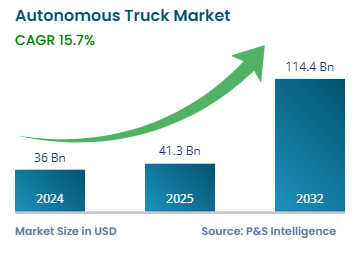
The autonomous truck market size was USD 36 billion in 2024, and it will grow by 15.7% during 2025–2032, to reach USD 114.4 billion by 2032.
The market growth is driven by the rising demand for safe and efficient transportation solutions, advancements in technologies, and the need to control labor and fuel expenses. These trucks use cameras and GPS systems to operate without any human intervention. The rising inadequacy of commercial drivers and growing pressure for supply chain efficiency also propel the market.
Governments are creating rules for pilot projects and developing infrastructure to support autonomous driving. For instance, in the U.S., the National Highway Traffic Safety Administration has designed rules for testing and using self-operated vehicles. Moreover, the U.S. Department of Transportation is upgrading roads with AV lanes and smart traffic gadgets for the safe operation of autonomous trucks.
However, the biggest reason for the market growth is the expansion in domestic and international trade. As per the UNCTAD, the value of global trade was expected to cross USD 33 trillion in 2024, almost USD 1 trillion more than in 2023. As per numerous studies, roads carry almost 60% of the goods by volume domestically, with trucks playing a vital role in connecting industrial hubs, logistics centers, railway terminals, airports, ports, and sea freight terminals.
Autonomous Truck Market Growth Factors
Rapid Technological Advancements Are Key Trend
Technological innovations, such as LiDAR, AI, and self-driving systems, are making autonomous trucks safe and more advanced.
Strategic partnerships among manufacturers, logistics firms, and tech companies are enhancing the design and quickening the rollout of these systems.
These partnerships boost work efficiency, minimize human intervention, and enable stakeholders to handle major challenges, such as worker shortage and traffic safety issues.
According to the American Trucking Association, driver shortage in the U.S. is expected to increase from 80,000 in 2022 to 160,000 by 2030.
According to the International Road Transport Union, Europe has more than 200,000 unfilled truck driver jobs, and this number is expected to reach 745,000 by 2028, led by Poland, France, and Germany.
The U.S. Department of Transportation supports field tests and pilot programs as autonomous vehicles can minimize fuel consumption and operate actively without driver breaks.
This advancement also supports the global goals for electrification and sustainability.
Many companies are working on electric autonomous trucks to reduce carbon emissions and follow strict eco-friendly policies.
Rising Need for Fuel Efficiency and Cost Optimization Is Biggest Driver
The autonomous trucking technology is boosting logistics with better performance and eco-friendly practices, which is a key market driver.
By using advanced technologies, like AI, machine learning, these trucks enable the accurate control of speed, acceleration, and braking, which makes driving smoother and helps in reducing fuel cost.
According to a TuSimple Holdings Inc. and UC San Diego study, autonomous trucks can reduce fuel expenses by 10% compared to manually driven trucks and save 4 billion gallons of fuel every year.
This fuel saving can also minimize 42 million tonnes of COâ‚‚ emissions per year, helping reduce the ecological effects of the transportation sector.
The automatic lower of the speed by these trucks in urban areas saves fuel, especially in stop-and-go traffic, where automation enhances accuracy.
Smart maintenance features monitor the conditions of the vehicle in real time, helping reduce the likelihood of major problems and need for emergency repairs.
Autonomous Truck Market Segmentation Analysis
Truck Type Analysis
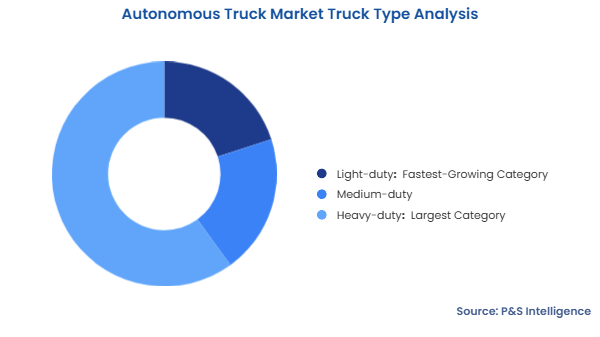
The heavy-duty category held the largest market share, of 60%, in 2024 because of its widespread use in long-haul freight transport, mining, and port operations. Their high cargo capacity and sustainability for fixed routes encourage investments in heavy-duty autonomous trucks by freight carriers.
The light-duty category will have the highest CAGR, due to the rising demand for urban and last-mile deliveries, especially due to the growth of the e-commerce sector. This includes electric autonomous vans and pickups deployed for e-commerce and retail logistics, especially in densely populated areas. As per the UNCTAD, B2C e-commerce order value could grow to USD 5.5 trillion by 2027.
The truck types analyzed in this report are:
Light-duty (Fastest-Growing Category)
Medium-duty
Heavy-duty (Largest Category)
Level of Autonomy Analysis
The SAE level 1–2 category held the largest market share, of 65%, in 2024 due to the early availability and acceptance, regulatory reasons, and ease of integration into existing commercial vehicles. Features such as adaptive cruise control, lane departure warning, and automatic emergency braking assist the driver but do not take control away from them. These systems provide safety, reduce driver fatigue, and improve efficiency without complete autonomy.
The SAE Level 4 category will have the highest CAGR because Level 4 trucks can autonomously move in certain zones and without any operator inside, such as on highways or fixed delivery routes. Companies are testing and investing in level-4 autonomous trucks. Volvo’s VNL autonomous truck level 4 is projected to launch in 2025, highlighting the level-4 technologies as high-end and full driverless services.
The level of autonomy analyzed in this report are:
SAE Level 1–2 (Driver Assist) (Largest Category)
SAE Level 3 (Conditional)
SAE Level 4 (High) (Fastest-Growing Category)
SAE Level 5 (Full)
ADAS Feature Analysis
The adaptive cruise control category held the largest market share, of 70%, in 2024, because it increases safety. Additionally, digital transformation, such as RADAR technology, and regulations mandating ACC in commercial vehicles drive this category. The rising electric and hybrid vehicle sales also contribute to the market growth.
The ADAS features analyzed in this report are:
Adaptive Cruise Control (Largest Category)
Lane Departure Warning
Traffic Jam Assist
Highway Pilot (Fastest-Growing Category)
Automatic Emergency Braking
Blind-Spot Detection
Lane-Keeping Assist
Industry Analysis
The FMCG category held the largest market share, of 75%, in 2024 due to the rising demand for fast and efficient deliveries and greater reliance on high-frequency logistics. A large chunk of the FMCG deliveries are now made over short distances, as a result of the rising number of people shopping online. As per studies, over 2.7 billion people, which is more than 30% of the global population, shop online.
The construction and mining category will have the highest CAGR, due to the rising use of self-driving haul trucks and machinery to boost safety, productivity, and minimize labor costs in tough and remote areas. The growing population globally drives the demand for residential, public, industrial, and commercial infrastructure, which, in turn, propels need for all kinds of metals and non-metals. As per studies, global construction spending crossed USD 13 trillion in 2023 and rose beyond USD 14.5 trillion in 2024. Moreover, the global mining sector produced over 18.5 billion tonnes of materials in 2022.
The industries analyzed in this report are:
Manufacturing
Construction and Mining (Fastest-Growing Category)
Military
FMCG (Largest Category)
Others
Component Analysis
The RADAR category held the largest market share, of 80% in 2024, due to its cost-effectiveness, stability, and high durability in adverse climates. They are widely used for advanced cruise control and an autonomous braking system, making it ideal for OEMs.
The LiDAR category will have the highest CAGR, due to advancing 3D imaging capability, rising demand in advanced self-driving models, and reducing costs. RoboSense, shipped 519,800 LiDAR units in 2024, highlighting the importance of this technology for autonomous driving.
The components analyzed in this report are:
LiDAR (Fastest-Growing Category)
RADAR (Largest Category)
Cameras
Ultrasonic and Other Sensors
AI Compute Modules
Propulsion Type Analysis
The IC engine category held the largest market share, of 85% in 2024, due to the well-developed infrastructure, low initial costs, and enhanced driving distance. They are durable and reliable, making them ideal for long-distance travel across different climates. The easy availability of diesel in remote and rural locations further makes ICE the predominant propulsion. As per the International Energy Agency, 91% of the final energy consumed by the global transportation sector in 2022 came from oil products.
The battery-electric category will have the highest CAGR, due to the strict environmental rules, especially in the U.S. and Europe. The European Union’s Green Deal plans to reduce carbon emissions by 55% below the levels in 1990 by 2030. This shift supports the use of electric trucks, and many companies are creating autonomous electric trucks. Tesla’s Semi is powered by autonomous driving abilities and has been adopted by companies like PepsiCo, to minimize carbon emissions. As per the IEA’s Global EV Outlook 2025 report, electric heavy-duty truck sales rose beyond 90,000 units in 2024.
The propulsion types analyzed in this report are:
IC Engine (Largest Category)
Battery-Electric (Fastest-Growing Category)
Hybrid/Plug-in Hybrid
Hydrogen Fuel-Cell
Drive strategic growth with comprehensive market analysis
Autonomous Truck Market Regional Outlook
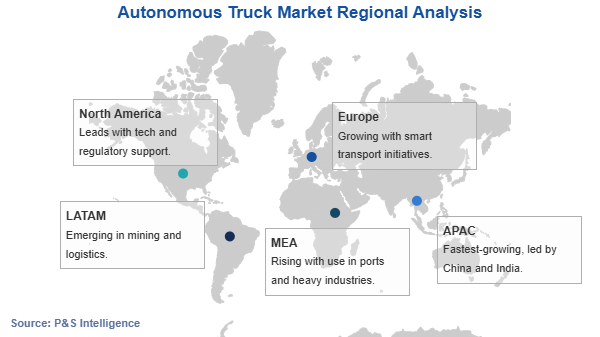
North America held the largest market share, of 40%, in 2024, due to the widespread use of advanced technology, major investments by large companies, and increasing demand for affordable and efficient logistics solutions. The strong government support for the testing of self-driving trucks accelerates the market growth. Companies such as Tesla, Aurora, and Waymo are actively testing and launching autonomous trucks. The Bureau of Transportation Statistics says that trucks carried 12,975 million tonnes of freight around the country in 2022, compared to 12,800 million tonnes in 2017. This number will further rise to 19,304 million tonnes by 2050.
Asia-Pacific will have the highest CAGR due to the strong public support, local technological advancement, and broad utilization in transportation. China, Japan, India, and South Korea are the drivers of the market in this region due to government initiatives and investments in freight, construction, and mining. China leads the regional market with its smart highway projects, helping companies reach 20 million driverless kilometers by mid-2025. Moreover, South Korea’s K-Mobility 2030 plan aims to build smart road systems across the country. The NITI Aayog says that roads carry more than 70% of the freight, by volume, in India.
The geographical breakdown of the market is as follows:
North America (Largest Regional Market)
North America (Larger and Faster-Growing Country)
Canada
Europe
Germany (Largest and Fastest-Growing Country)
U.K.
France
Italy
Spain
Rest of Europe
Asia-Pacific (Fastest-Growing Regional Market)
China (Largest Country)
India (Fastest-Growing Country)
Japan
South Korea
Australia
Rest of APAC
Latin America
Brazil (Largest Country)
Mexico (Fastest-Growing Country)
Rest of LATAM
Middle East and Africa
Saudi Arabia (Fastest-Growing Country)
South Africa
U.A.E. (Largest Country)
Rest of MEA
Autonomous Truck Market Share
The market is fragmented because of the presence of large global and regional players working on AI algorithms and sensor systems. Moreover, companies are focusing on solutions that provide safety and efficiency, which leads the niche and emerging brands to innovate products. As a result, no company dominates the market, making it highly competitive. Additionally, a large number of truck manufacturers already exist around the world, and they are increasingly incorporating autonomous features into their models.
Key Autonomous Truck Companies:
AB Volvo
Aurora Innovation, Inc.
TuSimple Holding Inc.
Kodiak Robotics, Inc.
PACCAR Inc.
Waymo LLC
Toyota Motor Corporation
Scania AB
PlusAI Inc.
Einride AB
Navistar, Inc.
Ford Motor Company
Autonomous Truck Market News & Updates
In June 2025, Plus Automation, a developer of autonomous trucks, announced plans to merge with Churchill Capital Corp IX in a deal valued at USD 1.2 billion.
In June 2025, Vay and Kodiak Robotics announced a partnership to help the latter further develop its patented Assisted Autonomy technology via the integration of Vay Stations and certain software tools.
In June 2025, Torc Robotics joined the Stanford Center for AI Safety in developing and advancing ML algorithms for autonomous driving.
In April 2025, Plus Al Inc. and Hyundai Motor Company collaborated to integrate the latter’s Plus SuperDrive with Hyundai’s XCIENT hydrogen fuel-cell Class 8 trucks. The collaboration aims to create a zero-emission self-driving logistics network in the U.S.
In January 2025, Aurora Innovation, Inc., Nvidia Corporation, and Continental AG entered a strategic partnership to integrate Nvidia’s Drive Thor computing platform and DriveOS into Aurora’s autonomous driving system, aiming to develop and scale bulk production of SAE Level 4 autonomous trucks.
In February 2025, Waabi Innovation Inc. and AB Volvo partnered to integrate AI drivers into Volvo’s VNL Autonomous trucks.
In May 2024, AB Volvo and Daimler Truck AG issued a joint venture named Coretura to create a shared software-defined vehicle platform for heavy-duty trucks.
Want a report tailored exactly to your business need?
Leading companies across industries trust us to deliver data-driven insights and innovative solutions for their most critical decisions. From data-driven strategies to actionable insights, we empower the decision-makers who shape industries and define the future. From Fortune 500 companies to innovative startups, we are proud to partner with organisations that drive progress in their industries.
Client Testimonials
Working with P&S Intelligence and their team was an absolute pleasure – their awareness of timelines and commitment to value greatly contributed to our project's success. Eagerly anticipating future collaborations.
McKinsey & Company
India
Unmatched Standards
Our insights into the minutest levels of the markets, including the latest trends and competitive landscape, give you all the answers you need to take your business to new heights
Complete Data Security
We take a cautious approach to protecting your personal and confidential information. Trust is the strongest bond that connects us and our clients, and trust we build by complying with all international and domestic data protection and privacy laws