This Report Provides In-Depth Analysis of the Autonomous Enterprise Market Report Prepared by P&S Intelligence, Segmented by Component (Solutions, Services), Business Function (Accounting & Finance, Information Technology, Human Resources, Sales & Marketing, Supply Chain & Operations), Application (Process Automation, Customer & Employee Engagement, Order Management, Credit Evaluation & Management, Predictive Maintenance), End Use Industry (BFSI, IT & Telecom, Manufacturing, Healthcare, Retail & E-commerce, Transportation & Logistics, Government & Public Sector, Energy & Utilities), and Geographical Outlook for the Period of 2021 to 2032
Explore the market potential with our data-driven report
Autonomous Enterprise Market Overview
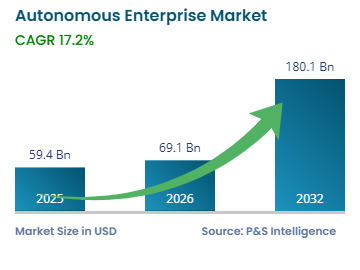
The autonomous enterprise market size was USD 59.4 billion for 2025, and it will grow by 17.2% during 2026–2032, to reach USD 180.1 billion by 2032.
The autonomous enterprise market is experiencing robust growth due to the increasing adoption of artificial intelligence, machine learning, robotic process automation, and intelligent automation technologies that enable organizations to automate complex business processes with minimal human intervention. Enterprises are investing in autonomous systems to improve operational efficiency, reduce costs, enhance workforce productivity, and accelerate decision-making through real-time data analysis. The growing demand for hyperautomation, intelligent business process management, and AI-powered enterprise software is further accelerating market expansion. According to the International Data Corporation (IDC), global AI and generative AI spending is projected to exceed USD 631 billion by 2028, growing from nearly USD 235 billion in 2024, as enterprises accelerate AI adoption across business functions.
The market is further driven by increasing cloud adoption, digital transformation initiatives, and the growing deployment of generative AI and autonomous agents across finance, IT operations, customer service, cybersecurity, and supply chain management. Organizations are leveraging these technologies to improve business resilience, optimize resource utilization, strengthen security, and enhance customer experiences while addressing labor shortages and operational complexity. According to IDC, more than 50% of the enterprise application market is already enhanced with AI assistants or AI advisors, while approximately 20% is further supplemented with complete AI agents, highlighting the rapid integration of autonomous AI capabilities into enterprise software.
Key Market Insights
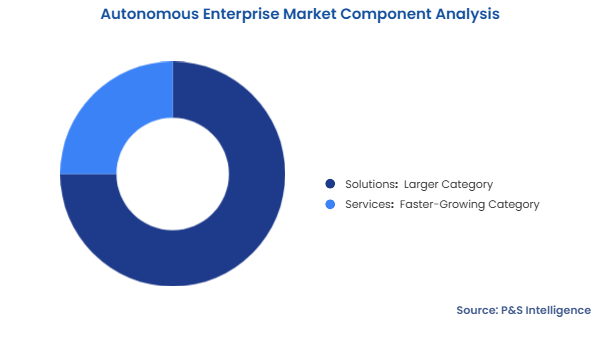
The solutions category holds the larger market share, of 75%, in 2025, driven by the growing adoption of RPA, autonomous agents, and intelligent automation.
The services category will have the higher CAGR, of approximately 17.5%, driven by growing demand for implementation, integration, and managed services.
The process automation category holds the largest market share, of 35%, in 2025, driven by widespread adoption of autonomous workflow automation.
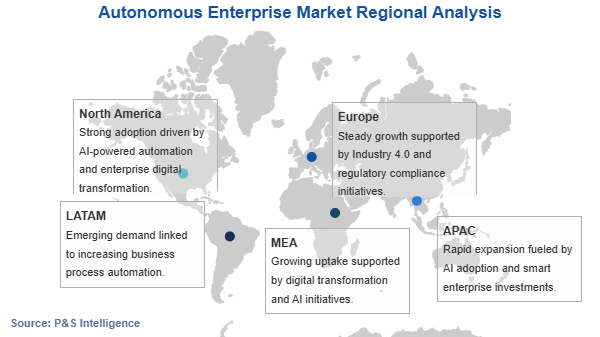
North America holds the largest market share, of 40%, in 2025, driven by a concentration of hyperscale cloud providers and enterprise software vendors.
Asia-Pacific will have the highest CAGR, of approximately 18.1%, driven by digital transformation, AI investment, and cloud adoption.
Autonomous Enterprise Market Trends and Drivers
Emergence of Agentic AI and Autonomous Agents across Enterprise Workflows Are Key Trends
The emergence of agentic AI and autonomous agents is redefining how enterprises execute and manage business operations. Unlike traditional automation solutions that perform predefined tasks, autonomous agents can independently plan, reason, execute, and optimize complex workflows while interacting with multiple enterprise applications and data sources. Organizations are increasingly deploying these AI agents across finance, IT operations, procurement, customer service, cybersecurity, and supply chain management to automate decision-making, improve operational agility, and reduce manual intervention. This shift is enabling enterprises to transition from isolated task automation to intelligent, end-to-end autonomous business processes.
The growing adoption of agentic AI is prompting enterprises to redesign their digital transformation strategies around intelligent orchestration and autonomous decision-making. Technology vendors are embedding AI agents into enterprise resource planning (ERP), customer relationship management (CRM), human capital management (HCM), and other enterprise platforms to improve efficiency and business responsiveness. According to IDC, 42% of enterprises already have AI agents in production, while another 40% plan to deploy them within the next year, reflecting the rapid adoption of agentic automation, which is expected to enhance the capabilities of more than 40% of enterprise applications by 2027. These developments highlight the rapid transition toward AI-driven autonomous enterprise ecosystems.
Growing Cloud Adoption and Intelligent Workflow Orchestration Are Biggest Drivers
The increasing adoption of cloud computing is a major driver of the autonomous enterprise market. Cloud infrastructure provides the scalability and computing power required to deploy AI-driven automation, autonomous agents, and intelligent workflow orchestration, allowing enterprises to scale automation capabilities as operational needs evolve. Enterprises are migrating mission-critical applications and business processes to cloud environments to enable real-time data access, supporting seamless integration across business functions and continuous optimization of operations. Cloud-native architectures facilitate faster deployment of autonomous enterprise solutions while reducing infrastructure costs and improving system resilience. According to the Ministry of Electronics and Information Technology (MeitY), India's public cloud services market is projected to reach approximately USD 24.2 billion by 2028. This growth reflects the country's accelerating cloud adoption and digital transformation initiatives that support enterprise automation.
The widespread adoption of cloud services is enabling organizations to integrate artificial intelligence, analytics, cybersecurity, and automation capabilities into a unified digital ecosystem. This integration is accelerating the deployment of autonomous solutions across finance, IT, human resources, supply chain, and customer operations. According to Eurostat, 45.2% of large enterprises in the European Union purchased cloud computing services for advanced applications in 2023. As cloud adoption continues to expand globally, it is creating a foundation for the growth of autonomous enterprise platforms.
Data Privacy, Cybersecurity, and Governance Challenges Are Key Restraints
Data privacy, cybersecurity, and governance concerns remain restraints on the growth of the autonomous enterprise market. Autonomous enterprise platforms continuously process large volumes of sensitive business, financial, operational, and customer data while enabling AI-driven decision-making across interconnected systems. As organizations expand the deployment of autonomous agents and AI-powered automation, concerns regarding unauthorized data access, algorithm transparency, regulatory compliance, and cyber threats are increasing. Enterprises operating in highly regulated sectors such as BFSI, healthcare, and government often face stringent data protection requirements. These requirements make the deployment of autonomous systems more complex and time-consuming.
The increasing frequency and sophistication of cyberattacks are compelling organizations to strengthen security frameworks before implementing enterprise-wide autonomous solutions. This security-hardening step is slowing adoption in some industries. Compliance with regulations such as GDPR, sector-specific security standards, and national data protection laws adds to implementation complexity and costs. According to the European Union Agency for Cybersecurity (ENISA), the public administration, digital service providers, and financial sectors were among the most targeted industries in the EU Threat Landscape 2024, highlighting the growing cybersecurity risks associated with highly interconnected digital enterprise environments. These challenges continue to restrain the widespread adoption of autonomous enterprise platforms among organizations handling critical and sensitive information.
Expansion of Autonomous Enterprise Solutions across Small and Medium-Sized Enterprises Is Biggest Opportunity
The increasing digital transformation of small and medium-sized enterprises (SMEs) presents a significant growth opportunity for the autonomous enterprise market. Traditionally, autonomous technologies were adopted primarily by large organizations due to high implementation costs and complex IT infrastructure requirements. However, the emergence of cloud-native platforms, software-as-a-service (SaaS) delivery models, low-code development tools, and subscription-based pricing has made autonomous enterprise solutions more affordable and accessible for SMEs. In India, the Ministry of Micro, Small and Medium Enterprises (MSME) reported that more than 50.8 million enterprises had registered on the Udyam portal as of July 2026, reflecting the vast and expanding base of formalized businesses that can adopt AI-driven automation and autonomous enterprise solutions.
Governments worldwide are also promoting SME digitalization through dedicated funding programs, digital innovation initiatives, and technology adoption schemes, further creating favorable conditions for market expansion. The integration of AI, automation, and intelligent analytics enables SMEs to improve competitiveness, reduce operational costs, and scale operations without significant investments in traditional IT infrastructure. According to the OECD, SMEs represent around 99% of all firms across OECD countries and generate 50% to 60% of value added on average, highlighting the substantial market potential for autonomous enterprise solution providers as these businesses accelerate digital transformation.
The solutions category holds the larger market share, of 75%, in 2025, driven by enterprises' preference for modular platforms that integrate with existing ERP, CRM, and cloud infrastructure without requiring extensive system replacements, alongside the increasing deployment of robotic process automation (RPA), autonomous agents, and intelligent workflow orchestration across core business functions. The expansion of AI-powered enterprise applications and automation platforms continues to drive investment in software solutions that improve operational efficiency and decision-making.
The services category will have the higher CAGR, of approximately 17.5%, driven by the increasing enterprise reliance on external expertise to design, implement, integrate, and manage complex autonomous enterprise environments. As organizations deploy AI agents, intelligent automation, and governance frameworks at scale, demand for professional consulting, system integration, managed services, and ongoing optimization continues to rise. The shortage of skilled AI and automation professionals encourages enterprises to partner with specialized service providers rather than build capabilities entirely in-house. According to the U.S. Bureau of Labor Statistics, approximately 317,700 annual job openings are projected in computer and information technology occupations during 2024–2034, with a median annual wage of USD 105,990, highlighting the persistent talent gap that supports continued expansion of the services segment.
The components analyzed in this report are:
Solutions (Larger Category)
Robotic Process Automation (RPA)
Autonomous Agents
Autonomous Network Management
Security Automation
Finance & Accounting Automation
Others
Services (Faster-Growing Category)
Professional Services
Managed Services
Business Function Analysis
The IT category holds the largest market share, of 45%, in 2025, driven by its role as the primary integration hub through which autonomous capabilities are deployed across enterprise systems, enabling automation to extend to finance, human resources, sales, and operations. Organizations typically implement autonomous network management, AI-powered IT operations (AIOps), self-healing infrastructure, and intelligent workflow orchestration within IT first, as these functions are directly responsible for system performance, cybersecurity, and digital infrastructure.
The supply chain & operations category will have the highest CAGR, of approximately 17.7%, driven by the rising adoption of AI-powered supply chain planning, warehouse automation, demand forecasting, inventory optimization, logistics orchestration, and predictive maintenance. Organizations are increasingly deploying autonomous technologies to improve operational efficiency and enhance supply chain resilience. These deployments reduce costs and enable real-time decision-making across complex global supply networks.
The business functions analyzed in this report are:
The process automation category holds the largest market share, of 35%, in 2025, driven by broad enterprise adoption of autonomous tools to execute structured, high-volume workflows. These workflows span invoice processing, data reconciliation, routine approvals, and workflow orchestration. Enterprises typically begin their autonomous transformation with process automation due to its relatively straightforward implementation. This approach delivers immediate, measurable gains in operational efficiency and accuracy, with corresponding reductions in cost. According to the Federal Reserve Bank of Minneapolis's analysis of U.S. Census Bureau Business Trends and Outlook Survey data, approximately 10% of businesses reported using AI in producing goods or services by late 2025. This share is roughly double the figure recorded in mid-2024, highlighting the accelerating adoption of AI-driven automation across enterprise operations.
The predictive maintenance category will have the highest CAGR, driven by the increasing deployment of autonomous monitoring systems that analyze real-time equipment data to detect anomalies and predict failures before they occur. Growing emphasis on reducing unplanned downtime and extending asset life is accelerating enterprise investment in AI-powered predictive maintenance solutions, while improving operational efficiency is further reinforcing enterprise adoption. The U.S. Department of Energy's Federal Energy Management Program reports that predictive maintenance delivers 8%–12% greater cost savings than preventive maintenance programs. This cost advantage reinforces the value proposition of predictive maintenance and is accelerating the transition toward autonomous, condition-based maintenance strategies.
The applications analyzed in this report are:
Process Automation (Largest Category)
Customer & Employee Engagement
Order Management
Credit Evaluation & Management
Predictive Maintenance (Fastest-Growing Category)
Others
End Use Industry Analysis
The BFSI category holds the largest market share, of 25%, in 2025, driven by high transaction volumes, stringent regulatory reporting requirements, and early digital banking adoption that created natural entry points for autonomous decision-making in credit evaluation, fraud detection, and compliance workflows. These factors are accelerating investments in AI-driven autonomous workflows that improve operational efficiency, strengthen fraud prevention, and enhance regulatory compliance.
The manufacturing category will have the highest CAGR, driven by smart factory initiatives and Industry 4.0 adoption that are expanding autonomous capabilities from administrative functions to production operations. Growing deployment of AI-driven predictive maintenance, quality inspection, autonomous robotics, and real-time production optimization is accelerating digital transformation across manufacturing facilities. The U.S. Department of Energy estimates that unplanned downtime costs industrial manufacturers approximately USD 50 billion annually in the United States. This cost burden reinforces the business case for autonomous monitoring, predictive analytics, and self-optimizing production systems that minimize operational disruptions.
The end use industries analyzed in this report are:
BFSI (Largest Category)
IT & Telecom
Manufacturing (Fastest-Growing Category)
Healthcare
Retail & E-commerce
Transportation & Logistics
Government & Public Sector
Energy & Utilities
Others
Drive strategic growth with comprehensive market analysis
Autonomous Enterprise Market Regional Outlook
North America Autonomous Enterprise Market Size
North America holds the largest market share, of 40%, in 2025, driven by a concentration of hyperscale cloud providers and enterprise software vendors. Venture capital investment in AI and automation startups has reinforced this base. Early modernization of enterprise resource planning (ERP) and IT service management systems created a mature foundation for deploying autonomous enterprise capabilities across the region. Regulatory frameworks governing data privacy, cybersecurity, and AI deployment have encouraged enterprise adoption across highly regulated industries such as BFSI and healthcare.
According to the Federal Reserve, approximately 78% of the U.S. labor force works at firms that have adopted AI, while around 54% works at firms using large language models (LLMs) as of late 2025. This level of AI and LLM adoption reflects the region's enterprise readiness for autonomous technologies.
U.S. Autonomous Enterprise Market Size
The U.S. is the largest and fastest-growing country market within North America, driven by the concentration of leading AI, cloud computing, and enterprise software providers in the country, along with high enterprise IT investment across the U.S. Widespread adoption of hybrid and digital-first operating models has accelerated deployment of autonomous enterprise solutions. Organizations across industries are increasingly deploying autonomous enterprise solutions to automate IT operations, customer service, cybersecurity, and business workflow orchestration, driving sustained investment in intelligent automation technologies. The country's mature digital infrastructure and innovation ecosystem reinforce market expansion.
According to the U.S. Census Bureau's 2023 Annual Business Survey, businesses adopted artificial intelligence, or AI, at a higher rate of 68.0% than other surveyed technologies between 2021 and 2022. Surveyed technologies included cloud-based technology at 40.0%, specialized software at 27.0%, specialized equipment at 23.6%, and robotics at 26.9%, highlighting the acceleration of AI adoption across U.S. enterprises and supporting continued demand for autonomous enterprise solutions.
Asia-Pacific Autonomous Enterprise Market Size
Asia-Pacific will have the highest CAGR, of approximately 18.1%, driven by government-led digital transformation initiatives, rising AI investment, and expanding cloud adoption across the region. Growing investment in artificial intelligence by both large enterprises and SMEs is accelerating the adoption of autonomous enterprise solutions across organizations of all sizes. The region's manufacturing base is accelerating the deployment of AI-powered automation, autonomous quality inspection, predictive maintenance, and intelligent production planning, while growing investments in digital infrastructure continue to strengthen enterprise automation capabilities across industries. This momentum is also reflected in recent industry developments. For instance, in July 2026, AutomationEdge Inc. partnered with Redington Limited to expand the availability of its Agentic Process Automation portfolio across India and the broader Asia-Pacific region through the Redington AI Exchange Marketplace.
According to the Asian Development Bank (ADB), a one-unit increase in urban digitalization reduces regional household income inequality by approximately 1.94%, demonstrating the broader economic benefits of digital transformation and the productivity improvements enabled by digital technologies across developing Asia. These productivity improvements are encouraging enterprises to invest in autonomous business operations, cloud-native platforms, and AI-driven workflow automation.
China Autonomous Enterprise Market Size
China is the largest country market within the Asia-Pacific region, driven by government support for digital transformation, rising adoption of artificial intelligence, or AI, across Chinese enterprises, and continued investment in smart manufacturing and industrial automation. National initiatives promoting the digital economy, industrial internet, and AI integration are encouraging enterprises to deploy autonomous systems across manufacturing, logistics, finance, healthcare, and public services. Expansion of 5G networks, cloud computing infrastructure, and the Industrial Internet of Things (IIoT) is enabling real-time data processing, intelligent decision-making, and enterprise-wide workflow automation. This infrastructure growth is accelerating the adoption of autonomous enterprise solutions across industries.
According to the National Data Administration's National Informatization Development Report 2025, the added value of China's core digital economy industries accounted for more than 10.5% of the country's GDP in 2025, while the country's core artificial intelligence industry exceeded RMB 1.2 trillion. The continued expansion of China's digital economy and AI ecosystem is creating a foundation for the deployment of autonomous enterprise platforms, intelligent automation, and AI-driven business operations across both public and private sectors.
The regions and countries analysed in this report are:
The autonomous enterprise market is fragmented due to the broad range of technologies and applications it encompasses, including artificial intelligence (AI), robotic process automation, autonomous agents, cloud computing, intelligent workflow orchestration, cybersecurity automation, and enterprise software. These diverse technology segments have attracted numerous global technology companies, enterprise software providers, cloud vendors, and specialized AI startups, each competing in different areas of the value chain. Companies such as Microsoft, IBM, SAP, Oracle, Salesforce, UiPath, and ServiceNow are among the leading participants. These companies apply their expertise in cloud infrastructure, AI platforms, enterprise applications, and automation software to strengthen their respective positions while competing across distinct solution categories. Additionally, continuous innovation is a defining feature of the competitive landscape, with strategic partnerships, acquisitions, and frequent product launches continuing to reshape the field and redraw category boundaries. As enterprises increasingly demand customized, industry-specific autonomous solutions, new entrants continue to emerge, reinforcing the market's fragmented structure and preventing dominance by a limited number of companies.
Key Players in the Autonomous Enterprise Market:
Microsoft Corporation
IBM Corporation
Oracle Corporation
SAP SE
ServiceNow, Inc.
Salesforce, Inc.
UiPath, Inc.
Automation Anywhere, Inc.
Pegasystems Inc.
Appian Corporation
Cisco Systems, Inc.
AutomationEdge Inc.
Autonomous Enterprise Market Developments
In May 2026, Automation Anywhere, Inc. unveiled Agentic Process Automation platform enhancements at its Imagine 2026 conference, including a Process Reasoning Engine paired with a Context Intelligence Graph that demonstrated over 30% higher accuracy in internal evaluations. The upgrade extends governance across the full agent lifecycle, from design-time testing to runtime monitoring.
In May 2026, SAP SE unveiled its Autonomous Enterprise platform vision at SAP Sapphire 2026, introducing agent-to-agent interoperability between SAP Joule and Microsoft 365 Copilot alongside new AI partnerships spanning Amazon Web Services, Google Cloud, and NVIDIA. The announcement extends agentic capabilities across HR, procurement, and supply chain functions.
In May 2026, IBM Corporation brought watsonx Orchestrate to general availability, launching an Agent Catalog with more than 150 pre-built agents and enterprise connectors spanning Salesforce, SAP, Workday, and Oracle. The release positions IBM's platform as a governed marketplace for multi-vendor agent deployment.
In February 2026, UiPath Inc. acquired WorkFusion, expanding its agentic automation capabilities for regulated financial services workflows including exception handling and compliance-heavy document processing. The acquisition strengthens UiPath's vertical-specific offerings in a segment where automation value is closely tied to measurable operational outcomes.
In February 2026, Cisco Systems, Inc. announced an expanded security portfolio for agentic AI workflows, combining AI Defense capabilities with AI-aware Secure Access Service Edge protections. The launch addresses enterprise demand for governance and resilient connectivity as autonomous agents interact across hybrid environments.
Frequently Asked Questions About This Report
What factors are driving the growth of the autonomous enterprise market?+
The market is driven by the increasing adoption of AI, ML, hyperautomation, robotic process automation, and the growing need to improve operational efficiency, reduce costs, and enable data-driven decision-making across enterprises.
What are the major challenges limiting the adoption of autonomous enterprise solutions?+
Key challenges include data privacy and cybersecurity concerns, integration with legacy IT systems, high implementation costs, a shortage of skilled AI professionals, and organizational resistance to change.
How are AI agents reshaping autonomous enterprise operations?+
AI agents automate complex workflows, support autonomous decision-making, optimize resource allocation, improve customer interactions, and continuously learn from enterprise data to enhance operational efficiency with minimal human intervention.
What role does hyperautomation play in the autonomous enterprise market?+
Hyperautomation integrates AI, RPA, process mining, analytics, and low-code platforms to automate end-to-end business processes, enabling enterprises to increase productivity, reduce manual effort, improve accuracy, and accelerate digital transformation.
What are the key regulatory and data security challenges affecting autonomous enterprise adoption?+
Organizations must comply with data protection regulations, industry-specific compliance requirements, AI governance frameworks, and cybersecurity standards while ensuring responsible AI usage, data transparency, and protection against cyber threats.
Want a report tailored exactly to your business need?
Leading companies across industries trust us to deliver data-driven insights and innovative solutions for their most critical decisions. From data-driven strategies to actionable insights, we empower the decision-makers who shape industries and define the future. From Fortune 500 companies to innovative startups, we are proud to partner with organisations that drive progress in their industries.
Client Testimonials
Working with P&S Intelligence and their team was an absolute pleasure – their awareness of timelines and commitment to value greatly contributed to our project's success. Eagerly anticipating future collaborations.
McKinsey & Company
India
Unmatched Standards
Our insights into the minutest levels of the markets, including the latest trends and competitive landscape, give you all the answers you need to take your business to new heights
Complete Data Security
We take a cautious approach to protecting your personal and confidential information. Trust is the strongest bond that connects us and our clients, and trust we build by complying with all international and domestic data protection and privacy laws