Autonomous Construction Equipment Market Size & Share Analysis - Trends, Drivers, Competitive Landscape, and Forecasts (2026 - 2032)
This Report Provides In-Depth Analysis of the Autonomous Construction Equipment Market Report Prepared by P&S Intelligence, Segmented by Level of Autonomy (Semi-Autonomous, Fully Autonomous), Equipment Type (Earthmoving Equipment, Construction Vehicles, Material Handling Equipment, Concrete and Road Construction Equipment), Application (Road and Transport Infrastructure, Building Construction, Other Civil Construction and Construction-Material Quarrying), and Geographical Outlook for the Period of 2021 to 2032
Autonomous Construction Equipment Market Size Estimation
Key Highlights
Study Period
2021 - 2032
Market Size in 2025
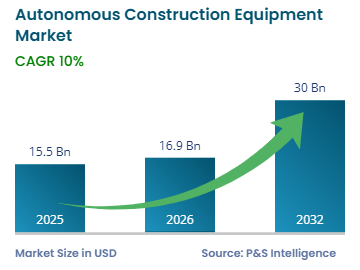
USD 15.50 Billion
Market Size in 2026
USD 16.90 Billion
Market Size by 2032
USD 30.00 Billion
Projected CAGR
10%
Largest Region
North America
Fastest Growing Region
Asia-Pacific
Market Structure
Moderately Fragmented
Market Size
Explore the market potential with our data-driven report
Autonomous Construction Equipment Market Overview
The autonomous construction equipment market size is estimated at USD 15.5 billion in 2025 and USD 16.9 billion in 2026. The market is projected to reach USD 30.0 billion by 2032, a 10.0% compound annual growth rate from 2026 to 2032. These are first-sale equipment and retrofit values, and the central case has low–medium confidence because the global share of machines meeting the active-control threshold has not been measured directly.
Contractors have a practical reason to test automatic grading, compaction, and site travel where work can be repeated against a digital plan. In the U.S., the Bureau of Labor Statistics projects an average of 42,500 annual openings for construction equipment operators over 2025–2035, largely as workers leave or change occupations. This national workforce measure illustrates one purchasing pressure. It does not establish a global automation adoption rate.
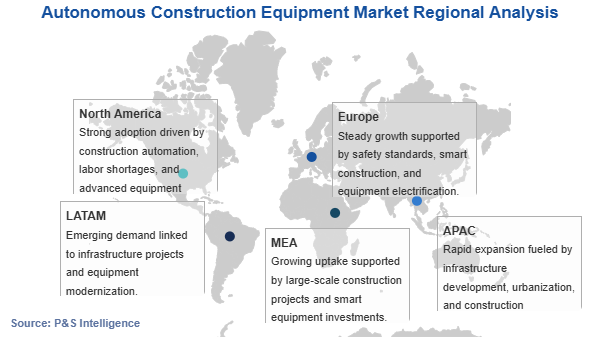
North America holds the largest modeled 2025 share, at 35.1%, while Asia-Pacific is projected to grow fastest at 11.3% annually from 2026 to 2032. The Autonomous Construction Equipment Market share pattern reflects where machine-control buying and large civil projects can overlap, but country spending alone cannot prove autonomous equipment sales. Contractors still need usable design data, trained crews, and machines suited to each site's operating conditions.
The forecast therefore hinges on conversion from compatible jobsites to repeat purchases. New factory-integrated machines and first-sale retrofit systems both qualify when they actively control travel or implements. The model does not treat connectivity, guidance-only displays, remote viewing, rental billings, or recurring software revenue as additional equipment sales.
Key Market Insights
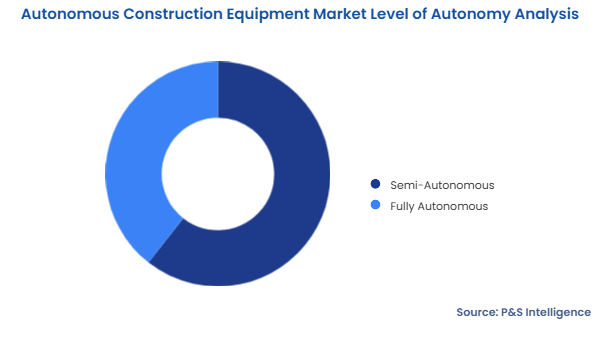
By level of autonomy, semi-autonomous equipment held 60.7% of 2025 value, while fully autonomous equipment is modeled to grow at 12.6% annually from 2026 to 2032.
By equipment type, earthmoving equipment held 40.4% of 2025 value, while construction vehicles are modeled to grow at 12.2% annually from 2026 to 2032.
By application, road and transport infrastructure held 43.2% of 2025 value, while building construction is modeled to grow at 11.5% annually from 2026 to 2032.
By geography, North America held 35.1% of 2025 value, while Asia-Pacific is modeled to grow at 11.3% annually from 2026 to 2032.
Autonomous Construction Equipment Market Trends and Growth Drivers
Automatic grade control cuts correction work on repeatable tasks
Rework exposes contractors to extra machine hours, survey checks, and material movement. The Autonomous Construction Equipment Market growth case begins with tasks where the operator can load a design and let the machine control an implement while retaining oversight. This can help an operator reproduce a specified grade across passes, but the gain depends on the task and the quality of the design supplied to the machine.
On a crowned-road comparison against string-line operation, Deere & Company reports that an experienced operator achieved 27% better grade accuracy with SmartGrade on its motor grader. The result is a bounded product test rather than a fleet-wide productivity measure. It nonetheless identifies a buyer incentive. A contractor able to meet grade specifications with fewer corrections can free equipment time for the next section of work. The model assumes such site economics support adoption, without treating the reported test improvement as a market-wide rate.
Parameterized compaction opens an incremental automation path
The autonomous construction equipment industry can expand through operator-assisted control before contractors commit to unattended operation. Compaction is well suited to that step because a job can prescribe travel speed, pass count, overlap, and vibration settings. Caterpillar Inc. says Command for Compaction uses those operator inputs to control the speed, direction, steering, and vibration of supported soil compactors.
That arrangement leaves the operator responsible for setting the work area and supervising the machine. It gives equipment buyers a narrower implementation decision than full autonomy and gives suppliers a defined active-control product to sell with the compactor. Uptake will depend on how often a fleet performs similar compaction work and whether project specifications reward consistent pass coverage. The source establishes the control function, not how many systems have been sold.
Mixed-fleet control systems move beyond display-only guidance
The autonomous construction equipment industry trends toward control packages that can fit more than one machine brand or task. Mixed fleets create a channel for independent suppliers when a contractor wants to automate existing equipment instead of waiting for a full replacement cycle. Trimble Inc. describes Earthworks configurations that automatically control excavator buckets and dozer blades, with compactor steering control on supported machines.
The commercial effect is conditional. The same product family also contains guidance functions that do not meet this report's active-control boundary. Retrofit value enters the model only at the first sale of a qualifying control system, and the underlying used machine is not sold again in the estimate. Compatibility checks, hydraulic integration, and dealer setup govern how far a supplier can extend such a package across a contractor's fleet.
Site safety validation slows moves toward unattended operation
Greater machine autonomy changes the work of commissioning a site. Routes, work boundaries, neighboring crews, and the response to a failed sensor or communication link need to be tested for the actual operating environment. The International Organization for Standardization's 2019 earthmoving autonomy standard sets safety criteria for autonomous and semi-autonomous systems, including the machine, associated infrastructure, and defined functional environment. The organization confirmed the standard remained current in 2024.
This is an engineering and procurement restraint, especially where earthworks change the terrain or multiple trades share limited space. A buyer may keep an operator in the cab, restrict autonomy to a segregated work zone, or postpone a purchase until the site plan and supervision process are ready. The standard is a safety framework, not proof of a legal ban or a uniform compliance cost. Longer commissioning can slow revenue even when an automated task is technically possible.
Autonomous Construction Equipment Market Segmentation Analysis
Level of Autonomy
The autonomous construction equipment market analysis places semi-autonomous equipment at the largest approved share, 60.7% of 2025 market value. Its commercial advantage is that an operator can supervise a machine while automatic control manages a repeatable cut, grade, or pass. Komatsu Ltd. reported that it had provided more than 22,000 iMC-equipped construction machines worldwide on a cumulative basis by July 2026. That installed scale is a separate operating fact, not a calculation of this report's share or annual sales.
Fully autonomous equipment is the fastest modeled pole, with a 12.6% CAGR from 2026 to 2032. The forecast depends on work zones where the machine can execute a bounded task without continuous operator input and where the contractor can supervise exceptions safely. Gravis Robotics AG reported an autonomous excavator trial on Taylor Woodrow's active Manchester Airport car-park project in 2025. That live-site case shows a route to deployment, while its trial status limits any inference about commercial penetration. Repeatable performance and contractor acceptance must follow before pilots become routine purchases.
Equipment Type
Earthmoving equipment represented 40.4% of approved 2025 value, the largest equipment pole. Excavation and grading expose a direct cost of missed design surfaces because crews must make another pass or move excess material. Caterpillar Inc. says its active boom and bucket control for excavators can reduce grading time by up to 45%, an issuer-reported capability without a published fleet sample. The figure provides a quantified task-level incentive, not a measured global productivity gain.
Factory integration can put control into the machine at first sale. Komatsu Ltd. identifies its PC220LCi-12 as an excavator with built-in iMC 3.0 that follows a digital design during digging. The model assigns that full new-machine first-sale value to earthmoving. It does not add the control system as a separate sale when it is already part of the machine.
Construction vehicles are modeled as the fastest equipment pole, at 12.2% annually from 2026 to 2032. Repeated travel between loading and dumping points is easier to bound than changing excavation faces. Teleo Inc. describes three equipped articulated dump trucks autonomously tramming material at Tomahawk Construction's Naples, Florida, site, while an operator handled other actions remotely. The operating case supports the haulage mechanism, not unattended operation or an industry-wide utilization rate.
Application
Road and transport infrastructure held the largest approved application share, 43.2% in 2025. Long, specified alignments permit controlled paving and rolling passes when the work area can be separated from traffic and crews. SANY Heavy Industry Co. Ltd. reported a 20% efficiency improvement for an unmanned paver and roller fleet on the Beijing–Harbin Expressway in 2025. This project result is the distinct quantified operating fact behind the road-work mechanism. It is not a global road-construction productivity estimate.
Building construction is modeled to grow fastest among applications, at 11.5% annually from 2026 to 2032. Site preparation, foundations, and utility trenches create machine-control tasks before vertical work begins. The U.S. Census Bureau estimated private residential construction at a seasonally adjusted annual rate of USD 859.0 billion in July 2026, including improvements as well as new work. That domestic spending base can support equipment purchases where contractors repeat graded earthwork, but it is broader than equipment spending and does not measure autonomous adoption. The forecast relies on that conversion rather than on building expenditure alone.
The following categories have been analyzed in this report:
Level of Autonomy
Semi-Autonomous
Fully Autonomous
Equipment Type
Earthmoving Equipment
Excavators
Bulldozers
Motor Graders
Wheel Loaders
Construction Vehicles
Articulated Dump Trucks
Rigid Haul Trucks
Site Transport Vehicles
Material Handling Equipment
Telehandlers
Site Forklifts
Other Construction-Site Handling Machines
Concrete and Road Construction Equipment
Pavers
Compactors and Rollers
Concrete Placement Machines
Application
Road and Transport Infrastructure
Building Construction
Residential
Commercial and Institutional
Industrial Buildings
Other Civil Construction and Construction-Material Quarrying
Utilities and Site Preparation
Quarrying for Construction Aggregates
Ports and Airports
Drive strategic growth with comprehensive market analysis
Autonomous Construction Equipment Market Geographical Analysis
North America accounted for the largest modeled regional share, 35.1% of global autonomous construction equipment value in 2025. The region's buying case is anchored in large civil fleets, dealer-supported machines, and long stretches of planned earthwork where active control can be commissioned repeatedly. In one component country, U.S. highway expenditures across all levels of government totaled USD 332 billion in 2024, according to the Federal Highway Administration. The expenditure measure includes more than construction and does not establish North American autonomous-equipment revenue.
Through 2032, the modeled North American market grows as contractors turn selective grade and task automation into standard fleet specifications. That conversion is more credible on projects with digital design files, enough machine hours to amortize setup, and dealers able to support controls in the field. A shift toward short, irregular jobs or tighter capital budgets would lower the realized value even if infrastructure spending remains substantial. The region's leading share is an approved model allocation, not a sum of the cited U.S. spending.
Asia-Pacific is the fastest modeled region, with Autonomous Construction Equipment Market growth of 11.3% annually from 2026 to 2032. Public works awards create a pipeline for earthmoving and road fleets, but contractors must specify active control for any of that spending to enter this market. The Asian Development Bank recorded USD 3.58 billion in transport-sector contract awards under its financed projects in 2025, up from USD 1.6 billion in 2024, with two large Philippine projects driving the increase. Those awards cover only bank-financed work, not all regional construction or automation purchases.
The growth trajectory depends on localized machine support and contractor experience across differing project rules and terrain. Repeat orders would increase if equipment can carry digital plans and control settings between sites without lengthy recalibration. Delays in procurement, weak survey data, or price-sensitive fleets could slow conversion even while civil works continue. The regional CAGR is an analytical proxy adopted in Stage 1. The bank's contract data corroborate an opportunity, not the forecast rate.
China is the largest allocated Asia-Pacific country, with a modeled 43% share of the region's 2025 autonomous construction equipment value. Its scale gives factory-integrated machine control a potential route through replacement purchases. The China Construction Machinery Association recorded 118,518 domestic excavator sales by major manufacturers in 2025, up 17.9% from 2024. That count includes conventional machines, and no association figure measures how many carried active automatic control.
China's path through 2032 therefore depends on the share of new civil and road machines ordered with control functions, and on whether project owners reward more consistent grade execution. Broader equipment demand can lift the addressable base without automatically lifting automation penetration. Clear safety procurement requirements and lower system prices would accelerate the change. A preference for basic connected or guidance-only machines would weaken it. The approved country share should be read as a modeled allocation under those conditions.
India is the fastest allocated Asia-Pacific country, with a modeled 14.0% CAGR from 2026 to 2032. National road construction offers recurring grading, paving, and compaction work where active-control packages can be tested on large contracts before moving into smaller fleets. India's National Highways Authority reported construction of 5,313 km of national highways in FY2025–26 and capital expenditure of INR 2,44,362 crore through the Press Information Bureau of India. These figures describe road delivery and expenditure, not autonomous-equipment purchases.
For the forecast to hold, successful large-project use must translate into repeat procurement, operator training, and dependable positioning and service support. More accessible financing and specifications that accept digitally documented work could speed adoption. Conversely, contractors who cannot fund control packages or keep them calibrated across sites may remain with conventional equipment. India's modeled growth rate is conditional on that transition, rather than a direct extrapolation from highway kilometers.
The following geographies have been analyzed in this report:
North America
U.S.
Canada
Asia-Pacific
China
India
Japan
South Korea
Australia
Indonesia
Rest of Asia-Pacific
Europe
Germany
U.K.
France
Italy
Spain
Rest of Europe
Latin America
Brazil
Mexico
Rest of Latin America
Middle East and Africa
Saudi Arabia
U.A.E.
South Africa
Rest of Middle East and Africa
Autonomous Construction Equipment Market Competitive Landscape
The autonomous construction equipment industry's concentration remains moderately fragmented. Buyers can choose among new-machine manufacturers, independent control suppliers, and specialized retrofit developers. Competition is consequently better explained by how a buyer acquires, installs, and supports active control on the machines already used for grading, digging, compaction, and site movement.
Factory integration reduces the number of separate installation steps at equipment delivery. Deere & Company offers SmartGrade motor graders configured and calibrated from the factory, which gives a buyer a single equipment purchase and a dealer support route. An independent supplier can instead win when a contractor wants control across brands. TOPCON CORPORATION offers dealer-configured automatic blade control through 3D-MC Edge, while Hexagon AB works with equipment makers on factory-fit machine-control integration. These are different channels, not evidence of relative market rank.
Specialized entrants compete where a narrow task can justify a retrofit. Built Robotics, Inc. markets an excavator Exosystem for autonomous trenching, focusing its commercial proposition on a repeatable cut rather than a general-purpose autonomous fleet. Buyers must weigh machine compatibility, design-file preparation, site validation, operator supervision, and service coverage alongside the purchase price.
Competitive intensity should rise as the same contractors compare embedded controls with retrofit packages during fleet replacement and upgrades. The relevant purchasing test is whether the system performs reliably on the contractor's actual terrain and work plan, then can be serviced through the project. Product pages establish available routes and functions. They do not establish a company's global revenue, installed base, or leadership position in this modeled market.
Top Companies in the Autonomous Construction Equipment Market:
Caterpillar Inc.
Komatsu Ltd.
Deere & Company
SANY Heavy Industry Co. Ltd.
Trimble Inc.
TOPCON CORPORATION
Hexagon AB
Teleo Inc.
Built Robotics Inc.
Gravis Robotics AG
Autonomous Construction Equipment Market Developments
In August 2026, Gravis Robotics AG announced it had raised USD 200 million in Series A financing from SoftBank to fund expansion of its construction-autonomy platform. The financing adds capacity for development and rollout, but the announcement does not establish that planned fleet retrofits or future site deployments have already occurred.
In July 2026, Komatsu Ltd. entered a strategic partnership with AIM Intelligent Machines and EARTHBRAIN Ltd. for autonomous dozer and excavator operation. Komatsu reported that the combined approach had reached commercial deployment at U.S. customer jobsites. The release gave no fleet count and described Japanese entry as future work.
In March 2026, Trimble Inc. expanded Earthworks availability to additional automated excavator, grader, dozer, and scraper integrations. The executed portfolio expansion broadens machine compatibility for civil contractors, while the separately announced swing-boom option was scheduled for later availability and is not counted as completed here.
Frequently Asked Questions About This Report
What drives the forecast for autonomous construction equipment?+
The forecast therefore hinges on conversion from compatible jobsites to repeat purchases. New factory-integrated machines and first-sale retrofit systems both qualify when they actively control travel or implements.
What can support autonomous construction equipment purchases in building work?+
That domestic spending base can support equipment purchases where contractors repeat graded earthwork, but it is broader than equipment spending and does not measure autonomous adoption.
What could support regional repeat orders?+
Repeat orders would increase if equipment can carry digital plans and control settings between sites without lengthy recalibration. Delays in procurement, weak survey data, or price-sensitive fleets could slow conversion even while civil works continue.
What conditions affect autonomous construction equipment adoption in China?+
China's path through 2032 therefore depends on the share of new civil and road machines ordered with control functions, and on whether project owners reward more consistent grade execution.
What safety work is required for autonomous equipment?+
Greater machine autonomy changes the work of commissioning a site. Routes, work boundaries, neighboring crews, and the response to a failed sensor or communication link need to be tested for the actual operating environment.
Want a report tailored exactly to your business need?
Leading companies across industries trust us to deliver data-driven insights and innovative solutions for their most critical decisions. From data-driven strategies to actionable insights, we empower the decision-makers who shape industries and define the future. From Fortune 500 companies to innovative startups, we are proud to partner with organisations that drive progress in their industries.
Client Testimonials
Working with P&S Intelligence and their team was an absolute pleasure – their awareness of timelines and commitment to value greatly contributed to our project's success. Eagerly anticipating future collaborations.
McKinsey & Company
India
Unmatched Standards
Our insights into the minutest levels of the markets, including the latest trends and competitive landscape, give you all the answers you need to take your business to new heights
Complete Data Security
We take a cautious approach to protecting your personal and confidential information. Trust is the strongest bond that connects us and our clients, and trust we build by complying with all international and domestic data protection and privacy laws