This Report Provides In-Depth Analysis of the Autonomous Aircraft Market Report Prepared by P&S Intelligence, Segmented by Aircraft Type (Rotary Wing, Fixed Wing, Hybrid/VTOL), Platform (Unmanned Aerial Vehicles, Urban Air Mobility, Commercial Aircraft, Military Aircraft), Autonomy Level (Conditional Automation (Level 3), High Automation (Level 4), Full Automation (Level 5)), Propulsion Type (Air Turbine Fuel, Sustainable Aviation Fuel, Electric, Hybrid-Electric, Hydrogen Fuel Cell), Application (Defense & Military, Cargo & Logistics, Passenger & Air Taxi, Agriculture & Environmental Monitoring, Emergency & Medical Services), and Geographical Outlook for the Period of 2021 to 2032
Explore the market potential with our data-driven report
Autonomous Aircraft Market Key Insights
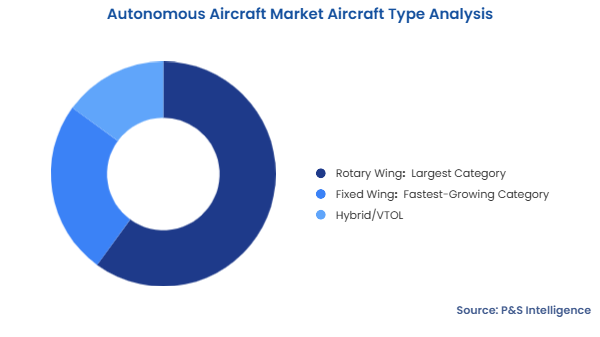
Rotary wing aircraft accounted for the largest share, of 60%, in 2025.
UAM is the fastest-growing platform category over 2026–2032, at approximately 19.2% CAGR.
Conditional automation (level 3) systems held the largest share, of 55%, in 2025.
SAF is projected to register the fastest growth during 2026–2032, at approximately 19.5% CAGR.
Defense & military applications accounted for the largest share, of 35%, in 2025.
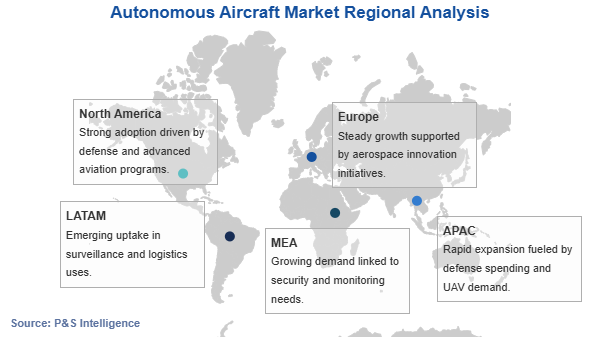
North America accounted for the largest share, of 40%, in 2025.
Asia-Pacific is the fastest-growing market with a CAGR of approximately 19.7% during 2026–2032.
Autonomous Aircraft Market Analysis
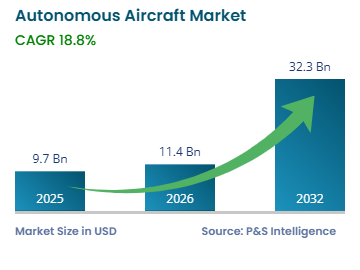
The global autonomous aircraft market size stood at USD 9.7 billion in 2025 and is projected to reach USD 32.3 billion by 2032, expanding at a compound annual growth rate of 18.8% over 2026–2032.
The autonomous aircraft market is driven by growing defense and security needs for surveillance and strike capabilities, increasing investment in urban air mobility and eVTOL technologies, advances in AI and autonomous flight systems, and rising demand for cost-effective, low-risk unmanned operations across military and commercial sectors.
In the defense sector, governments are investing heavily in unmanned aerial vehicles (UAVs) for surveillance, reconnaissance, and combat applications to reduce pilot risk in contested environments. The U.S. Department of Defense has consistently increased budget allocations for autonomous systems programs, reflecting the strategic priority attached to pilotless platforms in future warfare doctrines. Commercial operators and logistics providers are pursuing cargo drone and air taxi deployments to reduce last-mile delivery costs and ease urban congestion.
Autonomous Aircraft Market Trends and Drivers
AI and Sensor Fusion Advancements Are Major Trends
The rapid maturation of artificial intelligence, computer vision, and multi-spectral sensor fusion is fundamentally transforming what autonomous aircraft can safely accomplish. Detect-and-avoid (DAA) algorithms enable real-time obstacle recognition and automated avoidance maneuvers, significantly reducing reliance on pilot intervention and supporting operations beyond visual line-of-sight, which previously required more controlled operational environments. Machine learning models trained on billions of flight data points are enabling predictive maintenance scheduling. Unplanned downtime in both military UAV fleets and commercial cargo drone networks is declining as a direct result.
Edge computing hardware miniaturization has allowed these computational capabilities to be embedded directly in aircraft avionics, eliminating dependence on low-latency ground-link architectures. The Federal Aviation Administration is actively exploring safety assurance frameworks for AI and machine learning in aviation, focusing on validation, reliability, and certification challenges associated with autonomous systems. These advances are narrowing the performance gap between conditionally automated Level 3 systems and high-automation Level 4 architectures, accelerating the market's migration toward full operational autonomy.
Military Modernization Programs Driving UAV Procurement
Escalating geopolitical tensions across multiple theaters have compelled nations across NATO, the Indo-Pacific, and the Gulf to accelerate autonomous platform procurement as part of broader military modernization programs. The shift from expensive crewed combat aircraft toward lower-cost, attritable UAVs and Collaborative Combat Aircraft (CCA) is reducing the financial barrier to deploying autonomous systems at scale. The U.S. Department of Defense has designated autonomous systems as a priority investment area, with the Air Force's CCA program targeting a fleet of over 1,000 drone wingmen to augment crewed fighter capacity.
NATO members committed to 2% GDP defense spending targets are channeling a growing proportion of procurement budgets toward UAVs and surveillance drones. Loitering munitions represent a further procurement category absorbing an increasing share of alliance defense spending. India's Defence Research and Development Organisation (DRDO) tested its indigenous Autonomous Flying Wing Technology Demonstrator in July 2022. These defense-driven investments are generating volume procurement contracts that fund R&D spillover into commercial platforms. Overall market development is accelerating as a consequence.
UAVs with autonomous capabilities have become central to modern warfare. The shift toward low-cost, scalable, and automated combat systems is restructuring procurement priorities across defense establishments globally, with loitering munitions and autonomous strike platforms moving from experimental programs to standard operational inventory. In the India–Pakistan context, loitering munitions are deployed for border surveillance and precision strikes, with onboard autonomy enabling target navigation and identification within predefined parameters. India has implemented an INR 120 crore Production-Linked Incentive (PLI) scheme to promote domestic drone manufacturing and accelerate indigenous UAV development.
In the Russia–Ukraine war, autonomous and semi-autonomous systems dominate large-scale deployments. Iranian-origin Shahed-131/136 loitering munitions operate in a fire-and-forget mode using pre-programmed navigation to strike infrastructure targets. Certain loitering munitions, such as Shahed-type drones, are estimated to cost around USD 20,000–50,000 per unit, highlighting their cost advantage in large-scale deployment scenarios. Ukraine allocates approximately UAH 2.5 billion per month to combat units for drone procurement, alongside additional government funding programs, including allocations such as UAH 24 billion to support drone acquisition and domestic production. European funding in the hundreds of millions of euros supplements this domestic production base.
Iran has built a broad portfolio of autonomous-capable UAVs across the Middle East theater. Shahed-131/136 loitering munitions have been deployed in coordinated, high-volume attack operations against strategic infrastructure and military targets, using pre-programmed and semi-autonomous targeting systems.
Urban Air Mobility Is Key Market Opportunity
The transition of urban air mobility from prototype demonstration to early commercial operation is creating an entirely new market segment for autonomous electric aircraft. Regulatory milestones are the primary catalyst. The Civil Aviation Administration of China (CAAC) issued the first-ever commercial operating certificates for autonomous passenger drone services in early 2025, with EHang Holdings receiving approval to conduct commercial air taxi operations. Similarly, the Federal Aviation Administration issued a final rule in October 2024 defining regulatory frameworks for powered-lift aircraft, supporting the certification and operational development of eVTOL platforms.
These approvals reduce investor uncertainty and catalyze infrastructure investment in vertiports and charging networks. Air traffic management systems represent the third critical infrastructure layer receiving accelerated capital allocation as a result. The International Civil Aviation Organization (ICAO) is actively developing global standards for advanced air mobility integration, providing an international framework that enables cross-border certification harmonization.
Passenger acceptance surveys indicate strong willingness to use autonomous air taxis, particularly among younger demographics and frequent business travelers, validating the commercial demand thesis underpinning the USD billions in eVTOL investment currently deployed across the sector. The global urban air mobility market generated about USD 3,903 million in 2023, which is expected to reach USD 29,718 million by 2030, with autonomous flights registering a CAGR of 304% during 2024–2030.
Regulatory and Certification Complexity Constrain Market Growth
The complexity of certifying autonomous aircraft across multiple aviation authorities remains a binding constraint on deployment timelines. Type certification for novel eVTOL and UAV configurations requires demonstration of safety performance standards that were originally designed for crewed aircraft. This creates compliance burdens that extend development schedules and capital requirements. The certification of commercial eVTOL platforms in Europe by the European Union Aviation Safety Agency involves evaluating novel system architectures and potential failure modes, requiring extensive flight testing and validation campaigns.
Beyond initial certification, operators must secure beyond visual line of sight (BVLOS) approvals for commercial utility in logistics and emergency services. This is a regulatory category that most jurisdictions have only recently begun to define. Type certification, production approval, airworthiness certification, and operational authorization collectively add 3–5 years to commercial launch plans and create capital intensity that narrows the field of viable competitors. While the regulatory environment is gradually evolving, the pace of rule-making consistently trails the pace of technology development, constraining near-term market growth.
Autonomous Aircraft Market Segmentation Analysis
Aircraft Type Analysis
Rotary wing aircraft accounted for the largest share, of 60%, in 2025, due to their operational versatility. They can perform VTOL, hover over targets, and operate from unprepared surfaces — each a distinct operational requirement in defense reconnaissance, search and rescue, and precision agricultural monitoring. The established manufacturing ecosystem for rotary wing UAVs, anchored by decades of conventional helicopter production, has kept per-unit costs manageable. Rapid capability integration has followed from this production maturity rather than from new development programs. The U.S. Department of Defense continues to procure rotary-wing UAVs in volume for battlefield resupply and casualty evacuation missions, sustaining baseline demand.
Fixed-wing autonomous aircraft is the fastest-growing category over 2026–2032, at approximately 19.4% CAGR. Long-endurance ISR platforms operating at high altitude require the aerodynamic efficiency that only fixed-wing configurations can deliver at operational range. Fixed-wing designs achieve higher cruise speeds and greater payload capacity per unit of fuel consumed compared with rotary-wing alternatives, making them ideal for logistics operators building hub-to-spoke freight delivery networks. The FAA has expanded approved flight corridors for fixed-wing autonomous cargo operations, removing a key barrier to commercial scale-up.
The market segments into the following aircraft types:
Rotary Wing (Largest Category)
Fixed Wing (Fastest-Growing Category)
Hybrid/VTOL
Platform Analysis
UAVs accounted for the largest share, of 40%, in 2025, due to the decades of technology maturity across both military and commercial applications. UAV applications span battlefield surveillance, precision agriculture, infrastructure inspection, and commercial delivery, generating a diversified demand. Defense ministries worldwide procure tactical and medium-altitude long-endurance (MALE) class UAVs in high volumes. The U.S. Air Force operates the world's largest fleet of military UAVs and continues to expand procurement under multi-year contracts.
UAM is the fastest-growing platform category over 2026–2032, at approximately 19.2% CAGR. Regulatory approvals in China and the United States have removed the primary commercial entry barrier. Moreover, the flight test milestones of eVTOL developers, including Joby Aviation, Archer Aviation, and Wisk Aero, are demonstrating airworthiness across a growing range of operating conditions. Electric propulsion maturity and AI-based flight management have reached the performance thresholds required for commercial passenger operations.
Vertiport networks under development in the UAE, Japan, South Korea, and the United States are providing the ground infrastructure for commercial UAM services. ICAO projections indicate that advanced air mobility will become a distinct aviation category requiring dedicated airspace management infrastructure.
Urban Air Mobility (UAM) (Fastest-Growing Category)
Commercial Aircraft
Military Aircraft
Others
Autonomy Level Analysis
Conditional automation (level 3) systems accounted for the largest share in 2025, as this is how most operational autonomous aircraft are classified. At Level 3, aircraft handle all flight functions within defined operational design domains, but require human override capability for edge cases and system failures. Regulators, insurers, and defense procurement authorities have converged on this risk profile as the current acceptance threshold for certified autonomous operations. Widespread deployment across military ISR missions and commercial cargo routes has followed from this regulatory alignment, with human monitoring availability satisfying the residual oversight requirements that Level 3 certification imposes.
High automation (level 4) is the fastest-growing category over 2026–2032. Aircraft operating within geofenced urban corridors and controlled cargo delivery routes are progressively achieving certification for extended autonomous operations without real-time human supervision. This is expanding the addressable deployment envelope beyond what Level 3 permits. The Federal Aviation Administration is advancing BVLOS regulatory frameworks through waivers and pilot programs, while the European Union Aviation Safety Agency U-space framework establishes a foundation for the gradual integration of automated drone operations in European airspace. Eliminating the dedicated remote pilot requirement per aircraft and enabling multi-aircraft remote supervision fundamentally restructures the unit economics of autonomous fleet operations. This compresses the per-flight labor cost, which currently constrains commercial scalability.
The market segments into the following autonomy levels:
High Automation (Level 4) (Fastest-Growing Category)
Full Automation (Level 5)
Propulsion Type Analysis
Conventional air turbine fuel (ATF) held the largest share of the global autonomous aircraft propulsion segment in 2025. This is due to its dominance in military UAV and high-altitude ISR platforms that require sustained endurance, high speed, and payload capacity beyond the current capabilities of alternative propulsion systems. Turbine-powered platforms, such as the General Atomics MQ-9 Reaper and Northrop Grumman RQ-4 Global Hawk, remain the backbone of high-value military surveillance and strike missions globally.
The established ATF supply chain, refueling infrastructure, and decades-long reliability record across defense and commercial aviation drive the procurement of conventional propulsion for applications demanding extended range and heavy payload. The U.S. Department of Defense continues to procure ATF-powered autonomous tactical, MALE, and HALE UAVs under multi-year contracts.
Sustainable aviation fuel (SAF) is projected to register the fastest growth during 2026–2032, at approximately 19.5% CAGR. It is driven by mandatory blending requirements, net-zero emissions commitments from civil aviation authorities, and growing regulatory incentives. The ICAO’s CORSIA framework mandates carbon-neutral growth for international aviation from 2027, directly incentivizing operators of autonomous cargo and passenger platforms to transition toward SAF-blended propulsion to meet compliance obligations. SAF's compatibility with existing ATF turbine infrastructure eliminates the need for airframe or engine redesign, reducing adoption barriers relative to hydrogen or full-electric alternatives. SAF production capacity is scaling rapidly, following the USA Inflation Reduction Act's SAF tax credit provisions and under the EU’s ReFuelEU Aviation regulation, which mandates progressive SAF blend minimums rising to 70% by 2050.
The market segments into the following propulsion types:
Defense & military applications accounted for the largest share, of 35%, in 2025, due to the high unit value of military UAV systems and consistent volume procurement. The U.S. Department of Defense, NATO allies, and major Asia-Pacific defense forces maintain active procurement pipelines across tactical, MALE, and strategic UAV classes. Military doctrine has shifted structurally toward autonomous and unmanned systems. Pilot safety imperatives are driving this reorientation at the operational level, while persistent surveillance requirements in contested environments demand continuous on-station presence that crewed platforms cannot sustain at equivalent cost. The CCA programs in the United States and equivalent programs in Australia, the United Kingdom, and Japan signal a generational expansion of autonomous platform spending within defense budgets.
Cargo & logistics is the fastest-growing category over 2026–2032. The commercial imperative to reduce last-mile delivery costs is the primary demand driver, as conventional air freight economics make sub-50-mile final delivery routes financially unviable at scale. Remote and infrastructure-poor communities represent a second demand layer, where autonomous cargo drones provide the only economically feasible supply chain link. E-commerce volume growth is adding structural pressure on conventional air freight capacity, accelerating carrier interest in autonomous alternatives.
The ICAO has recognized autonomous cargo aviation as a priority integration area. Frameworks under development for routine BVLOS cargo operations worldwide will provide the regulatory foundation for commercial scaling. Operators, including Amazon, Wing (Alphabet), and UPS, are scaling autonomous cargo drone operations across approved corridors. These commercial proof points validate unit economics and reduce perceived deployment risk for institutional investors entering the logistics application segment.
The market segments into the following applications:
Defense & Military (Largest Category)
Cargo & Logistics (Fastest-Growing Category)
Passenger & Air Taxi
Agriculture & Environmental Monitoring
Emergency & Medical Services
Others
Drive strategic growth with comprehensive market analysis
Autonomous Aircraft Market Geographical Analysis
North America Autonomous Aircraft Market Outlook
North America accounted for the largest share, of 40%, in 2025, due to the U.S. Department of Defense's investment in autonomous platforms. Tactical UAVs and high-altitude ISR drones form the procurement foundation, while the multi-billion-dollar CCA program represents the next generational spending cycle. A dense ecosystem of aerospace primes, advanced air mobility startups, and university-based R&D programs provides the commercial and innovation infrastructure at scale.
The FAA's Innovate28 roadmap and the eVTOL Integration Pilot Program provide commercial operators with a credible certification pathway, which attracts global investment to U.S.-based autonomous aviation ventures. The U.S. Department of Defense budget documents confirm that autonomous systems funding exceeded USD 3 billion annually across service branches in FY2024. Moreover, FAA data shows that over 900,000 commercial and recreational UAVs are registered in the United States as of 2025. Defense procurement is sustained by geopolitical competition with China and Russia, and commercial growth is accelerating as eVTOL and cargo drone operators approach commercial service launch.
Canada is the fastest-growing market in North America. Transport Canada's progressive BVLOS framework is enabling commercial operations across geographically dispersed territories. Drone-enabled resource management and agricultural monitoring are generating the early revenue base, with infrastructure inspection adding a third commercial application layer as operator certification scales.
U.S. Autonomous Aircraft Market Analysis
Beyond defense procurement, the U.S. commercial autonomous aircraft ecosystem is the most advanced globally. Joby Aviation, Archer Aviation, Wisk Aero, Beta Technologies, and General Atomics Aeronautical Systems are all based in the USA, reflecting a strong development pipeline and easy availability. The U.S. Air Force has designated CCA as a core program of record, while the U.S. Navy awarded CCA conceptual design contracts to five major primes in September 2025.
Europe Autonomous Aircraft Market Forecast
Europe is the second-largest regional market, with Germany as the largest country market in Europe. Airbus Defence & Space and HENSOLDT anchor the defense industrial base, and Germany's active participation in NATO autonomous platform programs sustains procurement volume across ISR and tactical UAV categories. Moreover, the EASA's special condition for VTOL aircraft provides the certification foundation for the first European eVTOL commercial launches.
The U.K. is the fastest-growing country market in Europe. The Civil Aviation Authority's proactive BVLOS framework and dedicated autonomous flight testing corridors established at several airfields are compressing the timeline between development and commercial deployment. British defense commitments within NATO and the UK's Tempest/GCAP advanced combat aircraft program include autonomous wingman requirements, which drive R&D investment.
The European market’s growth is supported by increasing defense budgets across NATO member states and the commercial momentum building around urban air mobility pilots in France, Germany, and the UK. Sustainability regulation is shifting procurement in favor of electric propulsion platforms, aligning with broader trends toward electric propulsion in autonomous aviation.
Asia-Pacific Autonomous Aircraft Market Growth
Asia-Pacific is the fastest-growing autonomous aircraft region globally, registering a CAGR of approximately 19.7% during 2026–2032. The market is driven by China's scaling of commercial UAM operations, India's defense-driven UAV procurement ramp, and Japan and South Korea's eVTOL certification progress.
China is the largest country market in Asia-Pacific. The government's low-altitude economy policy framework targets 1.5 trillion yuan in aviation output and is funding eVTOL production facilities across major cities. Vertiport networks and autonomous drone delivery corridors represent the infrastructure layer receiving the next tranche of policy-directed capital. The CAAC approved commercial air taxi AOCs for EHang and Hefei Hey Airlines in early 2025.
India is the fastest-growing country market in Asia-Pacific. DRDO's domestic autonomous aircraft development programs are building sovereign production capability across tactical UAV classes. The Indian Air Force's UAV fleet expansion is generating near-term procurement volume, and India's liberalized drone rules are producing a growing commercial operator base.
The regions and countries analyzed in this report include:
North America (Largest Region)
U.S. (Largest Country Market)
Canada (Fastest-Growing Country Market)
Europe
Germany (Largest Country Market)
U.K. (Fastest-Growing Country Market)
France
Italy
Spain
Rest of Europe
Asia-Pacific (Fastest-Growing Region)
China (Largest Country Market)
India (Fastest-Growing Country Market)
Japan
South Korea
Australia
Rest of APAC
Latin America
Brazil (Largest Country Market)
Mexico (Fastest-Growing Country Market)
Rest of Latin America
Middle East & Africa
Saudi Arabia (Largest Country Market)
South Africa
U.A.E. (Fastest-Growing Country Market)
Rest of MEA
Autonomous Aircraft Market Share Analysis
The global autonomous aircraft market exhibits a moderately fragmented competitive structure. Established defense aerospace primes occupy the upper tier, where multi-decade government contracting relationships and deep platform integration capabilities create durable incumbency advantages. Advanced air mobility startups, commercial UAV manufacturers, and autonomous systems software specialists form a rapidly expanding second tier with differentiated technology approaches and, in several cases, substantial venture and institutional capital backing.
Defense UAV procurement rewards incumbents with proven platform pedigrees, while UAM and commercial logistics introduce well-funded challengers, who compete on autonomy architecture rather than platform heritage. Capital requirements for certification and commercial launch will narrow the competitive field as underfunded participants exit and defense CCA and ISR programs create sustained revenue streams for the incumbents that secure long-cycle contracts.
Leading Companies in the Autonomous Aircraft Market:
The Boeing Company
Airbus SE
Northrop Grumman Corporation
Lockheed Martin Corporation
General Atomics Aeronautical Systems Inc.
AeroVironment Inc.
Elbit Systems Ltd.
Leonardo S.p.A.
Saab AB
Kratos Defense & Security Solutions Inc.
BAE Systems plc
MBDA Group
QinetiQ Group plc
Joby Aviation Inc.
Archer Aviation Inc.
Wisk Aero LLC
Volocopter GmbH
Beta Technologies Inc.
EHang Holdings Limited
Autonomous Aircraft Market News
In December 2025, Wisk Aero LLC completed the inaugural flight of its Generation 6 autonomous air taxi, a fully autonomous-from-launch platform. The flight advances Wisk's FAA type certification campaign and supports planned commercial urban air mobility operations in Houston, Los Angeles, Miami, and Brisbane.
In September 2025, the U.S. Navy awarded CCA conceptual design contracts to Northrop Grumman Corporation, The Boeing Company, General Atomics Aeronautical Systems Inc., Anduril Industries, and Lockheed Martin Corporation. The program targets carrier-based autonomous combat drones designed to augment crewed naval fighter capacity in maritime strike missions.
In March 2025, the CAAC granted commercial air taxi operating certificates to EHang Holdings Limited and Hefei Hey Airlines for autonomous passenger drone services.
In February 2025, Northrop Grumman Corporation unveiled Project Talon, a stealthy autonomous CCA developed with Scaled Composites in 15 months from project launch. The U.S. Air Force assigned the platform the YFQ-48A designator. Project Talon demonstrates a rapid, lower-cost development pathway for autonomous wingmen intended to operate alongside manned fighters in contested airspace.
In September 2024, Pyka Inc. secured USD 40 million in Series B funding to advance development of its autonomous electric cargo aircraft. The capital will expand production capacity at Pyka's Alameda, California, facility and fund platform development across agricultural protection and defense logistics applications.
Frequently Asked Questions About This Report
What will be the autonomous aircraft market 2032 size?+
In 2032, the market for autonomous aircraft will value USD 32.3 billion.
Which platform leads the autonomous aircraft industry?+
UAVs dominate the autonomous aircraft industry with 40% revenue.
Which is the largest region in the autonomous aircraft market?+
North America is the largest market for autonomous aircraft, with 40% share.
What are the key autonomous aircraft industry drivers?+
The global autonomous aircraft industry is driven by growing defense and security needs for surveillance and strike capabilities, increasing investment in UAM and eVTOL technologies, advances in AI and autonomous flight systems, and rising demand for cost-effective, low-risk unmanned operations across military and commercial sectors.
What is the autonomous aircraft market nature?+
The market for autonomous aircraft is moderately fragmented.
Want a report tailored exactly to your business need?
Leading companies across industries trust us to deliver data-driven insights and innovative solutions for their most critical decisions. From data-driven strategies to actionable insights, we empower the decision-makers who shape industries and define the future. From Fortune 500 companies to innovative startups, we are proud to partner with organisations that drive progress in their industries.
Client Testimonials
Working with P&S Intelligence and their team was an absolute pleasure – their awareness of timelines and commitment to value greatly contributed to our project's success. Eagerly anticipating future collaborations.
McKinsey & Company
India
Unmatched Standards
Our insights into the minutest levels of the markets, including the latest trends and competitive landscape, give you all the answers you need to take your business to new heights
Complete Data Security
We take a cautious approach to protecting your personal and confidential information. Trust is the strongest bond that connects us and our clients, and trust we build by complying with all international and domestic data protection and privacy laws