This Report Provides In-Depth Analysis of the Automotive Zonal Architecture Market Report Prepared by P&S Intelligence, Segmented by Component (Hardware, Software, Services), Architecture Type (Hybrid zonal architecture, Full zonal architecture, Transitional zonal architecture), Vehicle Type (Passenger cars, Light commercial vehicles, Medium- and heavy-duty commercial vehicles), Propulsion (Internal-combustion-engine vehicles, Hybrid electric vehicles, Battery-electric vehicles, Fuel-cell electric vehicles), Application (Body, comfort and smart power distribution, ADAS and automated driving, Infotainment, cockpit and connectivity, Powertrain and energy management, Chassis and vehicle motion, Safety, security and gateway functions), and Geographical Outlook for the Period of 2021 to 2032
Explore the market potential with our data-driven report
Automotive Zonal Architecture Market Overview
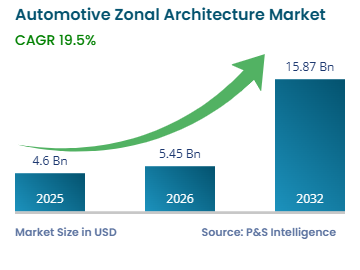
The automotive zonal architecture market size was USD 4.60 billion in 2025 and is projected to reach USD 5.45 billion in 2026 and USD 15.87 billion by 2032, advancing at a CAGR of 19.5% during 2026–2032. Vehicle manufacturers are replacing networks of function-specific electronic control units with physical-zone controllers linked to central computers. The commercial effect extends across zone-control hardware, networking and power semiconductors, platform software, and engineering services sold for identified zonal programs.
The architecture shift changes vehicle-level power and data design together. Physical-zone control can shorten wiring paths, consolidate protection, and connect local loads to shared computing resources. The combined design effects give OEMs a reason to coordinate electrical distribution and software architecture, while suppliers can compete for system-level content instead of isolated control-unit sockets.
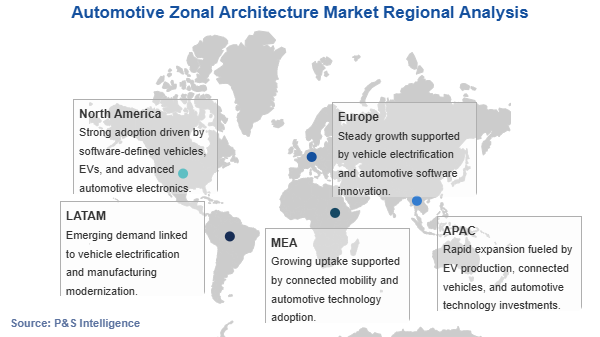
Electrified platforms add another route to adoption without limiting zonal designs to battery-electric vehicles. Clean-sheet electric platforms can coordinate low-voltage distribution, computing, thermal control, and data networks from the start, while zonal layouts also support body, comfort, connectivity, and driver-assistance functions in other propulsion types. Asia-Pacific held 39.0% of the Automotive Zonal Architecture Market share in 2025 and is forecast to record a 22.0% CAGR during 2026–2032, making it both the largest and fastest-growing region under the approved model.
Key Market Insights
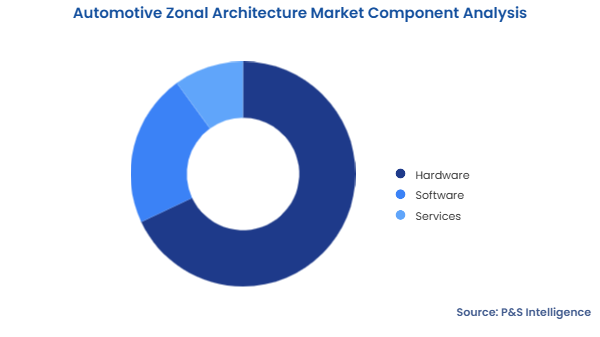
By component, hardware held 68.0% in 2025, while software is forecast to grow at a 23.8% CAGR during 2026–2032.
By architecture type, hybrid zonal architecture held 52.0% in 2025, while full zonal architecture is forecast to grow at a 25.6% CAGR during 2026–2032.
By vehicle type, passenger cars held 87.5% in 2025, while light commercial vehicles are forecast to grow at a 21.7% CAGR during 2026–2032.
By propulsion, internal-combustion-engine vehicles held 48.0% in 2025, while battery-electric vehicles are forecast to grow at a 24.6% CAGR during 2026–2032.
By application, body, comfort and smart power distribution held 27.0% in 2025, while ADAS and automated driving is forecast to grow at a 23.5% CAGR during 2026–2032.
By geography, Asia-Pacific held 39.0% in 2025 and is forecast to grow at a 22.0% CAGR during 2026–2032.
Automotive Zonal Architecture Market Trends and Growth Drivers
Centralized vehicle platforms pull zonal content into new programs
New vehicle platforms support automotive zonal architecture market growth because physical-zone layouts require coordinated changes to wiring, power distribution, networking, compute, and software. A platform-wide redesign connects local I/O and power control to shared computing resources across several vehicle functions. A platform decision therefore creates simultaneous demand for zone controllers, Ethernet links, intelligent protection, central-compute attribution, and integration work.
The mechanism is strongest when an OEM can spread a common electrical and electronic foundation across several vehicles. Reuse raises the addressable production volume for validated hardware and software while lowering the incremental cost of adding functions to later models. Suppliers that can support migration from retained edge controllers to more centralized execution can compete for content as full-zonal adoption expands. The pace still depends on vehicle-program launches, so an architecture demonstration does not establish immediate fleetwide conversion.
Prevalidated platforms open a shorter path to production
The automotive zonal architecture industry has an opportunity to monetize integration assets as OEMs seek to reduce the engineering burden of joining silicon, operating software, networking, power control, safety, and diagnostics. Prevalidated reference foundations can combine those layers with reusable interfaces, test assets, and support documentation. A coordinated reference foundation gives customers a more complete evaluation environment than a component-only offer.
Reference systems can expand supplier revenue through software, validation, tooling, and customization even when controller hardware becomes more price competitive. They also give OEM programs a path to evaluate zonal designs without building every layer internally. The opportunity is bounded by customer qualification and series-production decisions. Availability of a development platform supports shorter evaluation cycles, but it does not prove a design win or production volume.
48 V power and data networks converge inside zone controllers
automotive zonal architecture industry trends increasingly combine local data routing with intelligent power distribution. A zone controller can aggregate communication, protection, sensing, and load actuation near the devices it serves. Local power-data convergence explains why zonal suppliers are broadening from gateways into power conversion, electronic protection, and local control.
The move toward mixed 48 V and 12 V networks reinforces that convergence. At a given power level, higher-voltage distribution can reduce current for demanding loads, while local conversion preserves compatibility with remaining 12 V devices. Semiconductor vendors and Tier 1 integrators can therefore compete across a combined power-and-data bill of materials. The trajectory favors integrated reference designs, though the voltage mix and function split will continue to vary by vehicle class and OEM platform.
Integration and validation burdens slow platform conversion
Zonal consolidation increases the consequence of faults because a smaller set of controllers and networks carries functions that were previously separated. UNECE Regulations Nos. 155 and 156 require vehicle manufacturers in participating markets to maintain cybersecurity and software-update management processes, including verification, validation, and secure update controls. Each additional consolidated workload must also preserve functional safety, timing, and isolation across hardware and software layers.
These obligations lengthen qualification and raise switching costs for OEMs with established distributed or domain architectures. A supplier can reduce the burden with preintegrated stacks and reusable safety evidence, yet vehicle-specific testing remains unavoidable. Migration is therefore likely to proceed through hybrid zonal designs before full consolidation. Delays in validation, unresolved responsibility across vendors, or weak reuse across vehicle lines could shift revenue to later program cycles.
Hardware held 68.0% of revenue in 2025 because every zonal deployment requires physical controllers, networking interfaces, power distribution, protection, and an attributable share of central compute. BMW Group’s disclosed Neue Klasse layout uses four high-performance computers and a harness with 600 fewer meters of wiring. The combined compute-and-zone layout shows how the architecture replaces passive complexity with concentrated electronic content, supporting a large hardware value pool without treating the vehicle itself as market revenue.
Software is forecast to expand at a 23.8% CAGR during 2026–2032. Growth comes from hardware abstraction, service-oriented communication, virtualization, orchestration, cybersecurity, diagnostics, and update management across reusable platforms. Controlled lifecycle processes become more important as functions move onto shared computing and network resources. Revenue realization depends on externally monetized licenses and integration work, since internal OEM development remains outside the market boundary.
Architecture Type
Hybrid zonal architecture accounted for 52.0% in 2025. It lets OEMs introduce physical-zone aggregation while retaining selected domain controllers and edge electronic control units, reducing the number of systems that must migrate in one vehicle cycle. Infineon Technologies reported that three zone controllers in the BMW iX3 support four central computers. The disclosed arrangement shows central and zonal layers operating together without implying that every hybrid design uses the same topology.
Full zonal architecture is projected to grow at a 25.6% CAGR during 2026–2032. Its expansion will follow clean-sheet platforms that move more I/O, power control, and real-time functions into zones connected to vehicle-level orchestration. Coordinating interfaces, software, and validation assets can reduce integration work as more functions move from retained controllers into the zonal layer. Full-zonal adoption still depends on vehicle-specific safety and production validation.
Vehicle Type
Passenger cars represented 87.5% of the market in 2025, reflecting the scale and renewal cadence of global car platforms. An ACEA report based on OICA data recorded nearly 46 million passenger cars produced in Asia during 2024. High-volume passenger programs give suppliers more units across which to recover architecture engineering and software-validation costs, strengthening the case for reusable zonal foundations. The regional production figure supports scale but does not independently establish the approved global share.
Light commercial vehicles are forecast to post a 21.7% CAGR during 2026–2032. Their growth driver is the move toward centralized intelligence, secure updates, diagnostics, and connected fleet functions that improve uptime and lifecycle management. ZF documented active development of software-defined commercial-vehicle building blocks in 2026. The evidence supports the direction of demand, while the approved CAGR remains a model output rather than a reported zonal adoption rate.
Propulsion
Internal-combustion-engine vehicles held 48.0% in 2025 because zonal architecture also serves body, comfort, connectivity, ADAS, and power distribution in vehicles without a battery-electric drivetrain. The International Energy Agency reported that electric cars, including battery-electric and plug-in hybrid vehicles, were 25% of new-car sales in 2025 as sales rose 20% to more than 20 million, with battery-electric models representing 65% of the total. The remaining conventional and non-plug-in platform base offers broad scope for zonal upgrades, although these statistics do not independently establish the approved propulsion share.
Battery-electric vehicles are expected to record a 24.6% CAGR during 2026–2032. The expansion of electric-car sales and the battery-electric share within that pool enlarge the number of clean-sheet programs available for architecture renewal. New electric platforms give engineers an opportunity to coordinate low-voltage distribution, central computing, thermal controls, and data networks, making zonal content easier to design in from the start.
Application
Body, comfort and smart power distribution captured 27.0% in 2025. Physical-zone controllers sit close to doors, lighting, seats, pumps, and other loads, allowing shorter wiring runs and localized protection. Aptiv reported a zonal smart-electrical-center case that removed 2 kilograms and USD 40 per vehicle. The disclosed result supports demand for switches, drivers, power management, I/O, and controller integration without establishing the approved application share.
ADAS and automated driving is forecast to grow at a 23.5% CAGR during 2026–2032. Higher sensor bandwidth and real-time coordination increase the value of deterministic Ethernet backbones and central compute linked through zone controllers. Bosch reported EUR 10 billion of 2025 orders for intelligent driver-assistance systems across software, central computers, and sensing products. The order total is broader than zonal architecture, but it evidences investment in the compute-intensive functions that zonal networks must carry.
The complete segmentation hierarchy is as follows:
Component
Hardware
Zone control units and zonal gateways
Central/vehicle compute attributable to zonal platforms
Networking and interface semiconductors
Intelligent power distribution and protection
Software
Middleware and service-oriented architecture layers
Operating system, virtualization and orchestration
Network management, cybersecurity, diagnostics and OTA enablement
Services
Architecture design and engineering
Integration, validation and testing
Architecture Type
Hybrid zonal architecture
Domain-zonal
Central-zonal with retained edge ECUs
Full zonal architecture
Centralized compute with zonal I/O
Distributed zonal compute with vehicle-level orchestration
Transitional zonal architecture
Partial body/power zonal deployment
Zonal gateway overlay on legacy E/E architecture
Vehicle Type
Passenger cars
Hatchbacks and sedans
SUVs and crossovers
MPVs and other passenger cars
Light commercial vehicles
Medium- and heavy-duty commercial vehicles
Propulsion
Internal-combustion-engine vehicles
Hybrid electric vehicles
Mild hybrid
Full hybrid
Plug-in hybrid and range-extended electric
Battery-electric vehicles
Fuel-cell electric vehicles
Application
Body, comfort and smart power distribution
ADAS and automated driving
Infotainment, cockpit and connectivity
Powertrain and energy management
Chassis and vehicle motion
Safety, security and gateway functions
Drive strategic growth with comprehensive market analysis
Asia-Pacific led with 39.0% of global revenue in 2025. Scale is the central mechanism. OICA recorded 59.2 million vehicles produced in Asia-Oceania during 2025, including 34.5 million in China. Continued conversion of high-volume Chinese platforms, followed by wider Japanese, Korean, and Indian adoption, should preserve the region’s revenue lead. A prolonged vehicle slowdown or severe component-price compression could narrow its advantage.
Asia-Pacific also provides the fastest Automotive Zonal Architecture Market growth, with a projected 22.0% CAGR during 2026–2032. The International Energy Agency reported that electric-car sales in Asia-Pacific markets outside China grew 80% year on year in the first quarter of 2026. Growth outside China broadens the clean-sheet platform pool and gives regional suppliers more opportunities to scale common controllers and software. Slower electrification or delayed architecture renewal among established OEMs would weaken the trajectory.
China accounted for 22.0% of global revenue in 2025, making it the largest country allocation. More than 13 million electric cars were sold there in 2025, equal to six in ten global electric-car sales, according to the International Energy Agency. Domestic OEM scale and rapid model renewal support deployment of centralized and zonal platforms across price bands. China should remain the largest national pool, though aggressive semiconductor and controller price erosion could reduce revenue leadership even if unit leadership continues.
India is forecast to grow at a 26.0% CAGR during 2026–2032, the fastest country rate in the approved model. Aptiv’s Chennai software-defined vehicle center is designed to support up to 500 engineers and localize advanced software and safety work for Indian automakers. The engineering-center capacity supports a mechanism for small-base acceleration in locally engineered platforms, but it does not independently establish zonal adoption or the approved CAGR. Persistent cost constraints or continued reliance on distributed architectures would challenge the forecast.
The regions and countries in scope are listed below.
The automotive zonal architecture industry is fragmented because commercial value is divided among Tier 1 system integrators, semiconductor vendors, software providers, and engineering specialists. No approved evidence establishes a supplier as market leader or provides a scope-matched concentration ratio. OEMs can therefore source layers separately, but they must manage interface ownership, safety evidence, and lifecycle accountability across the resulting stack. Entrants still face long qualification cycles despite the fragmented value chain.
Robert Bosch GmbH, AUMOVIO SE, and Aptiv PLC compete through zone-controller and vehicle-architecture integration. Bosch combines zone ECUs with vehicle computers, communications, power supply, and platform software. AUMOVIO links zone control units with high-performance computers and smart power distribution. Aptiv combines zone controllers, electrical distribution, architecture engineering, and a cross-domain software foundation. ZF Friedrichshafen AG is differentiated by control software and vehicle-compute platforms that can operate within domain, zone, and central architectures.
Semiconductor participants compete across distinct technical layers. NXP Semiconductors N.V. spans zonal processing, networking, power management, and preintegrated CoreRide reference systems. Infineon Technologies AG combines AURIX control, Ethernet, power management, smart switches, and electronic fuses. STMicroelectronics N.V. connects Stellar processing with intelligent power and zonal endpoints, while Renesas Electronics Corporation emphasizes real-time virtualization and power distribution. Texas Instruments Incorporated brings embedded processing, analog, load control, and networking breadth, and ON Semiconductor Corporation focuses on intelligent power, protection, and Ethernet components. The competitive outcome will depend on design reuse, validation depth, software portability, and the ability to industrialize customer-specific configurations.
Top Companies in the Automotive Zonal Architecture Market:
Robert Bosch GmbH
AUMOVIO SE
Aptiv PLC
ZF Friedrichshafen AG
NXP Semiconductors N.V.
Infineon Technologies AG
STMicroelectronics N.V.
Renesas Electronics Corporation
Texas Instruments Incorporated
ON Semiconductor Corporation
Automotive Zonal Architecture Market News
In March 2026, NXP Semiconductors N.V. introduced the CoreRide Z248 zonal reference system and made it available to selected customers. The prevalidated platform combines 48 V energy distribution, deterministic data routing, safety support, and an integrated software ecosystem to shorten evaluation and integration work.
In February 2026, STMicroelectronics N.V. introduced the Stellar P3E automotive microcontroller with integrated AI acceleration for real-time edge functions, including body zonal architectures. Production was scheduled for the fourth quarter of 2026, so the event represents a product introduction rather than confirmed volume output.
In January 2026, Infineon Technologies AG and Flex launched a modular Zone Controller Development Kit at CES with approximately 30 reusable building blocks. The kit combines Infineon semiconductors, Flex design and manufacturing, and Vector software tools to support configurable, production-oriented zone-controller development.
Frequently Asked Questions About This Report
What supports automotive zonal architecture market growth?+
New vehicle platforms support automotive zonal architecture market growth because physical-zone layouts require coordinated changes to wiring, power distribution, networking, compute, and software.
Why does hardware hold the largest component share?+
Hardware held 68.0% of revenue in 2025 because every zonal deployment requires physical controllers, networking interfaces, power distribution, protection, and an attributable share of central compute.
Which region is both the largest and fastest growing?+
Asia-Pacific held 39.0% of the automotive zonal architecture market share in 2025 and is forecast to record a 22.0% CAGR during 2026-2032, making it both the largest and fastest-growing region under the approved model.
How competitive is the automotive zonal architecture industry?+
The automotive zonal architecture industry is fragmented because commercial value is divided among Tier 1 system integrators, semiconductor vendors, software providers, and engineering specialists.
How do clean-sheet electric platforms support zonal adoption?+
Clean-sheet electric platforms can coordinate low-voltage distribution, computing, thermal control, and data networks from the start, while zonal layouts also support body, comfort, connectivity, and driver-assistance functions in other propulsion types.
Want a report tailored exactly to your business need?
Leading companies across industries trust us to deliver data-driven insights and innovative solutions for their most critical decisions. From data-driven strategies to actionable insights, we empower the decision-makers who shape industries and define the future. From Fortune 500 companies to innovative startups, we are proud to partner with organisations that drive progress in their industries.
Client Testimonials
Working with P&S Intelligence and their team was an absolute pleasure – their awareness of timelines and commitment to value greatly contributed to our project's success. Eagerly anticipating future collaborations.
McKinsey & Company
India
Unmatched Standards
Our insights into the minutest levels of the markets, including the latest trends and competitive landscape, give you all the answers you need to take your business to new heights
Complete Data Security
We take a cautious approach to protecting your personal and confidential information. Trust is the strongest bond that connects us and our clients, and trust we build by complying with all international and domestic data protection and privacy laws