This Report Provides In-Depth Analysis of the Automotive Wireless Battery Management Components Market Report Prepared by P&S Intelligence, Segmented by Component (Battery Control Unit, Wireless Cell Monitoring Unit, Wireless Network Manager Unit), Application (Passenger Vehicles, Commercial Vehicles), Technology (Proprietary RF, Bluetooth, Ultra-Wideband (UWB)), and Geographical Outlook for the Period of 2022 to 2033
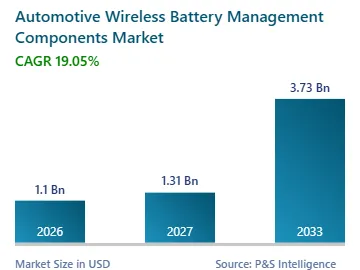
The automotive wireless battery management components market is estimated at USD 1.10 billion in 2026 and is projected to reach USD 1.31 billion in 2027. Revenue is projected to climb to USD 3.73 billion by 2033, expanding at a CAGR of 19.05% over the 2027-2033 forecast period. Carmakers are paying for wireless cell monitoring and control modules because removing the copper harness inside a battery pack frees space for more cells and cuts hand-fitted wiring work. For suppliers, each electric platform that drops the harness turns into multi-year orders for radio chips and monitoring modules.
Demand follows electric car output, and that base keeps widening. The International Energy Agency reports that electric car sales grew 20% to more than 20 million in 2025, a quarter of all new cars sold worldwide. Every one of those vehicles needs battery management, but only platforms engineered around a wireless architecture buy automotive wireless battery management components, so revenue depends on how many new platforms adopt the design as much as on vehicle volume. Suppliers that win a platform early tend to keep it for the model's production run, which makes design-in timing worth more than spot pricing.
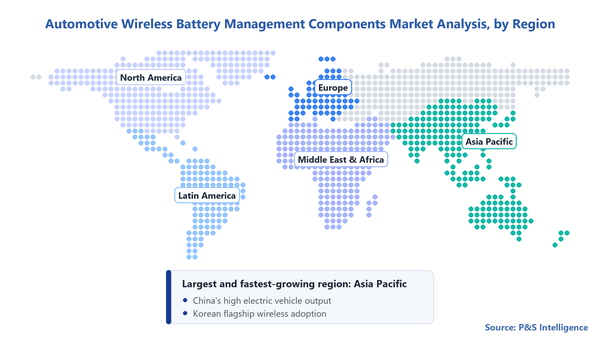
Asia-Pacific accounts for 42% of 2026 revenue and is also the fastest-growing region, with a projected CAGR of 20.55% over 2027-2033. China supplies most of the region's electric vehicle output, while South Korean and Japanese carmakers bring premium programs and India adds newer local platforms. North America, where wireless monitoring first reached production electric vehicles, grows on a different basis, with orders depending on whether carmakers carry the design onto their next platforms instead of on fresh capacity.
Key market insights
By component, battery control unit accounts for 42% of 2026 revenue, while wireless cell monitoring unit is set to expand at a 21.45% CAGR over 2027-2033.
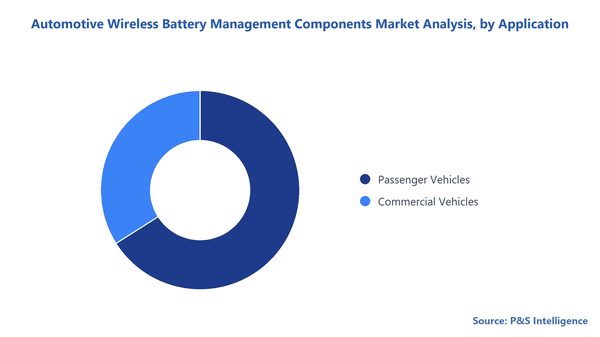
By application, passenger vehicles take 66% of 2026 spending, and commercial vehicles are on course for a 21.15% CAGR during 2027-2033.
By technology, demand spans proprietary RF, Bluetooth, and ultra-wideband (UWB) radio links.
By geography, Asia-Pacific holds 42% of 2026 revenue and also leads on growth, with a 20.55% CAGR expected over 2027-2033.
Ultra-wideband radio options are widening wireless pack design choices
Chipmakers are widening the radio options for wireless cell monitoring, which gives carmakers more than one architecture to test for a new battery pack. A pack enclosure is a sealed metal box filled with cells and busbars, so any radio link inside it must cope with reflections that rarely trouble a cabin or roadside link. Each radio option has to be validated in the actual pack layout, so a change of protocol usually arrives with a new vehicle platform and brings its own round of module orders.
NXP Semiconductors introduced an ultra-wideband wireless battery management solution in November 2024, stating that its pulse-based signal offers higher resistance to reflections and frequency-selective fading, and it opened the solution to carmaker evaluation from the second quarter of 2025. The chipset is still listed as preproduction, so ultra-wideband remains an evaluation-stage option. If it is validated, it would give pack engineers a fallback when one link struggles in a dense module layout, and suppliers of monitoring silicon may need to support several protocols to stay on shortlists.
Pressure to fit more cells per pack is accelerating harness-free designs
Carmakers selling large electric SUVs and pickups need more battery capacity without enlarging the pack, and the harness that links cell monitors to the control unit takes up room they would rather fill with cells. Replacing that harness with radio links frees space inside the enclosure and removes a manual connection step on the assembly line. Each platform that makes the switch replaces harness purchases with orders for wireless monitoring modules and a network manager that link to the pack's control unit.
Genesis, the luxury brand of Hyundai Motor Group, unveiled its GV90 flagship SUV in August 2026, with a wireless battery management system that the company says maximizes the battery system's packaging efficiency. The GV90 carries a 123.5 kWh battery, the largest capacity among the group's electric vehicles. Large premium packs are where the space argument is likely to pay back first, so suppliers selling into luxury and full-size programs are better positioned for early volume than those selling mainly into compact cars.
Battery health disclosure rules are raising the value of reliable cell data
Regulators are starting to treat battery management data as information that owners and third parties must be able to read, which raises the value of reliable cell-level history. That record matters most when a pack is resold, repaired, or moved into second-life use, because the next owner needs a trustworthy view of remaining capacity. Wireless designs that let modules be swapped without rewiring could ease repair and repurposing, a benefit suppliers cite alongside first-fit assembly.
Regulation (EU) 2023/1542 states that end-users of electric-vehicle batteries should be able to determine state of health and expected lifetime at any time from data stored in the battery management system, and it requires a digital battery passport for every electric-vehicle battery placed on the EU market from February 18, 2027. These duties sit at battery level and do not favor any communication technology, so they neither require a wireless design nor name a module as the record store. They do make trustworthy cell data a larger part of the wired versus wireless comparison.
Vehicle cybersecurity approval rules are limiting the pace of wireless adoption
Moving cell data onto a radio link turns the inside of the battery pack into another interface a carmaker must protect, test, and document before a vehicle can be approved. Wired systems do not add that radio interface, so a carmaker planning a new platform has to weigh harness and space savings against extra security engineering and validation time. Programs with tight launch dates or thin margins, such as low-cost compact cars, may keep a wired design for another generation, which pushes wireless module orders further out.
The European Commission's vehicle safety rules made cybersecurity mandatory for all new vehicles from July 7, 2024, after first applying it to new vehicle types. Any wireless battery link in a car sold in the EU therefore falls inside the carmaker's cybersecurity case. Analog Devices holds a TÜV NORD certificate, first issued in 2022 and renewed in 2025, assessing its Sentinel wireless battery management system against ISO/SAE 21434 at cybersecurity assurance level 4. Evidence of that kind can shorten a carmaker's validation, while suppliers that leave the work to the customer risk dropping out of late-stage evaluations.
Segmentation Analysis
Component
Battery control units account for 42% of automotive wireless battery management components revenue in 2026. Wired packs also need a control unit, so this report counts it only when specified for a wireless architecture. A wireless pack typically carries one control unit, which makes the battery's safety-critical decisions and connects the pack to the vehicle. Its bill of materials usually includes a safety-rated microcontroller, isolation parts, and contactor drivers, which tends to give it a higher value per vehicle than any single monitoring module.
Wireless cell monitoring units are projected to post a 21.45% CAGR over 2027-2033, the quickest pace among the component groups. A pack typically holds one monitoring unit per module or cell group, so unit demand climbs with the number of modules in each pack and with the number of wireless platforms in production. Larger packs on SUVs, pickups, and commercial vehicles add to that count. Monitoring units also sit closest to the cells, so they carry most of the radio and sensing hardware in a pack.
Application
Passenger vehicles hold 66% of 2026 revenue. Wireless battery management first reached production on passenger electric models, and the cars, SUVs, and pickups that make up most electric vehicle sales give suppliers far larger program volumes than truck or bus platforms. Passenger programs also tend to run on shorter model cycles, so each redesign is a fresh chance to drop the pack harness. Large-format and premium models show the clearest payback, because extra pack space converts into range that buyers will pay for, and suppliers with passenger-car safety qualifications can reuse them across several brands.
Commercial vehicles are expected to expand at a 21.15% CAGR during 2027-2033. Electric trucks and buses carry far larger battery capacity than cars, often spread across several packs, so a wireless design removes more harness length and more connectors per vehicle. The European Automobile Manufacturers' Association (ACEA) reports that electrically chargeable trucks above 3.5 tonnes took 4.2% of EU truck registrations in 2025, up from 2.3% a year earlier. A base that small leaves room for rapid percentage growth as fleets and bus operators electrify, and operators also value easier pack servicing because downtime costs them directly.Copyright P&S Intelligence. Reuse requires attribution under CC BY 4.0.
Technology
Carmakers choose a radio protocol early in pack design, and that choice decides which chip supplier and which monitoring modules a platform will buy. Proprietary RF links are typically tuned by their chip vendors for conditions inside a battery enclosure, which lets the design be optimized for timing on the battery network. Bluetooth Low Energy links draw on an open standard, and Renesas describes its Bluetooth-based system as avoiding reliance on proprietary protocols tied to a single supplier. Because a protocol is qualified for a specific pack, the decision usually holds for the life of that platform.
Ultra-Wideband (UWB) is the newest option, offered as a way to cope with signal reflections inside a metal enclosure, and its uptake depends on carmakers completing evaluation on upcoming platforms before any volume orders follow. For component vendors, a module that can be re-qualified on a second radio with limited hardware change could shorten the requalification work when a carmaker switches protocol between platform generations, keeping that vendor on the next shortlist.
The following segments are analyzed in this report:
Component
Battery Control Unit
Wireless Cell Monitoring Unit
Wireless Network Manager Unit
Others
Application
Passenger Vehicles
Commercial Vehicles
Technology
Proprietary RF
Bluetooth
Ultra-Wideband (UWB)
Regional Analysis
Asia-Pacific automotive wireless battery management components market outlook
Asia-Pacific accounts for 42% of 2026 revenue and is also on track to grow fastest, with a projected 20.55% CAGR over 2027-2033. The region builds most of the world's electric vehicles and battery packs, so pack engineering decisions for a large share of global output are made by carmakers and cell suppliers in China, South Korea, and Japan. Engineering teams that sit close to module and chip vendors can shorten qualification cycles. Several of the region's battery groups also build complete packs for carmakers, which puts monitoring hardware choices partly in their hands.
China, the region's largest market, sets the volume baseline. The China Association of Automobile Manufacturers (CAAM) reports that new energy vehicle sales reached 16.49 million units in 2025, up 28.2% on the prior year. That is manufacturer sales and includes about 2.6 million exported vehicles, so it sizes China's production base rather than domestic demand. Even a modest wireless share of those platforms produces large module volumes, and frequent model refreshes multiply design-in opportunities. Suppliers with local engineering support and prices that match domestic module makers have a better chance of winning those programs.
South Korea and Japan add premium programs to that volume. A Korean luxury flagship unveiled in 2026 already carries wireless monitoring, and both countries host electronics groups able to supply monitoring modules alongside other pack hardware. India is at an earlier stage of its electric shift, so its contribution is likely to build later in the forecast period as local platforms scale. Asia-Pacific's lead looks set to hold, because platform decisions for the largest pool of new electric models are made in the region.Copyright P&S Intelligence. Reuse requires attribution under CC BY 4.0.
Europe market analysis
Europe trails Asia-Pacific in revenue but sets some of the toughest conditions for wireless pack designs, because its carmakers pair large electric programs with demanding approval and battery-data rules. German, French, and Italian brands are moving more of their ranges onto dedicated electric platforms, and each new platform is a point where the wired harness can be replaced. Suppliers selling here need documentation that satisfies both type approval and battery record-keeping, which tends to favor vendors with established European engineering teams.
Germany shows how quickly that platform base is growing. The Kraftfahrt-Bundesamt (KBA) reports that 545,142 battery-electric cars were newly registered in Germany in 2025, a 19.1% share of new registrations and 43.2% more than a year earlier. Registrations show the size of the platform base, not wireless adoption, but rising volumes strengthen the case for German premium and volume brands to fund fresh pack designs. Suppliers with engineering staff near German platform centers are better positioned to join early pack development, which is usually when the wireless decision is made.
Latin America market analysis
Latin America contributes a smaller share of global revenue, since few electric platforms are engineered in the region and most battery packs arrive inside imported or locally finished vehicles. Component demand there follows the vehicle import mix more closely than local design choices. Brazil and Mexico matter most, Brazil as a growing sales market and Mexico as an assembly base for North American brands, where pack decisions are made at the parent company.
Brazil's registration data show how fast the sales base is moving. The Brazilian Electric Vehicle Association (ABVE) reports that 57,386 electrified light vehicles were registered in August 2026, 184% more than in August 2025, with plug-in models making up 83.1% of the month's electrified sales. Plug-in models carry far larger packs than conventional hybrids, which makes them the realistic candidates for wireless monitoring. Suppliers reach this demand mainly through the carmakers and importers that source vehicles for Brazil.
Middle East & Africa market analysis
The Middle East & Africa holds a small share of global revenue, because the region assembles few electric vehicles and most of its demand arrives inside imported cars and buses. Saudi Arabia is trying to change that through national programs to build vehicles locally, while South Africa's vehicle industry, which produces largely for export, is only beginning to add electrified models. Component purchases in both countries therefore follow the decisions of global carmakers more than local engineering teams.
Local pack assembly is the step that would change component demand. Once carmakers begin building electric models in Saudi Arabia at volume, pack-level purchasing could follow, although early programs are likely to reuse monitoring designs already qualified for other markets. Hot-climate operation also puts weight on accurate cell temperature monitoring, which gives suppliers of monitoring units a practical argument when bidding. Until then, suppliers reach the region through the global carmakers whose vehicles it imports.
North America market analysis
North America is where wireless battery management first moved toward volume production. General Motors stated in a November 2020 filing that it would be the first automaker to use a wireless battery management system for production electric vehicles, adding that the design allows over-the-air updates and eliminates the cost and weight of wiring. That early start gave U.S. carmakers, suppliers, and test laboratories years of field experience with wireless packs, which can shorten validation when the design moves to a new platform.
Growth in the region now depends more on platform decisions than on new buyers. U.S. electric car demand lost pace after federal purchase tax credits ended in 2025, and a slower sales outlook can delay new platform launches, leaving wireless designs to compete for tighter engineering budgets against established wired options. Canada's battery and assembly projects are largely tied to U.S. programs, so they follow the same timing. Suppliers already qualified on existing wireless platforms are better positioned, because carmakers extending a platform tend to keep hardware that has passed validation.
The following geographies are analysed in this report.
The automotive wireless battery management components market is moderately concentrated, with a small group of semiconductor suppliers providing the radio and monitoring silicon that module makers and carmakers build around. Automotive functional-safety qualification, years of in-pack radio validation, and the software stacks that ship with each chipset all raise the cost of entry. Module assembly is more open, since tier-one suppliers and some carmakers build their own units on the same chips. Those builders still buy radio and monitoring chips from the same small group of vendors, so the structure looks stable until a new radio protocol wins production platforms.
Analog Devices, Texas Instruments, NXP Semiconductors, Renesas Electronics, and Visteon illustrate how competition divides. Analog Devices and Texas Instruments sell complete wireless chipsets with software and reference designs, which suits carmakers that want a pre-validated starting point. Renesas Electronics offers a Bluetooth-based system, NXP Semiconductors offers an ultra-wideband option for carmaker evaluation, and Visteon delivers finished modules rather than chips alone.
For buyers, the chip layer matters more than the number of module makers, because it fixes the radio protocol, the safety documentation, and the software a pack will run. Once a carmaker qualifies a chipset and its radio protocol for a pack, switching suppliers usually means repeating safety and cybersecurity validation. New entrants are more likely to find openings when a carmaker starts a fresh platform or adopts a different radio, which is when supplier shortlists are redrawn. Established vendors can defend their position by carrying validated hardware across platforms.
Major Companies in Automotive Wireless Battery Management Components Market:
In January 2026, LG Innotek Co. Ltd. showcased B-Link at CES 2026, a unit combining a wireless battery management system and a battery junction box, among 15 power and motor components on its electric vehicle mockup. One combined part could reduce the pack electronics a carmaker must source and validate.
In December 2025, Texas Instruments Incorporated released the TIDA-020076 reference design, a stackable cell supervision unit for 6 to 18 cells with a wired daisy chain and a wireless link on its CC2662R-Q1 microcontroller. Carrying both links on one board lets carmakers compare wired and wireless performance before choosing one.
Frequently Asked Questions About This Report
How big is the automotive wireless battery management components market?+
The automotive wireless battery management components market is estimated at USD 1.10 billion in 2026 and is projected to reach USD 1.31 billion in 2027.
How fast is the automotive wireless BMS market growing?+
Revenue is projected to climb to USD 3.73 billion by 2033, expanding at a CAGR of 19.05% over the 2027-2033 forecast period.
Which region leads the automotive wireless battery management market?+
Asia-Pacific accounts for 42% of 2026 revenue and is also the fastest-growing region, with a projected CAGR of 20.55% over 2027-2033.
What are the advantages of a wireless BMS in electric vehicles?+
Carmakers are paying for wireless cell monitoring and control modules because removing the copper harness inside a battery pack frees space for more cells and cuts hand-fitted wiring work.
What are the disadvantages of wireless battery management systems?+
Moving cell data onto a radio link turns the inside of the battery pack into another interface a carmaker must protect, test, and document before a vehicle can be approved.
Which cars use a wireless battery management system?+
Genesis, the luxury brand of Hyundai Motor Group, unveiled its GV90 flagship SUV in August 2026, with a wireless battery management system that the company says maximizes the battery system's packaging efficiency.
Who makes wireless BMS chips for electric vehicles?+
Analog Devices and Texas Instruments sell complete wireless chipsets with software and reference designs, which suits carmakers that want a pre-validated starting point.
Want a report tailored exactly to your business need?
Leading companies across industries trust us to deliver data-driven insights and innovative solutions for their most critical decisions. From data-driven strategies to actionable insights, we empower the decision-makers who shape industries and define the future. From Fortune 500 companies to innovative startups, we are proud to partner with organisations that drive progress in their industries.
Client Testimonials
Working with P&S Intelligence and their team was an absolute pleasure – their awareness of timelines and commitment to value greatly contributed to our project's success. Eagerly anticipating future collaborations.
McKinsey & Company
India
Unmatched Standards
Our insights into the minutest levels of the markets, including the latest trends and competitive landscape, give you all the answers you need to take your business to new heights
Complete Data Security
We take a cautious approach to protecting your personal and confidential information. Trust is the strongest bond that connects us and our clients, and trust we build by complying with all international and domestic data protection and privacy laws