Automotive and Transportation Functional Safety Market Size & Opportunities Analysis - Growth Strategies, Competitiveness, and Forecasts (2025 - 2032)
This Report Provides In-Depth Analysis of the Automotive and Transportation Functional Safety Market Report Prepared by P&S Intelligence, Segmented by System Type (Electronic Control Units (ECUs), Microcontrollers (MCUs), Sensors, Actuator, Power Management Systems, Brake and Steering Systems), Offerings (Hardware, Software, Services), Vehicle Type (Passenger Cars, Commercial, Off-Highway), Propulsion (ICE Vehicles, EVs, Hydrogen Fuel Cell Vehicles), Application (ADAS & Autonomous Driving, Powertrain & Transmission, Infotainment & Telematics, BMS, Chassis & Braking Systems, Steering & Suspension, Body Electronics & Lighting), Automation (Level 0-1, Level 1-2, Level 1-3), and Geographical Outlook for the Period of 2019 to 2032
Automotive and Transportation Functional Safety Market Valuation
Key Highlights
Study Period
2019 - 2032
Market Size in 2024
USD 1.9 billion
Market Size in 2025
USD 2.1 billion
Market Size by 2032
USD 3.9 billion
Projected CAGR
9.5%
Largest Region
North America
Fastest Growing Region
Asia-Pacific
Market Structure
Fragmented
Market Size
Major Companies
Important Takeaways
Market Size and Forecast
Industry Trend
Regulatory Landscape
Demand Trend Analysis
Companies Recent Strategical Developments
Key Stakeholders
Voice of Industry Experts/KOLs
Future Opportunity
Explore the market potential with our data-driven report
Automotive and Transportation Functional Safety Market Outlook
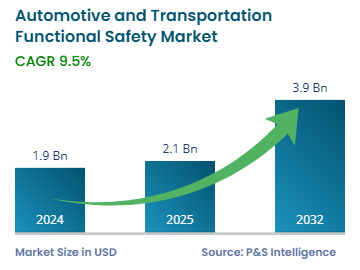
The global automotive and transportation functional safety market size was USD 1.9 billion in 2024, and it will grow by 9.5% during 2025–2032, to reach USD 3.9 billion by 2032.
The market growth is driven by the increasing development in the vehicle electronics and software systems, mainly focusing on ADAS, EVs, and self-driving technologies. As vehicles increasingly become a technologically dense, with safety operations controlled by intricate software, strong functional safety becomes essential to prevent system malfunction and ensure passenger safety. As per the World Health Organization (WHO), over 1.35 million people worldwide die in traffic accidents yearly, which highlights the need for advanced vehicle safety systems.
Functional safety guarantees system operations are safe and reliable, even under critical conditions. Furthermore, automotive engineers and operations are currently focused on advanced automation, fault tolerance, and prevention of hazardous events even when one component fails. To achieve this, safety standards, such as ISO 26262, are applied. This is derived from the more-general IEC61508 safety standard of processes meant to provide safety lifecycle that can be integrated with electronic systems suitable for use.
Automotive and Transportation Functional Safety Market Emerging Trends
Shift toward Centralized Vehicle E/E Architectures Is Key Trend
The shift toward automotive software frameworks and hardware refinement is hastening the adoption of zonal infrastructure from distributed systems, reducing wiring challenges and boosting dependability.
Centralized control systems are changing traditional ECUs by providing live coordination of essential safety operations across ADAS, braking, and powertrain systems on a unified and enhanced framework.
These systems increase functional safety through error localization, replication, and fault tolerance, which are essential for EVs and self-driving vehicles.
They also allow for flexible software enhancement and digital security inclusions, adapting to changing legal frameworks, such as UNECE R155 and R156.
The European Commission’s Horizon Europe program funds integrated vehicle E/E architecture projects to boost autonomous safety and reliability.
Leading automotive companies, such as Volkswagen, GM, and Mercedes-Benz, are adopting these systems to ensure the long-term viability of smart EVs and satisfy global functional safety regulations.
Government Mandates on Functional Safety and Cybersecurity Compliance Drive Market
The integration of software in vehicles leads to a rise in cybersecurity risks, which pose a direct threat to functional safety.
This requires governments and international organizations to create new regulations and technical safeguards.
Functional safety is not only integrated for hardware but also for software vulnerabilities and cyberattacks, which can trigger unsafe operational states.
To ensure this integrity, automotive cybersecurity and software updates are being installed, especially for EVs, self-driving, and software-defined vehicles.
These regulatory mandates apply the secure-by-design architecture, forcing companies to add cybersecurity controls in critical safety systems, such as ADAS.
These global regulatory frameworks are pushing OEMs and Tier 1 suppliers to adopt the ISO 26262 and ISO/SAE 21434 standards in parallel, aligning functional safety with cybersecurity best practices.
In January 2024, the UNECE’s GRVA approved the inclusion of motorcycles, scooters, and electric bicycles, which are Category L under Regulation No. 155, to expand cybersecurity mandates to more vehicle types.
In 2024, the Dutch vehicle authority, RDW, officially designated Keysight and Riscure as approved testing service providers for R155 and R156 compliance, including cybersecurity and over-the-air software updates.
South Korea will begin enforcing cybersecurity regulations aligned with UNECE R155.
New vehicle models will need to comply by August 2025, and all models by 2027, under its own version of a Cybersecurity Management System.
Automotive and Transportation Functional Safety Market Segmentation Analysis
System Type Analysis
The electronic control units category held the largest market share, of around 35%, in 2024, as they can control and perform a broad range of essential vehicle operations, such as steering, braking, engine performance, and driver assistance. Advanced vehicles depend on ECUs, more than 70 of which are integrated into high-end models, to assure live response and reliability as per safety standards, such as ISO 26262. They are important for safety actions under all driving conditions to detect faults and ensure safety.
The sensors category will have the highest CAGR owing to the rapid adoption of ADAS and autonomous driving technologies. Radar, LiDAR, vision, and ultrasound sensors detect nearby objects, identify lanes and the vehicle’s position, analyze pedestrians’ movements, and detect road signs. As the consumer demand rises for automatic safety technologies, such as blind spot warning, the need for integrated standards on each vehicle also increases.
In May 2024, the National Highway Traffic Safety Administration approved FMVSS No. 127, mandating automatic emergency braking system (ABS) in light vehicles, to detect both pedestrians and sensor-equipped vehicles.
The system types analyzed in this report are:
Electronic Control Units (ECUs) (Largest Category)
Microcontrollers (MCUs)
Sensors (Fastest-Growing Category)
Actuator
Power Management Systems
Brake and Steering Systems
Offering Analysis
The hardware category held the largest market share in 2024, as sensors, actuators, safety controllers, and ECUs serve as the basis of the safety system. Automotive manufacturers are investing in hardware to create advanced electronic systems and devices compliant with the ISO 26262 standard.
The software category will have the highest CAGR due to its growing role in architecture planning, virtual testing, data protection, and safety assurance. The growing trend of remote OTA software updates also drives this category. As vehicles become more defined with software, the need for strong product safety lifecycle tools, connectivity software, and testing & validation frameworks increases. Moreover, regulations, such as UNECE R155, propel the demand for advanced software solutions that secure operational safety and data security.
The offerings analyzed in this report are:
Hardware (Largest Category)
Software (Fastest-Growing Category)
Services
Vehicle Type Analysis
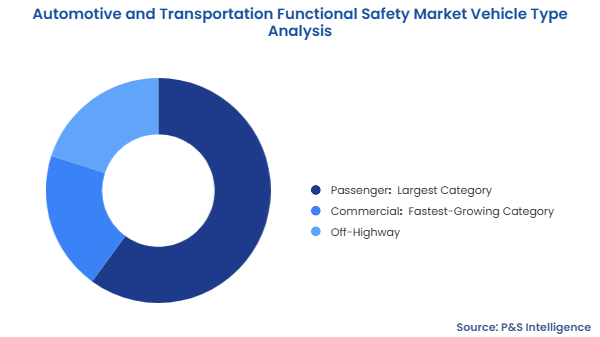
The passenger category held the largest market share of around 60% in 2024, due to the large-scale production, extensive consumer adoption of smart safety technologies, such as automatic emergency braking, and broad integration of safety systems by OEMs. The market growth in this type is widely supported by consumer demand and severe safety controls focusing on light vehicles. As per OICA, 67,674,745 passenger cars were manufactured worldwide in 2024, compared to 24,829,593 commercial vehicles.
The commercial category will have the highest CAGR of 9.9% due to the rising stringency of fleet safety standards, expanding installation of ADAS and telematics for management, and growing concerns about occupant and cargo safety.
The vehicle types analyzed in this report are:
Passenger (Largest Category)
Commercial (Fastest-Growing Category)
Off-Highway
Propulsion Analysis
The ICE category held the largest market share, of about 65% in 2024, due to the established prevalence and broad utilization globally. They make up large global fleets, particularly in regions where electric transportation is still emerging, such as Southeast Asia and Africa. The developed manufacturing ecosystem and an extensive fueling network also propel the market growth. Manufacturers are integrating functional safety systems into ICE platforms to meet changing safety rules.
The EVs category will have the highest CAGR, as they heavily depend upon high-voltage batteries, electric powertrains, and centralized control systems, making safety management more crucial. These systems need secure booting and over-the-air updates with strict functional and cyber safety standards. Moreover, the rapid consumer shift towards net-zero emission vehicles increases the demand for certified-safe EV platforms.
In July 2024, UNECE’s UN Regulations No. 155 and 156 became compulsory for new vehicles produced in associated countries. These regulations mainly focus on cybersecurity management systems and validated software updates. As per the International Energy Agency’s Global EVE Outlook 2025, worldwide electric car sales touched 17 million units in 2024.
The propulsions analyzed in this report are:
ICE (Largest Category)
EV (Fastest-Growing Category)
Hydrogen Fuel Cell
Application Analysis
The ADAS & autonomous driving category held the largest market share of about 35% in 2024 due to the rising integration of automation and safety technologies in new vehicles. These systems range from basic assistance to full self-driving capabilities and require live processing, data fusion, and replication. Moreover, the European Union's General Safety Regulations mandate the inclusion of automatic emergency braking and lane keeping in all new vehicles.
The powertrain & transmission category will have the highest CAGR due to the electrification and complexity of electric powertrains, including battery management systems, inverters, and electric motors. They require advanced functional safety solutions to manage high-voltage risks and ensure safe operation under all conditions.
The levels 1–2 category held the largest market share, of approx. 45% in 2024, as these vehicles are provided with driver assistance systems, partial lane-keeping aid, and partial steering controls. They are affordable, widely known, fulfill the current consumer demands, and comply with the minimum standards imposed.
The level 1–3 category will have the highest CAGR due to the shift toward advanced autonomous capabilities. These systems provide self-driving under certain conditions; they demand high-level data fusion and fault-tolerant operations.
The automations analyzed in this report are:
Level 0
Levels 1–2 (Largest Category)
Levels 1–3 (Fastest-Growing Category)
Levels 4–5
Drive strategic growth with comprehensive market analysis
Automotive and Transportation Functional Safety Market Regional Growth Dynamics
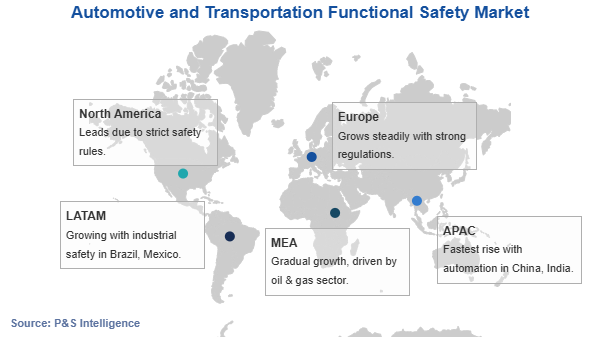
North America held the largest market share of around 40% in 2024, due to an advanced automotive ecosystem, stringent safety regulations, and the implementation of functional safety. In December 2024, the NHTSA required that all light vehicles must have rear seatbelt reminders by September 2027, aiming at improving safety by increasing the use of rear seat belts and thereby improving the effect of front-seat belt warnings.
Moreover, Transport Canada leads policy development efforts for the safe testing and installation of automated vehicles. The Federal Motor Carrier Safety Administration and the NHTSA are developing new rules that implement technologies, such as Automatic Emergency Braking, in heavy-duty vehicles.
Asia-Pacific will have the highest CAGR due to the accelerating electrification, infrastructure development, and consistent regional regulations. China has established a national EV battery safety regulation, GB38031-2025, which will be effective by July 2026. This regulation requires adding EV batteries that cannot catch fire or explosion proof at least two hours after thermal runaway.
The geographical breakdown of the market is as follows:
North America (Largest Regional Market)
U.S. (Larger Country)
Canada (Faster-Growing Country)
Europe
Germany (Largest Country)
U.K.
France (Fastest-Growing Country)
Italy
Spain
Rest of Europe
Asia-Pacific (Fastest-Growing Regional Market)
China (Largest Country)
India (Fastest-Growing Country)
Japan
South Korea
Australia
Rest of APAC
Latin America
Brazil (Largest Country)
Mexico (Fastest-Growing Country)
Rest of LATAM
Middle East and Africa
Saudi Arabia (Larger Country)
South Africa
U.A.E. (Fastest-Growing Country
Rest of MEA
Automotive and Transportation Functional Safety Market Share
The market is fragmented due to the presence of a wide range of players providing hardware, services, and software across large vehicle systems. Different players specialize in different products, such as sensors, ECU, and testing tools. This leads to niche and emerging players in a competitive landscape and prevents a single entity from controlling the entire market. Moreover, various regulations, such as UNECE standards in Europe and FMVSS in the U.S., diversify the market demands.
Key Automotive and Transportation Functional Safety Companies:
Emerson Electric Co.
Marelli Holdings Co., Ltd.
Robert Bosch GmbH
Valeo SE
Harman International Industries, Incorporated
SGS Société Générale de Surveillance SA
TÜV SÜD AG
NXP Semiconductors N.V.
DEKRA SE
DENSO Corporation
Autoliv, Inc.
Continental Aktiengesellschaft
Automotive and Transportation Functional Safety Market News
In March 2025, Valeo SA, Mobileye Global Inc., and Volkswagen AG announced a joint venture on surround-sensing ADAS, by integrating cameras and radar to increase reliability across VW’s MQB platform.
In September 2023, Valeo SA signed an agreement to integrate Mobileye Global Inc.’s imaging radar IP and software into its hardware solutions to achieve compliance with functional safety standards.
In December 2023, NXP Semiconductors N.V. and Hon Hai Technology Group (Foxconn) jointly opened a lab to hasten the development of software-defined vehicle safety platforms.
In May 2023, Autoliv Inc. and NIO Inc. signed a framework to co-develop advanced safety systems for EVs, including sustainable materials and next-generation airbags.
Want a report tailored exactly to your business need?
Leading companies across industries trust us to deliver data-driven insights and innovative solutions for their most critical decisions. From data-driven strategies to actionable insights, we empower the decision-makers who shape industries and define the future. From Fortune 500 companies to innovative startups, we are proud to partner with organisations that drive progress in their industries.
Client Testimonials
Working with P&S Intelligence and their team was an absolute pleasure – their awareness of timelines and commitment to value greatly contributed to our project's success. Eagerly anticipating future collaborations.
McKinsey & Company
India
Unmatched Standards
Our insights into the minutest levels of the markets, including the latest trends and competitive landscape, give you all the answers you need to take your business to new heights
Complete Data Security
We take a cautious approach to protecting your personal and confidential information. Trust is the strongest bond that connects us and our clients, and trust we build by complying with all international and domestic data protection and privacy laws