This Report Provides In-Depth Analysis of the Automotive Sensors Market Report Prepared by P&S Intelligence, Segmented by Sensor Type (Pressure Sensor, Temperature Sensor, Position Sensor, Oxygen Sensor, Motion Sensor, Optical Sensor, Torque Sensor, Gas Sensor, Level Sensor), Application (Advanced Driver-Assistance System (ADAS), Powertrain, Chassis, Body), Technology (MEMS, Non-MEMS), Vehicle Type (Passenger Car, Commercial Vehicle), End Use (Original Equipment Manufacturer (OEM), Aftermarket), and Geographical Outlook for the Period of 2021 to 2032
Explore the market potential with our data-driven report
Automotive Sensors Market Outlook
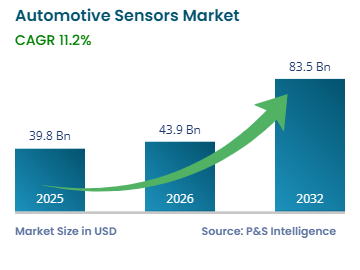
The automotive sensors market size was USD 39.8 billion for 2025, and it will grow by 11.2% during 2026–2032, to reach USD 83.5 billion by 2032.
The expansion of automotive sensors is also driven by an increasing number of vehicles with advanced driver-assistance systems (ADAS) and government regulations mandating the inclusion of these features into vehicles. Pressure sensors, temperature sensors, position sensors, and optical sensors are increasingly being used in vehicle components, such as the engine, chassis, body, and ADAS, to enable intelligent architectures for mobility.
Key Market Insights
Pressure sensors accounted for the largest share at 30% in 2025, supported by mandatory TPMS and extensive powertrain integration.
Optical sensors are the fastest-growing sensor type, driven by ADAS and autonomous driving adoption.
ADAS applications are expected to grow at the highest CAGR of 11.4%.
MEMS technology held the largest technology share at 75%, benefiting from cost efficiency and large-scale automotive deployment.
Asia-Pacific led the global market with 30% share in 2025 and is expected to remain the fastest-growing region, driven by China and India.
Government regulations further increase the demand for radar, cameras, and LiDAR-based sensors and their associated software for years to come. In addition to this, the International Energy Agency reported in January 2025 that electric cars accounted for over one-fifth of all cars sold in 2024 and forecast over 20 million sales for 2025. This increases the demand for temperature sensors in battery thermal management systems, pressure sensors in cooling circuits, and position sensors in electric motor control systems, among others.
Automotive Sensors Market Growth Factors
Autonomous Vehicle Development Is Key Trend
With the increasing levels of automation, a wider variety of sensors will be required beyond those deployed for better ADAS features. In addition, multiple redundant sensing systems for perception, as well as the need for redundancy within the architecture of these sensing systems drive this shift. In the development of autonomous vehicles, different types of sensors such as radar, LiDAR, camera and ultrasonic systems, are combined into a sensor suite using redundant configurations. This is done to meet fail-operational safety requirements and support higher level automation concepts. They often require between 20–40 individual sensing devices per vehicle, compared to 15–25 sensors found on most modern passenger cars equipped with an ADAS system.
The scope space includes more than just the hardware to perceive and interpret data. It also needs software to fuse this information together, systems to calibrate this hardware, and a lifecycle management structure to recertify and rescale sensors in order to maintain accurate perception. This is because the majority of the autonomous or semi-autonomous vehicles on the road today need to have their sensors recalibrated approximately every 10,000–20,000 kilometers.
Sensor calibration services, replacement sensors, and system validation tool sets will emerge as deployments transition from small controlled pilot projects to larger scale commercial fleet projects. Lifecycle sensing and calibration account for 15–25% of the total cost of the sensing system throughout the lifespan of a vehicle. While it may take some time for large-scale autonomous deployment to become widespread, these architectural models are already beginning to influence how mainstream vehicles are designed. This will provide continued long term sensor demand within both the hardware, integration, and recurrent services of each vehicle.
Regulatory Mandates and Safety Standards Are Biggest Drivers
Government-mandated safety regulations drive car makers to implement sophisticated sensor technology over the vehicle platform, providing a non-cyclical expansion in demand through an estimated 92 million units manufactured annually worldwide. On July 1, 2024, the NHTSA implemented Federal Motor Vehicle Safety Standards (FMVSS) number 127. IT requires all U.S. manufactured passenger cars and light trucks include automatic emergency braking system as standard equipment by September 2029. This will affect approximately 15–17 million U.S. light vehicles sold annually.
Mandatory safety components include radar-based long-range distance detection, camera-based object recognition, and ultrasonic sensors for near range monitoring. Thus. the total number of perception sensor components will increase from 0–2 per vehicle to 3–5, and what were previously optional ADAS features will now become mandatory safety features.
According to the World Health Organization, there are over 1 million deaths from road traffic accidents each year, and they represent the most common cause of death among youth and children between the ages of 5 and 29. Thus, the European Commission has expanded its General Safety Regulations to include more than 10 sensor-based safety systems. Further, over 50 countries have aligned their vehicle safety standards to those of the United Nations Economic Commission for Europe’s World Forum for Harmonization of Vehicle Regulations (WP.29).
As regulatory paths converge on both sides of the globe, regulatory pressure is being created to synchronize sensor deployments across all vehicle manufacturing worldwide, resulting in an increase in the average number of sensors installed on vehicles, despite market fluctuations, and consumer demand for reduced sensor configurations.
Automotive Sensors Market Segmentation Analysis
Sensor Type Analysis
The pressure sensor category holds the largest market share, of 30%, in 2025, as a result of their use on virtually all major automotive applications, including tire pressure monitoring, engine management, hydraulic brake failure detection, exhaust gas recirculation monitoring, and optimized airbag deployment. The NHTSA has mandated tire pressure monitoring systems. Additionally, the increasing regulatory requirements for exhaust pressure monitoring in emissions control systems and fuel system vapor leak detection create the demand for pressure sensors.
The optical sensor category will have the highest CAGR, due to the need for high-resolution environmental sensing required by autonomous vehicles and ADAS, which cameras, lidar, and infrared can deliver. Today's ADAS-equipped passenger cars have 6–12 optical sensors per car compared to 2–3 in earlier generations.
The sensor types analyzed in this report are:
Pressure Sensor (Largest Category)
Temperature Sensor
Position Sensor
Oxygen Sensor
Motion Sensor
Optical Sensor (Fastest-Growing Category)
Torque Sensor
Gas Sensor
Level Sensor
Others
Application Analysis
The powertrain category holds the largest market share, of 40%, in 2025. This is due to the high number of sensors within engine control units, transmission systems and drivetrain components managing combustion timing, fuel injection precision, torque distribution, and thermal management on conventional and electric powertrains. This was also due to global motor vehicle production of around 92 million units in 2024.
The transition from hybrid to electric propulsion technology will create a continued demand for powertrain sensors, including motor position sensors for commutation control, battery pack temperature monitoring arrays, inverter thermal management, and regenerative braking coordination sensors. The transition is being driven by sales of over 17 million units in 2024, which were forecast to rise to 20 million units in 2025 by the International Energy Agency.
The ADAS category will have the highest CAGR, of 11.4%, as government regulations requiring automatic emergency braking fuel the consumer desire for adaptive cruise control and lane-keeping assist (LKA) in their vehicles. This is pushing ADAS into non-premium markets, where safety-equipped passenger vehicles now account for more than 60% of new passenger vehicle registrations throughout the European Union.
The EU’s General Safety Regulation mandates ADAS features such as advanced emergency braking and emergency lane keeping systems on all new vehicles beginning in 2024. This creates a need for sensor integration across radar for distance detection, cameras for object classification, LiDAR for precise 3D mapping, and ultrasonic sensors for close range monitoring. This is expected to cover in excess of 12 million new passenger cars annually across the EU.
The applications analyzed in this report are:
Powertrain (Largest Category)
Advanced Driver-Assistance System (ADAS) (Fastest-Growing Category)
Radar
LiDAR
Camera
Ultrasonic
Chassis
Body
Technology Analysis
The MEMS category holds the largest market share, of 75%, in 2025. Many years of semiconductor processing technology development allows for high-volume manufacturing of small low-cost sensors that have better performance than traditional large sensors. The use of MEMS inertial sensors and MEMS accelerometers for airbags and MEMS gyroscopes for vehicle navigation further solidify MEMS' dominance through proven reliability and lower manufacturing costs. They are the major factors behind the mandates for electronic stability control and tire pressure monitoring systems in the EU, the USA, Japan, and China, under the UNECE-aligned vehicle safety regulatory frameworks.
The non-MEMS category will have the highest CAGR, of 11.5%, because multiple metrics must be measured over larger ranges than can currently be achieved with MEMS devices. The sensors also need to be physically configured to meet specific application requirements and ne robust enough to perform adequately in extreme environments, such as extremely high temperatures and pressures; and measure applied torque. The need for these conventional technologies will remain strong throughout a global commercial vehicle parc of over 400 million operational vehicles worldwide per year.
The technologies analyzed in this report are:
MEMS (Largest Category)
Non-MEMS (Fastest-Growing Category)
Vehicle Type Analysis
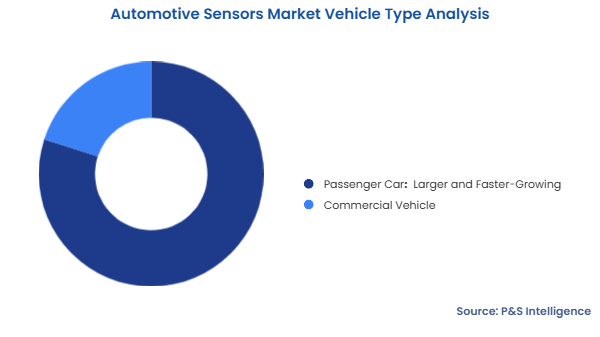
The passenger cars category holds the largest market share, of 80%, in 2025, and it will have the highest CAGR, as a result of high-volume production of passenger vehicles and increasing rate of technology integration into them. According to the International Energy Agency, over 14 million electric passenger cars were sold worldwide in 2024. The IEA had also indicated that electric passenger cars will hold an at least 25%, share of all cars sold in 2025. The additional sensors required for conventional passenger vehicles and increasing number of sensors in electric cars across battery management, thermal control, and energy optimization systems drive the market.
The vehicle types analyzed in this report are:
Passenger Car (Larger and Faster-Growing Category)
Conventional Fuel Car
Alternative Fuel Car
Commercial Vehicle
Light Commercial Vehicle (LCV)
Medium & Heavy Commercial Vehicle (M&HCV)
End User Analysis
The OEM category holds the largest market share, of 85%, in 2025, as most safety systems and emission control systems are installed on vehicles during production. Sensors allow automobile manufacturers to test and evaluate how each component works within a full vehicle system, enables sensor calibrations during vehicle assembly, and provides warranty support for OEM-installed safety systems. These include automatic emergency braking, electronic stability control, and airbags. Additionally, the NHTSA mandates AEB in all passenger automobiles and light trucks sold in the U.S. by September 2029.
The aftermarket category is expected to grow fastest during the forecast period in the automotive sensors market. The introduction of numerous legislations in different countries across the world pertaining to emission control and safety feature incorporation is expected to boost up the demand for the sensors in the aftermarket. With the introduction of numerous legislations in different countries across the world pertaining to emission control and safety feature incorporation, the demand for the sensors is expected to boost up in the aftermarket.
The end users analyzed in this report are:
Original Equipment Manufacturer (OEM) (Largest Category)
Aftermarket (Fastest-Growing Category)
Drive strategic growth with comprehensive market analysis
Automotive Sensors Market Geographical Analysis
Asia-Pacific Automotive Sensors Market Size
Asia-Pacific holds the largest market share, of 30%, in 2025, and will have the highest CAGR, of 11.3%, driven by concentrated automotive manufacturing capacity, rapid electric vehicle adoption, and expanding regulatory requirements for safety systems across China, Japan, South Korea, and India. In November 2024, Murata Manufacturing Co. Ltd. launched the SCH1633-D01 six-degree-of-freedom MEMS sensor for automotive ADAS applications, integrating accelerometer and gyroscope functions in a single AEC-Q100 Grade 1–qualified package.
The region's dominance in the automotive sensor market is a result of established semiconductor fabrication infrastructure and lower component procurement costs due to the proximity to global electronic supply chains and lower labor costs. This enable lower pricing for automotive sensors for both domestic demand and export markets. Furthermore, across major Asian economies, industrial policy initiatives support the development of automotive technologies directly through funding and/or investment, such as R&D subsidies, tax incentives for EV adoption, and regulatory mandates for ADAS.
The China Association of Automobile Manufacturers (CAAM) reports that China produced 31.28 million vehicles in 2024, marking a 3.7% year-on-year increase and maintaining China's position as the world's largest automotive market for the 16th consecutive year. The International Energy Agency indicates that electric car sales in Asia-Pacific reached approximately 11 million units in 2024, with the region accounting for over 60% of global sales. This multiplies sensor content requirements for battery management, thermal control, and powertrain systems.
China Automotive Sensors Market Size
China represented the largest country market within Asia Pacific in 2025, reflecting its position as the world's largest automotive producer and the dominant global EV manufacturing hub. China's automotive sensor market lead stems from annual vehicle production exceeding 31 million units, industrial subsidies and regulatory frameworks directing investment toward intelligent vehicle development, and domestic sensor manufacturing capacity expansion. This reduces import dependence, while improving cost competitiveness. According to the CAAM, China’s new-energy vehicle production in 2024 reached approximately 12.9 million units.
India Automotive Sensors Market Size
India is expected to demonstrate the fastest growth among during the forecast period. The market is driven by the expanding EV production and adoption, supported by government incentives, and the implementation of safety regulations requiring advanced sensor systems. The growth is further supported by the higher sensor intensity per vehicle and the strengthening alignment of domestic safety regulations with global frameworks. The increasing two-wheeler and car production, government policies mandating ADAS features and emission control systems, and growing presence of global automotive manufacturers drive the market. As per the India Brand Equity Foundation, EV sales in India grew by around 27% in 2024, reaching nearly 1.94 million units, up from 1.5 million units in 2023.
The regions and countries studied in the market are as follows:
North America
U.S. (Larger and Faster-Growing Country Market)
Canada
Europe
Germany (Largest Country Market)
U.K. (Fastest-Growing Country Market)
France
Italy
Spain
Rest of Europe
Asia-Pacific (Largest and Fastest-Growing Regional Market)
China (Largest Country Market)
India (Fastest-Growing Country Market)
Japan
South Korea
Australia
Rest of APAC
Latin America
Brazil (Largest Country Market)
Mexico (Fastest-Growing Country Market)
Rest of LATAM
Middle East and Africa
Saudi Arabia
South Africa (Largest Country Market)
U.A.E. (Fastest-Growing Country Market)
Rest of MEA
Automotive Sensors Market Share
The market is semi-consolidated with leading semiconductor and automotive component manufacturers maintaining substantial market presence through diversified product portfolios, established automotive supply chain relationships, and technology development capabilities spanning multiple sensor modalities. Economies of scale offer advantages in MEMS sensor fabrication, as do technology barriers requiring sustained R&D investment across pressure sensing, optical perception systems, and MEMS integration. Additionally, automotive qualification requirements demanding multi-year validation cycles for sensor reliability, durability testing across temperature extremes and vibration profiles, and compliance with automotive safety standards favor established suppliers with proven track records in automotive applications.
Key Automotive Sensors Companies:
Robert Bosch GmbH
Denso Corp.
Valeo SA
Continental AG
Infineon Technologies AG
Sensata Technologies Holding plc
Melexis NV
STMicroelectronics N.V.
ams OSRAM AG
NXP Semiconductors N.V.
Analog Devices Inc.
ON Semiconductor Corp.
TE Connectivity Ltd.
BorgWarner Inc.
Renesas Electronics Corporation
Automotive Sensors Market News
In August 2025, Infineon Technologies AG completed the acquisition of Marvell Technology Inc.'s automotive Ethernet business for USD 2.5 billion, strengthening its system expertise for software-defined vehicles and automotive microcontrollers.
In July 2025, STMicroelectronics N.V. entered into a definitive agreement to acquire NXP Semiconductors N.V.'s MEMS sensors business for up to USD 950 million in cash, including USD 900 million upfront and USD 50 million subject to achievement of technical milestones.
In April 2025, Robert Bosch GmbH launched a new radar sensor utilizing RF CMOS technology with 22-nanometer transistors. The sensor commenced serial production in mid-2025 with Chinese automotive manufacturers, targeting both premium and mid-range vehicle segments with enhanced object detection performance and compact integration.
In October 2024, NOVOSENSE and Continental AG formed a strategic alliance to co-develop automotive-grade pressure sensor chips featuring functional-safety diagnostics compliant with ASIL-D requirements.
Frequently Asked Questions About This Report
What will be the automotive sensors market size in 2032?+
In 2032, the automotive sensors market will value USD 83.5 billion.
Which sensor type is most dominant in the automotive sensors market?+
The pressure sensors dominate the automotive sensors market.
Which region is the most dominant in the automotive sensors market?+
Asia-Pacific is the largest automotive sensors market.
What are the key drivers of the automotive sensors market?+
The automotive sensors market is driven by rising vehicle electrification, increasing ADAS adoption, stricter emission and safety regulations, and growing demand for connected vehicles.
What is the market structure of the automotive sensors industry?+
The automotive sensors market is semi-consolidated.
Want a report tailored exactly to your business need?
Leading companies across industries trust us to deliver data-driven insights and innovative solutions for their most critical decisions. From data-driven strategies to actionable insights, we empower the decision-makers who shape industries and define the future. From Fortune 500 companies to innovative startups, we are proud to partner with organisations that drive progress in their industries.
Client Testimonials
Working with P&S Intelligence and their team was an absolute pleasure – their awareness of timelines and commitment to value greatly contributed to our project's success. Eagerly anticipating future collaborations.
McKinsey & Company
India
Unmatched Standards
Our insights into the minutest levels of the markets, including the latest trends and competitive landscape, give you all the answers you need to take your business to new heights
Complete Data Security
We take a cautious approach to protecting your personal and confidential information. Trust is the strongest bond that connects us and our clients, and trust we build by complying with all international and domestic data protection and privacy laws