Automotive Semiconductor Market Outlook (2027 - 2033)
This Report Provides In-Depth Analysis of the Automotive Semiconductor Market Report Prepared by P&S Intelligence, Segmented by Component Type (Discrete & Power Semiconductors, Microcontrollers (MCUs) & Microprocessors (MPUs), Analog Integrated Circuits (ICs), Logic & Computing SoCs / Processors, Sensors & Actuator ICs, Memory & Storage ICs), Vehicle Application (Powertrain & Electrification, Advanced Driver Assistance Systems (ADAS) & Autonomous Driving, Infotainment, Telematics & Digital Cockpit, Body Electronics & Comfort, Safety & Chassis Systems), Vehicle Propulsion Type (Battery Electric Vehicles (BEV), Internal Combustion Engine (ICE) Vehicles, Hybrid & Plug-in Hybrid Electric Vehicles (HEV / PHEV)), Vehicle Type (Passenger Cars, Commercial Vehicles), and Geographical Outlook for the Period of 2022 to 2033
Explore the market potential with our data-driven report
Automotive Semiconductor Market Overview
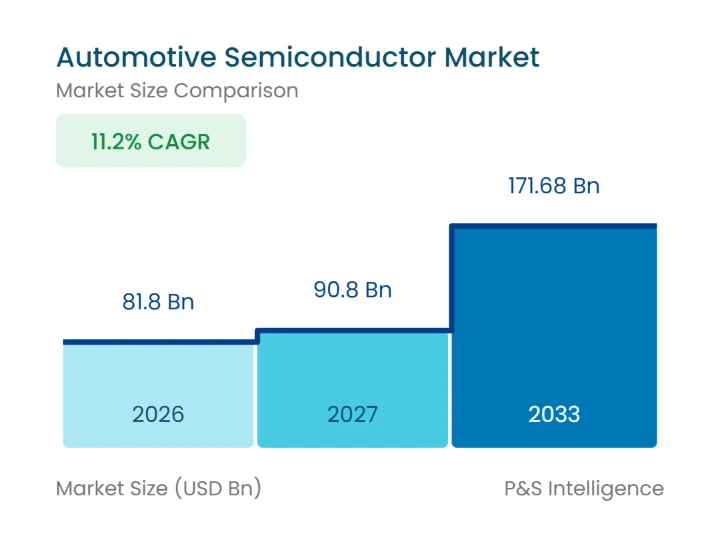
The global automotive semiconductor market size is estimated at USD 81.80 Billion in 2026 and is projected to reach USD 90.80 Billion in 2027. From there, revenue is projected to climb to USD 171.68 Billion by 2033, at a CAGR of 11.2% during 2027-2033. Carmakers and their Tier-1 suppliers are buying more silicon for each vehicle they build, as battery-electric drivetrains, mandated driver-assistance features, and centralized computers take over functions that mechanical and hydraulic parts once handled. For chipmakers, revenue therefore rises faster than vehicle output, because each new platform carries a larger and costlier chip bill of materials.
Battery-electric drivetrains generate the largest block of new chip orders, since traction inverters, battery monitoring, and on-board charging add power and analog devices that a conventional combustion car does not carry. According to the International Energy Agency, global electric car sales grew by 20% to exceed 20 million in 2025, a quarter of all new cars sold. Those sales size the platform base, while chip spend also depends on how much content each platform specifies. Suppliers of silicon carbide modules, battery-monitoring ICs, and safety microcontrollers capture a larger share of each electrified program as voltage levels and feature counts rise.
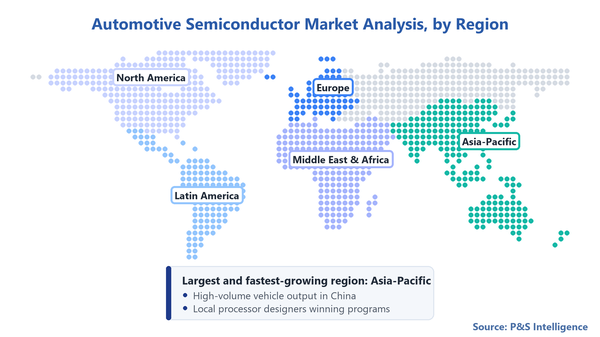
Asia-Pacific accounts for 46.0% of 2026 revenue and leads growth as well, with a 12.2% CAGR through 2027-2033. China anchors that position with the world's largest vehicle output and a local chip-design base, while Japan and South Korea add demand from export-oriented brands that fit high-value electronics. Europe and North America grow mainly through richer content on existing production, so the automotive semiconductor market expands there by value per vehicle more than by new plant capacity. Chipmakers with design centers and supply close to Chinese automakers are better positioned to follow the region's model cycles.
Key market insights
By component type, discrete & power semiconductors accounts for 29.5% in 2026 and carries a 13.8% CAGR for 2027-2033.
By vehicle application, powertrain & electrification accounts for 32.5% in 2026 and carries a 14.2% CAGR for 2027-2033.
By vehicle propulsion type, battery electric vehicles (BEV) account for 41.5% in 2026 and carry a 15.6% CAGR for 2027-2033.
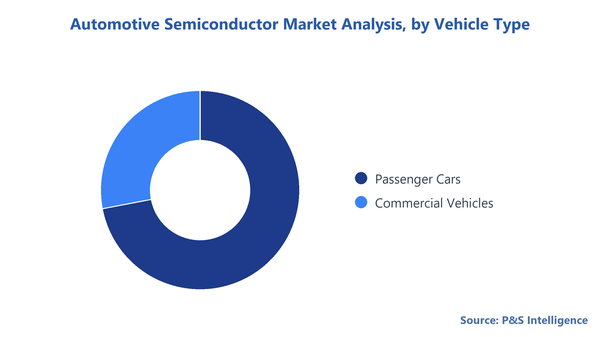
By vehicle type, passenger cars account for 72.0% in 2026 and carry an 11.5% CAGR for 2027-2033.
By geography, Asia-Pacific accounts for 46.0% in 2026 and carries a 12.2% CAGR for 2027-2033.
Automakers redesigning their electrical architectures are folding dozens of single-function control units into a handful of domain, zonal, and central computers. Each consolidation removes some low-cost microcontrollers from the bill of materials but adds a high-performance system-on-chip, LPDDR memory, Ethernet switches, and power management ICs around it. Chip spending per vehicle rises, yet it is concentrated in fewer sourcing decisions, which raises the stakes of every platform award for processor and memory vendors.
Figures from Qualcomm's earnings release for the quarter ended June 2026 put its automotive revenue at USD 1.59 Billion, 61% above the USD 0.98 Billion of a year earlier. One vendor's result does not size the category, but it shows how quickly processor design wins signed years earlier can turn into revenue once the vehicles carrying them reach showrooms. Suppliers of standalone body and gateway controllers are likely to see slower unit growth as zonal hardware absorbs their functions.
Mandatory driver-assistance features are lifting sensor and processor content in entry-level cars
Safety rules that require automated braking, lane keeping, and driver-attention warnings on every new vehicle convert optional camera and radar packages into standard equipment. Each mandated function needs a sensing path, such as an image sensor or radar transceiver, a processor to interpret the signal, and safety-rated microcontrollers that act on brakes and steering. Because the rules cover entry-level models too, they lift chip content at the high-volume end of the range, where optional features once had low take rates.
As per the European Commission, new general vehicle safety rules have applied to all new motor vehicles sold in the EU since July 7, 2024, and cars and vans must now carry lane keeping and automated braking systems. The Commission expects the measures to help save over 25,000 lives by 2038. The rules set function-level requirements and do not name specific chips, so carmakers buy on cost per function, which can favor single-chip vision processors and integrated radar transceivers in budget vehicles.
Chinese carmakers' preference for local chips is opening room for domestic processor designers
Chinese carmakers are qualifying domestic chip designers for driver-assistance and cockpit computing, partly to reduce exposure to export controls and import pricing. A local design win often comes with software tools and engineering support matched to fast Chinese model cycles, which shortens the path from contract to production. This creates an opening for domestic fabless designers, and also for foreign vendors that build China-specific product lines and localize their supply chains to compete for the same programs.
Horizon Robotics recorded shipments of 4.01 million Journey-series processor sets in 2025, up 38.8% from 2024, while its mid-to-high-end shipments rose to nearly five times the prior year's level. The mix suggests local designs are moving beyond entry-level assistance into more demanding driving functions. For international processor vendors, this points to tougher price competition inside China, so more of their design-win prospects are likely to come from European, Japanese, and North American programs.
Concentrated supply of mature-node chips is limiting production continuity for carmakers
A large part of each vehicle's chip count consists of low-cost discretes, logic, and analog parts made on mature process nodes, often with few qualified sources per part number. Automotive qualification ties each part to a specific supplier and fab, so a shortage cannot be closed by buying an equivalent device on the open market. When one source stops shipping, vehicle assembly can halt over components that represent a small fraction of the electronics bill.
The European Automobile Manufacturers' Association (ACEA) cautioned on October 16, 2025 that qualifying new suppliers for specific components and ramping their output would take several months, while existing stocks of Nexperia chips were expected to last only a few weeks. The episode showed how an ownership dispute at one discrete-chip supplier can threaten assembly lines across regions. Several chipmakers are adding mature-node capacity in Europe and the United States, yet carmakers that qualify second sources or hold larger buffer stocks take on higher qualification and inventory costs.
Segmentation Analysis
Component Type
Discrete & power semiconductors hold 29.5% of the automotive semiconductor market in 2026, the largest share of any component group. Every electrified vehicle routes battery energy through a traction inverter, an on-board charger, and a DC-DC converter, each built from MOSFETs, IGBTs, or silicon carbide modules with high unit prices. Combustion vehicles also use power devices for pumps, lighting, and body loads, so the category earns revenue across both propulsion types. Power modules are qualified together with the inverter design, which ties a supplier to a platform for its production life.
Discrete & power semiconductors are also projected to post the quickest growth among component groups, at a 13.8% CAGR during 2027-2033. Carmakers moving to 800-volt platforms specify silicon carbide MOSFETs, which cost more than silicon IGBTs but cut inverter losses and allow faster charging. STMicroelectronics plans its Catania campus in Italy to run every step from substrate to finished device on 200mm silicon carbide wafers, at up to 15,000 wafers a week at full build-out, a shift expected to lower cost per die. Gallium nitride devices add a second growth path in on-board chargers and DC-DC converters.
Vehicle Application
Powertrain & electrification holds 32.5% of 2026 revenue, more than any other vehicle application. Its lead comes from the cost of the parts it consumes. Battery management systems need cell-monitoring ICs on every module, traction inverters need gate drivers and power modules, and charging units add high-voltage controllers. Hybrid and combustion programs still buy engine and transmission control units, so the segment collects revenue across every propulsion type. Engine-control suppliers face a shrinking base as battery-electric volumes rise, while battery-electronics suppliers gain.
Powertrain & electrification is set to grow fastest among the five applications as well, at a 14.2% CAGR during 2027-2033. Growth depends less on vehicle volume than on the content of each new electric platform. Bidirectional on-board chargers, which let a vehicle feed power back to a home or the grid, add switching devices and controllers. Larger packs on SUVs and pickups need more monitoring channels per vehicle. For battery-IC and power-module suppliers, each electric platform award carries more revenue than the combustion program it replaces.
Vehicle Propulsion Type
Battery electric vehicles (BEV) account for 41.5% of 2026 revenue, the largest share by propulsion type even though combustion and hybrid models still make up most global production. The gap comes from content. A battery-electric car replaces the engine controller with an inverter, battery monitoring, charging electronics, and thermal management, all chip-intensive. Automakers also tend to launch their newest cockpit and driver-assistance computers on these models first, which adds processor and memory spend on top of the powertrain bill.
BEVs are projected to grow at a 15.6% CAGR during 2027-2033, the fastest of the three propulsion types. China Passenger Car Association (CPCA) data show new energy vehicles made up 54.1% of China's passenger-vehicle retail sales in 2025, a domestic retail measure that also includes plug-in hybrids and sizes the platform base, not chip adoption. Each step from 400-volt to 800-volt architecture raises silicon carbide and isolated gate-driver content per car, which favors suppliers already qualified on high-voltage designs.
Vehicle Type
Passenger cars account for 72.0% of 2026 revenue. The International Organization of Motor Vehicle Manufacturers (OICA) counted 71.0 million passenger cars among 99.8 million vehicles registered or sold worldwide in 2025, so the segment's revenue share broadly mirrors its unit share. Consumer models also carry infotainment screens, camera-based assistance, and comfort electronics that many fleet-specified vans and trucks omit. For chipmakers, passenger programs provide the volume needed to recover the high design and qualification cost of an automotive-grade part.
Copyright P&S Intelligence. Reuse requires attribution under CC BY 4.0.
Passenger cars are projected to grow at an 11.5% CAGR during 2027-2033, the faster of the two vehicle types. SUVs and crossovers, which carry larger battery packs and more sensors than sedans, are likely to account for much of that growth as automakers tilt model ranges toward them. Over-the-air updates and paid feature unlocks encourage carmakers to fit more capable computers at the factory, raising hardware spend per car. Commercial vehicles add steady demand from electric vans and trucks, although smaller production runs spread qualification costs over fewer units.
The following segments are analysed in this report.
Component Type
Discrete & Power Semiconductors
Microcontrollers (MCUs) & Microprocessors (MPUs)
Analog Integrated Circuits (ICs)
Logic & Computing SoCs / Processors
Sensors & Actuator ICs
Memory & Storage ICs
Vehicle Application
Powertrain & Electrification
Advanced Driver Assistance Systems (ADAS) & Autonomous Driving
Infotainment, Telematics & Digital Cockpit
Body Electronics & Comfort
Safety & Chassis Systems
Vehicle Propulsion Type
Battery Electric Vehicles (BEV)
Internal Combustion Engine (ICE) Vehicles
Hybrid & Plug-in Hybrid Electric Vehicles (HEV / PHEV)
Vehicle Type
Passenger Cars
Commercial Vehicles
Regional Analysis
Asia-Pacific automotive semiconductor market outlook
Asia-Pacific holds 46.0% of global automotive semiconductor market revenue in 2026 and is also projected to post the fastest growth, at a 12.2% CAGR during 2027-2033. China is the region's largest market. Its vehicle plants buy chips for domestic sales and for a fast-growing export trade. Output reached 34.53 million vehicles in 2025, including 7.10 million exported units, according to the China Association of Automobile Manufacturers (CAAM), so a growing part of the chips bought in China ends up in cars sold abroad.
India adds the region's newest layer of demand, as carmakers there shift their mix toward utility vehicles that carry more electronics. Society of Indian Automobile Manufacturers (SIAM) data show domestic passenger-vehicle wholesales of 4,643,439 units in FY2025-26, up 7.9%, with utility vehicles driving most of the gain, a dispatch count that sizes the vehicle base and not chip content. Japan and South Korea contribute value-led demand from brands that fit hybrid powertrains and advanced safety features. The region's lead is likely to widen because it combines new plant capacity with rising content per vehicle.
Copyright P&S Intelligence. Reuse requires attribution under CC BY 4.0.
Europe market analysis
Europe trails Asia-Pacific in revenue but carries some of the highest chip content per vehicle, supported by premium carmakers and by the headquarters of three major automotive chip suppliers. Growth comes mainly from content upgrades on existing production lines, such as 800-volt platforms and centralized computers, while overall vehicle output has shown little expansion. Because the region's safety rules already require camera and radar-based functions on all new cars, demand for sensing silicon now follows model renewals more than first-time fitment.
Local supply of mature-node logic is the region's other growth lever. TSMC's announcement of its Dresden joint venture with Bosch, Infineon, and NXP confirms a planned capacity of 40,000 300mm wafers a month on 28/22 nanometer and 16/12 nanometer processes, aimed at automotive and industrial demand, with production targeted by the end of 2027. For European microcontroller and radar buyers, a fab inside the region shortens supply lines and could reduce exposure to export disruptions like those seen in 2025.
North America market analysis
North America's chip demand depends heavily on large pickups and SUVs, which carry more sensors, displays, and power electronics per vehicle than smaller cars. Electric vehicle adoption in the United States slowed after federal purchase credits ended in September 2025, so near-term growth relies more on hybrids, driver-assistance features, and centralized cockpit computers. These content upgrades tend to favor processor, memory, and analog suppliers over silicon carbide vendors in the region's near-term order mix.
Domestic chip production is expanding alongside these shifts. Texas Instruments announced in December 2025 that it had begun production at SM1, its newest 300mm wafer fab in Sherman, Texas, three and a half years after breaking ground. Trade and reshoring policy can encourage carmakers and Tier-1 suppliers to qualify US-made analog and power parts where local alternatives exist. Growth in the region is tied mainly to content per vehicle, so suppliers with established positions in cockpit and driver-assistance programs are better positioned to benefit.
Latin America market analysis
Latin America's chip demand comes largely from vehicle assembly for export, with Mexico building cars and trucks mainly for the United States and Brazil serving a large domestic market. In Mexican plants, chip specifications and sourcing contracts are typically set by the global headquarters of US, Japanese, and German carmakers, so local purchasing follows decisions made elsewhere. Brazil's market leans toward flex-fuel combustion engines and hybrids, which use less power silicon per vehicle than battery-electric models.
Mexico produced 3,953,494 light vehicles in 2025, 0.9% fewer than in 2024, Mexico's National Institute of Statistics and Geography (INEGI) recorded, a total that measures the platform base and not chip adoption. Changes in US trade policy toward imported vehicles make Mexican output sensitive to tariff decisions, which can delay new electronics-heavy programs. For chip vendors, success in the region depends mostly on being qualified on the global platforms that Mexican plants build.
Middle East & Africa market analysis
Middle East & Africa contributes a smaller share of revenue, with demand split between export assembly in South Africa and Morocco and a newer push in Saudi Arabia to build electric vehicles locally. Plants in South Africa and Morocco mostly build to European specifications for European buyers, so their chip content follows EU safety and emission requirements. Gulf projects are at an early stage, and their chip demand depends on assembly volumes reaching production scale.
Figures from the National Association of Automobile Manufacturers of South Africa (NAAMSA) put the country's 2025 vehicle exports at a record 414,268 units, with 332,695 of them shipped to the EU and the U.K. That export orientation means power, sensor, and safety chips for these vehicles are specified under European platform programs, which favors suppliers already qualified with European carmakers. Gulf assembly projects reaching volume would add a second source of chip demand alongside the export plants, although purchasing in the region remains small next to Asia-Pacific.
The following geographies are analysed in this report.
The automotive semiconductor market is moderately fragmented, with competition spread across several product layers and no single supplier leading all of them. Power devices, microcontrollers, analog and networking chips, high-performance processors, sensors, and memory each have their own group of established vendors, because each layer demands different process technology and fab investment. Qualification under AEC-Q100 and ISO 26262 functional-safety requirements keeps incumbents in place for the life of a vehicle platform, so the structure changes slowly, mainly at the compute and silicon carbide layers where new designs are still being awarded.
Broad-line suppliers such as Infineon Technologies AG, NXP Semiconductors N.V., STMicroelectronics N.V., Texas Instruments Incorporated, Renesas Electronics Corporation, and ON Semiconductor Corporation compete on portfolio breadth, selling microcontrollers, power devices, and analog chips into the same vehicle program and supporting Tier-1 suppliers with reference designs. Compute specialists including Qualcomm Incorporated, NVIDIA Corporation, Mobileye Global Inc., and Horizon Robotics compete on processing performance and software stacks, frequently contracting with carmakers directly. At the silicon carbide and image-sensor layers, wafer supply and module qualification weigh heavily in awards.
For carmakers, this structure means each vehicle depends on many chip vendors, and replacing any one of them requires requalification of the part and the module around it. Earlier shortages and the 2025 discrete-chip disruption have led some carmakers to negotiate supply directly with chipmakers instead of leaving sourcing entirely to Tier-1 suppliers. Direct relationships give the largest vendors earlier visibility into platform plans, which helps them align fab capacity with the programs they have won.
Major Companies in Automotive Semiconductor Market:
In October 2026, Infineon Technologies AG signed an expanded multi-year agreement with Wolfspeed that moves its long-term silicon carbide substrate supply from 150mm to 200mm wafers. The deal supports Infineon's conversion to 200mm silicon carbide manufacturing, where larger wafers yield more usable die area per substrate and can lower the cost of power devices for electric vehicle drivetrains.
In March 2026, NVIDIA Corporation announced that BYD, Geely, Isuzu, and Nissan are building Level 4-ready vehicles on its DRIVE Hyperion platform, with Isuzu developing autonomous buses on DRIVE AGX Thor. The programs extend demand for high-performance vehicle compute from premium driver assistance toward robotaxi and commercial fleets.
In January 2026, NXP Semiconductors N.V. introduced the S32N7 processor series, built on a 5nm process to centralize propulsion, vehicle dynamics, body, gateway, and safety functions, with Bosch the first to adopt it in a vehicle integration platform. NXP estimates up to 20% lower total cost of ownership for carmakers consolidating control units.
In January 2026, Mobileye Global Inc. announced that a top-10 U.S.-based automaker selected its EyeQ6H chip for Surround ADAS with hands-free driving on select highways, lifting expected future deliveries of the system to more than 19 million units. The award carries single-chip driver assistance into high-volume mainstream models.
In December 2025, Renesas Electronics Corporation began shipping samples of the R-Car X5H, a 3nm multi-domain system-on-chip with up to 400 TOPS of AI performance, to select customers. The chip lets carmakers run driver-assistance and cockpit workloads on one device, which cuts the number of separate processors per vehicle.
Last Updated: November 2026
Frequently Asked Questions About This Report
How big is the automotive semiconductor market?+
The global automotive semiconductor market size is estimated at USD 81.80 Billion in 2026 and is projected to reach USD 90.80 Billion in 2027.
Which region leads the automotive semiconductor market?+
Asia-Pacific holds 46.0% of global automotive semiconductor market revenue in 2026 and is also projected to post the fastest growth, at a 12.2% CAGR during 2027-2033.
Why do electric vehicles need more semiconductors than gasoline cars?+
The gap comes from content. A battery-electric car replaces the engine controller with an inverter, battery monitoring, charging electronics, and thermal management, all chip-intensive.
Which segment holds the largest share of the automotive semiconductor market?+
Discrete & power semiconductors hold 29.5% of the automotive semiconductor market in 2026, the largest share of any component group.
Why is silicon carbide used in electric vehicle inverters?+
Carmakers moving to 800-volt platforms specify silicon carbide MOSFETs, which cost more than silicon IGBTs but cut inverter losses and allow faster charging.
Why do chip shortages stop car production?+
Automotive qualification ties each part to a specific supplier and fab, so a shortage cannot be closed by buying an equivalent device on the open market.
Want a report tailored exactly to your business need?
Leading companies across industries trust us to deliver data-driven insights and innovative solutions for their most critical decisions. From data-driven strategies to actionable insights, we empower the decision-makers who shape industries and define the future. From Fortune 500 companies to innovative startups, we are proud to partner with organisations that drive progress in their industries.
Client Testimonials
Working with P&S Intelligence and their team was an absolute pleasure – their awareness of timelines and commitment to value greatly contributed to our project's success. Eagerly anticipating future collaborations.
McKinsey & Company
India
Unmatched Standards
Our insights into the minutest levels of the markets, including the latest trends and competitive landscape, give you all the answers you need to take your business to new heights
Complete Data Security
We take a cautious approach to protecting your personal and confidential information. Trust is the strongest bond that connects us and our clients, and trust we build by complying with all international and domestic data protection and privacy laws