This Report Provides In-Depth Analysis of the Automotive Occupant Monitoring Sensor Market Report Prepared by P&S Intelligence, Segmented by Sensor/Technology Type (Pressure Sensors, Weight Sensors, Ultrasonic Sensors, Radar Sensors, Camera Sensors), Sales Channel (OEM, Aftermarket), Propulsion Type (ICE, Electric), Application/Function (Occupant Classification, Driver Monitoring, Seatbelt Reminder, Child Presence Detection), and Geographical Outlook for the Period of 2021 to 2032
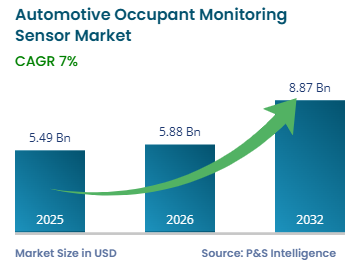
The automotive occupant monitoring sensor market was valued at USD 5.49 billion in 2025, and climbed to an estimated USD 5.88 billion in 2026. The market is projected to reach USD 8.87 billion by 2032, growing at a CAGR of 7.0% during 2026-2032. Automakers are fitting more pressure, radar, and camera-based sensors per vehicle as crash-test protocols and safety-rating bodies raise the bar on in-cabin monitoring, turning occupant sensing from a single seat-weight switch into a multi-sensor system that buyers now specify at the platform level.
Regulatory pressure is the clearest engine behind rising occupant monitoring sensor demand. Euro NCAP's updated protocol makes driver monitoring worth up to 25 points toward a five-star rating and requires continuous eye- and head-tracking for a vehicle to qualify, starting in 2026, a change that pushes automakers to specify camera-based sensors alongside the pressure and weight hardware most platforms already carry. For Tier-1 suppliers, every new points-based safety criterion becomes a fresh line item on the next vehicle program's sensor bill of materials.
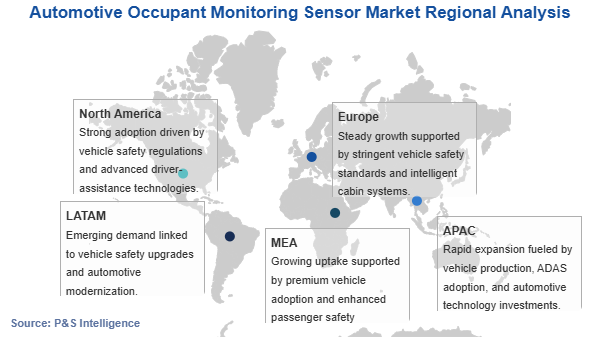
North America generated 34% of 2025 revenue, the largest regional base, as the U.S.' long-standing occupant-classification mandate keeps pressure and weight sensors standard on every new light vehicle sold there and in Canada. Asia-Pacific is set to grow fastest, at an 8.6% CAGR during 2026-2032, as China, Japan, India, and South Korea tighten crash-test and safety-rating requirements on fast-expanding new-vehicle output, adding occupant-sensor fitment to platforms that previously shipped without it. That shift is pulling incremental radar and camera content onto vehicles that once carried only a single seat-weight sensor.
Key market insights
By sensor/technology type, pressure sensors held 32% share in 2025, while radar sensors are projected to grow at a 13.7% CAGR during 2026-2032.
By sales channel, OEM held 87% share in 2025, while aftermarket is set to register the fastest growth over the forecast period.
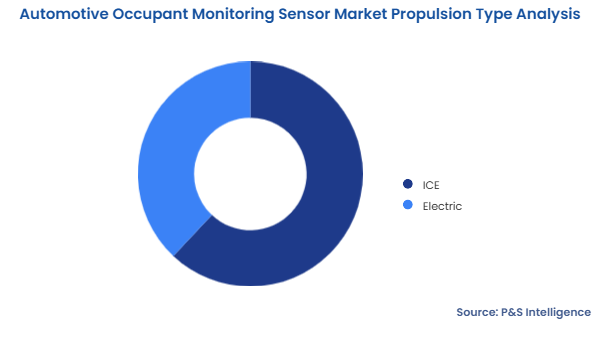
By propulsion type, ICE held 62% share in 2025, while electric is set to post the fastest growth over the forecast period.
By application/function, occupant classification led the market in 2025, while child presence detection is projected to grow at a 9% CAGR during 2026-2032.
By geography, North America held 34% share in 2025, while Asia-Pacific is projected to grow at an 8.6% CAGR during 2026-2032.
Automotive Occupant Monitoring Sensor Market Trends and Growth Drivers
Camera-based driver monitoring mandates are reshaping in-cabin sensor mix
A wave of new vehicle safety regulation is pushing automakers to add camera-based driver monitoring next to the pressure and weight sensors already built into every seat. Regulators increasingly treat eye- and head-tracking as a baseline safety feature rather than an option reserved for premium trims, and platform teams are specifying vision sensors at the same design stage as airbags and seatbelts instead of retrofitting them later in a vehicle's life.
The European Commission's vehicle safety framework, Regulation (EU) 2019/2144, made driver drowsiness and attention warning systems mandatory on all newly registered vehicles from July 7, 2024, requiring a camera or equivalent sensor capable of detecting fatigue in real time. That single requirement effectively doubled the sensor count on entry vehicles sold in Europe, since older platforms carried seat sensors alone. Suppliers that already had a qualified camera-based module ready for volume production captured those platform wins first, while camera-only entrants without pressure-sensor experience had to partner for the rest of the occupant-sensing bill of materials.
Occupant classification mandates are driving demand for pressure and weight sensors
Crash-protection rules that require a vehicle to identify who is sitting in the front passenger seat before deciding how an airbag deploys remain the single largest source of occupant-sensor demand. Every light vehicle sold in a market with this requirement needs a weight or pressure sensor built into the seat cushion, which keeps baseline sensor volume tied directly to new-vehicle production rather than to any optional safety package.
The US National Highway Traffic Safety Administration's Federal Motor Vehicle Safety Standard 208 has required advanced air bag systems, including occupant classification, on all new light vehicles since September 2014, and a revised appendix begins a phase-in requiring 40% compliance by September 2025 and full compliance by September 2026. That refresh forces suppliers to requalify existing pressure-sensor and control-module designs against tighter criteria. Vendors with designs already validated against the new appendix can move directly into new vehicle programs, while suppliers still running the older design face a compressed requalification window.
Automated-driving readiness rules are opening a market for driver-presence sensors
Vehicles built to operate hands-off under automated lane-keeping features need a way to confirm the driver is present, belted, and able to resume control, a requirement that did not exist for conventional driver-assist systems. That creates demand for a distinct category of presence and posture sensors on top of the pressure and camera hardware that occupant-classification rules already require.
The United Nations Economic Commission for Europe's Regulation No. 157 requires vehicles approved with Automated Lane Keeping Systems to carry a driver availability recognition system that confirms the driver occupies the seat with the belt fastened before, and throughout, automated operation. As more markets adopt UNECE-aligned type-approval rules for Level 3 features, automakers rolling out automated lane-keeping trims need a dedicated presence sensor on every one of those models. Suppliers that can bundle a presence sensor with existing seatbelt and weight hardware have an opening to win that content without a separate sourcing process.
Biometric privacy compliance is limiting camera-based sensor rollout
Camera-based driver and occupant monitoring works by analyzing facial geometry and eye movement, data that regulators in privacy-focused markets classify as biometric information subject to stricter handling rules than a simple presence signal from a seat sensor. That classification adds a compliance step, a consent design, and a data-handling review that pressure- and radar-based sensors, which do not capture identifiable facial data, can largely avoid.
The European Data Protection Board reaffirmed in 2025 that consent for processing biometric data such as facial images must be freely given, specific, informed, and unambiguous, a standard that camera-based driver monitoring systems must satisfy before an automaker can activate certain analysis features in the European Union. Meeting that bar can add legal review and localized software configuration to a program timeline. Automakers weighing tight launch schedules sometimes default to non-biometric sensors, such as radar or pressure hardware, for baseline compliance and treat camera-based analytics as a later, opt-in feature.
Pressure sensors held 32% of 2025 revenue, the largest share among occupant-sensing technologies. Seat-cushion pressure and weight sensors were the first hardware automakers adopted to satisfy occupant-classification mandates, and that installed base keeps growing simply because every new light vehicle sold in a market with an occupant-classification rule needs one. The technology is also the cheapest sensor category to qualify and manufacture at scale, giving Tier-1 suppliers a low-risk, high-volume product line they can bundle into a seat assembly rather than sell as a standalone module.
Radar sensors lead every other category on growth, with a 13.7% CAGR forecast for 2026-2032 that puts them well ahead of the market's overall pace. In-cabin radar can detect a person's presence, breathing rate, and a child left behind in a rear seat without a direct line of sight, a capability a pressure sensor or camera struggles to match. The US Federal Communications Commission's 2021 waivers opened the 57-64 GHz band for cabin-mounted radar, and Tier-1 suppliers are now packaging it alongside existing pressure hardware rather than replacing that hardware.
Sales Channel
OEM factory-fit accounted for 87% of 2025 revenue, since occupant-sensing hardware is fitted almost entirely at the point of vehicle assembly rather than added later. Crash-protection and driver-monitoring mandates apply to the vehicle as built, so a pressure sensor, seatbelt-tension switch, or camera module has to be validated and wired into the platform before it leaves the factory. That requirement locks most sensor volume into the OEM production line and leaves little room for a bolt-on aftermarket product to satisfy the same compliance obligation.
Aftermarket sales are on track to outpace OEM fitment in percentage terms over the forecast period, though they are expanding off a much smaller base. Fleet operators and owners of older vehicles built before occupant-classification and driver-monitoring rules took effect are adding compatible sensor modules through Tier-1-approved repair and upgrade channels to bring existing vehicles closer to current safety standards. That demand is concentrated in commercial fleets, where insurers and corporate safety policies increasingly expect the same monitoring capability that new vehicles carry from the factory.
Propulsion Type
ICE vehicles accounted for 62% of 2025 revenue, reflecting their continued dominance of global new-vehicle production. Occupant-sensing hardware is specified per vehicle platform rather than per powertrain, so the internal-combustion fleet's sheer production volume, still the majority of new light vehicles built worldwide, keeps it the largest single propulsion category for sensor demand even as electrified models expand their own take rate.
Electric vehicles are on track to add occupant-sensor revenue faster than any other propulsion category, with electrified-platform sensor content advancing at 9.0% between 2025 and 2032, ahead of the market's 7.0% CAGR over 2026-2032. New electric-vehicle programs are engineered from a blank sheet, so designers add a fuller sensor suite, including radar and camera modules, at the outset instead of retrofitting an ICE platform. The International Energy Agency reports electric cars are on course to reach 28% of global new-car sales in 2026, giving automakers a fast-growing base of platforms for richer occupant-sensing packages.
Application and Function
Occupant classification leads the market by application, the function every seat-integrated pressure and weight sensor exists to support in the first place. The category traces back to the mid-2000s, when the U.S. began requiring vehicles to identify a child or small adult in the front passenger seat before allowing full-force airbag deployment, giving occupant classification the longest run of continuous regulatory demand of any function tracked in this market.
Child presence detection is set to expand faster than any other application tracked in this market, with a 9% CAGR forecast for 2026-2032, though it is growing from a far smaller base than occupant classification. Automakers are adding radar- and ultrasonic-based detection specifically to warn a driver who has left a child unattended in a rear seat, a feature that safety-rating bodies now score separately from general occupant classification. That narrower function is pulling new sensor content onto vehicles that already carry a pressure-based classification system, adding a second sensor layer rather than displacing the first.
The following segments are analysed in this report.
Sensor/Technology Type
Pressure Sensors
Weight Sensors
Ultrasonic Sensors
Radar Sensors
Camera Sensors
Sales Channel
OEM
Aftermarket
Propulsion Type
ICE
Electric
Application/Function
Occupant Classification
Driver Monitoring
Seatbelt Reminder
Child Presence Detection
Drive strategic growth with comprehensive market analysis
North America Automotive Occupant Monitoring Sensor Market outlook
North America accounted for 34% of global Automotive Occupant Monitoring Sensor Market revenue in 2025, the largest share of any region. The U.S. has required occupant-classification hardware on every new light vehicle for more than a decade, giving Tier-1 suppliers a mature, high-volume production base that other regions are only beginning to build. Automakers selling into the U.S. and Canada specify pressure, weight, and seatbelt-reminder sensors as standard content rather than optional trim, which keeps regional sensor volume tied directly to new-vehicle output rather than to buyer take-rate.
The U.S. carries the bulk of this installed base as the region's largest single market, with automakers there increasingly layering camera- and radar-based monitoring on top of mandatory pressure and weight hardware. The Insurance Institute for Highway Safety reports that 71% of 2025 model-year vehicles it evaluated earned a good rating for seat belt reminders, up from just 16% of 2022 models, evidence of how quickly automakers are adding sensor-based reminder hardware to meet tightening private rating criteria.
Purchasing in the region is moving beyond mandate compliance toward voluntary upgrades that chase these private safety ratings rather than a new federal requirement. Automakers competing for top marks from independent testers are adding sensor-based reminder and monitoring hardware ahead of any regulatory deadline, a pattern that keeps pulling incremental sensor content onto vehicles independent of the federal rulemaking calendar.
Asia-Pacific is set to outpace every other region in the Automotive Occupant Monitoring Sensor Market, expanding at an 8.6% CAGR during 2026-2032. China, Japan, India, and South Korea are tightening crash-test and safety-rating requirements just as regional light-vehicle output keeps climbing, adding occupant-sensor fitment to a far larger number of new platforms each year than mature markets add. OICA, the International Organization of Motor Vehicle Manufacturers, reports that China alone produced 34.53 million vehicles in 2025, up 10.4% from 2024, giving the region an expanding base of new-build platforms for richer sensor packages.
China, the region's largest vehicle-producing market, is leading this build-out as domestic and joint-venture automakers add occupant-sensing hardware to meet tightening domestic and export crash-test requirements. India's Ministry of Road Transport and Highways confirms that Bharat NCAP ratings, in effect since October 2023, are entering a second phase that will broaden vehicle-safety assessment beyond occupant protection to the full crash chain, giving automakers in the region's two largest vehicle markets a direct reason to add sensor content to platforms that previously shipped without it.
As more of the region's safety-rating programs move toward stricter, points-based scoring similar to Europe's, occupant-sensor fitment rates in Asia-Pacific should keep converging with those in mature markets over the forecast period, narrowing a gap that has persisted since crash-test requirements there lagged North America and Europe by several vehicle-generation cycles.
Europe holds a steady, mid-sized slice of global occupant-sensing revenue, well behind North America and Asia-Pacific in absolute terms even as its vehicle fleet keeps adding sensor content model by model. New-vehicle safety rules across the region increasingly bundle driver-monitoring and occupant-classification hardware into a single compliance package, giving automakers less reason to skip a sensor once a platform is already being redesigned to add another.
The European Automobile Manufacturers' Association reported that new car registrations across the region rose 1.8% in 2025, with battery-electric models reaching 17.4% share, a shift that is expanding the pool of newly engineered platforms onto which automakers can specify a fuller occupant-sensing suite from the start. Germany, France, the U.K., Italy, and Spain remain the region's largest vehicle markets, and automakers based there are typically among the first in Europe to adopt a new sensor requirement ahead of it becoming mandatory bloc-wide.
Latin America contributes a comparatively small but growing piece of worldwide occupant-sensing demand, concentrated in Brazil's vehicle-assembly base and Mexico's export-manufacturing sector. Regional crash-test programs are extending stricter occupant-safety criteria to a market that historically lagged North American and European requirements, giving automakers building for Brazil and Mexico a fresh reason to add sensor content to platforms sold there.
Latin NCAP's updated assessment protocol, which took effect in January 2026, requires audible and visual seatbelt reminders across front and rear seats and pushes automakers toward sensor-based systems that make bypassing a seatbelt sensor harder. Automakers selling into Brazil and Mexico are upgrading reminder and classification hardware to keep pace with that tightened scoring rather than risk a lower crash-test rating.
Brazil remains the region's principal production base, while Mexico's assembly plants add a second, export-oriented source of demand tied closely to the sensor specifications required by their North American customers. Suppliers already qualified for Brazil's crash-test protocols find it easier to extend the same sensor package into Mexican assembly lines built to similar specifications.
The Middle East and Africa together hold the smallest regional slice of the global Automotive Occupant Monitoring Sensor Market, with GCC countries accounting for most regional vehicle sales. Vehicle-safety certification requirements administered across the Gulf are increasingly aligned with international crash-test norms, giving automakers importing into the region a reason to keep occupant-sensing hardware consistent with the specification already built for European and Asian markets rather than offering a stripped-down variant.
The GCC Standardization Organization's vehicle technical regulations cover safety-belt anchorage, restraint-system, and occupant-safety requirements that GCC-market vehicles must meet before sale, a bar that keeps regional sensor specifications tied to the hardware automakers already build for other markets rather than a separate, lower-cost design. South Africa represents a smaller, growing pocket of demand as its vehicle-assembly sector adopts similar safety specifications, giving suppliers already certified for GCC requirements a template for expanding into the region's south.
The following geographies are analysed in this report.
The Automotive Occupant Monitoring Sensor Market is moderately fragmented, with more than a dozen established suppliers competing across a technology base that spans mature pressure and weight sensors, established radar and ultrasonic modules, and newer camera-based monitoring software. No single supplier controls all four sensor types at scale, since winning pressure-sensor business depends on seat-integration manufacturing while winning camera-based content depends on computer-vision software, two different competitive skill sets. That split has kept the market from consolidating around a handful of dominant vendors.
Diversified Tier-1 suppliers, including Robert Bosch GmbH, Continental AG, Denso Corporation, ZF Friedrichshafen AG, and Valeo SE, compete on the strength of their existing seat, airbag, and body-electronics manufacturing lines, bundling pressure, weight, and radar sensors into the same production relationship automakers already use for restraint systems. Their global plant footprints let them supply the same qualified module to multiple regional assembly lines at once, spreading the qualification cost across a far larger production run than a single-region entrant can match.
Camera- and software-focused specialists, including Seeing Machines Limited and Smart Eye AB, compete instead on driver-monitoring algorithm accuracy and typically license their software to a Tier-1 integrator rather than selling hardware modules directly to an automaker. Infineon Technologies AG occupies a third position, supplying the radar and sensing semiconductors that both clusters build their modules around.
Qualification requirements set the main barrier to entry. A new occupant-sensing supplier must pass automotive-grade validation testing and prove its module performs reliably across years of vehicle life before an automaker will specify it on a new platform, a process that typically takes several years and favors suppliers with an existing safety-systems track record. That barrier keeps the diversified Tier-1 cluster relatively stable, even as new camera-based entrants continue to find an opening by partnering with an established integrator rather than seeking direct OEM qualification on their own.
Key Players in the Automotive Occupant Monitoring Sensor Market:
In June 2026, Smart Eye AB secured four new Driver Monitoring System design wins with a leading global automaker, covering vehicle models entering production in 2028 and 2029 across Europe and North America. The wins extend the company's software into Level 2+ automated-driving programs that require continuous driver-presence confirmation.
In June 2026, Seeing Machines Limited secured a USD 31 million expansion of an existing automotive production program with a European carmaker, extending its driver and occupant monitoring software into additional vehicle models from the second half of 2026. The expansion, delivered alongside a Tier-1 automotive partner, broadens the company's in-cabin sensing content across vehicles built for Europe, the U.S., and China.
In May 2026, Visteon Corporation introduced an LCD instrument cluster with an integrated Driver Monitoring System camera, developed with its driver-monitoring software partner and unveiled at Japan's JSAE exposition. The design lets automakers place monitoring cameras behind cockpit displays without losing imaging accuracy, simplifying cockpit layouts on new platforms.
In May 2026, Magna International Inc. was awarded a Driver and Occupant Monitoring System program with a European OEM, expanding its mirror-integrated sensing platform across the manufacturer's next-generation vehicle lineup. The award positions Magna's combined camera-and-software system as standard architecture rather than an optional add-on for the automaker's future platforms.
In January 2026, Harman International Industries, Incorporated added single-heartbeat vital-sign detection to its Ready Care in-cabin monitoring platform, enhancing occupant-position and driver-monitoring capabilities offered directly to OEM integrators. The upgrade positions Harman's cabin-sensing software as a scalable safety layer automakers can adopt without added camera hardware.
Frequently Asked Questions About This Report
What is North America's share of the automotive occupant monitoring sensor market?+
North America generated 34% of 2025 revenue, the largest regional base, as the U.S.' long-standing occupant-classification mandate keeps pressure and weight sensors standard on every new light vehicle sold there and in Canada.
Which region is expected to grow the fastest in occupant monitoring sensors?+
Asia-Pacific is set to outpace every other region in the automotive occupant monitoring sensor market, expanding at an 8.6% CAGR during 2026-2032.
What percentage of the occupant monitoring sensor market does OEM factory-fit represent?+
OEM factory-fit accounted for 87% of 2025 revenue, since occupant-sensing hardware is fitted almost entirely at the point of vehicle assembly rather than added later.
Why must occupant-sensing hardware be validated before vehicle production?+
Crash-protection and driver-monitoring mandates apply to the vehicle as built, so a pressure sensor, seatbelt-tension switch, or camera module has to be validated and wired into the platform before it leaves the factory.
Is there growth potential in aftermarket occupant sensors?+
Fleet operators and owners of older vehicles built before occupant-classification and driver-monitoring rules took effect are adding compatible sensor modules through Tier-1-approved repair and upgrade channels to bring existing vehicles closer to current safety standards.
How are electric vehicle platforms approaching occupant sensing?+
New electric-vehicle programs are engineered from a blank sheet, so designers add a fuller sensor suite, including radar and camera modules, at the outset instead of retrofitting an ICE platform.
Why is child presence detection growing rapidly?+
Child Presence Detection is set to expand faster than any other application tracked in this market, with a 49.2% CAGR forecast for 2026-2032, though it is growing from a far smaller base than occupant classification.
What types of detection methods are used for child presence safety features?+
Automakers are adding radar- and ultrasonic-based detection specifically to warn a driver who has left a child unattended in a rear seat, a feature that safety-rating bodies now score separately from general occupant classification.
Want a report tailored exactly to your business need?
Leading companies across industries trust us to deliver data-driven insights and innovative solutions for their most critical decisions. From data-driven strategies to actionable insights, we empower the decision-makers who shape industries and define the future. From Fortune 500 companies to innovative startups, we are proud to partner with organisations that drive progress in their industries.
Client Testimonials
Working with P&S Intelligence and their team was an absolute pleasure – their awareness of timelines and commitment to value greatly contributed to our project's success. Eagerly anticipating future collaborations.
McKinsey & Company
India
Unmatched Standards
Our insights into the minutest levels of the markets, including the latest trends and competitive landscape, give you all the answers you need to take your business to new heights
Complete Data Security
We take a cautious approach to protecting your personal and confidential information. Trust is the strongest bond that connects us and our clients, and trust we build by complying with all international and domestic data protection and privacy laws