Key Highlights
| Study Period | 2019 - 2032 |
| Market Size in 2025 | USD 4.6 Billion |
| Market Size in 2026 | USD 5.0 Billion |
| Market Size by 2032 | USD 8.5 Billion |
| Projected CAGR | 9.5% |
| Largest Region | APAC |
| Fastest Growing Region | APAC |
| Market Structure | Fragmented |

| Study Period | 2019 - 2032 |
| Market Size in 2025 | USD 4.6 Billion |
| Market Size in 2026 | USD 5.0 Billion |
| Market Size by 2032 | USD 8.5 Billion |
| Projected CAGR | 9.5% |
| Largest Region | APAC |
| Fastest Growing Region | APAC |
| Market Structure | Fragmented |
Explore the market potential with our data-driven report
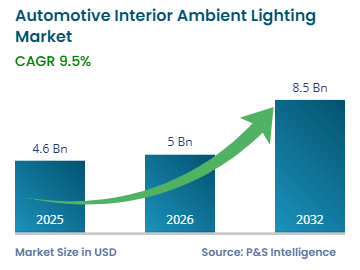
The automotive interior ambient lighting market size was USD 4.6 billion in 2025, which is predicted to reach USD 8.5 billion by 2032, growing at a CAGR of 9.5% during 2026–2032.
The major factors responsible for market growth include rising demand for personalized vehicle interiors, increasing adoption of electric vehicles, growing consumer preference for premium cabin aesthetics, and technological advancements in LED and OLED lighting systems. Electric vehicles feature advanced, futuristic interior designs where ambient lighting plays a crucial role in creating a high-tech cabin environment and enhancing the overall user experience. Leading manufacturers, such as Tesla, Ford, and General Motors, now offer dynamic interior lighting systems that change according to driving modes, voice assistant responses, and safety signals, making ambient lighting an integral part of the in-cabin experience.
According to the European Automobile Manufacturers’ Association (ACEA), global passenger car production in 2023 rose to 76 million units. The growing consumer preference for vehicle personalization and premium cabin aesthetics is reshaping the automotive interior lighting landscape. Ambient lighting has evolved from a luxury feature exclusive to high-end vehicles to a standard offering in mid-range models, as automakers recognize its role in brand differentiation and customer satisfaction.
The LED category holds the largest share in the automotive interior ambient lighting market in 2025, of 40%, and it is also the fastest-growing category. This dominance is primarily attributed to LED technology's superior energy efficiency, longer lifespan exceeding 50,000 hours, reduced heat emission, and exceptional design flexibility that enables complex lighting patterns and dynamic effects. LED systems consume approximately 50% less energy compared to traditional halogen lighting while producing equivalent or superior illumination, making them ideal for modern vehicles where energy conservation is increasingly critical, particularly in electric vehicles where every watt of power consumption directly impacts driving range.
These technologies are covered:
Dashboard lights are expected to dominate the industry throughout the forecast period, also witnessing the highest CAGR, of 45%. With the rise in the installation of ambient lighting owing to the increasing emphasis on comfort and luxury, dashboard ambient lighting demand is expected to grow at a high pace, which will further assist the automotive ambient lighting market in booming.
For instance, in North America, the rise in the passenger car penetration and progress toward autonomous vehicles have expanded the adoption of advanced lights in dashboards, such as the augmented reality system, which is available in the VW ID3 with ambient lighting. This will further enhance the entertainment experience and the way the information is presented in the cockpit, as well as ensuring optimal comfort and driver concentration.
The heads-up display category, in the product type segment, will also show substantial growth during the forecast period. The increasing need for displaying vehicle information to drivers without creating a distraction is associated with the market’s growth.
Moreover, several key automotive ambient lighting market players are concentrating on creating improved and advanced display solutions to meet the needs and gain new market prospects.
These product types are covered:
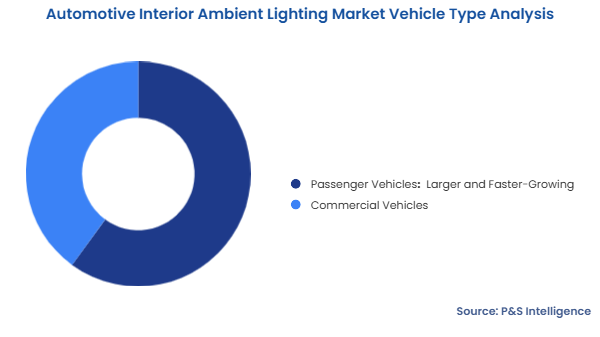
Passenger vehicles, especially cars, dominate the automotive ambient lighting market with 60% revenue share in 2025, and they will also witness the highest CAGR. This is because these products serve no practical purpose other than setting the mood and enhancing the aesthetics of the car. The demand for ambient lights for cars is driven by the growing tech-savvy young population, who is strongly influenced by what they see on digital media, including TV, mobile phones, and laptops. People in developed region already make up a significant portion of the customer base for cars with stylish and sleek interiors with mood-centric and music-synchronized lighting. To attract more customers, especially in developing countries, OEMs of economy and mid-segment cars are increasingly offering ambient lighting to compete with luxury OEMs.
These vehicle types are covered:
Drive strategic growth with comprehensive market analysis
Geographically, Asia-Pacific held the largest share in the automotive interior ambient lighting market in 2025, of 40%, and is expected to be the fastest-growing regional market, with approx. 10.5% CAGR during the forecast period. This leadership position is primarily attributed to the region's status as the global automotive production hub, rapid urbanization driving vehicle demand, expanding middle-class population with increasing disposable income, and strong consumer preference for feature-rich vehicles with advanced interior technologies.
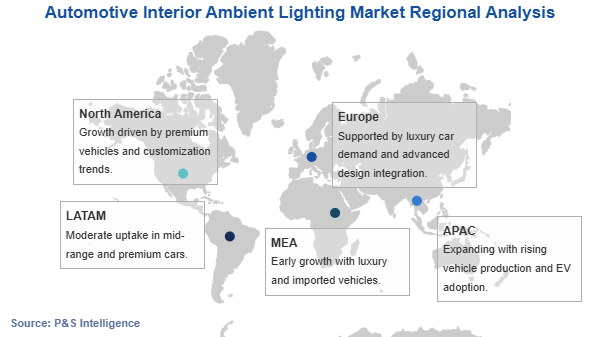
The region's dominance is further reinforced by aggressive electric vehicle adoption, particularly in China where government incentives and regulatory mandates have accelerated EV penetration. Japanese and South Korean manufacturers maintain strong positions through technological innovation, with companies like Toyota, Honda, Hyundai, and Kia incorporating advanced ambient lighting across expanded model portfolios to compete in the region's intensely competitive automotive market.
China represents the world's largest automotive market and demonstrates exceptional growth in ambient lighting adoption driven by domestic consumer preferences for technology-rich vehicles, rapid electric vehicle proliferation, and aggressive innovation by Chinese automotive manufacturers. Chinese consumers exhibit strong preference for feature-laden vehicles with advanced interior technologies, creating robust demand for customizable ambient lighting systems across vehicle segments from affordable compacts to luxury models. Chinese automotive companies have established comprehensive ambient lighting supply chains, enabling rapid innovation cycles and cost-effective production that supports widespread feature deployment across price segments.
The regions and countries analyzed in this report are:
The automotive interior ambient lighting market is slightly fragmented due to the presence of established tier-one automotive suppliers alongside specialized lighting technology companies and emerging innovation-focused firms. The market structure reflects increasing competition as ambient lighting transitions from luxury-exclusive to mainstream vehicle features, with suppliers expanding production capacity and technological capabilities to meet growing demand across vehicle segments. Major automotive lighting manufacturers maintain strong positions through comprehensive product portfolios, established relationships with global automakers, and vertically integrated operations encompassing design, manufacturing, and system integration.
The competitive landscape is also characterized by geographic considerations, with Asian suppliers gaining market share through cost-competitive offerings and proximity to major automotive production centers. European and North American suppliers maintain advantages in premium segments through technological leadership, established brand recognition, and deep integration with luxury automotive manufacturers. The emergence of electric vehicle platforms creates opportunities for new entrants and specialized technology companies to establish positions in the market, particularly those offering software-defined lighting solutions, AI integration capabilities, and advanced human-machine interface technologies that align with evolving electric vehicle architectures and consumer expectations.
Want a report tailored exactly to your business need?
Request CustomizationLeading companies across industries trust us to deliver data-driven insights and innovative solutions for their most critical decisions. From data-driven strategies to actionable insights, we empower the decision-makers who shape industries and define the future. From Fortune 500 companies to innovative startups, we are proud to partner with organisations that drive progress in their industries.

Working with P&S Intelligence and their team was an absolute pleasure – their awareness of timelines and commitment to value greatly contributed to our project's success. Eagerly anticipating future collaborations.
McKinsey & Company
India
Our insights into the minutest levels of the markets, including the latest trends and competitive landscape, give you all the answers you need to take your business to new heights

We take a cautious approach to protecting your personal and confidential information. Trust is the strongest bond that connects us and our clients, and trust we build by complying with all international and domestic data protection and privacy laws


Customize the Report to Align with Your Business Objectives

Request the Free Sample Pages