This Report Provides In-Depth Analysis of the Automotive-Grade MEMS Pressure Sensors Market Report Prepared by P&S Intelligence, Segmented by Sensing Technology (Piezoresistive, Capacitive), Pressure Type (Absolute, Gauge, Differential), Application (Tire Pressure Monitoring Systems (TPMS), Engine and Powertrain Management, Braking Systems, Exhaust After-treatment, Airbag and Safety Restraint Systems), Vehicle Type (Passenger Cars, Light Commercial Vehicles, Medium and Heavy Commercial Vehicles), and Geographical Outlook for the Period of 2022 to 2033
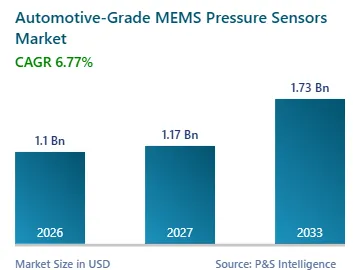
The global automotive-grade MEMS pressure sensors market size is estimated at USD 1.10 billion in 2026 and is projected to reach USD 1.17 billion in 2027. The market is then projected to climb to USD 1.73 billion by 2033, expanding at a CAGR of 6.77% over 2027-2033 as the number of pressure points per vehicle grows. Carmakers and Tier-1 suppliers buy these qualified chips for wheels, engine air paths, exhaust filters, and battery packs, so revenue can outpace vehicle output. Value is counted at the die and conditioning-chip level and excludes complete wheel modules, receivers, and control units.
Tire-pressure fitment rules underpin the largest application in this market, and Europe has widened that base to heavy vehicles. Germany's Federal Ministry of Transport confirms that the EU General Safety Regulation requires a tire pressure monitoring system on all commercial vehicles, buses, coaches, and trailers above 3.5 tonnes, with every first registration covered from July 7, 2024. Only passenger cars had to carry one before. The rule leaves the sensing technology open, yet every newly covered wheel adds a socket that MEMS die suppliers can bid for once their parts are qualified for truck and trailer duty.
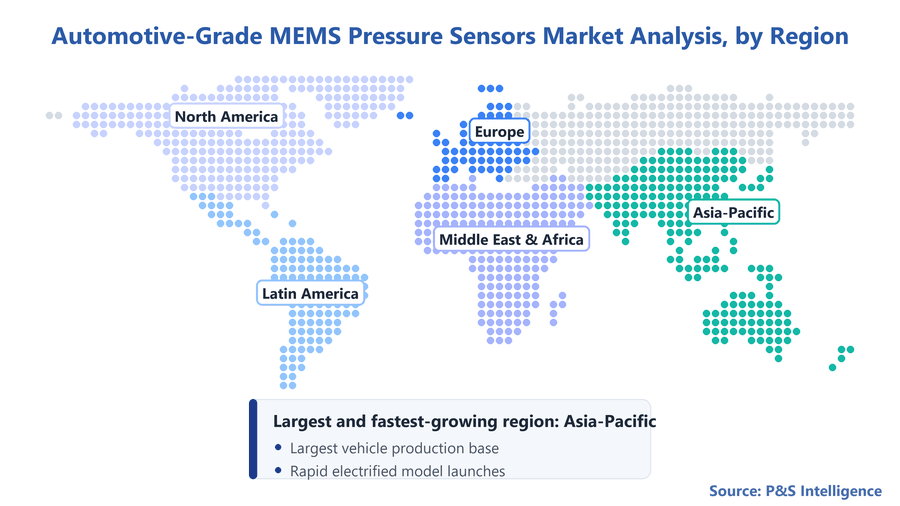
Asia-Pacific accounts for 49% of 2026 revenue and is also projected to expand the quickest, at an 8.0% CAGR during 2027-2033. OICA counted 59.2 million vehicles built in the region in 2025, more than 61% of global output, which sizes the production base, not sensor use. China supplies most of that weight, Japan and South Korea house Tier-1 groups that design these parts into regional platforms, and India adds rising car assembly. North America and Europe follow with similar shares, and their demand for automotive-grade MEMS pressure sensors depends more on content per vehicle than on new plant capacity.
Key market insights
By sensing technology, piezoresistive devices account for the largest share in 2026, and capacitive devices are set to post the highest growth, an 8.6% CAGR over 2027-2033.
By pressure type, absolute sensors account for 47% in 2026, while gauge sensors are on track for an 8.7% CAGR through 2027-2033.
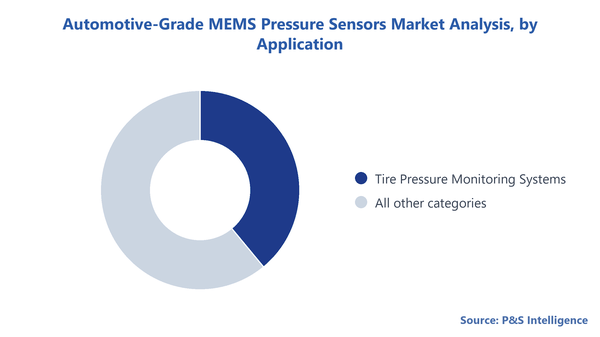
By application, tire pressure monitoring systems account for 39% in 2026, and exhaust after-treatment is forecast to advance at a 9.9% CAGR over 2027-2033.
By vehicle type, passenger cars account for 65% in 2026 and also lead growth, with a projected 7.7% CAGR for 2027-2033.
By geography, Asia-Pacific accounts for 49% in 2026 and is expected to expand fastest, at an 8.0% CAGR during 2027-2033.
Single-chip tire sensors with built-in radios are redefining TPMS sourcing
Tire pressure monitoring is the largest application in this market, and the device that goes into each wheel is changing shape. Chip suppliers now combine the pressure die, temperature sensing, motion sensing, a microcontroller, and a wireless link in one package. For TPMS module makers this cuts the number of parts they qualify, test, and assemble per wheel unit. For chip vendors it means each socket can carry more functions, so the value captured per wheel depends on how much of the module a single qualified part replaces.
NXP describes its tire pressure sensors as combining a pressure sensor, an 8-bit microcontroller, an RF transmitter, and an accelerometer in a single package, and notes that its NTM88 family is going through a MEMS fab supply-chain requalification, with updated silicon available only as limited samples. That second point shows what a change of silicon costs in this application, because a reworked wheel sensor must clear approval again before carmakers will ship it. Integration therefore raises the stakes of each design win and favors suppliers whose single-chip parts are already approved on running wheel-module programs.
Tighter exhaust monitoring rules are driving pressure-sensing content in after-treatment
Exhaust after-treatment is the fastest-growing application, and emission rules that reach further into how filters and recirculation valves are checked over a vehicle's life explain much of that pace. Engine controllers commonly judge particulate-filter loading and exhaust-gas recirculation flow from pressure differences across those components, so each tightening of on-road monitoring raises the accuracy and durability these sensors must hold. Carmakers re-sourcing sensor sets for new emission platforms open design-in windows, and those windows tend to stay shut for the platform's life once a part is qualified.
The European Union's Euro 7 regulation, (EU) 2024/1257, bars new emission type approvals for non-compliant cars and vans from November 29, 2026 and stops registration of non-compliant new cars and vans from November 29, 2027. It also brings in on-board monitoring systems and a driver warning for excess exhaust emissions. The text is technology-neutral and does not require MEMS pressure sensors. Its timing coincides with the start of the forecast period, which favors suppliers already qualified on filter and recirculation measurement as carmakers settle the sensor sets for compliant platforms.
Battery thermal-runaway safety rules are opening a new socket inside EV packs
Battery-pack designers are adding pressure sensing to sealed enclosures, because a failing lithium-ion cell vents gas and raises enclosure pressure before heat spreads to neighboring cells. That turns the pack into the clearest new application for this market, a position with no equivalent on combustion vehicles. Products already target it, including Honeywell's BPS series, which combines MEMS and ASIC technology, uses AEC-Q100-qualified integrated circuits, and is designed to detect and report thermal runaway in lithium-ion packs. Volumes depend on how many carmakers write pressure detection into their pack specifications.
As per China's GB 38031-2025 standard, which took effect for new EV type approvals on July 1, 2026, a battery system must contain a thermal runaway event for at least two hours without fire or explosion, and existing vehicles must comply from July 1, 2027. The standard sets outcomes and does not mandate a pressure sensor, so pack makers can meet it with gas, voltage, temperature, or pressure signals. Suppliers with safety-rated pressure parts could still win positions in Chinese packs as engineers combine signals to pass the alarm and containment tests.
Battery-electric drivetrains are limiting combustion-side sensor content
Engine and powertrain management remains a large application, and it is also the one most exposed to electrification. A battery-electric car has no intake manifold, fuel-vapor system, or exhaust filter, so the manifold-pressure, evaporative leak-check, and differential sensors that a combustion car carries disappear from its bill of materials. Hybrids keep those positions, which softens the loss while plug-in and full hybrids stay common. Each battery-electric sale that replaces a combustion sale still removes several established sockets from the addressable base.
IEA data show electric cars, battery-electric and plug-in hybrid combined, took 25% of global new car sales in 2025, with sales passing 20 million units. That figure sizes the electrified platform base and does not measure how many pressure sensors those vehicles use. Battery packs, coolant loops, and heat pumps add new pressure points, but these sockets call for different media compatibility and qualifications than engine parts. Suppliers whose portfolios lean on engine air-path products face the steepest adjustment.
Segmentation Outlook
Sensing Technology
Piezoresistive devices hold the largest share of the automotive-grade MEMS pressure sensors market in 2026. The technology has the longest qualification record in engine management, where manifold, barometric, and exhaust-side parts must survive engine-bay heat and contact with fuel vapor and exhaust condensate. Piezoresistive designs also serve the differential positions across particulate filters and recirculation valves. Carmakers tend to reorder a qualified part across platform generations because requalifying a powertrain sensor is slow and costly, and that habit keeps volume with established suppliers.
Capacitive devices are projected to grow at an 8.6% CAGR during 2027-2033, the fastest rate in this axis. A capacitive element draws very little current, which matters most in battery-powered wheel units expected to run for years without service, and tire monitoring is where capacitive parts have their clearest commercial foothold. Battery-pack monitoring adds a second outlet, since pack sensors also run from limited standby power and must wake the controller only when pressure moves. Suppliers with capacitive TPMS lines can carry the same die and packaging know-how into packs.
Pressure Type
Absolute sensors account for 47% of 2026 revenue. Engine controllers need true absolute readings of manifold and barometric pressure to calculate air mass and fueling, tire monitors measure inflation against a sealed reference, and side-impact airbag sensors track sudden pressure rises inside door cavities. Tire and airbag positions apply to every powertrain, while manifold and barometric positions cover every combustion and hybrid engine. That breadth gives absolute parts the widest installed footprint and buyers the deepest pool of qualified suppliers in this axis.
Gauge sensors are expected to expand at an 8.7% CAGR during 2027-2033, helped by fuel-vapor leak checks, crankcase ventilation monitoring, and brake-booster vacuum, all positions measured against the surrounding air. Under the U.S. Environmental Protection Agency's onboard diagnostics rule, 2017 and later vehicles must detect evaporative-system leaks with an effective diameter as small as 0.020 inch, a check commonly run by reading small pressure changes in a sealed fuel system. Coolant and refrigerant loops in electrified vehicles add relative-pressure points of their own. Tight diagnostic limits favor suppliers that ship gauge parts with stable low-range accuracy and built-in self-test.
Application
Tire pressure monitoring systems account for 39% of 2026 revenue because a direct system needs one sensor in every road wheel, and fitment mandates make tire monitoring standard on new passenger cars. Each wheel unit must also survive years of rotation, temperature swings, and battery-only power, which makes carmakers reluctant to switch a qualified wheel sensor mid-platform. Revenue here counts the sensor chip only. Brake, transmission, and refrigerant sensors that also exist in non-MEMS form are counted only when their sensing element is MEMS.
Exhaust after-treatment is projected to post the quickest growth among applications, at a 9.9% CAGR during 2027-2033. Particulate filters on gasoline as well as diesel engines, recirculation valves, and the differential sensors that monitor them are spreading as emission limits tighten in Europe, China, and India. Hybrids keep this content because they still burn fuel, so their growing presence in new sales extends the life of exhaust-side sockets. Suppliers that already hold qualified differential parts for diesel filters may be able to carry them onto gasoline filter programs with limited redesign.
Copyright P&S Intelligence. Reuse requires attribution under CC BY 4.0.
Vehicle Type
Passenger cars account for 65% of 2026 revenue, a position built on both volume and content. Cars make up most of global vehicle output, and each carries pressure sensors across tires, engine or battery, brakes, and restraint systems. Passenger-car platforms also turn over faster than truck platforms, which gives sensor suppliers more frequent design-in rounds. Commercial vehicles carry rugged, higher-value parts in braking and after-treatment, but their lower unit count keeps them a smaller revenue pool for chipmakers.
Passenger cars are also set to be the fastest-growing vehicle class, with a 7.7% CAGR projected for 2027-2033. Electrified cars add battery-pack and thermal-loop sensors while hybrids retain engine and exhaust positions, so content per car rises through the forecast period. Light commercial vehicles adopt car technology with a lag, and medium and heavy trucks are now adding tire monitoring under European rules, yet both classes grow from smaller bases and at slower rates. For chip vendors, car programs remain where most new qualification work pays back.
The following segments are analyzed in this report:
Sensing Technology
Piezoresistive
Capacitive
Pressure Type
Absolute
Gauge
Differential
Application
Tire Pressure Monitoring Systems (TPMS)
Engine and Powertrain Management
Braking Systems
Exhaust After-treatment
Airbag and Safety Restraint Systems
Others (HVAC and Thermal Management, EV Battery Pack)
Vehicle Type
Passenger Cars
Light Commercial Vehicles
Medium and Heavy Commercial Vehicles
Regional Analysis
Asia-Pacific automotive-grade MEMS pressure sensors market outlook
Asia-Pacific accounts for 49% of 2026 revenue and is projected to grow the fastest, at an 8.0% CAGR during 2027-2033. The region assembles the largest share of the world's vehicles, makes most traction batteries, and hosts Tier-1 groups in Japan, South Korea, and China that design pressure sensors into each new platform. China is the region's largest market, where domestic brands launch electrified models at a pace that creates frequent design-in rounds and lifts regional demand for automotive-grade MEMS pressure sensors.
The China Association of Automobile Manufacturers recorded production of 34.4 million vehicles in 2025, and its manufacturer sales count, which includes 7.098 million exported units, put new energy vehicles at 47.9% of the total. These numbers size the platform base and do not measure the uptake of MEMS pressure sensors. They do help explain why battery-pack and thermal-loop sockets are spreading quickly in China, and exports carry that sensor content to buyers in other regions, which ties part of the region's growth to overseas demand.
India is the region's fastest-growing market, with rising car output creating new sensor sockets on platforms that are still adding equipment. According to the Society of Indian Automobile Manufacturers, domestic passenger vehicle dispatches reached 4.64 million units in the fiscal year to March 2026, up 7.9%, with a record 905,000 more exported. Those counts size the vehicle base, not sensor uptake. Japan's hybrid-heavy mix keeps combustion-side positions in use, and suppliers with parts already approved by Chinese, Japanese, and Indian carmakers are better positioned as the region's share of global revenue rises through 2033.
Copyright P&S Intelligence. Reuse requires attribution under CC BY 4.0.
North America market analysis
North America ranks among the larger regional markets, and its demand is shaped by a vehicle fleet that has carried tire monitoring for close to two decades and by full-size pickups and SUVs with large engines. Growth here comes mostly from content per vehicle as these models add hybrid drivetrains, heavier after-treatment, and battery packs. Mexican assembly plants supply a large part of the region's vehicles, but this report counts that output under Latin America, so U.S. and Canadian programs carry the regional figure.
The National Highway Traffic Safety Administration's FMVSS 138 requires light vehicles up to 10,000 pounds gross vehicle weight rating to carry a system that warns the driver when one or more tires, up to all four, fall 25% or more below the recommended inflation pressure. Because the rule covers any combination of tires, direct wheel-mounted sensors became a widely used way to comply, which keeps four sensor positions on most light vehicles. Suppliers holding U.S. carmaker approvals for tire and engine parts are well placed to defend volume as those platforms are renewed.
Europe market analysis
Europe holds a share close to North America's, with demand anchored in German, French, and Italian carmakers and the Tier-1 groups that engineer their powertrain and safety systems. Its growth depends on regulation-led content changes more than on rising vehicle output. Heavy vehicles now carry tire monitoring, Euro 7 tightens exhaust monitoring for cars and vans, and electrified drivetrains add pack and thermal-loop sensors while removing engine positions on battery-electric models.
Figures from the European Automobile Manufacturers' Association put battery-electric cars at 17.4% of EU new car registrations in 2025, with hybrid-electric cars at 34.5% and petrol and diesel cars together at 35.5%. Registrations measure domestic demand, and this mix sizes the powertrain base rather than sensor adoption. A market where hybrids outnumber battery-electric cars by a wide margin keeps combustion-side sensors in volume while battery sockets grow, which suits suppliers able to serve both sets of programs from one qualified portfolio.
Latin America market analysis
Latin America trails the three larger regions, with demand coming from vehicle assembly in Brazil, Mexico, and Argentina, much of it built on combustion and flex-fuel engines. Flex-fuel powertrains keep manifold, fuel, and evaporative sensor positions in every car, and Mexico's export plants build to U.S. specifications, including tire monitoring. Sensor devices typically reach these plants through the regional operations of global Tier-1 groups, so local purchasing follows platform choices made in the U.S., Europe, or Japan.
Brazil produced 2,644,054 vehicles in 2025, up 3.5%, with about 528,000 units exported and domestic registrations of 2,689,634 units, according to ANFAVEA. That output sizes the vehicle base and does not measure sensor adoption. Brazilian content per car is likely to rise as emission rules and safety equipment on new models catch up with export markets, which favors suppliers already qualified on the global platforms built there.
Middle East & Africa market analysis
Middle East & Africa trails the other regions, and its demand splits into two different patterns. South Africa builds vehicles largely for export, so sensor content there follows the specifications of overseas buyers. Saudi Arabia and the U.A.E. import nearly all of their vehicles, so commercial demand for sensor devices there is minimal. Saudi Arabia's plans for domestic vehicle assembly could change that once plants reach volume output, which would make early supplier approvals there worth watching.
South Africa's vehicle manufacturers' association, naamsa, puts 2025 vehicle exports at a record 414,268 units, equal to 70.3% of light-vehicle production, with Europe taking 80.3% of those exports. Plants serving European buyers must meet European safety and emission requirements, which brings tire monitoring and current exhaust-control content onto South African lines. Suppliers already approved on the European platforms assembled there can pick up that volume with little extra qualification work.
The following geographies are analyzed in this report:
The automotive-grade MEMS pressure sensors market is concentrated at the die and qualification layer and more open at the packaging and module layer. A small group of semiconductor makers runs the MEMS wafer processes, automotive-grade test flows, and functional-safety documentation that carmakers require, and building that capability can take years of fab investment and field history. Switching suppliers is costly because a new pressure sensor must pass AEC-Q qualification, a production part approval process, and often ISO 26262 safety analysis before it ships on a platform. Acquisitions and portfolio transfers between chipmakers continue to reshape who supplies which socket.
Two supplier groups compete in different ways. Robert Bosch GmbH, Infineon Technologies AG, and STMicroelectronics N.V. run their own MEMS fabs and sell broad sensor portfolios across tire, powertrain, safety, and battery positions. They compete on wafer scale, cost per die, and the ability to bundle pressure parts with other sensors and controllers. Melexis NV and Honeywell International Inc. compete on sensing specifications, packaging for harsh media, and early entry into newer positions such as coolant-loop and battery-pack measurement.
For buyers, a concentrated die layer means adding a second qualified pressure sensor source can take long lead times, so carmakers and Tier-1s tend to commit to suppliers at platform award. Battery packs and thermal loops are where the supplier line-up is least settled, and design wins there over the next platform cycle are likely to shape which suppliers enlarge their position. Engine-side sockets, by contrast, are largely held by incumbents and shrink as battery-electric sales rise.
Major Companies in Automotive-Grade MEMS Pressure Sensors Market:
In September 2026, Robert Bosch GmbH made its SMP290 tire pressure sensor available for in-tire mounting, extending a single MEMS chip that carries a microcontroller, two-axis acceleration sensing, pressure and temperature sensing, and a Bluetooth interface, with up to ten years of battery life. Moving the part inside the tire lets fleet operators, for whom tires are the second-largest cost after fuel, monitor more than inflation through one qualified chip.
In July 2026, Melexis NV released low-pressure variants of its Triphibian MEMS pressure sensor family (MLX90830 analog, MLX90833 LIN, and MLX90834 SENT) with configurable spans down to 2 bar, 2 or 4 bar operating ranges, and ISO 26262 development for integration up to ASIL B. The lower spans let the family address coolant-loop pressure in EV thermal management, a position that grows with each battery-electric platform.
In April 2026, Infineon Technologies AG's XENSIV KP497 smart barometric pressure sensor began shipping through distribution, combining a 20 to 250 kPa absolute range at ±2 kPa accuracy with an integrated z-axis accelerometer and AEC-Q100 Grade 1 qualification for battery management systems. Pairing pressure and motion sensing in one qualified part lets pack designers watch for a venting cell and a mechanical shock without adding a second component.
In February 2026, STMicroelectronics N.V. completed its acquisition of the MEMS sensors business of NXP Semiconductors N.V., a deal valued at up to USD 950 million including performance-linked payments, adding automotive safety and tire pressure monitoring sensors to its range. The transfer moves an established TPMS sensor line into ST, leaving carmakers with one fewer independent die supplier to choose from.
Last Updated: October 2026
Frequently Asked Questions About This Report
How big is the automotive MEMS pressure sensor market?+
The global automotive-grade MEMS pressure sensors market size is estimated at USD 1.10 billion in 2026 and is projected to reach USD 1.17 billion in 2027.
What is the growth rate of the automotive MEMS pressure sensor market?+
The market is then projected to climb to USD 1.73 billion by 2033, expanding at a CAGR of 6.77% over 2027-2033 as the number of pressure points per vehicle grows.
Which region leads the automotive MEMS pressure sensor market?+
Asia-Pacific accounts for 49% of 2026 revenue and is also projected to expand the quickest, at an 8.0% CAGR during 2027-2033.
Which automotive application uses the most MEMS pressure sensors?+
Tire pressure monitoring systems account for 39% of 2026 revenue because a direct system needs one sensor in every road wheel, and fitment mandates make tire monitoring standard on new passenger cars.
Why do tire pressure sensors use capacitive MEMS sensing?+
A capacitive element draws very little current, which matters most in battery-powered wheel units expected to run for years without service, and tire monitoring is where capacitive parts have their clearest commercial foothold.
How do electric vehicles affect demand for automotive pressure sensors?+
A battery-electric car has no intake manifold, fuel-vapor system, or exhaust filter, so the manifold-pressure, evaporative leak-check, and differential sensors that a combustion car carries disappear from its bill of materials.
Who are the key players in the automotive MEMS pressure sensor market?+
Robert Bosch GmbH, Infineon Technologies AG, and STMicroelectronics N.V. run their own MEMS fabs and sell broad sensor portfolios across tire, powertrain, safety, and battery positions.
Want a report tailored exactly to your business need?
Leading companies across industries trust us to deliver data-driven insights and innovative solutions for their most critical decisions. From data-driven strategies to actionable insights, we empower the decision-makers who shape industries and define the future. From Fortune 500 companies to innovative startups, we are proud to partner with organisations that drive progress in their industries.
Client Testimonials
Working with P&S Intelligence and their team was an absolute pleasure – their awareness of timelines and commitment to value greatly contributed to our project's success. Eagerly anticipating future collaborations.
McKinsey & Company
India
Unmatched Standards
Our insights into the minutest levels of the markets, including the latest trends and competitive landscape, give you all the answers you need to take your business to new heights
Complete Data Security
We take a cautious approach to protecting your personal and confidential information. Trust is the strongest bond that connects us and our clients, and trust we build by complying with all international and domestic data protection and privacy laws