This Report Provides In-Depth Analysis of the Automotive Electronic Cables Market Report Prepared by P&S Intelligence, Segmented by Cable Type (Data, Power, Sensor, Coaxial), Application (Infotainment & Telematics Systems, ADAS, Body Electronics, Powertrain, Safety & Security Systems, Chassis, Charging & Lighting Systems), Vehicle Type (Passenger Cars, Commercial Vehicle, Two-Wheelers, Three-Wheelers), Sales Channel (OEM, Aftermarket), Propulsion Type (ICE, Hybrid EVs, Plug-in Hybrid EVs, Battery EVs), and Geographical Outlook for the Period of 2019 to 2032
Explore the market potential with our data-driven report
Automotive Electronic Cables Market Overview
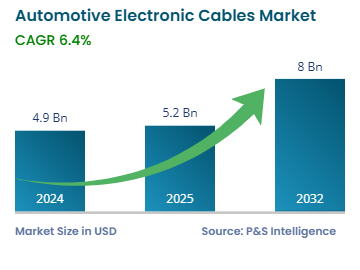
The automotive electronic cables market size was USD 4.9 billion in 2024, and it will grow by 6.4% during 2025–2032, to reach USD 8.0 billion by 2032.
The market growth is primarily driven by the increasing integration of advanced electronic systems in vehicles, the rapid adoption of electric vehicles globally, and the growing demand for connected and autonomous vehicle technologies.
As next-generation vehicles are highly dependent on electronic devices, the need for advanced and complex cable systems to handle a wide range of applications, such as ADAS, rises. According to the International Energy Agency, global electric vehicle sales reached 14.2 million units in 2023, representing a 35% increase from the previous year, significantly boosting demand for high-voltage cables and specialized wiring harnesses. This electrification, combined with the proliferation of sensors and electronic control units in modern vehicles, is also creating substantial opportunities for automotive electronics cable manufacturers.
Moreover, the stringent automotive safety regulations worldwide mandate the integration of various safety systems, each requiring reliable cable connections. The shift toward software-defined vehicles and the implementation of zonal architecture in automotive design is revolutionizing cable requirements, with Ethernet cables gaining prominence for high-speed data transmission. As vehicles are becoming like mobile computing platforms, having capabilities ranging from over-the-air updates to autonomous driving features, automotive electronics cables market is expected to witness constant growth throughout the forecast period.
Automotive Electronic Cables Market Dynamics
Technological Advancement in Cable Materials and Design Is Key Trend
Innovation in cable materials and manufacturing processes is a key trend for market growth.
Manufacturers are developing lightweight cables by using aluminum conductors instead of traditional copper, which reduces vehicle weight by up to 40% in wiring harness applications.
According to the Aluminum Association, aluminum wiring can reduce the total weight of a vehicle's electrical system by approximately 48%, contributing to improved fuel efficiency and extended range in electric vehicles.
Manufacturers are developing cables with heat-resistant materials, which helps cables to work safely and effectively even under the car hood, where temperatures can exceed 150 °C.
These materials, including cross-linked polyethylene and thermoplastic polyurethane, provide superior mechanical properties and chemical resistance compared to traditional PVC insulation.
The integration of smart cable technologies with embedded sensors for real-time monitoring of cable health and performance is gaining traction, particularly in high-value electric and autonomous vehicle applications.
The emergence of flat flexible cables and flexible printed circuits is revolutionizing cable routing in space-constrained automotive applications.
These ultra-thin cables enable designers to route connections through tight spaces while reducing overall system weight.
The automotive industry's shift towards modular vehicle platforms is also driving standardization in cable designs, allowing manufacturers to achieve economies of scale, while meeting diverse application requirements across different vehicle models and segments.
Rising Adoption of Electric and Autonomous Vehicles Is Biggest Driver
The growing utilization of electric and self-driving vehicles is driving the demand for smart electronic cable systems used for data transfer, sensor connectivity, and power transmission.
Electric vehicles require specialized high-voltage cables capable of handling power transmission from batteries to electric motors, creating a need for cables that can support voltages ranging from 400 V to 800 V and even higher in next-generation vehicles.
According to the report, electric vehicle sales are expected to reach 30 million units globally by 2027, creating unprecedented demand for high-voltage cables and charging infrastructure wiring.
Level 3 and above autonomous vehicles require extensive sensor networks, including LiDAR, radar, cameras, and ultrasonic sensors, all connected through sophisticated cable systems.
The Society of Automotive Engineers estimates that a fully autonomous vehicle may contain over 100 sensors, each requiring reliable cable connections for power and data transmission.
The implementation of redundant systems for safety-critical functions in autonomous vehicles necessitates duplicate cable pathways, effectively doubling the cable content in certain applications.
The shift from traditional 12-V electrical systems to 48-V mild-hybrid systems is also creating new opportunities for cable manufacturers to develop products that can handle higher power loads while maintaining electromagnetic compatibility standards.
The European Automobile Manufacturers' Association reports that electric vehicles accounted for 23% of all new car registrations in the EU in 2023, up from 12% in 2021, demonstrating the rapid pace of electrification.
Moreover, as per reports, autonomous car sales could reach USD 52.3 billion in North America and 4 million units in Europe by 2030.
The power category held the larger market share, of 55%, in 2024. This is driven by the rising shift towards EVs, which requires high-voltage cables to efficiently transmit electricity from the battery to the motor and charger. According to the International Copper Association, electric vehicles use approximately 3–4 times more copper cabling than conventional vehicles, largely due to high-voltage cables. Moreover, the development of ultra-fast charging technologies requiring 350kW and higher power delivery is further accelerating demand for advanced high-voltage cable solutions.
The data category will have the higher CAGR, of approx. 6.5%, due to the massive growth in data transmission requirements within modern vehicles. The expanding use of infotainment systems, ADAS features, and connected vehicle technologies has created the need for high-speed data transmission capabilities. CAN bus dominates due to its widespread adoption for in-vehicle networking, while Ethernet cables are rapidly gaining market share as automakers transition to centralized computing architectures requiring gigabit-speed data transmission. Studies predict software-defined vehicle sales to fetch USD 489.7 billion by 2030.
The cable types analyzed in this report are:
Data (Fastest-Growing Category)
CAN Bus
Ethernet
USB
LVDS
FlexRay
HSD
Power (Largest Category)
High-voltage
Low-voltage
Sensor
Coaxial
Others
Technology Analysis
The infotainment & telematics systems category held the largest market share, of 35%, in 2024, due to the increasing consumer demand for connected car features, including navigation systems, smartphone integration, Wi-Fi hotspots, and rear-seat entertainment systems. These systems require multiple cable types, including USB for device connectivity, Ethernet for high-speed data backbone, and coaxial cables for antenna connections. The adoption of digital dashboards with multiple high-resolution advanced displays contributes to the growing demand for cables. As per reports, global automotive telematics technology suppliers could get sales opportunities worth USD 16,673.5 million by 2030.
The ADAS category will have the highest CAGR, due to the required adoption of safety features such as automatic emergency braking, lane departure warning, and blind-spot detection across various regions. According to the European Transport Safety Council, from July 2024, all new vehicles sold in the European Union will need to include advanced safety features, which boosts the demand for sensor cables and high-speed data transmission solutions. The evolution toward higher levels of vehicle autonomy requires increasingly sophisticated sensor arrays and processing capabilities, necessitating advanced cable solutions for reliable connectivity. As per reports, global automotive ADAS Spending could cross USD 156.4 billion by decade-end.
The technologies analyzed in this report are:
Infotainment & Telematics Systems (Largest Category)
ADAS (Fastest-Growing Category)
Body Electronics
Powertrain
Safety & Security Systems
Chassis
Charging & Lighting Systems
Others
Vehicle Type Analysis
The passenger cars category held the largest market share, of 40%, in 2024, due to the high volume of passenger vehicle production globally and the increasing electronic content per vehicle. Modern passenger cars incorporate numerous electronic systems ranging from basic body electronics to advanced ADAS, each demanding a complex cable network. As per OICA, 67,674,745 cars were manufactured globally in 2024.
The commercial vehicles category will have the higher CAGR, especially light commercial vehicles. This dominance is due to rising adoption of electric commercial transport, expansion of online retail and delivery services, continuous fleet utilization, and integration of smart technologies in fleets. Also, the rising government policies regarding zero emissions are shifting commercial operators towards EVs, particularly in urban areas.
The vehicle types analyzed in this report are:
Passenger Cars (Largest Category)
Commercial Vehicles (Fastest-Growing Category)
Light commercial vehicles
Heavy commercial vehicles
Two-Wheelers
Three-Wheelers
Sales Channel Analysis
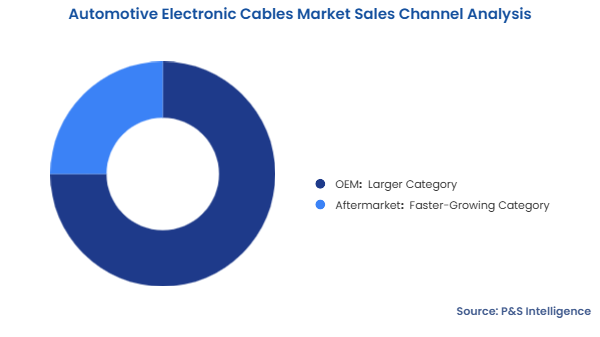
The OEM category held the larger market share, of 75%, in 2024, as cables are essential components built into vehicles during manufacturing. OEMs maintain strict regulatory standards and mandate high-level certification, making it hard for new players and helping established manufacturers. They benefit from long-term supply contracts, collaborative development programs, and the integration of cable design into the early stages of vehicle development, ensuring optimal performance and reliability.
The aftermarket category will have the higher CAGR, due to the numerous aligning factors, such as the growing demand for vehicle upgrades, longer vehicle lifespan, increasing electronic component replacements, and the rising trend for retrofitting. According to the Automotive Aftermarket Suppliers Association, the average age of vehicles on U.S. roads reached 12.5 years in 2023, with older vehicles requiring more-frequent cable replacements due to wear and environmental degradation. The growing trend of vehicle customization and upgrades, particularly in infotainment and lighting systems, also boosts aftermarket cable demand.
Moreover, a rise in electric vehicle conversions and the retrofitting of advanced driver assistance systems in older vehicles drive the market in this category. Independent repair shops and DIY enthusiasts are increasingly sourcing high-quality replacement cables to maintain and upgrade vehicle electronic systems. The proliferation of e-commerce platforms has made automotive cables more accessible to end consumers, contributing to market growth. Furthermore, the regulations on right-to-repair in many regions may allow local players to work on advanced electronic systems, which will propel the demand for these cables.
The sales channels analyzed in this report are:
OEM (Largest Category)
Aftermarket (Fastest-Growing Category)
Propulsion Type Analysis
The ICE category held the largest market share, of 40%, in 2024, due to its dominance in the global automotive fleet and well-established manufacturing facilities. These vehicles require substantial electronic cabling for engine management systems, emissions control, and the increasing array of comfort and safety features being integrated into modern vehicles. As per estimates, well over 90% of the operational automobiles around the world are based on the traditional internal combustion engine, fueled by gasoline (petrol), diesel, biofuels, and CNG/LNG.
The battery electric category will have the highest CAGR, due to the government mandates for zero-emission vehicles, declining battery costs, and expanding charging infrastructure. These vehicles require specialized high-voltage cables for power distribution, including smart wiring for BMS and thermal management cables. According to reports, battery electric vehicles represented 70% of all electric car sales in 2023, highlighting the segment's rapid expansion and its impact on automotive cable demand.
The propulsion types analyzed in this report are:
ICE (Largest Category)
Hybrid Electric
Plug-in Hybrid Electric
Battery Electric (Fastest-Growing Category)
Fuel Cell Electric
Drive strategic growth with comprehensive market analysis
Automotive Electronic Cables Market Regional Outlook
Asia-Pacific held the largest market share, of 45%, in 2024, and it also has the highest CAGR during the forecast period. This is because this region is the global automotive manufacturing hub and has rapid adoption of electric vehicles, especially in China. They have major automotive manufacturers, a well-established supply chain ecosystem for electronic components and cables, competitive manufacturing costs, and the presence of leading cable manufacturers who are investing heavily in R&D to develop next-generation cable solutions for autonomous and electric vehicles.
China has more than 60% of global electric vehicle production, creating constant demand for high-voltage cables and specialized wiring harnesses. According to the China Association of Automobile Manufacturers, in 2023, new energy vehicle production in China reached 9.58 million units, representing a 35.8% year-over-year increase. The rising shift towards EVs and the government support for advanced connected vehicles are also creating a strong demand for this market.
Furthermore, Japan and South Korea also lead the solutions in developing new technology, such as advanced driver assistance systems and hydrogen fuel cell vehicles, each requiring specialized cable solutions. According to the JAMA reports, Japanese automakers invested USD 61.6 billion in 2023 in U.S.-based automotive facilities for electrification and autonomous driving technologies, creating demand for high-performance automotive cables.
North America will have the highest CAGR, of 7.5%, due to the accelerating transition to electric vehicles and the implementation of stringent safety regulations requiring advanced electronic systems. The United States government has set a target, including the goal of making 50% of all new vehicle sales electric by 2030, creating a favorable environment for market growth. The Bipartisan Infrastructure Law allocated USD 7.5 billion for EV charging infrastructure, indirectly boosting demand for automotive cables.
Moreover, the region's focus on developing autonomous vehicle technology is another significant growth driver. According to the NHTSA, over 40 companies are testing autonomous vehicles on U.S. roads, each vehicle equipped with extensive sensor networks and requiring sophisticated cable systems. Technology leaders like Tesla, Waymo, and Cruise in the region are accelerating innovation in automotive electronics and creating demand for cutting-edge cable solutions capable of handling high-speed data transmission and power delivery requirements.
The geographical breakdown of the market is as follows:
North America (Fastest-Growing Regional Market)
U.S. (Larger Country)
Canada (Faster-Growing Country)
Europe
Germany (Larger Country)
U.K. (Fastest-Growing Country)
France
Italy
Spain
Rest of Europe
Asia-Pacific (Largest Regional Market)
China (Largest Country)
India (Fastest-Growing Country)
Japan
South Korea
Australia
Rest of APAC
Latin America
Brazil (Largest Country)
Mexico (Fastest-Growing Country)
Rest of LATAM
Middle East and Africa
Saudi Arabia (Fastest-Growing Country)
South Africa
U.A.E. (Largest Country)
Rest of MEA
Automotive Electronic Cables Market Share
The market is moderately fragmented due to the presence of large and established players. Companies, such as TE Connectivity and Yazaki, have a significant share due to the strong OEM relationships. Moreover, many players serve personalization and technological complications required by autonomous vehicles, like high-speed data cables and sensor-specific components, which creates a niche and emerging players to compete in the market.
Key Automotive Electronic Cables Companies:
Leoni Aktiengesellschaft
Yazaki Corporation
Sumitomo Electric Industries, Ltd.
Aptiv PLC
TE Connectivity Ltd.
The Furukawa Electric Co., Ltd.
Fujikura Ltd.
Prysmian S.p.A.
Nexans S.A.
LS Cable & System Ltd.
Amphenol Corporation
Huber+Suhner AG
Automotive Electronic Cables Market News
In March 2024, ENNOVI unveiled its new Ethernet cable solution capable of 10-Gbps data transmission for autonomous vehicle applications, marking a significant advancement in in-vehicle networking technology.
In September 2024, Rosenberger Hochfrequenztechnik and ept GmbH collaborated to develop hybrid connectors integrating high-speed data and power/signal lines for automotive ECUs.
In January 2024, Leoni AG signed a USD-100 million investment deal to build an automotive cable manufacturing plant focused on NEVs in Changzhou, China.
In July 2024, Leoni AG launched LIMEVERSE, a 100% recyclable automotive cable line, which reduces COâ‚‚ footprint by around 50%.
Want a report tailored exactly to your business need?
Leading companies across industries trust us to deliver data-driven insights and innovative solutions for their most critical decisions. From data-driven strategies to actionable insights, we empower the decision-makers who shape industries and define the future. From Fortune 500 companies to innovative startups, we are proud to partner with organisations that drive progress in their industries.
Client Testimonials
Working with P&S Intelligence and their team was an absolute pleasure – their awareness of timelines and commitment to value greatly contributed to our project's success. Eagerly anticipating future collaborations.
McKinsey & Company
India
Unmatched Standards
Our insights into the minutest levels of the markets, including the latest trends and competitive landscape, give you all the answers you need to take your business to new heights
Complete Data Security
We take a cautious approach to protecting your personal and confidential information. Trust is the strongest bond that connects us and our clients, and trust we build by complying with all international and domestic data protection and privacy laws