This Report Provides In-Depth Analysis of the Automotive Cybersecurity Market Report Prepared by P&S Intelligence, Segmented by Application (Advanced Driver-Assistance Systems & Safety Systems, Infotainment, Body Electronics, Powertrain, Telematics), Vehicle Type (Passenger Cars, Commercial Vehicles), Form (In-Vehicle Services, External Cloud Services), and Geographical Outlook for the Period of 2021 to 2032
Explore the market potential with our data-driven report
Automotive Cybersecurity Market Overview
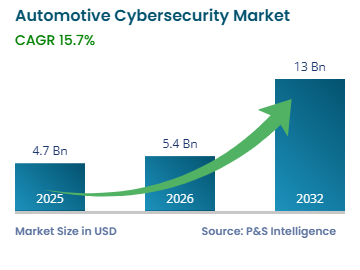
The automotive cybersecurity market size was USD 4.7 billion for 2025, and it will grow by 15.7% during 2026–2032, to reach USD 13.0 billion by 2032.
This growth is supported by the accelerating integration of connected vehicle technologies, advanced driver-assistance systems, and over-the-air software update mechanisms across passenger cars and commercial fleets. The proliferation of electronic control units, in-vehicle connectivity interfaces, and vehicle-to-everything communication protocols creates expanded attack surfaces requiring intrusion detection systems, secure gateways, and encrypted data transmission architectures, further contributing to market growth.
The adoption trajectory is being reinforced by regulatory mandates that establish cybersecurity as a prerequisite for vehicle type approval in major automotive markets. The United Nations Economic Commission for Europe (UNECE) implemented UN Regulation No. 155 in 2021, requiring manufacturers to establish certified Cybersecurity Management Systems covering risk management, secure-by-design principles, incident response, and software update protection across vehicle lifecycles. In July 2022, compliance became mandatory for new vehicle types sold in the European Union, Japan, and South Korea, with the requirement extending to all new vehicles by July 2024. The complementary ISO/SAE 21434 standard provides cybersecurity engineering guidelines that align with regulatory frameworks, creating a unified approach across the 56 UNECE member countries.
Key Market Insights
The ADAS & safety systems category holds the largest market share, of 30%, in 2025, driven by the safety-critical nature of ADAS functions such as automatic emergency braking, lane-keeping assist, adaptive cruise control, and collision avoidance.
The in-vehicle services segment held a 65% market share in 2025 due to the need for local, offline-capable cybersecurity supporting real-time safety-critical functions.
The commercial vehicles category will have the highest CAGR, driven by accelerating fleet electrification combining cybersecurity requirements with electric powertrain connectivity.
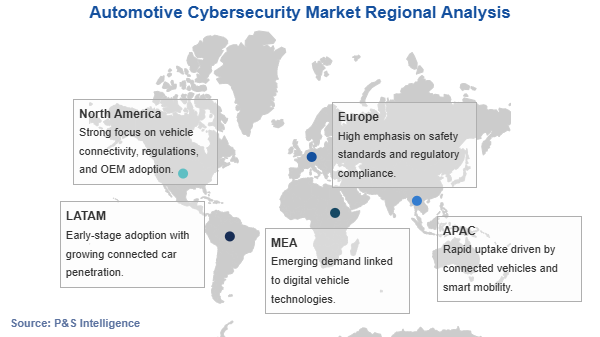
North America holds the largest market share, of 35%, in 2025, driven by concentrated technology investment, established regulatory frameworks, and early adoption of connected vehicle platforms across passenger cars and commercial fleets.
China is the largest country, and India is the fastest-growing country in the Asia-Pacific automotive cybersecurity market.
Automotive Cybersecurity Market Emerging Trends
Artificial Intelligence Integration and Cloud-Native Architectures Are Key Trends
The automotive cybersecurity market is experiencing fundamental architectural transformation as manufacturers adopt artificial intelligence-driven threat detection systems and cloud-native security platforms. Machine learning algorithms trained on fleet-wide telemetry data enable behavioral anomaly detection. These systems identify unusual communication patterns, unauthorized access attempts, or suspicious command sequences that deviate from normal vehicle operation baselines. According to the International Energy Agency, global electric car sales have reached approximately 14 million units, significantly expanding the volume of software-defined and connected vehicles generating telemetry data that supports AI-based cybersecurity monitoring.
Cloud-based security architectures enable advanced cryptographic processing and large-scale threat analysis that cannot be handled entirely within vehicle-constrained computing environments. These architectures also support rapid, fleet-wide distribution of security patches and configuration updates following vulnerability discovery.
According to the United Nations Economic Commission for Europe, cybersecurity regulations under UNECE WP.29 frameworks are applied across more than 50 participating countries, reinforcing cloud-based compliance monitoring, fleet-level incident response, and centralized security governance models. The integration of zero-trust security frameworks, requiring continuous authentication and authorization for every system interaction rather than perimeter-based defenses, represents a shift from traditional automotive security approaches, with implementations using hardware root-of-trust mechanisms in secure microcontrollers, cryptographic identity verification for every ECU communication, and micro-segmentation limiting lateral movement opportunities if attackers penetrate initial defenses.
Regulatory Mandates and Compliance Requirements Are Biggest Drivers
Global regulatory frameworks are compelling automotive manufacturers to implement comprehensive cybersecurity management systems as mandatory prerequisites for vehicle type approval. The UNECE's implementation of UN Regulation No. 155, with mandatory compliance timelines across UNECE contracting parties that have adopted the regulation into national law, including the European Union, Japan, and South Korea, established legally enforceable cybersecurity standards covering vehicle development, production, and post-production monitoring phases. This regulatory architecture requires manufacturers to demonstrate certified Cybersecurity Management Systems encompassing risk assessment methodologies, secure-by-design principles, threat detection capabilities, and incident response protocols before obtaining permission to sell vehicles in regulated markets.
Under the UNECE framework, cybersecurity compliance applies not only to original equipment manufacturers but also extends to suppliers whose components, software, and services directly affect vehicle cybersecurity performance, through OEM accountability across the automotive value chain. The regulation's dual-approval structure, requiring both organizational CSMS certification and vehicle-specific type approval, creates sustained demand for cybersecurity solutions throughout vehicle lifecycles rather than one-time implementation projects.
The U.S. market, while maintaining voluntary guidelines through NHTSA rather than mandatory regulations, is experiencing parallel cybersecurity adoption driven by tort liability concerns that incentivize proactive security implementation. Industry coordination through organizations such as Auto-ISAC, whose membership includes more than 70 automotive manufacturers, suppliers, and commercial vehicle stakeholders, reinforces cybersecurity as a core operational and governance priority across vehicle programs.
Electric Vehicle Expansion and Autonomous Driving Development Are Biggest Opportunities
The accelerating transition to electric powertrains and autonomous driving capabilities is creating unprecedented cybersecurity requirements beyond traditional automotive security paradigms, opening substantial market opportunities for specialized protection solutions. Electric vehicles require comprehensive security architectures protecting battery management systems from manipulation attacks that could trigger thermal runaway conditions, securing vehicle-to-grid bidirectional energy flow communications, and implementing authentication protocols for charging infrastructure access that prevent unauthorized electricity consumption or grid destabilization. According to the International Energy Agency, global public electric vehicle charging points exceeded 3 million units worldwide in 2023, significantly expanding the cybersecurity attack surface beyond vehicles to include energy and charging communication interfaces.
Autonomous driving systems operating at SAE Level 3 and above introduce cybersecurity requirements protecting sensor fusion algorithms, machine learning models, and real-time decision-making processes from adversarial attacks designed to manipulate vehicle behavior or create dangerous driving situations. The SAE International formally defines 6 levels of driving automation, with Level 3 and higher transferring dynamic driving control to software systems, substantially increasing cybersecurity exposure compared with driver-controlled vehicles. Commercial fleet operators deploying autonomous vehicles for ride-hailing, goods delivery, and logistics applications require enterprise-grade cybersecurity management platforms that monitor thousands of vehicles simultaneously, detect coordinated attack patterns across fleets, and provide centralized incident response capabilities protecting both individual vehicle safety and overall service availability.
The ADAS & safety systems category holds the largest market share, of 30%, in 2025, driven by the safety-critical nature of ADAS functions such as automatic emergency braking, lane-keeping assist, adaptive cruise control, and collision avoidance. ADAS cybersecurity requirements stem from their real-time, safety-critical nature. These systems rely on sensor fusion integrating data from cameras, radar, LiDAR, and ultrasonic sensors, which are vulnerable to spoofing attacks. These systems are implemented through complex software algorithms processing terabytes of perception data that create substantial attack surfaces. Regulatory frameworks amplify ADAS importance, for instance, Euro NCAP’s 2024 Assisted Driving Grading protocols added around 40 new test scenarios that more rigorously assess ADAS performance, driver monitoring, and system fallback behavior under real-world conditions.
The telematics category will have the highest CAGR, of 15.8%, driven by expanding connected vehicle services supporting insurance, fleet management, theft recovery, and predictive maintenance use cases. This growth is further supported by rising adoption of usage-based insurance programs, increasing connectivity requirements among commercial fleets for compliance and operational efficiency, and automakers deploying embedded telematics to enable subscription-based digital services. The NHTSA’s Standing General Order demonstrates how telematics enables rapid crash reporting while increasing cybersecurity requirements for data protection and access control.
The applications analyzed in this report are:
ADAS & Safety Systems (Largest Category)
Telematics (Fastest Growing Category)
Infotainment
Body Electronics
Powertrain
Vehicle Type Analysis
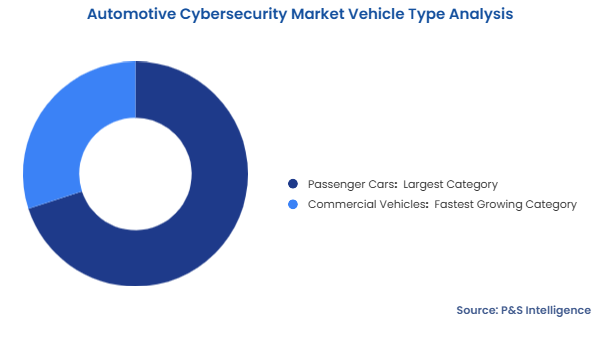
The passenger cars category holds the largest market share, of 70%, in 2025, driven by premium segment competition emphasizing advanced connectivity features, autonomous driving capabilities, and over-the-air update functionalities that necessitate comprehensive security architectures. The UNECE WP.29 UN Regulation No. 155 requirements applying equally to passenger cars (Category M) established mandatory cybersecurity management systems for vehicle type approval effective July 2022 for new types and July 2024 for all new vehicles.
The commercial vehicles category will have the highest CAGR, of 15.9%, driven by accelerating fleet electrification combining cybersecurity requirements with electric powertrain connectivity. Autonomous trucking pilots deploying Level 4 systems requiring advanced threat protection for safety-critical autonomous driving functions, and regulatory pressures extending UNECE R155 cybersecurity compliance to trucks, buses, and vans (Category N vehicles) creating mandatory security implementation timelines.
The vehicle types analyzed in this report are:
Passenger Cars (Largest Category)
Commercial Vehicles (Fastest Growing Category)
Form Analysis
The in-vehicle services segment held the largest market share of 65% in 2025, driven by the need for local, offline-capable cybersecurity supporting real-time safety-critical vehicle functions. This in-vehicle security emphasis is reinforced by industry developments such as in 2025, VicOne partnered with NXP Semiconductors N.V. to integrate AI-powered cybersecurity into automotive platforms, combining VicOne's xCarbon intrusion detection system with NXP's OrangeBox Automotive Connectivity Domain Controller to enable edge AI processing that correlates vehicle data and security events across multiple electronic control units.
The external cloud services category will have the highest CAGR, driven by cloud platforms unique capabilities for centralized threat intelligence aggregation across millions of vehicles, enabling rapid identification of coordinated attack patterns. These platforms also support computationally intensive machine learning analysis of fleet-wide behavioral anomalies exceeding onboard processing capabilities, and coordinated incident response, deploying security patches or configuration updates to entire vehicle populations within hours of vulnerability discovery rather than waiting for individual vehicles to visit service centers.
The forms analyzed in this report are:
In-Vehicle Services (Larger Category)
External Cloud Services (Faster-Growing Category)
Drive strategic growth with comprehensive market analysis
Automotive Cybersecurity Market Regional Outlook
North America Automotive Cybersecurity Market Size
North America holds the largest market share, of 35%, in 2025, driven by concentrated technology investment, established regulatory frameworks, and early adoption of connected vehicle platforms across passenger cars and commercial fleets. The region's leadership position reflects mature automotive manufacturing infrastructure combined with Silicon Valley's software development capabilities, creating an ecosystem where traditional OEMs collaborate extensively with technology companies on cybersecurity architecture development. The U.S. National Highway Traffic Safety Administration released updated Cybersecurity Best Practices for the safety of modern vehicles, establishing voluntary guidelines that cover vehicle lifecycle cybersecurity from development through decommissioning and referencing ISO/SAE 21434 integration.
California’s zero-emission vehicle mandates requiring secure over-the-air update capabilities, along with Canada’s accelerating electric vehicle infrastructure deployment, are reinforcing regional cybersecurity demand, as software-defined vehicle architectures become mandatory for compliance and fleet scalability. Federal initiatives supporting electric vehicle deployment and advanced driver-assistance systems expansion are creating substantial cybersecurity requirements. The Auto-ISAC, established with NHTSA collaboration, facilitates threat intelligence sharing across over 100 member organizations representing manufacturers, suppliers, and commercial fleet operators.
U.S. Automotive Cybersecurity Market Size
The United States represented the largest country market globally in 2025, driven by concentrated automotive technology development in Detroit and Silicon Valley ecosystems, and early adoption of connected vehicle features across mainstream passenger car segments. The market's leadership reflects mature regulatory engagement through NHTSA's voluntary cybersecurity guidelines combined with state-level mandates, particularly California's Advanced Clean Cars II that accelerate software-defined vehicle adoption and reinforce demand for secure over-the-air update mechanisms. American automotive manufacturers are investing substantially in cybersecurity capabilities to address expanding attack surfaces from vehicle connectivity, autonomous driving development programs, and electric vehicle platform deployments that integrate battery management systems with vehicle networks. Silicon Valley technology companies' partnerships with traditional OEMs are accelerating adoption of cloud-native security architectures, zero-trust frameworks, and artificial intelligence-enabled threat detection systems adapted from enterprise cybersecurity domains.
Asia-Pacific Automotive Cybersecurity Market Size
Asia-Pacific will have the highest CAGR, of 16.0%, driven by China, Japan, and India's combined vehicle production volumes that represent a substantial share of global automotive manufacturing output. The region's rapid adoption stems from government-mandated connected vehicle standards, aggressive electric vehicle deployment targets, and large-scale smart city initiatives requiring vehicle-to-infrastructure communication protocols with embedded cybersecurity architectures. Japan implemented UNECE WP.29 cybersecurity regulations, while South Korea adopted a phased approach with national guidelines preceding full regulatory implementation, creating compliance drivers across major automotive manufacturing hubs.
China’s Ministry of Industry and Information Technology enforces strict cybersecurity and data security requirements for connected vehicles. The rapid expansion of electric vehicle production, with China producing over 10 million battery electric and plug-in hybrid vehicles in 2024, necessitates cybersecurity solutions protecting battery management systems, autonomous driving stacks, and charging infrastructure communications. Moreover, India's automotive sector growth, which is accelerated by government production-linked incentive schemes and expanding middle-class vehicle ownership, is driving cybersecurity adoption across vehicle segments from entry-level passenger cars to commercial logistics fleets.
China Automotive Cybersecurity Market Size
China held the largest country market within Asia-Pacific in 2025, driven by the world's largest vehicle production base, manufacturing over 25 million passenger cars and commercial vehicles annually. The market's substantial scale stems from government-mandated cybersecurity standards for intelligent connected vehicles, domestic electric vehicle manufacturers' rapid scaling requiring comprehensive security architectures, and smart city infrastructure projects integrating millions of connected vehicles into urban transportation management systems. China's Cybersecurity Law and Data Security Law establish comprehensive requirements for automotive data collection, storage, and cross-border transfer, compelling both domestic manufacturers and foreign joint ventures to implement robust cybersecurity management systems.
The Ministry of Industry and Information Technology's connected vehicle cybersecurity standards specify requirements for intrusion detection systems, secure communication protocols, and vulnerability management processes across vehicle lifecycles, creating substantial demand for hardware security modules, secure gateways, and cloud-based threat monitoring platforms. Domestic technology companies are developing integrated solutions combining automotive cybersecurity with artificial intelligence capabilities, creating competitive alternatives to international suppliers while meeting localization requirements. The ongoing expansion of Level 2+ and Level 3 autonomous driving features across passenger vehicle segments, particularly in electric vehicles from BYD, NIO, XPeng, and Li Auto, necessitates multi-layered security architectures protecting sensor fusion systems and decision-making algorithms.
China's automotive cybersecurity trajectory through 2032 indicates sustained high growth rates exceeding regional averages, supported by the New Energy Vehicle Industry Development Plan targeting 40% new energy vehicle sales penetration by 2030, aggressive autonomous vehicle commercialization timelines in designated pilot cities, and continued government emphasis on automotive data security sovereignty.
The regions and countries of the market are as follows:
North America (Largest Region)
U.S. (Larger Country Market)
Canada (Faster-Growing Country Market)
Europe
Germany (Largest Country Market)
U.K. (Fastest-Growing Country Market)
France
Italy
Spain
Rest of Europe
Asia Pacific (Fastest-Growing Region)
China (Largest Country Market)
India (Fastest-Growing Country Market)
Japan
South Korea
Australia
Rest of Asia Pacific
Latin America
Brazil (Largest Country Market)
Mexico (Fastest-Growing Country Market)
Rest of Latin America
Middle East & Africa
Saudi Arabia (Fastest-Growing Country Market)
South Africa
U.A.E. (Largest Country Market)
Rest of MEA
Automotive Cybersecurity Market Share Analysis
The market exhibits a semi-consolidated competitive structure, with established automotive tier-1 suppliers, specialized cybersecurity startups, and semiconductor manufacturers competing across complementary solution domains. High certification, safety validation, and vehicle integration requirements restrict rapid market entry while still allowing innovation at the subsystem and software layer. No single company provides a fully dominant end-to-end cybersecurity stack across hardware, embedded software, cloud security, and lifecycle monitoring. Strategic partnerships between OEMs, tier-1 suppliers, and cybersecurity specialists are more prevalent than exclusive supplier lock-ins. This market structure reflects substantial barriers to entry stemming from deep automotive industry relationships required for OEM procurement access, extensive regulatory compliance expertise necessary for UNECE WP.29 and ISO/SAE 21434 alignment, and technical capabilities spanning both traditional automotive engineering and modern cybersecurity methodologies.
Automotive Cybersecurity Producers:
Continental AG
Robert Bosch GmbH
Aptiv PLC
HARMAN International
DENSO Corporation
Argus Cyber Security Ltd.
Karamba Security Ltd.
Upstream Security Ltd.
VicOne
Cybellum Ltd.
Arilou Information Security Technologies Ltd.
GuardKnox Cyber Technologies Ltd.
RunSafe Security
Vector Informatik GmbH
ETAS GmbH
ESCRYPT GmbH
BlackBerry Limited
NXP Semiconductors N.V.
Infineon Technologies AG
STMicroelectronics N.V.
Microchip Technology Inc.
Automotive Cybersecurity Market Developments
In January 2025, Anritsu Corporation and AUTOCRYPT signed a memorandum of understanding to develop automotive cybersecurity testing solutions using simulated 5G networks, combining AUTOCRYPT's Cybersecurity Testing Platform with Anritsu's Radio Communication Test Station MT8000A.
In November 2024, NXP Semiconductors announced its new i.MX 94 family of applications processors designed for industrial and automotive edge applications, featuring integrated 2.5 Gbps TSN networking, post-quantum cryptography support, and an embedded neural processing unit for advanced connectivity and security capabilities.
In January 2024, ETAS GmbH, ESCRYPT, and Rambus Inc. announced a strategic partnership to develop bundled security solutions combining Rambus' RT-640 embedded hardware security module IP with ETAS' ESCRYPT CycurSoC software.
Frequently Asked Questions About This Report
What is driving the growth of the automotive cybersecurity market?+
The growth is driven by rising vehicle connectivity, increasing cyberattack risks, mandatory cybersecurity regulations, and the expansion of software-defined and autonomous vehicles.
Which vehicle systems require the highest level of cybersecurity protection?+
ADAS and safety systems require the highest protection due to their direct impact on vehicle control, passenger safety, and autonomous driving functions.
Which vehicle type dominates automotive cybersecurity demand?+
Passenger cars dominate the automotive cybersecurity market.
Which cybersecurity form holds the largest market share?+
In-vehicle cybersecurity services hold the largest share as OEMs embed security at the ECU, gateway, and vehicle network levels.
Which region leads the Automotive Cybersecurity Market?+
North America leads the automotive cybersecurity market.
Which region is the fastest-growing for automotive cybersecurity?+
Asia-Pacific is the fastest-growing region in the automotive cybersecurity market.
Want a report tailored exactly to your business need?
Leading companies across industries trust us to deliver data-driven insights and innovative solutions for their most critical decisions. From data-driven strategies to actionable insights, we empower the decision-makers who shape industries and define the future. From Fortune 500 companies to innovative startups, we are proud to partner with organisations that drive progress in their industries.
Client Testimonials
Working with P&S Intelligence and their team was an absolute pleasure – their awareness of timelines and commitment to value greatly contributed to our project's success. Eagerly anticipating future collaborations.
McKinsey & Company
India
Unmatched Standards
Our insights into the minutest levels of the markets, including the latest trends and competitive landscape, give you all the answers you need to take your business to new heights
Complete Data Security
We take a cautious approach to protecting your personal and confidential information. Trust is the strongest bond that connects us and our clients, and trust we build by complying with all international and domestic data protection and privacy laws