This Report Provides In-Depth Analysis of the Automotive Chip Market Report Prepared by P&S Intelligence, Segmented by Product Type (Microcontrollers & Microprocessors, Analog ICs, Logic ICs, Memory Chips, Sensors), Application (Body Electronics, Safety Systems, Powertrain, Telematics & Infotainment, Chassis), Vehicle Type (Passenger Vehicles, Commercial Vehicles), and Geographical Outlook for the Period of 2019 to 2032
Explore the market potential with our data-driven report
Automotive Chip Market Outlook
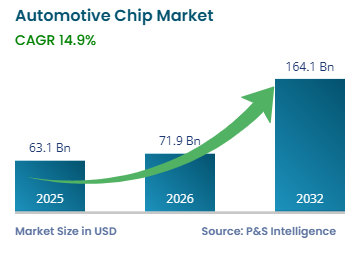
The global automotive chip market size is estimated at USD 63.1 billion in 2025, which is predicted to reach USD 164.1 billion by 2032, growing at a CAGR of 14.9% during 2026–2032.
The major factors responsible for the growth of the market include the accelerating shift towards electric vehicles, widespread adoption of advanced driver assistance systems, and increasing integration of connected car technologies across all vehicle segments. The surging adoption of electric vehicles represents a key factor for the rising demand for automotive semiconductors. Battery electric vehicles require approximately three times more semiconductor content compared to traditional internal combustion engine vehicles, with average semiconductor value reaching USD 1,500 per electric vehicle.
According to the International Energy Agency, over 17 million electric cars were sold globally in 2024, representing a 25% increase from the previous year. This rapid electrification trend has created unprecedented demand for power management chips, battery management systems, and high-efficiency semiconductors that enable optimal energy conversion and thermal management in electric powertrains.
The automotive industry's transformation towards software-defined vehicles has fundamentally altered semiconductor requirements. Modern vehicles incorporate over 100 electronic control units and require sophisticated processors capable of handling complex algorithms for real-time data processing. The integration of artificial intelligence and machine learning capabilities in automotive systems has driven demand for high-performance computing chips that can support autonomous driving features, predictive maintenance, and personalized user experiences. Furthermore, the implementation of over-the-air update capabilities requires robust memory solutions and secure communication chips, expanding the semiconductor content per vehicle significantly.
Automotive Chip Market Emerging Trends
Vehicle Electrification Surge Is a Key Trend
The shift from traditional internal combustion engine vehicles to EVs is creating a sharp rise in demand for automotive chips.
The U.S. Department of Commerce agreed to give up to USD 225 million in grants to Bosch to help it convert a facility in Roseville, California, to fabricate silicon carbide (SiC) power semiconductors.
EVs require significantly more semiconductors than conventional vehicles due to their reliance on electronic systems for power management, battery control, and motor operation.
The U.S. government committed USD 750 million to Wolfspeed to expand its SiC device manufacturing in North Carolina, under a larger USD 6-billion expansion plan.
This will help scale production of efficient chips used in EV power systems.
Battery management systems, inverters, onboard chargers, and electric drive controls all depend on specialized semiconductor chips.
This surge is driving growth in the sale of power semiconductors, microcontrollers, and sensors specifically designed for EV applications.
As EV adoption increases globally, chipmakers are scaling up production and investing in SiC and gallium nitride (GaN) compounds for better efficiency.
In India, under the India Semiconductor Mission, the government has approved ten semiconductor manufacturing projects with a total investment commitment of USD 18.2 billion (INR 1.60 trillion).
Some of these involve SiC compound semiconductors, which are highly relevant for EV power electronics.
The trend is reshaping the automotive chip market, making EV-related components one of its fastest-growing and most critical segments.
Governments supporting EV adoption through incentives and stricter emissions regulations are further accelerating semiconductor demand.
Rapid Adoption of Advanced Driver Assistance Systems Is Accelerating Market Growth
Advanced Driver Assistance Systems (ADAS) use a wide range of semiconductor chips to enable features such as lane keeping, automatic braking, adaptive cruise control, and parking assistance.
The worldwide market for advanced driver assistance systems is projected to grow to USD 156.4 billion by 2032, industry experts predict.
The bipartisan CHIPS and Science Act allocated approximately USD 52 billion to bolster domestic semiconductor production, including USD 2 billion designated for the legacy chips crucial to automotive applications.
This initiative aims to alleviate chip shortages and support the integration of ADAS technologies in vehicles.
As carmakers integrate more ADAS features into new vehicles, the demand for related chips—such as sensors, processors, and connectivity modules—is rapidly increasing.
The growing focus on vehicle safety, both from consumers and regulators, is pushing manufacturers to adopt these technologies faster.
ADAS requires high-performance chips to process large amounts of real-time data from cameras, radars, and LiDAR systems.
The U.S. government has awarded USD 1.5 billion to GlobalFoundries to support semiconductor production, enabling the construction of a new facility in Malta, New York, and expansion in Burlington, Vermont.
These chips are crucial for automotive technologies, including ADAS.
This trend is expanding the demand for automotive semiconductors, especially for artificial intelligence processors, image sensors, and microcontrollers.
Falling costs and improved performance of ADAS components are making these features more common, even in mid-range vehicles.
The Uttar Pradesh government has received project proposals worth approximately INR 40,000 crore for semiconductor manufacturing, including investments in ADAS-related chip production.
This initiative aims to establish Uttar Pradesh as a hub for the semiconductor ecosystem.
Automotive Chip Market Segmentation Analysis
Product Type Analysis
The microcontrollers & microprocessors category holds the largest share in the automotive chip market in 2025, of 35%, and it is expected to maintain its dominance throughout the forecast period. This is primarily due to their critical role in controlling virtually every electronic system in modern vehicles, from engine management and transmission control to ADAS and infotainment systems. The increasing complexity of vehicle architectures and the transition towards centralized computing platforms have driven demand for more powerful automotive microcontrollers with enhanced processing capabilities and integrated safety features.
Analog ICs will witness the highest CAGR, during the forecast period, owing to the proliferation of sensors and the need for signal conditioning in electric vehicles and ADAS applications. The growing adoption of electric powertrains requires sophisticated analog chips for battery monitoring, motor control, and power conversion. These devices enable precise measurement of current, voltage, and temperature parameters critical for safe and efficient operation of electric vehicles. The integration of more sensors for autonomous driving capabilities, including LiDAR, radar, and cameras, further drives demand for analog front-end devices and signal processing chips.
The body electronics category has captured the largest market share in 2025, of 30%, driven by the increasing integration of comfort and convenience features in modern vehicles. This category encompasses a wide range of applications, including lighting control, climate management, seat adjustment, and door modules. The trend towards smart interior systems with ambient lighting, massage seats, and personalized comfort zones has significantly increased semiconductor content in body electronics applications. Advanced body control modules now incorporate multiple microcontrollers and communication chips to manage the complex interactions between various comfort systems.
The safety systems category is projected to achieve the fastest growth, during 2026–2032, fueled by stringent safety regulations and consumer demand for enhanced protection features. Over 1 billion people globally are living with mental health disorders, contributing to increased road accidents and highlighting the critical need for advanced safety systems. Modern safety systems integrate multiple airbag controllers, collision detection sensors, and emergency braking systems, all requiring specialized automotive chips with functional safety certifications. The evolution towards predictive safety systems that can anticipate and prevent accidents before they occur has driven demand for artificial intelligence processors and sensor fusion chips.
These applications are covered:
Body Electronics (Largest Category)
Safety Systems (Fastest-Growing Category)
Powertrain
Telematics & Infotainment
Chassis
Others
Vehicle Type Analysis
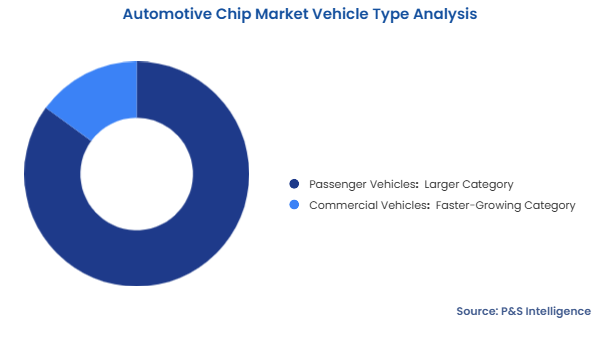
The passenger vehicles category dominates the market with 85% share in 2025, reflecting the massive volume of passenger car production globally and the increasing semiconductor content per vehicle. Consumer demand for advanced features, including autonomous driving capabilities, sophisticated infotainment systems, and enhanced comfort features, has driven semiconductor adoption in passenger vehicles. The democratization of premium features to mid-range and entry-level vehicles has further expanded the addressable market for automotive chips in this category.
Commercial vehicles are expected to witness the higher CAGR, during the forecast period, driven by fleet electrification initiatives and the adoption of advanced telematics solutions. The implementation of electronic logging devices, fleet management systems, and driver monitoring solutions has increased semiconductor content in commercial vehicles. The development of autonomous trucking technologies and platooning systems requires sophisticated sensors and processing capabilities, creating new opportunities for semiconductor suppliers in the commercial vehicle category.
These vehicle types are covered:
Passenger Vehicles (Larger Category)
Commercial Vehicles (Faster-Growing Category)
Drive strategic growth with comprehensive market analysis
Automotive Chip Market Regional Growth Dynamics
Asia-Pacific Automotive Chip Market Size
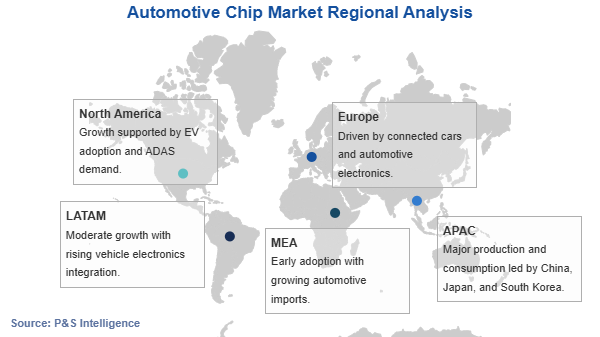
Asia-Pacific holds the largest share of 40% in 2025, and it is expected to maintain its leadership position in the coming years. This dominance is primarily attributed to the region's position as the global automotive manufacturing hub, with China, Japan, and South Korea collectively accounting for over 50% of global vehicle production. The rapid adoption of electric vehicles in China, supported by government incentives and infrastructure development, has created substantial demand for automotive semiconductors. China's electric car sales exceeded 11 million units in 2024.
The region benefits from a well-established semiconductor manufacturing ecosystem, with major foundries and assembly facilities located in Taiwan, China, and Southeast Asia. Government initiatives such as China's dual circulation strategy and Japan's semiconductor revival program have strengthened local chip production capabilities. The presence of leading automotive manufacturers, including Toyota, Honda, and Hyundai; and emerging electric vehicle companies, such as BYD and NIO; has created a robust demand environment for automotive chips. Furthermore, the region's focus on developing smart city infrastructure and connected mobility solutions has accelerated the adoption of advanced automotive technologies.
China has emerged as the single largest market for automotive chips within Asia-Pacific, driven by its massive electric vehicle market and ambitious autonomous driving development programs. The Chinese government's target of achieving 25% local chip content in vehicles by 2025 has spurred domestic semiconductor development and attracted foreign investments. India's automotive chip market is experiencing rapid growth, supported by the government's production-linked incentive schemes and the country's expanding automotive manufacturing base. The establishment of semiconductor fabrication facilities and design centers by global companies in India indicates the country's growing importance in the automotive chip supply chain.
North America Automotive Chip Market Share
North America is expected to be the fastest-growing market, with a CAGR of approx. 15.0%, during the forecast period. The growth can be attributed to the region's leadership in autonomous vehicle development, with major technology companies and automotive manufacturers investing heavily in self-driving technologies. The implementation of the CHIPS and Science Act in the United States, which allocates over USD 50 billion for semiconductor manufacturing and research, has strengthened the region's position in the automotive chip market.
The presence of leading automotive chip design companies and the establishment of new fabrication facilities by companies like TSMC and Samsung in the United States have enhanced the region's semiconductor manufacturing capabilities. In the United States, electric car sales grew by about 10% year-on-year in 2024, reaching more than one in ten cars sold. The growing adoption of electric vehicles, supported by federal tax incentives and state-level mandates, has created significant demand for power semiconductors and battery management chips. Additionally, the region's focus on developing vehicle-to-everything communication infrastructure and smart transportation systems has driven demand for connectivity and processing chips.
Europe Automotive Chip Market Outlook
Europe accounts for approximately 25% of the global automotive chip market, driven by the presence of premium automotive manufacturers and stringent emission regulations. The European Union's Green Deal and the mandate for carbon neutrality by 2050 have accelerated the transition to electric vehicles, creating substantial demand for automotive semiconductors. Germany, as the region's automotive powerhouse, leads in semiconductor consumption, with major manufacturers like Volkswagen, BMW, and Mercedes-Benz driving innovation in automotive electronics.
The implementation of the European Chips Act, which aims to double the region's global semiconductor market share by 2030, has attracted significant investments in automotive chip manufacturing. The focus on developing sovereign semiconductor capabilities has led to the establishment of new fabrication facilities and the expansion of existing ones. France's emphasis on electric vehicle adoption and the United Kingdom's zero-emission vehicle mandate have further contributed to market growth. The region's leadership in automotive safety standards and the early adoption of advanced driver assistance systems have positioned Europe as a key market for safety-related semiconductors.
The regions and countries analyzed in this report are:
North America (Fastest-Growing Regional Market)
U.S. (Larger Country Market)
Canada (Faster-Growing Country Market)
Europe
Germany (Largest Country Market)
U.K. (Fastest-Growing Country Market)
France
Italy
Spain
Rest of Europe
Asia-Pacific (Largest Regional Market)
Japan
China (Largest Country Market)
India (Fastest-Growing Country Market)
South Korea
Australia
Rest of APAC
Latin America
Brazil (Largest Country Market)
Mexico (Fastest-Growing Country Market)
Rest of LATAM
Middle East and Africa
Saudi Arabia (Largest Country Market)
South Africa
U.A.E. (Fastest-Growing Country Market)
Rest of MEA
Automotive Chip Market Share
The global automotive chip market exhibits a consolidated structure. The market is characterized by high barriers to entry due to substantial capital requirements for fabrication facilities, lengthy automotive qualification processes, and the need for specialized expertise in functional safety standards. The competitive landscape has intensified as traditional semiconductor companies face competition from automotive manufacturers developing their own chips and technology companies entering the automotive space. The leading companies have maintained their positions through continuous innovation, strategic acquisitions, and close partnerships with automotive manufacturers. The market leaders have invested heavily in developing next-generation technologies, including SiC power devices, automotive-grade processors for autonomous driving, and specialized chips for electric vehicle applications.
The competitive dynamics are evolving as automotive manufacturers increasingly collaborate with chip companies for custom silicon development. Vertical integration strategies adopted by companies like Tesla and partnerships between traditional automakers and semiconductor companies are reshaping the competitive landscape. The focus on securing semiconductor supply chains following recent chip shortages has led to long-term supply agreements and joint ventures between automotive and semiconductor companies.
Key Automotive Chip Companies:
Infineon Technologies
NXP Semiconductors
STMicroelectronics
Qualcomm
Renesas Electronics
Texas Instruments
Analog Devices
Robert Bosch GmbH
ON Semiconductor
Toshiba Corporation
Intel Corporation
Broadcom Inc.
MediaTek Inc.
Micron Technology
Samsung Electronics
Automotive Chip Market News
In April 2025, Infineon Technologies AG announced that it would acquire Marvell Technology Inc.’s automotive Ethernet business for USD 2.5 billion in cash.
In January 2025, NXP Semiconductors N.V. announced its agreement to acquire Austria's TTTech Auto AG for USD 625 million, strengthening its position in autonomous driving and advanced driver assistance systems software.
In October 2024, Qualcomm Incorporated announced a collaboration with Google LLC to develop next-generation integrated chips and software applications for automotive purposes, focusing on AI-powered voice assistants and Android Automotive OS optimization.
In March 2024, Sony Semiconductor Solutions Corporation began production at its new facility in Thailand, designed specifically for manufacturing image sensors used in automotive applications.
In January 2024, Texas Instruments Incorporated introduced new automotive chips, including the AWR2544 radar sensor and DRV3946-Q1 driver, aimed at enhancing vehicle safety and enabling smarter decision-making in ADAS applications.
In August 2023, Robert Bosch GmbH completed the acquisition of TSI Semiconductors' assets in California, investing USD 1.5 billion to establish silicon carbide semiconductor manufacturing capabilities for electric vehicles.
Want a report tailored exactly to your business need?
Leading companies across industries trust us to deliver data-driven insights and innovative solutions for their most critical decisions. From data-driven strategies to actionable insights, we empower the decision-makers who shape industries and define the future. From Fortune 500 companies to innovative startups, we are proud to partner with organisations that drive progress in their industries.
Client Testimonials
Working with P&S Intelligence and their team was an absolute pleasure – their awareness of timelines and commitment to value greatly contributed to our project's success. Eagerly anticipating future collaborations.
McKinsey & Company
India
Unmatched Standards
Our insights into the minutest levels of the markets, including the latest trends and competitive landscape, give you all the answers you need to take your business to new heights
Complete Data Security
We take a cautious approach to protecting your personal and confidential information. Trust is the strongest bond that connects us and our clients, and trust we build by complying with all international and domestic data protection and privacy laws