This Report Provides In-Depth Analysis of the Automotive Camshaft Market Report Prepared by P&S Intelligence, Segmented by Manufacturing Technology (Cast, Forged/Forged Steel, Assembled), Vehicle Type (Passenger Cars, Light Commercial Vehicles, Heavy Commercial Vehicles), Sales Channel (Original Equipment Manufacturers, Aftermarket), Material Type (Cast Iron/Alloy Cast Iron, Steel/Billet Steel, Ductile Iron), Engine Type (Inline, V), and Geographical Outlook for the Period of 2019 to 2032
Explore the market potential with our data-driven report
Automotive Camshaft Market Outlook
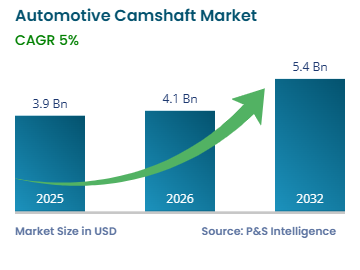
The global automotive camshaft market size is estimated at USD 3.9 billion in 2025, which is predicted to reach USD 5.4 billion by 2032, growing at a CAGR of 5.0% during 2026–2032.
The key factors driving the growth of the market include the rising vehicle production globally, increasing adoption of engine downsizing technologies, growing demand for fuel-efficient vehicles, and stringent emission regulations worldwide.
The surging adoption of turbocharged engines represents a crucial growth catalyst for the automotive camshaft market. As automakers increasingly embrace engine downsizing strategies to meet stringent fuel efficiency standards, while maintaining performance, advanced camshaft technologies have become essential. The International Organization of Motor Vehicle Manufacturers (OICA) confirms that global vehicle production in 2024 was 92,504,338 units, and China produced 31,281,592 vehicles that year. This massive production scale directly translates into substantial demand for automotive camshafts, which remain critical components in internal combustion engines despite the growing electrification trend.
The market is experiencing a significant technological shift toward lightweight and assembled camshafts, which offer superior design flexibility and reduced weight compared to traditional cast camshafts. These innovations enable automotive manufacturers to achieve better fuel economy and lower emissions, aligning with global environmental objectives. Furthermore, the persistence of internal combustion engines in hybrid vehicles ensures continued demand for advanced camshaft technologies, even as the automotive industry transitions toward electrification.
Automotive Camshaft Market Growth Factors
Growing Hybrid Vehicle Adoption Is a Key Trend
Despite the growing electric vehicle market, hybrids maintain a steady demand for camshafts as a key engine component during the transition period.
Hybrid vehicle adoption sustains the demand for camshafts because hybrid powertrains often include internal combustion engines that still need optimized camshafts for efficient operation.
The SPMEPCI is a government scheme requiring a INR 4,150 crore investment to set up EV manufacturing in India, with targets of 25–50% local value addition.
Approved companies get 15% lower customs duty on importing up to 8,000 EVs per year for five years, supporting Make in India goals.
Camshafts in hybrid vehicles are designed to manage complex engine functions with electric motor integration, to improve fuel efficiency and reduce emissions.
The UK government committed GBP 2.5 billion over the next decade under the DRIVE35 Programme to support the transition to zero‑emission vehicle manufacturing, R&D, innovation and scaling up of the supply chain.
The rise in hybrid vehicle sales, especially in developing and developed markets, drives growth in advanced camshaft technologies.
The US Department of Energy has set aside USD 2 billion in cost‑shared grants to help domestic manufacturers convert facilities to produce efficient hybrid, plug‑in hybrid, electric, and hydrogen fuel cell vehicles.
Manufacturers focus on lightweight materials and variable valve timing systems in camshafts to enhance engine performance and fuel economy in hybrids.
Hybridization encourages the development of camshafts compatible with alternative fuels and biofuels, supporting sustainability goals.
Thailand plans to attract USD 1.39 billion (THB 50 billion) in new investments by offering reduced excise taxes for hybrid vehicle makers.
The is conditional on the investment of at least THB 3 billion over four years, usage of local parts, and inclusion of advanced driver assistance systems (ADAS).
Sensor integration in camshafts enables real-time diagnostics and predictive maintenance for hybrid engine management.
Engine Downsizing and Turbocharging Efforts Are Accelerating Market Growth
Engine downsizing reduces engine displacement and cylinder count, improving fuel efficiency and reducing emissions.
As per the International Energy Agency (IEA), in 2023, global COâ‚‚ emissions from cars and vans reached 3.8 Gigatonnes.
Light‑duty vehicles (cars and vans) now contribute over 60% of all road transport emissions.
Turbocharging is used alongside downsizing to maintain or enhance engine power and torque by forcing more air into the smaller engine.
The US government provides up to USD 25 billion in loans, with USD 8.4 billion approved so far, to manufacturers developing advanced vehicles focused on fuel economy and emissions reduction.
Downsized turbocharged engines require precise camshaft designs to optimize air-fuel mixture, valve timing, and boost response.
Manufacturers develop camshafts with advanced technologies, such as variable valve timing, to improve performance and fuel economy in downsized engines.
These strategies create a strong demand for camshafts made from lightweight, durable materials able to withstand higher pressures and temperatures.
The UK government, together with private partners, has invested around GBP 1 billion to fund R&D projects in advanced vehicle propulsion, including efficient internal combustion engines, that use downsizing and turbocharging technologies.
This supports innovation in camshafts and other components that improve engine performance and decrease emissions.
The trend of engine downsizing with turbocharging is driven by stricter emission regulations and consumer demand for fuel-efficient vehicles.
Camshaft manufacturers invest in innovation to support the performance, reliability, and efficiency requirements of downsized turbocharged engines.
Automotive Camshaft Market Segmentation Analysis
Manufacturing Technology Analysis
The cast category dominates the automotive camshaft market in 2025, accounting for 65% share, primarily due to its cost-effectiveness and suitability for mass production. Cast camshafts, manufactured through proven casting processes using materials such as chilled cast iron and ductile iron, offer an optimal balance of durability, wear resistance, and production economics. The casting process enables efficient high-volume production with significant cost savings in both materials and manufacturing time, making these components particularly attractive for mainstream vehicle applications. Their ability to dampen engine vibrations and provide adequate performance across standard operating conditions ensures their continued dominance in the passenger vehicle category.
The assembled category is projected to witness the highest CAGR during 2026–2032, driven by increasing demand for lightweight and flexible engine designs. Assembled camshafts offer unprecedented design flexibility, allowing manufacturers to optimize cam profiles for specific engine requirements while reducing overall weight by up to 40% compared to traditional solid camshafts. This technology enables the use of different materials for various components—lightweight tubes for the shaft body and hardened steel for cam lobes—resulting in superior performance and fuel efficiency. The growing adoption of assembled camshafts in premium vehicles and their increasing application in engine downsizing initiatives position this category for exceptional growth during the forecast period.
These manufacturing technologies are covered:
Cast (Largest Category)
Forged/Forged Steel
Assembled (Fastest-Growing Category)
Vehicle Type Analysis
The passenger cars category holds the largest share, of 55%, in the automotive camshaft market in 2025, driven by the continuous growth in global passenger vehicle production and sales. Rising disposable incomes, increasing urbanization, and expanding middle-class populations in emerging economies fuel sustained demand for passenger vehicles, directly translating to camshaft requirements. Advanced engine technologies, such as variable valve timing, turbocharging, and cylinder deactivation systems, increasingly standard in passenger cars, require sophisticated camshaft designs that optimize performance while meeting emission standards. The category benefits from continuous technological innovations aimed at improving fuel efficiency and reducing emissions, ensuring its dominant market position.
Light commercial vehicles (LCVs) are expected to register the highest CAGR during the forecast period, propelled by the explosive growth in the demand for e-commerce and last-mile delivery services. The surge in online shopping has created unprecedented demand for delivery vans and light trucks, particularly in urban areas where LCVs navigate stop-and-go traffic that places unique stress on engine components. LCV camshafts must withstand frequent acceleration and deceleration cycles while maintaining reliability under commercial operating conditions. The increasing adoption of alternative fuel LCVs, including CNG and hybrid variants, further drives demand for specialized camshaft designs capable of handling different combustion characteristics.
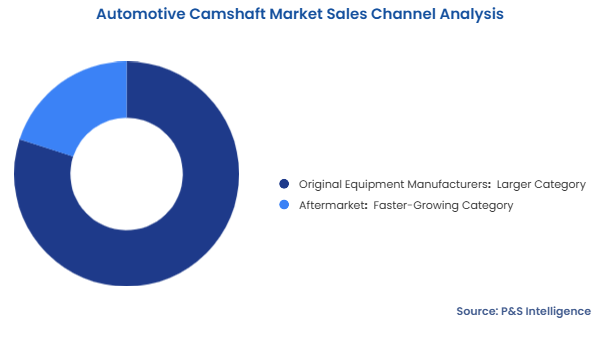
The original equipment manufacturers (OEM) category dominates the market with 80% share in 2025, reflecting its integral role in the automotive production ecosystem. OEMs manufacture camshafts to precise specifications for direct installation in new vehicle assemblies, ensuring optimal integration with engine designs and compliance with warranty requirements. Long-term contracts between camshaft manufacturers and automotive OEMs provide predictable demand and stable revenue streams. The continuous growth in global vehicle production, particularly in emerging markets, sustains OEM dominance as every new vehicle requires camshaft components. OEMs also drive technological advancement through collaborative development of next-generation camshaft technologies, including variable valve timing and cam phasing systems.
The aftermarket category is set to grow at the higher CAGR during 2026–2032, fueled by the expanding vehicle parc and increasing average vehicle age globally. Growing consumer interest in vehicle customization and performance enhancement drives demand for high-performance aftermarket camshafts. The proliferation of e-commerce platforms has revolutionized aftermarket parts distribution, making specialized camshafts more accessible to consumers and independent repair shops. Do-it-yourself automotive maintenance culture, particularly strong in North America and parts of Europe, further propels aftermarket growth. Additionally, the increasing complexity of modern engines creates opportunities for aftermarket suppliers to offer upgraded camshaft solutions that improve upon OEM specifications.
These sales channels are covered:
Original Equipment Manufacturers (OEM) (Larger Category)
Aftermarket (Faster-Growing Category)
Material Type Analysis
The cast iron category commanded the largest market share, of 45%, in 2025, owing to its exceptional durability, wear resistance, and cost-effectiveness. Cast iron camshafts, including variants made from chilled cast iron and ductile iron, provide superior resistance to wear and thermal stability under high-temperature engine operations. The material's inherent ability to dampen vibrations contributes to smoother engine operation and reduced noise, making it ideal for mass-market vehicle applications. Cast iron's proven track record of reliability over decades of automotive use, combined with well-established manufacturing processes, ensures its continued dominance in the market despite the emergence of alternative materials.
Steel/billet steel camshafts represent the fastest-growing category through 2032, driven by demand from high-performance and heavy-duty applications. Forged steel camshafts offer superior strength-to-weight ratios and can withstand higher stress and temperature conditions compared to cast iron alternatives. The material's suitability for precision machining enables the creation of complex cam profiles required for advanced variable valve timing systems. Racing and performance vehicle segments increasingly specify steel camshafts for their ability to maintain dimensional stability under extreme operating conditions. The growing adoption of steel camshafts in commercial vehicles, where durability under continuous operation is paramount, further accelerates category growth.
These material types are covered:
Cast Iron/Alloy Cast Iron (Largest Category)
Steel/Billet Steel (Fastest-Growing Category)
Ductile Iron
Others
Engine Type Analysis
The inline category dominates the automotive camshaft market with 60% share in 2025, benefiting from its widespread adoption in front-wheel-drive vehicles and compatibility with engine downsizing trends. Inline configurations offer simplified camshaft designs with reduced complexity compared to V-type engines, translating to lower manufacturing costs and easier maintenance. The proliferation of turbocharged inline four-cylinder engines, which have become the dominant configuration in passenger vehicles globally, drives sustained demand for inline engine camshafts. Their compact packaging and weight advantages align perfectly with automotive industry trends toward improved fuel efficiency and reduced emissions.
V engine camshafts are experiencing the fastest growth, supported by their continued prevalence in premium vehicles, SUVs, and performance applications. V-configuration engines, requiring dual camshafts or more complex single-camshaft designs, generate higher per-unit value in the camshaft market. The resurgence of V6 and V8 engines in the North American truck and SUV segments, driven by consumer preference for powerful towing capabilities, sustains demand growth. Advanced V-engine designs incorporating cylinder deactivation technology require sophisticated camshaft systems capable of selective valve operation, driving innovation and value creation in this category.
These engine type segments are covered:
Inline (Largest Category)
V (Fastest-Growing Category)
Others
Drive strategic growth with comprehensive market analysis
Automotive Camshaft Market Geographical Analysis
Asia-Pacific Automotive Camshaft Market Share
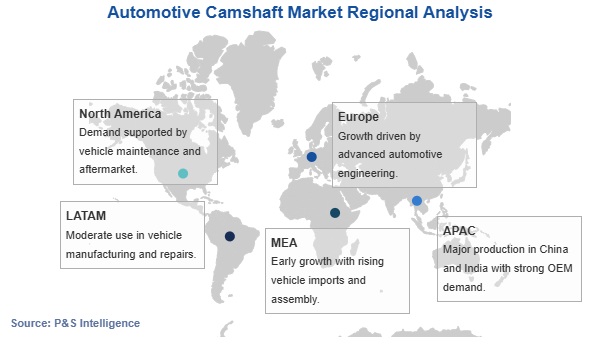
Asia-Pacific dominated the global automotive camshaft market in 2025 with a market share of 40%, driven by the region's position as the world's largest vehicle production hub. The region produced approximately 53.8 million vehicles in 2024, accounting for nearly 60% of global production, with China alone manufacturing over 31 million units. This massive production scale, combined with rapidly expanding domestic vehicle markets, creates unprecedented demand for automotive camshafts. The presence of both global automotive giants and emerging local manufacturers has established a robust supply chain ecosystem supporting continued market expansion.
The region benefits from competitive manufacturing costs, supportive government policies, and significant investments in automotive technology development. According to industry reports, India's vehicle production reached 28.4 million units (including two-wheelers) in fiscal year 2023-24, while emerging markets like Thailand and Indonesia are experiencing rapid automotive sector growth. The increasing adoption of advanced engine technologies, including turbocharging and variable valve timing systems, drives demand for sophisticated camshaft designs. Furthermore, the region's growing middle class, with rising disposable incomes and aspirations for personal mobility, ensures sustained growth in vehicle sales and corresponding camshaft demand throughout the forecast period.
Asia-Pacific Automotive Camshaft Market Share
China leads the regional market, accounting for approximately 60% of Asia-Pacific's camshaft demand, supported by its vast automotive manufacturing base and the world's largest domestic vehicle market. The country's push toward engine efficiency improvements, driven by stringent fuel economy standards and emission regulations, necessitates advanced camshaft technologies in both conventional and hybrid powertrains.
North America Automotive Camshaft Market Value
North America holds the second-largest market share, of 25%, in 2025, valued at USD 1,455.0 million, underpinned by its mature automotive industry and strong presence of leading camshaft manufacturers. The United States produced approximately 10.6 million vehicles in 2024, maintaining its position as a global automotive powerhouse despite increasing competition from Asian markets. The region's automotive sector benefits from advanced manufacturing capabilities, significant R&D investments, and a robust aftermarket ecosystem that drives both OEM and replacement camshaft demand.
The North American market is characterized by consumer preference for larger vehicles, including pickup trucks and SUVs, which typically feature more complex engine configurations requiring sophisticated camshaft systems. The persistence of V6 and V8 engines in these segments, despite overall downsizing trends, sustains demand for high-value camshaft products. Additionally, stringent emission regulations, including the EPA's new standards for 2027–2032 model years, compel manufacturers to adopt advanced camshaft technologies enabling improved combustion efficiency and reduced emissions. The region's strong performance tuning and customization culture further bolsters the aftermarket category, with enthusiasts seeking high-performance camshaft upgrades.
Europe Automotive Camshaft Market Forecast
Europe is projected to grow at a CAGR of approx. 5.5% during 2026–2032, driven by the region's aggressive pursuit of emission reduction and fuel efficiency improvements. The implementation of Euro 7 standards in 2024, mandating significant reductions in NOx and particulate emissions, forces automotive manufacturers to integrate advanced camshaft technologies supporting cleaner combustion. European automakers' leadership in engine downsizing and turbocharging technologies creates sustained demand for camshafts capable of operating under increased stress conditions while maintaining reliability.
Germany remains the regional leader, contributing approximately 35% of European camshaft demand, supported by its premium automotive brands and advanced engineering capabilities. The country's automotive industry, despite challenges from electrification trends, continues to invest heavily in internal combustion engine optimization, recognizing that ICE vehicles will remain relevant through the transition period. France and the United Kingdom follow, with their automotive sectors increasingly focusing on hybrid powertrains that require sophisticated camshaft systems for optimal performance.
The regions and countries analyzed in this report are:
North America
U.S. (Larger Country Market)
Canada (Faster-Growing Country Market)
Europe (Fastest-Growing Regional Market)
Germany (Largest Country Market)
U.K. (Fastest-Growing Country Market)
France
Italy
Spain
Rest of Europe
Asia-Pacific (Largest Regional Market)
Japan
China (Largest Country Market)
India (Fastest-Growing Country Market)
South Korea
Australia
Rest of APAC
Latin America
Brazil (Largest Country Market)
Mexico (Fastest-Growing Country Market)
Rest of LATAM
Middle East and Africa
Saudi Arabia (Largest Country Market)
South Africa
U.A.E. (Fastest-Growing Country Market)
Rest of MEA
Automotive Camshaft Market Share
The global automotive camshaft market exhibits a moderately consolidated structure. This market concentration reflects the high barriers to entry, including substantial capital requirements for manufacturing equipment, technical expertise in metallurgy and precision machining, and long-term relationships with automotive OEMs. The competitive landscape is characterized by a mix of large multinational corporations with diversified automotive component portfolios and specialized camshaft manufacturers focusing exclusively on valve train components.
Leading players maintain their market position through continuous innovation in materials and manufacturing processes, strategic partnerships with automotive OEMs, and global manufacturing footprints enabling cost-effective production and distribution.
Strategic collaborations between camshaft manufacturers and engine developers have become essential for market success. These partnerships facilitate early-stage integration of camshaft designs into new engine architectures, ensuring optimal performance and regulatory compliance. Companies that successfully balance innovation, quality, and cost-effectiveness while maintaining strong OEM relationships are best positioned to capture market share in this evolving landscape.
Key Automotive Camshaft Companies:
MAHLE GmbH
Schaeffler Group
Thyssenkrupp AG
Musashi Seimitsu Industry Co. Ltd.
American Axle & Manufacturing Inc.
Camshaft Machine Company
Piper Cams Ltd.
Kautex Textron GmbH & Co. KG
JD Norman Industries Inc.
Linamar Corporation
Jingjiang Jinxin Machinery Manufacturing Co. Ltd.
Seojin Cam Co. Ltd.
Xiamen Goldenbridge Imp. & Exp. Co. Ltd.
YASUNAGA Corporation
Estas Camshaft
Automotive Camshaft Market News
In February 2025, BorgWarner Inc. expanded its partnership with a major East Asian OEM by supplying variable cam timing (VCT) systems for the latest generation hybrid and gasoline engines.
In January 2025, Elgin Industries launched five new precision-matched performance camshaft kits designed to maximize racing and street-performance engines. The new models include CK-1838A, CK-1840A, CK-1841A, CK-1250A, and CK-1251A, targeting the growing performance aftermarket category.
In September 2024, BorgWarner Inc. completed the expansion of its Chennai facility in India to increase production and warehousing capacities. The redevelopment involved centralizing the assembly of variable camshaft timing systems and high-performance engine controls to serve the rapidly growing Asian market.
In July 2024, ThyssenKrupp AG secured a strategic 10-year contract to supply truck camshafts from its Chemnitz site, with production of 200,000 units annually beginning in summer 2025, including investments in expanded grinding and turning lines.
Want a report tailored exactly to your business need?
Leading companies across industries trust us to deliver data-driven insights and innovative solutions for their most critical decisions. From data-driven strategies to actionable insights, we empower the decision-makers who shape industries and define the future. From Fortune 500 companies to innovative startups, we are proud to partner with organisations that drive progress in their industries.
Client Testimonials
Working with P&S Intelligence and their team was an absolute pleasure – their awareness of timelines and commitment to value greatly contributed to our project's success. Eagerly anticipating future collaborations.
McKinsey & Company
India
Unmatched Standards
Our insights into the minutest levels of the markets, including the latest trends and competitive landscape, give you all the answers you need to take your business to new heights
Complete Data Security
We take a cautious approach to protecting your personal and confidential information. Trust is the strongest bond that connects us and our clients, and trust we build by complying with all international and domestic data protection and privacy laws