This Report Provides In-Depth Analysis of the Automotive 3PL Market Report Prepared by P&S Intelligence, Segmented by Type (Finished Vehicles, Auto Components), Service (Transportation, Warehousing & Distribution, Dedicated Contract Carriage, Domestic Transportation Management, International Transportation Management, Value-Added Logistics Services, Inventory Management), Transport Mode (Roadways, Railways, Waterways, Airways), End User (OEMs, Tier 1 & Tier 2 Suppliers, Aftermarket), and Geographical Outlook for the Period of 2019 to 2032
Explore the market potential with our data-driven report
Automotive 3PL Market Outlook
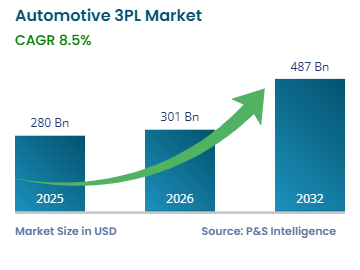
The global automotive 3PL market size is estimated at USD 280.0 billion for 2025, which is predicted to reach USD 487.0 billion by 2032, growing at a CAGR of 8.5% during 2026–2032.
The expansion of this market is primarily driven by the increasing complexity of automotive supply chains, growing vehicle production worldwide, and the rising demand for efficient logistics solutions that optimize cost and delivery performance. As automotive manufacturers increasingly focus on their core competencies in vehicle design and production, they are outsourcing logistics operations to specialized third-party providers who offer comprehensive transportation, warehousing, and value-added services.
The automotive industry's transformation toward electric vehicles and the growth of e-commerce in the automotive aftermarket sector are creating new opportunities for 3PL providers. According to the International Energy Agency (IEA), electric vehicle (EV) sales in the United States exceeded 1.6 million units in 2024, claiming more than 10% of the total light-duty vehicle market. This shift toward electrification requires specialized logistics capabilities for handling batteries, high-voltage components, and charging infrastructure equipment, driving demand for 3PL providers with expertise in these areas.
Automotive 3PL Market Growth Factors
Technological Advancement and Digitalization Are Key Trends
Players in the automotive 3PL market are rapidly integrating advanced technologies, such as AI, IoT, blockchain, and automation, to enhance efficiency, visibility, and transparency in logistics operations.
The global IoT in logistics market value is set to reach USD 100,984.5 million by 2030.
Autonomous mobile robots and smart warehousing systems are being deployed to automate picking, packing, and transportation within warehouses, thus reducing manual labor and increasing speed.
Real-time tracking through IoT sensors allows for enhanced monitoring of vehicle and component conditions, improving accuracy and reducing risks.
AI & machine learning are optimizing route planning, demand forecasting, and inventory management, leading to cost savings and operational flexibility.
Blockchain technology is used to secure and share data across supply chain partners, increasing trust and helping prevent fraud.
Digital platforms and automated processes streamline order processing, shipment tracking, and inventory replenishment.
The rise of digital twins and virtual simulation models helps identify operational inefficiencies and improve warehouse layouts.
Last-mile delivery is increasingly adopting drones, autonomous vehicles, and smart lockers to reduce costs and improve delivery times.
Emphasis on sustainability is driving the adoption of eco-friendly transportation modes and green warehousing practices.
Growing Complexity of Global Automotive Supply Chains Is Driving Market Expansion
The automotive industry now operates globally, meaning car parts are made and assembled in different countries.
This creates a complex web of suppliers and manufacturers that must work together efficiently.
Managing the movement of all these parts from suppliers to assembly plants to dealerships has become harder for automakers to handle on their own.
Many companies now hire third-party logistics (3PL) providers to manage transportation, storage, and delivery, as handling these complex operations internally has become increasingly difficult.
3PL companies specialize in optimizing routes, reducing costs, and ensuring that parts and vehicles arrive on time.
The rise of electric vehicles and customized car models has made supply chains even more complicated, as they require different materials and components.
3PL providers use advanced technologies like tracking systems, data analytics, and automation to manage these complex logistics networks effectively.
Global challenges such as changing trade policies, shipping delays, and varying regulations also make supply chains unpredictable, increasing the need for expert logistics partners.
Automotive 3PL Market Segmentation Analysis
Type Analysis
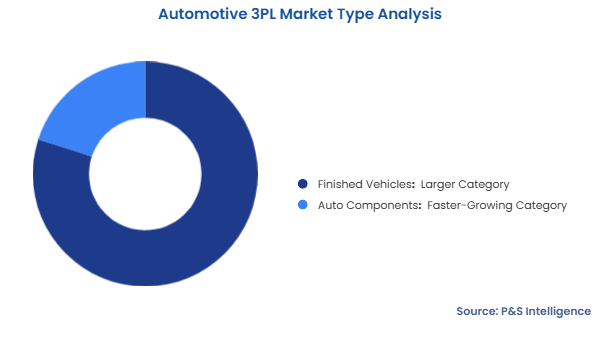
The finished vehicles segment holds the larger share in the automotive 3PL market in 2025, of approximately 80%, and it is expected to maintain its dominance throughout the forecast period. This is attributed to the complex logistics requirements for transporting completed vehicles from manufacturing plants to dealerships and end customers. Finished vehicle logistics involves specialized equipment such as car carriers, rail wagons, and roll-on/roll-off vessels, along with sophisticated tracking systems to ensure damage-free delivery. The growing trend of direct-to-consumer vehicle sales, particularly in the electric vehicle sector, is further driving demand for finished vehicle logistics services that can handle last- mile delivery to customers' homes. In FY2024–25, Maruti Suzuki India Limited transported 518,000 vehicles via Indian Railways, marking its highest record to date.
The auto components segment is projected to witness the higher CAGR, during 2026–2032. This rapid growth is driven by the increasing complexity of automotive components, particularly for electric vehicles that require specialized handling for batteries and high-voltage systems. Iin July 2025, BYD announced that it is investing BRL 5.5 billion in its Camaçari, Brazil, industrial complex, which is the company's largest facility outside of China. This move will establish a new 4.6-million-square-meter manufacturing and logistics hub with an initial annual capacity of 150,000 and final capacity of 300,000 electric and hybrid vehicles, to serve the Latin American market.
These types are covered:
Finished Vehicles (Larger Category)
Auto Components (Faster-Growing Category)
Service Analysis
The transportation segment dominates the automotive 3PL market in 2025 with a share of approximately 35%, reflecting its fundamental role in moving vehicles and components across the supply chain. This segment encompasses multimodal transportation solutions, including road, rail, ocean, and air freight, with providers offering integrated services that optimize cost and delivery time based on shipment requirements. The increasing focus on supply chain visibility and real-time tracking capabilities is driving investment in digital transportation management systems that provide end-to-end shipment visibility.
Value-added logistics services (VALS) are experiencing the fastest growth, during the forecast period. This growth is fueled by automotive manufacturers' increasing demand for services beyond basic transportation and storage, including kitting, sequencing, quality inspection, pre-assembly, and customization services. In January 2025, DHL Supply Chain purchased Inmar Supply Chain Solutions, integrating 14 return centers and 800 associates to create North America's largest returns platform, demonstrating the expansion of value-added services in the logistics sector.
The shift toward build-to-order manufacturing models and the need for postponement strategies to manage product variety are driving demand for 3PL providers who can perform final configuration and customization activities close to the point of consumption.
The roadways segment holds the dominant position in 2025 with an approximately 55% market share, driven by its flexibility, extensive network coverage, and suitability for last-mile delivery. Road transportation remains essential for automotive logistics due to its ability to provide door-to-door service and handle varying shipment sizes from single components to full truckloads of finished vehicles. The development of electric and autonomous trucking technologies is expected to further enhance the efficiency and sustainability of road transport in the automotive 3PL sector.
The airways segment is projected to register the highest CAGR, during the forecast period, driven by the automotive industry's increasing need for expedited shipping of high-value and time-critical components. The growth of emergency logistics services to prevent production line stoppages and the expansion of global automotive trade, particularly for premium and electric vehicles, are key factors driving air freight demand.
These transport modes are covered:
Roadways (Largest Category)
Railways
Waterways
Airways (Fastest-Growing Category)
End User Analysis
The OEMs segment has captured the largest market share, of approximately 65%, in 2025, as original equipment manufacturers represent the primary demand source for automotive 3PL services. OEMs require comprehensive logistics solutions covering inbound materials flow, inter-plant movements, and outbound distribution of finished vehicles. The trend toward platform sharing and global vehicle architectures is driving OEMs to seek 3PL partners capable of managing complex, multi-regional supply chains with standardized processes and consistent service quality across different markets.
The aftermarket segment is anticipated to grow at the highest CAGR, during the forecast period. This robust growth is attributed to the rapid expansion of e-commerce in the automotive aftermarket and the increasing vehicle parc requiring replacement parts and maintenance services. According to the European Automobile Manufacturers' Association (ACEA), global car sales reached 74.6 million units, marking a 2.5% increase compared to 2023, contributing to the growing vehicle population that drives aftermarket demand. The rising average age of vehicles globally, coupled with the trend toward DIY maintenance and online parts purchasing, is creating new logistics requirements for rapid, accurate delivery of aftermarket components directly to consumers and repair shops.
These end users are covered:
OEMs (Largest Category)
Tier 1 & Tier 2 Suppliers
Aftermarket (Fastest-Growing Category)
Drive strategic growth with comprehensive market analysis
Automotive 3PL Market Regional Outlook
Asia-Pacific Automotive 3PL Market Size
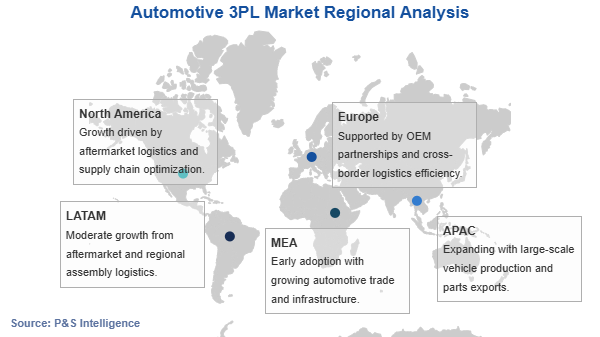
Asia-Pacific holds the largest share of the global automotive 3PL market in 2025, of around 40%, and is expected to maintain its leadership position through 2032. The region's dominance is primarily attributed to its position as the global automotive manufacturing hub, with China alone accounting for over 30% of global vehicle production. China produced over 31 million vehicles in 2024, which is more than the U.S. and Japan combined, creating massive demand for logistics services to manage both domestic distribution and exports. The rapid growth of electric vehicle manufacturing in China, supported by government policies and competitive pricing strategies, is driving demand for specialized 3PL services capable of handling battery logistics and new energy vehicle components.
North America Automotive 3PL Market Outlook
North America is projected to experience the fastest growth in the automotive 3PL market, with a CAGR of approx. 9.5% during 2026–2032. This growth is driven by the region's ongoing automotive industry transformation, including the shift toward electric vehicles, nearshoring initiatives, and the modernization of supply chains. The implementation of the United States-Mexico-Canada Agreement (USMCA) has intensified regional content requirements, driving automotive manufacturers to reconfigure their supply chains and rely more heavily on 3PL providers for cross-border logistics management. In May 2024, Rivian Automotive, Inc. secured an $827 million incentive package from the State of Illinois to expand its normal plant, boosting annual capacity from 150,000 to 215,000 units and supporting production of its upcoming R2 SUV.
The regions and countries analyzed in this report are:
North America (Fastest-Growing Regional Market)
U.S. (Larger Country Market)
Canada (Faster-Growing Country Market)
Europe
Germany (Largest Country Market)
U.K. (Fastest-Growing Country Market)
France
Italy
Spain
Rest of Europe
Asia-Pacific (Largest Regional Market)
Japan
China (Largest Country Market)
India (Fastest-Growing Country Market)
South Korea
Australia
Rest of APAC
Latin America
Brazil (Largest Country Market)
Mexico (Fastest-Growing Country Market)
Rest of LATAM
Middle East and Africa
Saudi Arabia (Largest Country Market)
South Africa
U.A.E. (Fastest-Growing Country Market)
Rest of MEA
Automotive 3PL Market Share
The automotive 3PL market is fragmented primarily due to the diverse, specialized, and geographically dispersed nature of automotive logistics. Numerous small and medium-sized regional logistics providers handle specific niches such as inbound component transport, finished-vehicle distribution, and aftermarket services. OEMs often require highly customized solutions, including just-in-sequence delivery, temperature-controlled handling, and EV battery logistics, which smaller specialized 3PLs are better positioned to provide than a few global players. Moreover, regulatory differences, infrastructure constraints, and varying road, rail, and port capacities across regions prevent large providers from dominating all segments.
While global 3PL giants exist, they typically serve major OEMs on specific routes or projects, leaving a substantial share of the market to smaller firms. High competition, low asset intensity in some logistics segments, and the continual entry of new niche players further contribute to market fragmentation, ensuring no single player has overwhelming control over the entire automotive 3PL ecosystem.
Key Automotive 3PL Companies:
Deutsche Post DHL Group
Kuehne + Nagel International AG
DB Schenker
DSV A/S
C.H. Robinson Worldwide, Inc.
XPO, Inc.
CEVA Logistics AG
Nippon Express Co., Ltd.
Kintetsu World Express, Inc.
Yusen Logistics Co., Ltd.
Geodis SA
Penske Logistics LLC
Ryder System, Inc.
Bollor
Rhenus Logistics GmbH & Co. KG
Automotive 3PL Market News
In November 2024, C.H. Robinson introduced Managed Solutions, blending TMS, 3PL, and 4PL services on a unified platform, to streamline 35 million annual shipments, marking a significant advancement in integrated logistics service delivery for the automotive sector.
In July 2024, CEVA Logistics announced the successful integration of Bolloré Logistics, following the February 2024 acquisition by its parent company, CMA CGM Group. This strategic integration enhances CEVA’s global ocean and air freight management capabilities and strengthens key trade corridors linking Europe, the Americas, and Asia, reinforcing the company’s position as a leading provider of automotive logistics and international supply chain solutions.
In August 2024, Korber Supply Chain Software acquired MercuryGate International, deepening its end-to-end execution stack across TMS and WMS functions, enhancing technology capabilities for automotive logistics management.
In March 2024, EFL 3PL, a subsidiary of EFL Global, launched a new warehousing facility in Bhiwandi, Mumbai, demonstrating the expansion of logistics infrastructure in emerging automotive markets.
Want a report tailored exactly to your business need?
Leading companies across industries trust us to deliver data-driven insights and innovative solutions for their most critical decisions. From data-driven strategies to actionable insights, we empower the decision-makers who shape industries and define the future. From Fortune 500 companies to innovative startups, we are proud to partner with organisations that drive progress in their industries.
Client Testimonials
Working with P&S Intelligence and their team was an absolute pleasure – their awareness of timelines and commitment to value greatly contributed to our project's success. Eagerly anticipating future collaborations.
McKinsey & Company
India
Unmatched Standards
Our insights into the minutest levels of the markets, including the latest trends and competitive landscape, give you all the answers you need to take your business to new heights
Complete Data Security
We take a cautious approach to protecting your personal and confidential information. Trust is the strongest bond that connects us and our clients, and trust we build by complying with all international and domestic data protection and privacy laws