This Report Provides In-Depth Analysis of the Automatic Weapon Market Report Prepared by P&S Intelligence, Segmented by Product (Automatic Rifles, Machine Guns, Automatic Launchers, Automatic Cannons, Gatling Guns), Platform (Land-Based Systems, Airborne Systems, Naval Systems, Handheld Systems, Stationary Systems), End-User (Military, Civilian, Law Enforcement), and Geographical Outlook for the Period of 2021 to 2032
Explore the market potential with our data-driven report
Automatic Weapon Market Analysis
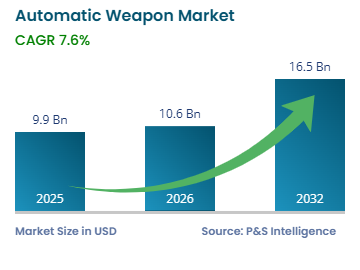
The automatic weapon market size was USD 9.9 billion for 2025, and it will grow by 7.6% during 2026-2032, to reach USD 16.5 billion by 2032.
The market is expanding because governments are placing greater emphasis on military modernization, force readiness, and national security preparedness in response to a more complex global security environment. Armed forces are increasingly replacing legacy firearms with advanced automatic weapon systems that provide improved accuracy, higher operational reliability, enhanced ergonomics, and compatibility with modern combat accessories. Demand is also increasing among special operations units and law enforcement agencies that require weapons capable of supporting diverse tactical missions, ranging from border protection and counterterrorism operations to urban security and rapid-response deployments. These evolving operational requirements are encouraging continuous investment in next-generation small arms across both developed and emerging defense markets.
The growth trajectory is further supported by sustained increases in defense budgets and long-term procurement programs focused on strengthening military capabilities. According to the Stockholm International Peace Research Institute, global military expenditure reached USD 2,718 billion in 2024. Higher defense allocations are enabling governments to accelerate weapon replacement cycles, expand infantry modernization initiatives, and strengthen domestic defense manufacturing capacities. The market impact extends beyond procurement volumes, as manufacturers are increasingly developing automatic weapons with modular configurations, improved recoil management systems, lightweight materials, and advanced sighting compatibility to meet changing battlefield requirements. Growing emphasis on operational effectiveness, soldier survivability, and mission adaptability is also creating demand for weapon platforms that can perform across multiple combat environments, supporting continued product development and broader adoption among military and security organizations worldwide.
Key Market Insights
Automatic rifles are the largest product, holding a market share of 35%, due to widespread standard-issue adoption across military and law enforcement forces globally.
Machine guns are the fastest-growing product, registering a CAGR of approximately 7.8%, driven by increasing demand for high-firepower support weapons in modern combat operations.
Land-based systems are the largest platform, holding a market share of 35%, due to extensive infantry deployment and sustained demand for ground combat readiness.
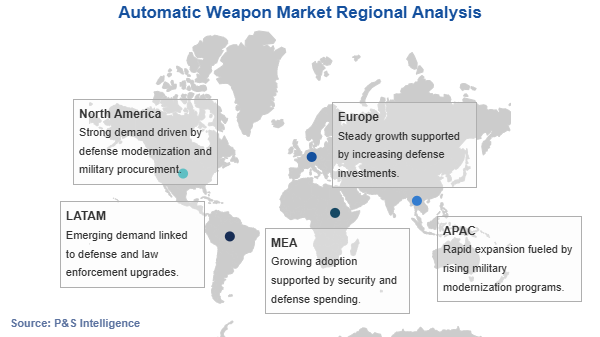
North America is the largest regional market, holding a share of 40%, due to strong defence funding, established procurement systems, and continuous military modernisation programs.
Asia-Pacific is the fastest-growing regional market, registering a CAGR of approximately 8.5%, driven by rising regional tensions, defence investments, and expansion of domestic manufacturing capabilities.
Automatic Weapon Market Trends and Drivers
Shift toward Smart and Modular Weapon Systems Is Major Trend
The shift toward smart and modular weapon systems is a major trend in the automatic weapon market as defense organizations increasingly prioritize flexibility, precision, and mission adaptability. Modern military operations require weapon platforms that can be quickly configured for different combat environments, creating strong demand for firearms with interchangeable components, advanced optics, digital targeting capabilities, and accessory integration.
This trend is being reinforced by the changing nature of conflicts and security operations. According to the United Nations Office of the High Commissioner for Human Rights, civilian deaths in conflict increased by 40% globally in 2024, highlighting the growing intensity and complexity of modern warfare. Additionally, according to United Nations Comtrade data, global exports of small arms and light weapons were valued at approximately USD 9.2 billion in 2024. These developments are encouraging armed forces to invest in upgrade-ready weapon systems that can support evolving operational requirements. The growing adoption of modular platforms is also influencing product development strategies, with manufacturers expanding customization options, improving system compatibility, and integrating advanced technologies to meet diverse military and security needs across multiple deployment scenarios.
Rising Defence Spending Due to Security Tensions Drives Market
Rising defense spending due to growing security tensions is a key driver of the automatic weapon market. Governments are allocating larger military budgets to strengthen combat readiness, improve force capabilities, and modernize infantry equipment as geopolitical risks continue to affect multiple regions. Border disputes, territorial disagreements, and evolving security threats are increasing the need for advanced firearms that can support rapid deployment and sustained operational effectiveness.
According to the United Nations, global military expenditure increased by more than 9% in 2024, reflecting a broad increase in defense investment across major and emerging military powers. Higher budget allocations are enabling armed forces to accelerate procurement programs, replace aging weapon inventories, and expand modernization initiatives focused on frontline personnel. This spending environment is creating sustained opportunities for automatic weapon manufacturers, while also encouraging investments in improved weapon performance, durability, and combat adaptability. Military organizations are increasingly seeking firearms that align with modern battlefield requirements, supporting continued procurement activity across training, operational, and strategic defense programs.
Strict Regulations and Export Controls Limiting Market Expansion
Strict regulations and export control frameworks remain a significant restraint on the automatic weapon market. Governments closely monitor the international movement of military equipment, requiring extensive licensing, compliance reviews, and end-user verification before transactions can proceed. These requirements increase administrative complexity and reduce flexibility for manufacturers participating in cross-border defense contracts.
According to the United Nations Arms Trade Treaty Secretariat, 116 States were Parties to the United Nations Arms Trade Treaty in 2024. The expanding adoption of common international arms transfer standards has increased scrutiny over export approvals and compliance procedures. This regulatory environment can extend procurement timelines, delay contract execution, and create uncertainty around delivery schedules. Manufacturers and suppliers must dedicate additional resources to legal compliance, documentation, and risk assessments, influencing market access strategies and limiting the speed at which new defense agreements move into active procurement stages.
Growing Demand from Emerging Economies and Local Manufacturing Programs
Growing demand from emerging economies and local manufacturing programs is creating substantial opportunities in the automatic weapon market. Many countries are strengthening domestic defense production capabilities to reduce import dependence, improve supply chain security, and support long-term military modernization objectives. This shift is encouraging technology partnerships, licensed production agreements, and joint ventures between local and international defense companies.
According to the United Nations Peacekeeping Operations, 121 countries contributed 59,887 uniformed personnel across 11 peacekeeping operations in 2024. The scale of these deployments highlights the ongoing requirement for reliable weapon systems across military, paramilitary, and specialized security forces. Expanding local production programs are supporting procurement flexibility while creating new demand channels beyond conventional armed forces. Manufacturers are increasingly aligning with national industrial policies, enabling broader market penetration and strengthening opportunities for long-term defense cooperation and capability development.
Automatic Weapon Market Segmentation Analysis
Product Analysis
Automatic rifles are the largest category, holding a market share of 35%, because they serve as the primary infantry weapon across military and law enforcement forces. Their balance of firepower, mobility, accuracy, and operational versatility makes them suitable for frontline combat, border security, and tactical response missions. According to the Small Arms Survey, sporting and hunting shotguns and rifles accounted for 21% of the value of reported global small arms imports during the 2019–2024 period. This consistent trade activity reflects sustained procurement of rifle platforms worldwide. Their widespread deployment also supports demand for compatible optics, accessories, and ammunition systems used across broader defense modernization programs.
Machine guns are the fastest-growing category, registering a CAGR of approximately 7.8%, because armed forces are increasing their focus on suppressive fire capabilities and force protection requirements. Unlike automatic rifles that primarily equip individual soldiers, machine guns provide sustained fire support for infantry units, armored vehicles, and specialized tactical teams. Defense organizations are also investing in mobile and mounted weapon systems to strengthen battlefield effectiveness across varied combat scenarios. Growing emphasis on high-intensity operations, perimeter security, and coordinated ground assaults is expanding adoption. This trend is encouraging manufacturers to develop lighter, more durable, and operationally flexible machine gun platforms for modern military requirements.
The products analysed in this report are:
Automatic Rifles (Largest Category)
Machine Guns (Fastest-Growing Category)
Automatic Launchers
Automatic Cannons
Gatling Guns
Others
Platform Analysis
Land-Based Systems are the largest category, because ground forces remain the foundation of most military operations worldwide. Automatic weapons are extensively deployed across infantry formations, border patrol units, and rapid-response forces responsible for maintaining territorial security. According to United Nations estimates, more than two billion people were living in conflict-affected areas worldwide in 2024. The scale of these security challenges continues to support investment in infantry readiness and weapon procurement. Demand for land-based systems also supports related purchases of automatic rifles, machine guns, and tactical equipment required for sustained ground operations.
Airborne Systems are the fastest-growing category, registering a CAGR of approximately 8.1%, because military forces are expanding the use of helicopters, drones, and fixed-wing aircraft for surveillance and combat missions. Automatic weapons mounted on aerial platforms provide rapid engagement capability while supporting mobility across challenging operational environments. Growing investments in airpower modernization are increasing demand for lightweight and highly reliable weapon systems compatible with advanced aircraft platforms. Furthermore, airborne operations often work alongside land-based forces, creating integrated combat requirements. This operational shift is encouraging broader adoption of automatic weapons designed specifically for aerial deployment and mission flexibility.
The platforms analysed in this report are:
Land-Based Systems (Largest Category)
Airborne Systems (Fastest-Growing Category)
Naval Systems
Handheld Systems
Stationary Systems
Others
End-User Analysis
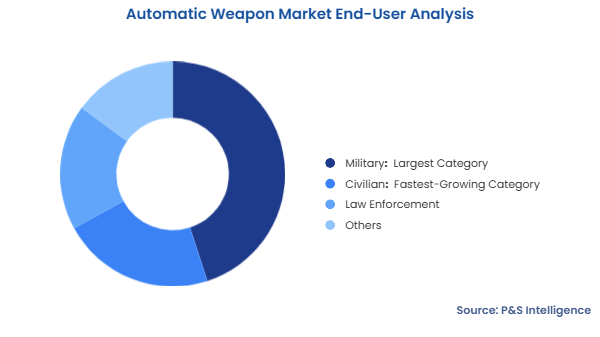
Military is the largest category, holding a market share of 45%, because armed forces represent the primary end users of automatic weapons across all major defense markets. Governments continue to invest in soldier modernization, combat readiness programs, and equipment replacement initiatives to maintain operational effectiveness. According to the United Nations, a USD 5.59 billion budget was approved for fourteen peacekeeping operations for 2024–2025. This level of military activity supports ongoing procurement of automatic rifles, machine guns, and platform-mounted weapon systems. Continued investment in force preparedness also strengthens demand for advanced firearms across training, deployment, and active operational environments.
Civilian is the fastest-growing category, because legal firearm ownership is increasing in several markets where regulations permit controlled access to automatic weapon variants and related firearms. Demand is supported by recreational shooting activities, licensed sporting applications, and personal security requirements among authorized users. Growth in this segment also complements broader firearm manufacturing activity, helping producers diversify beyond traditional military procurement channels. Additionally, expanding participation in shooting sports and firearms training programs is supporting equipment purchases and aftermarket demand. These factors are creating new commercial opportunities while strengthening the overall customer base for firearm manufacturers.
The end-users analysed in this report are:
Military (Largest Category)
Civilian (Fastest-Growing Category)
Law Enforcement
Others
Drive strategic growth with comprehensive market analysis
Automatic Weapon Market Geographical Analysis
North America Automatic Weapon Market Analysis
North America holds the largest share, of 40%, because the region maintains one of the world's most advanced defense procurement and military modernization frameworks. The United States continues to invest heavily in infantry weapon upgrades, soldier modernization programs, and next-generation combat systems, creating sustained demand for advanced automatic firearms. Strong defense budgets, long-term acquisition planning, and established supply chains support continuous procurement activity across military and security agencies. Additionally, the presence of major weapon manufacturers strengthens research, product development, and production capabilities. The region also benefits from extensive military training programs and operational deployments that require reliable and technologically advanced weapon systems. Demand remains supported by ongoing replacement of aging inventories and the integration of enhanced optics, targeting systems, and modular weapon platforms across multiple branches of the armed forces.
U.S. Automatic Weapon Market Analysis
The U.S. automatic weapon market expands as the country continues to invest in advanced military capabilities to maintain global defence leadership. The government consistently upgrades infantry weapons to address evolving combat requirements and enhance operational effectiveness. According to the Congressional Budget Office (CBO), the United States allocated approximately USD 886 billion for national defense in fiscal year 2024. This substantial funding supports continuous research, development, and procurement of modern weapon systems. Additionally, the U.S. armed forces maintained an authorised active-duty strength of 1.28 million personnel in 2024, according to the Congressional Research Service. This large force structure sustains steady, high-volume demand for automatic weapons.
Canada Automatic Weapon Market Analysis
The Canadian automatic weapon market grows as the country continues to modernise its defence forces to align with allied operational standards. Procurement strategies focus on high-performance and durable weapon systems suited for diverse environmental conditions. According to the Government of Canada, defence spending reached approximately USD 34.6 billion for the 2024–2025 fiscal year. This funding supports the acquisition of advanced military equipment and capabilities. Additionally, according to the Government of Canada, the Canadian Armed Forces maintained a trained regular force of 52,283 personnel in 2024. Consequently, this structured force base sustains steady and quality-focused procurement of modern automatic weapons.
Asia-Pacific Automatic Weapon Market Analysis
Asia-Pacific has the highest CAGR, of approximately 8.5%, due to accelerating defense modernization efforts across several countries. Rising geopolitical tensions, border security concerns, and military capability expansion programs are encouraging governments to strengthen procurement of advanced infantry weapons. Many countries are also increasing investments in domestic defense manufacturing to reduce dependence on imported equipment and improve long-term supply security. Additionally, large active military personnel bases and expanding paramilitary forces create significant procurement requirements across the region. Defense agencies are increasingly seeking modern weapon systems with improved accuracy, durability, and operational flexibility. Growing collaboration between local manufacturers and international defense companies is further supporting technology transfer and production capabilities. These developments continue to expand procurement opportunities across both established defense markets and rapidly developing economies.
China Automatic Weapon Market Analysis
The Chinese automatic weapon market is expanding due to a strong national focus on defence self-reliance and indigenous weapon development. The country prioritises domestic production to equip its large military and reduce dependence on foreign suppliers. China's official defense budget reached approximately 1.67 trillion yuan for fiscal year 2024, reflecting a 7.2% year-over-year increase. This sustained level of spending supports continuous research, development, and deployment of advanced automatic weapon systems. As a result, domestic manufacturers are strengthening capabilities to meet evolving military requirements.
India Automatic Weapon Market Analysis
The Indian automatic weapon market is growing due to a strong emphasis on domestic defence manufacturing and modernization of armed forces. The military is actively replacing outdated equipment and procuring reliable firearms to secure complex border regions. According to the Press Information Bureau (PIB), the defence budget was set at 6.21 lakh crore rupees for the 2024 fiscal year. This allocation supports increased participation from domestic manufacturers in defence production. As a result, local companies are expanding their role in supplying automatic weapons for military and paramilitary forces.
Europe Automatic Weapon Market Analysis
Europe demonstrates steady growth in the automatic weapon market due to increasing focus on regional security, force readiness, and defense capability enhancement. Many countries are upgrading infantry equipment and expanding military investment programs to address evolving security challenges and strengthen collective defense objectives. Furthermore, multinational defense cooperation initiatives and joint procurement programs support consistent demand for modern weapon systems across allied nations. The region has a well-established defense industrial base that enables ongoing product development and manufacturing activity. At the same time, regulatory oversight and export control requirements influence procurement strategies and supplier operations. Military organizations are also emphasizing equipment standardization to improve interoperability during joint exercises and multinational missions. This focus on operational coordination continues to support demand for advanced automatic weapons that can be deployed effectively across different defense environments.
The regions and countries analysed in this report are:
North America (Largest Regional Market)
U.S. (Larger Country)
Canada (Faster-Growing Country)
Europe
Germany (Largest Country)
U.K. (Fastest-Growing Country)
France
Italy
Spain
Rest of Europe
Asia-Pacific (Fastest-Growing Regional Market)
China (Largest Country)
India (Fastest-Growing Country)
Japan
South Korea
Australia
Rest of APAC
Latin America
Brazil (Largest Country)
Mexico (Fastest-Growing Country)
Rest of LATAM
Middle East and Africa
Saudi Arabia (Largest Country)
U.A.E. (Fastest-Growing Country)
South Africa
Rest of MEA
Automatic Weapon Market Competitive Landscape
The market is fragmented, with a large number of global and regional manufacturers competing across different product types and regions. No single company has full control, as procurement is often influenced by country-specific requirements, defence policies, and long-term contracts. Many governments also prefer working with local or domestic suppliers, which further spreads the market across multiple players. In addition, frequent upgrades, customisation needs, and varied operational uses create space for smaller and specialised companies. This wide distribution of demand and suppliers keeps the competitive landscape dispersed rather than concentrated.
Key Players Companies in the Automatic Weapon Market:
BAE Systems public limited company
General Dynamics Corporation
Northrop Grumman Corporation
Rheinmetall Aktiengesellschaft
Lockheed Martin Corporation
FN Browning Group
Colt CZ Group Societas Europaea
China North Industries Group Corporation Limited
Singapore Technologies Engineering Limited
Heckler and Koch Gesellschaft mit beschrankter Haftung
Kalashnikov Concern Joint Stock Company
Denel State Owned Company Limited
SK Group
Beretta Holding
SIG Sauer Incorporated
Automatic Weapon Market News
In February 2026, ST Engineering launched a modular squad rifle series to the export market. The defence producer engineered this firearm lineup to include carbine and light machine gun configurations. These weapons share a standardised receiver architecture.
In January 2026, SIG Sauer initiated commercial shipments of its belt-fed automatic rifle to international clients. The firm equipped this system with a specialised recoil reduction mechanism. It also features an integrated suppressor unit for sustained engagements.
In November 2025, TISAS commenced active manufacturing operations for a general-purpose machine gun platform in Turkey. The weapons producer established a dedicated production facility in the country to output these belt-fed systems; however, the exact factory location and development cost were not disclosed.
Frequently Asked Questions About This Report
What factors are driving growth in the automatic weapons market today?+
Growth is driven by defense modernization, rising security tensions, border conflicts, and increasing procurement of advanced infantry weapons for military and law enforcement use.
Which region holds the largest share in the automatic weapons market?+
North America holds the leading position due to high defense spending, advanced military procurement systems, established manufacturers, and continuous weapon modernization programs.
Which region is growing fastest in the automatic weapons market?+
Asia Pacific is growing fastest because countries are expanding defense budgets, strengthening border security, and investing in domestic weapon manufacturing capabilities.
Which product category leads the automatic weapons market globally?+
Automatic rifles lead the market because they are widely used as standard infantry weapons across military, law enforcement, and security operations.
Why are machine guns gaining demand across defense organizations?+
Machine guns are gaining demand because armed forces need sustained firepower, vehicle mounted systems, and stronger support weapons for modern combat missions.
Want a report tailored exactly to your business need?
Leading companies across industries trust us to deliver data-driven insights and innovative solutions for their most critical decisions. From data-driven strategies to actionable insights, we empower the decision-makers who shape industries and define the future. From Fortune 500 companies to innovative startups, we are proud to partner with organisations that drive progress in their industries.
Client Testimonials
Working with P&S Intelligence and their team was an absolute pleasure – their awareness of timelines and commitment to value greatly contributed to our project's success. Eagerly anticipating future collaborations.
McKinsey & Company
India
Unmatched Standards
Our insights into the minutest levels of the markets, including the latest trends and competitive landscape, give you all the answers you need to take your business to new heights
Complete Data Security
We take a cautious approach to protecting your personal and confidential information. Trust is the strongest bond that connects us and our clients, and trust we build by complying with all international and domestic data protection and privacy laws