Automatic Tire Inflation System Market Size & Opportunities Analysis - Growth Strategies, Competitiveness, and Forecasts (2026 - 2032)
This Report Provides In-Depth Analysis of the Automatic Tire Inflation System Market Report Prepared by P&S Intelligence, Segmented by Type (Central, Continuous), Component (Air Delivery System, Buffer Tank, Compressor, ECU, Housing, Pressure Sensor, Rotary Union), Vehicle Type (On-Highway, Off-Highway), and Geographical Outlook for the Period of 2019 to 2032
Automatic Tire Inflation System Market Revenue Scope
Key Highlights
Study Period
2019 - 2032
Market Size in 2025
USD 105.5 Million
Market Size in 2026
USD 115.7 Million
Market Size by 2032
USD 211.8 Million
Projected CAGR
10.5%
Largest Region
North America
Fastest Growing Region
Asia-Pacific
Market Structure
Fragmented
Market Size
Explore the market potential with our data-driven report
Automatic Tire Inflation System Market Outlook
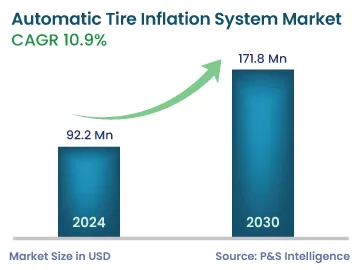
The automatic tire inflation system market size will be an estimated USD 105.5 million for 2025, and it will grow by 10.5% during 2026–2032, to reach USD 211.8 million by 2032.
The market expansion is primarily driven by stringent vehicle safety regulations, rising focus on fuel efficiency optimization, and increasing adoption of advanced fleet management systems across commercial transportation sectors. Growing awareness about tire underinflation's impact on vehicle performance has accelerated market penetration. According to the U.S. Department of Energy, underinflation by just 10 psi can reduce vehicle fuel efficiency by about 2%, making automatic tire inflation systems increasingly vital for operational efficiency.
The market's robust growth trajectory is reinforced by the expanding commercial vehicle fleets globally and rising implementation in off-highway applications. Agricultural machinery manufacturers are increasingly integrating automatic tire inflation systems to enhance field productivity and soil conservation, while the construction equipment segment adopts these systems for improved operational reliability in challenging terrains. Additionally, the convergence of telematics with tire inflation technology enables real-time monitoring and predictive maintenance capabilities, transforming traditional fleet management approaches and creating substantial value propositions for end-users seeking to minimize downtime and maximize asset utilization.
Automatic Tire Inflation System Market Trends & Drivers
Technological Advancements in Sensor Integration and Telematics Are Key Trends
The evolution of automatic tire inflation systems through advanced sensor technology and telematics integration represents a paradigm shift in tire management capabilities.
Modern systems incorporate sophisticated pressure sensors, electronic control units, and real-time data transmission capabilities that enable predictive maintenance strategies previously impossible with manual inspection methods.
These technological enhancements allow fleet managers to monitor tire conditions remotely, receive instant alerts about pressure deviations, and analyze historical data to optimize maintenance schedules.
Integration with vehicle telematics platforms has expanded the value proposition beyond simple inflation maintenance.
Fleet operators can now correlate tire pressure data with fuel consumption patterns, route optimization, and driver behavior analytics to achieve comprehensive operational improvements.
Technological advancements, such as intelligent tires and vehicle telematics, have further transformed the usage of these systems.
Intelligent tires can communicate with these systems and automatically adjust their pressure to the recommended levels, thus making vehicles more fuel-efficient and safer.
Contact area information sensing is a new innovation that measures the contact area between a tire and the road surface, which gives an idea of the air pressure inside.
The lower the pressure, the more the tire area in contact with the road surface.
Furthermore, autonomous systems and remote diagnostic systems are gaining popularity as they allow technicians to identify problems in vehicles remotely.
Remote diagnostics systems can be configured to analyze data from inflation systems to enhance road safety.
The advent of Internet of Things (IoT) connectivity enables cloud-based monitoring across entire fleets, facilitating centralized management and data-driven decision-making.
Artificial intelligence algorithms are being incorporated to predict tire wear patterns and recommend preventive actions, transforming reactive maintenance approaches into proactive asset management strategies.
This technological convergence has made automatic tire inflation systems integral components of modern fleet management ecosystems rather than standalone safety features.
Fuel Efficiency, Operational Cost Reduction, and Safety Concerns Are Biggest Drivers
The growing emphasis on vehicle safety and fuel efficiency has made automatic tire inflation systems essential for fleet operators, helping reduce costs, improve fuel economy, and ensure regulatory compliance.
These systems help in increasing vehicle performance and fuel economy, which ultimately leads to decreased downtime.
According to the U.S. Department of Energy, maintaining proper tire pressure can improve gas mileage by 0.6% on average—up to 3% in some cases.
On the other hand, underinflated tires lower gas mileage by about 0.2% for every 1-psi drop in average pressure.
This relationship between tire pressure and fuel consumption has become increasingly significant as transportation companies face mounting pressure to reduce operational costs and carbon emissions.
The 2024 Fleet Fuel Study by the North American Council for Freight Efficiency (NACFE) revealed that fleets improved fuel economy from MPG, which rose from 7.62 in 2022 to 7.77 in 2023, with tire management playing a crucial role.
Tires that have less air than recommended result in increased rolling resistance, thus leading to the consumption of more fuel.
In this regard, these systems can also reduce maintenance costs by slowing down tire wear and preventing damage.
Furthermore, the technology addresses multiple operational challenges simultaneously—from extending tire life by maintaining optimal pressure to reducing roadside breakdowns that cost valuable time and resources.
In addition, they eliminate the need for drivers to regularly check tire pressure and adjust it themselves, which saves time and effort.
Thus, ATIS are being integrated into trucks, trailers, and buses, for which proper tire condition is imperative as they travel long distances, carrying heavy loads.
This way these systems make roads safer and the transportation process more efficient, while optimizing fuel consumption and reducing emissions.
The integration of these systems has become particularly crucial for long-haul trucking operations, where maintaining consistent tire pressure across extended journeys directly impacts profitability margins and environmental compliance requirements.
Regulatory authorities worldwide are implementing stringent tire safety standards, recognizing that improper tire inflation contributes significantly to road accidents and vehicle breakdowns.
The European regulation ECE-R141.01 mandates that all newly registered semi-trailers weighing over 3.5 tonnes be equipped with tire pressure monitoring systems, with tire pressure replenishment systems recognized as a valid alternative.
The NACFE indicates that approximately one out of five tractors/trucks operates with one or more tires underinflated by at least 20 psi, while nearly 3.5% operate with four or more tires underinflated by this margin.
These alarming statistics have prompted regulatory interventions mandating advanced tire monitoring and inflation systems.
The implementation of the Federal Motor Vehicle Safety Standard in the United States has created mandatory requirements for tire pressure monitoring, indirectly boosting demand for automatic inflation capabilities.
Fleet operators face substantial penalties for non-compliance, making the investment in automatic tire inflation systems economically justified beyond operational benefits.
Additionally, insurance companies are increasingly offering premium reductions for vehicles equipped with advanced safety systems, including automatic tire inflation, creating additional financial incentives for adoption.
The technology's ability to maintain tire pressure within manufacturer-specified ranges continuously ensures compliance with safety inspections and reduces liability risks associated with tire-related incidents.
Automatic Tire Inflation System Market Segmentation Analysis
Type Analysis
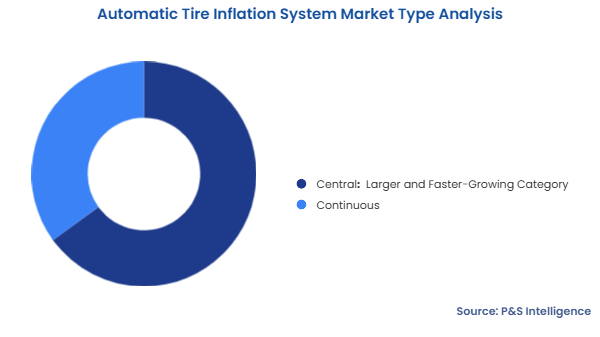
The central tire inflation system category holds the larger market share, of around 65%, in 2025, and it will have the higher CAGR, because these variants provide a number of advantages depending on the industry and vehicle type. For instance, they enable the adjustment of the tire pressure on the way, thus allowing vehicles to adapt to changing load conditions and terrain. This makes them highly beneficial for off-roading, military, and agricultural applications. By adjusting the air pressure as per terrain, traction improves, which results in greater vehicle stability and better performance.
Hence, the players in this domain are offering new products to cater to the changing customer preferences. With the growing popularity of off-roading, the demand for AWD/4WD vehicles, which can be used on all terrains, is increasing. This propels the demand for CTIS to adjust the tire pressure according to terrain, for an enhanced driving experience. Moreover, by using these systems, the life of both the tire and the vehicle lengthens, as the correct air pressure helps reduce premature tire wear and damage.
Additionally, these machines are being used by fleet operators to reduce maintenance costs and downtime. Hence, BFGoodrich launched a new tire inflation system, named ActivAir, in April 2023, which helps off-roaders change the tire pressure without exiting the vehicle. It gives drivers four options to choose from, based on the specific circumstances.
The types analyzed in this report are:
Central (Larger and Faster-Growing Category)
Continuous
Component Analysis
The ECU category holds the largest market share in 2025, and it will have the highest CAGR. This dominance is because the ECU is the brain of the entire system, continuously analyzing the tire pressure data from sensors and making precise adjustments, to maintain optimal levels. It controls the inflation and deflation processes by performing diagnostics and sending the communication to the driver. Furthermore, it can be easily integrated with other vehicle control systems, which aids in enhanced coordination between different vehicle functions.
Moreover, ECUs offer manufacturers flexibility in terms of programming and customization. This helps in tailoring the systems' functionality to suit specific vehicle types, industries, or operating conditions. These miniature computers are equipped with powerful processors able to handle real-time data processing, which enables rapid responses for adjusting tire pressure, particularly in dynamic situations and varying terrains.
The components analyzed in this report are:
Air Delivery System
Buffer Tank
Compressor
ECU (Largest and Fastest-Growing Category)
Housing
Pressure Sensor
Rotary Union
Vehicle Type Analysis
The on-highway category holds the larger market share, of about 65%, in 2025, driven by extensive adoption in commercial trucking and transportation fleets. The category's dominance reflects the compelling economic benefits automatic tire inflation systems deliver in long-distance transportation operations, where maintaining optimal tire pressure directly impacts fuel consumption and operational costs. Consistent tire pressure maintenance in heavy-duty highway trucks significantly reduces rolling resistance, enhancing fuel efficiency over long journeys. The integration of these systems has become standard practice among major fleet operators seeking to maximize asset utilization and comply with increasingly stringent emission regulations.
The off-highway category will have the higher CAGR, fueled by the expanding adoption in agricultural and construction equipment. Agricultural tractors equipped with automatic tire inflation systems achieve superior field performance through dynamic pressure adjustment based on soil conditions, reducing compaction and enhancing traction. Construction equipment operators similarly benefit from the ability to optimize tire pressure for varying terrain conditions, improving stability and reducing premature tire wear in challenging environments.
The vehicle types analyzed in this report are:
On-Highway (Larger Category)
Light-duty vehicles
Heavy-duty vehicles
Off-Highway (Faster-Growing Category)
Agricultural tractors
Construction equipment
Drive strategic growth with comprehensive market analysis
Automatic Tire Inflation System Market Regional Outlook
North America Automatic Tire Inflation System Market Size
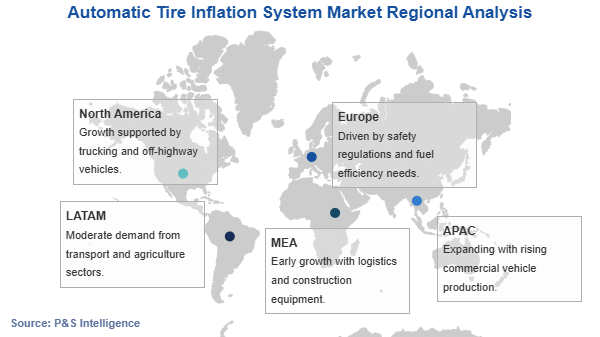
North America holds the largest market share in 2025, due to the presence of prominent market players, such as The Boler Company, Airgo Systems, Aperia Technologies, and Haltec Corporation. The system relies on the vehicle’s ECU to monitor tire pressure and alert drivers, and regulatory requirements have consequently boosted ATIS adoption in the region. Additionally, the awareness of technological advancements in and the benefits of these systems is rather high in the region owing to the collective efforts of industry associations and government agencies.
The continent's widespread network of logistics and transportation systems is also contributing significantly to the advance of the market. OEMs are offering heavy-duty trucks with pre-installed ATIS in order to lure customers with the promise of an enhanced vehicle performance. The region's agricultural sector significantly contributes to market growth, with large-scale farming operations increasingly adopting automatic tire inflation systems on high-horsepower tractors. Additionally, regulatory initiatives promoting vehicle safety and fuel efficiency continue to drive adoption rates, with fleet operators recognizing the dual benefits of regulatory compliance and operational cost reduction through system implementation.
U.S. Automatic Tire Inflation System Market Size
The U. S., which is the primary market within the region, benefits from one of the world's most extensive highway networks, creating substantial demand for technologies that enhance vehicle efficiency and safety. The emphasis on reducing transportation costs while meeting environmental regulations has made automatic tire inflation systems essential components of modern fleet management strategies.
Asia-Pacific Automatic Tire Inflation System Market Size
Asia-Pacific will have the highest CAGR, driven by rapid expansion in commercial vehicle production and increasing focus on transportation efficiency. The region's burgeoning logistics sector, fueled by e-commerce growth and manufacturing expansion, creates substantial demand for technologies that optimize fleet operations. China leads regional growth, with domestic manufacturers increasingly incorporating automatic tire inflation systems to meet rising safety standards and operational efficiency demands.
India's growing commercial vehicle sector and expanding agricultural mechanization present significant growth opportunities. The region's diverse terrain conditions and varying infrastructure quality make automatic tire inflation systems particularly valuable for maintaining optimal vehicle performance across different operating environments.
Europe Automatic Tire Inflation System Market Size
Europe maintains a strong market position, driven by advanced agricultural mechanization and stringent environmental regulations. The region's emphasis on sustainable farming practices has accelerated the adoption of automatic tire inflation systems in agricultural equipment, where soil conservation and operational efficiency are paramount concerns. European farmers increasingly recognize that proper tire pressure management reduces soil compaction while improving fuel efficiency, aligning with environmental stewardship objectives and regulatory requirements. Further, there has been an increase in the demand for safety features in vehicles. Some European countries have even mandated the use of ATIS in certain types of vehicles.
Moreover, there has been a growing popularity of off-road and all-terrain vehicles, which extensively use inflation systems. This is because of the continuously changing driving conditions. Further, these systems are becoming more sophisticated and affordable and, therefore, more attractive for a wide range of applications.
Germany Automatic Tire Inflation System Market Size
Germany leads the European market, benefiting from its robust automotive manufacturing sector and technological innovation capabilities. The country's focus on precision engineering extends to automatic tire inflation system development, with domestic manufacturers advancing system capabilities through integration with digital farming technologies. Additionally, European Union regulations promoting vehicle safety and emission reduction create favorable conditions for market expansion, as fleet operators seek technologies that simultaneously address multiple regulatory requirements, while delivering operational benefits.
The geographical breakdown of the market is as follows:
North America (Largest Regional Market)
U.S. (Larger Country)
Canada (Faster-Growing Country)
Europe
Germany (Largest Country)
U.K.
France (Fastest-Growing Country)
Italy
Russia
Rest of Europe
Asia-Pacific (Fastest-Growing Regional Market)
China (Largest Country)
India (Fastest-Growing Country)
Japan
South Korea
Australia
Rest of APAC
Latin America
Brazil (Largest Country)
Mexico (Fastest-Growing Country)
Rest of LATAM
Middle East and Africa
Saudi Arabia (Largest Country)
South Africa (Fastest-Growing Country)
U.A.E.
Rest of MEA
Automatic Tire Inflation System Market Share Analysis
The market is fragmented due to the presence of several established global players, such as Continental AG, Bridgestone, Pressure Systems International, and Aperia Technologies, alongside numerous smaller regional and niche companies. This competitive landscape is reinforced by diverse customer requirements across commercial trucks, buses, off-highway vehicles, and agricultural tractors, which necessitate customized solutions. Technological variations in system designs, sensors, power sources, and integration capabilities further contribute to the fragmentation, as no single standard dominates the market. Additionally, regional differences in adoption rates and regulations create opportunities for local players, while the growing demand and relatively low entry barriers enable new companies to enter the market.
Key Tire Inflation Systems Automatic:
Dana Incorporated
Airgo Systems LLC
Aperia Technologies Inc.
Haltec Corporation
Continental AG
Meritor Inc.
Bridgestone Corporation
Hendrickson USA L.L.C.
Goodyear Tire & Rubber Company
SAF-HOLLAND SE
IDEX Corporation
Bendix Commercial Vehicle Systems LLC
Automatic Tire Inflation System Market News
In May 2023, Compagnie Générale des Établissements Michelin SCA unveiled a new generation of ATIS featuring enhanced connectivity and predictive maintenance capabilities. This development aims to provide fleet operators with more advanced tools for tire management and maintenance.
In January 2023, Aperia Technologies Inc. expanded its ATIS deployments in the North American trucking industry. This expansion reflects the increasing adoption of ATIS solutions to improve vehicle safety and operational efficiency across commercial fleets.
Want a report tailored exactly to your business need?
Leading companies across industries trust us to deliver data-driven insights and innovative solutions for their most critical decisions. From data-driven strategies to actionable insights, we empower the decision-makers who shape industries and define the future. From Fortune 500 companies to innovative startups, we are proud to partner with organisations that drive progress in their industries.
Client Testimonials
Working with P&S Intelligence and their team was an absolute pleasure – their awareness of timelines and commitment to value greatly contributed to our project's success. Eagerly anticipating future collaborations.
McKinsey & Company
India
Unmatched Standards
Our insights into the minutest levels of the markets, including the latest trends and competitive landscape, give you all the answers you need to take your business to new heights
Complete Data Security
We take a cautious approach to protecting your personal and confidential information. Trust is the strongest bond that connects us and our clients, and trust we build by complying with all international and domestic data protection and privacy laws