This Report Provides In-Depth Analysis of the Automated Optical Inspection Market Report Prepared by P&S Intelligence, Segmented by Product Type (3D AOI Systems, 2D AOI Systems), Technology (Inline AOI Systems, Offline AOI Systems), End-user Industry (IT & Telecommunications, Automotive Electronics, Consumer Electronics, Industrial & Medical Devices, Aerospace & Defense), and Geographical Outlook for the Period of 2022 to 2033
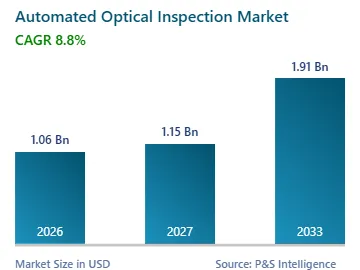
The global automated optical inspection (AOI) market size is estimated at USD 1.06 billion in 2026 and is projected to reach USD 1.15 billion in 2027. Revenue is projected to climb to USD 1.91 billion by 2033, a CAGR of 8.8% during 2027-2033. Contract assemblers, OEM board plants, and chip packaging houses are adding inspection after each critical process step, because denser boards and stacked chip packages leave fewer chances to catch a defect before final test. That spending favors vendors whose machines measure solder joints in three dimensions and clear false alarms without an operator re-checking every flag.
AI accelerator and memory makers, along with the assemblers that mount their chips on server boards, account for the biggest block of new inspection orders. Figures from the World Semiconductor Trade Statistics organization put global chip sales at USD 702 billion in the first half of 2026, more than double the level a year earlier. Those figures measure device sales, not inspection budgets, but each extra memory stack and accelerator board typically passes through packaging and board-assembly lines where optical checks are routine. Automated optical inspection market growth is therefore closely tied to how quickly these producers add lines.
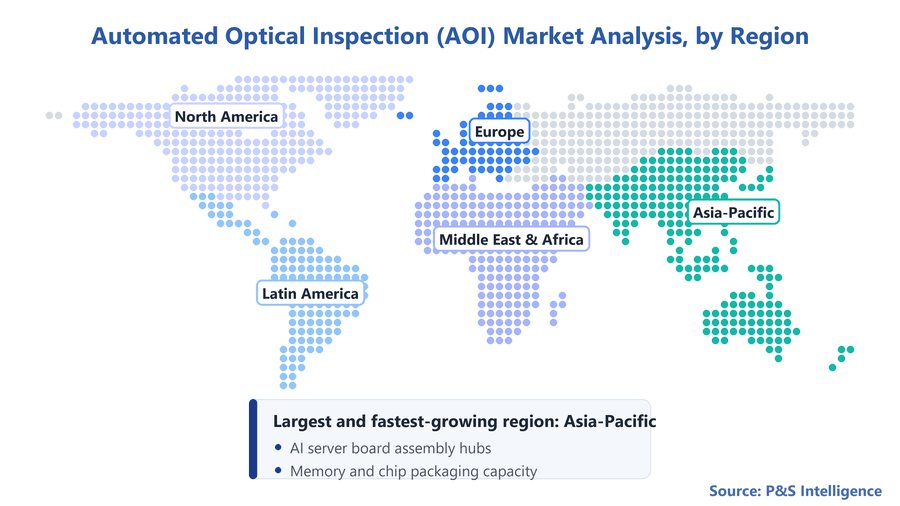
Asia-Pacific accounts for 48.5% of 2026 revenue and is also projected to grow fastest, at a 9.4% CAGR during 2027-2033. Chipmakers and contract assemblers in China, Taiwan, South Korea, and Japan equip new server, memory, and smartphone lines as they are built, while India adds younger plants buying their first inspection systems. North America and Europe spend more on upgrading and replacing machines in automotive, aerospace, and medical electronics plants, so their purchases depend on refresh cycles and quality requirements more than on new floor space.
Key market insights
By product type, 3D AOI Systems account for 62.0% of 2026 revenue and also lead growth on this axis, with a 10.1% CAGR projected for 2027-2033.
By technology, inline AOI Systems hold a 65.0% share in 2026, and their revenue is set to expand at a 9.3% CAGR over 2027-2033, ahead of offline units.
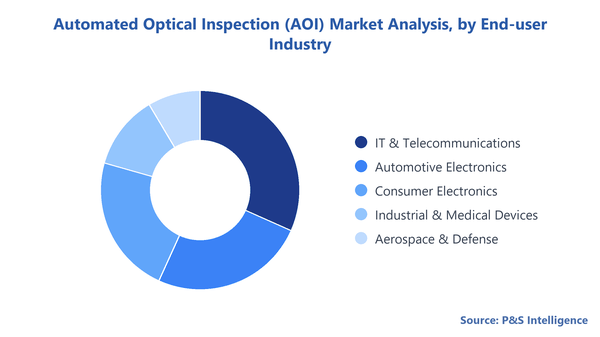
By end-user industry, IT & telecommunications contributes 31.5% of 2026 revenue, while automotive electronics posts the highest projected CAGR, 9.8% for 2027-2033.
By geography, Asia-Pacific generates 48.5% of 2026 revenue and is expected to advance at a 9.4% CAGR during 2027-2033, ahead of every other region.
AI-assisted defect review is reshaping how inspection lines are staffed
False calls, where a good board is flagged as defective, tie up review operators on high-volume SMT lines, and buyers now weigh how many flags a system can clear on its own when they compare bids. AI classification modules re-check each flagged image before a person sees it, which can cut review hours per shift and shorten programming when a new board is introduced. Part of each purchase is moving from optics to software as a result, since review modules, machine-to-machine data links, and later upgrades are often priced with the hardware.
Saki Corporation's 3Di-EX AOI series, which began shipping in April 2025, includes an AI Assist function that re-evaluates results with hybrid AI to reduce false positives, and the same launch added a link that shares data between paste inspection and optical inspection machines in real time. Selling on operator workload as well as image quality has become a common pitch among AOI vendors. For a plant manager, the total cost of an inspection station can depend as much on review labor saved as on the price of the machine.
AI data center hardware is accelerating inspection orders at packaging and board lines
AI accelerators built with stacked high-bandwidth memory (HBM) and multi-die chiplets can add inspection steps at bumping, die attach, and stacking, because one defective layer can scrap an expensive finished package. The servers that carry these chips also use large, densely populated boards that EMS providers inspect inline after reflow. Data center spending therefore turns into inspection demand twice, first at the packaging house and again at the board assembler, which widens the buyer base for vendors that serve both stages.
Camtek, which sells inspection and metrology systems to advanced packaging lines, booked about USD 600 million in orders between January and its August 10, 2026 results release, with deliveries scheduled through 2026 and into 2027. In that release, the company's chief executive pointed to AI as the force behind unprecedented data center demand, and Camtek named HBM and chiplet devices as future demand sources. An order book of that size gives Camtek delivery visibility into 2027. Board-level AOI vendors gain only as server assemblers add SMT lines, so their order timing can trail the chip side.
Electrified vehicle electronics are opening a zero-defect inspection pathway
Automotive electronics suppliers building inverter, battery-management, and driver-assistance boards work to zero-defect targets, because a solder fault that reaches a vehicle becomes a warranty or safety problem. Those targets push plants toward inspecting every critical board instead of sampling, which raises the number of AOI stations per line and favors 3D systems that measure joint height and component lift. Each new electrified platform adds board programs of this kind to tier-one supplier plants, and those programs tend to run for several model years once approved.
The International Energy Agency estimates that electric car sales topped 20 million in 2025, a quarter of all new cars sold worldwide. That figure sizes the vehicle platform base and does not measure AOI adoption, yet each of those vehicles needs power and control electronics assembled somewhere. Suppliers with automotive customer approvals and traceability software could turn that base into repeat line orders as carmakers launch new electrified models through 2033, since an approved inspection setup is often reused when the same customer adds a line.
Uneven factory investment outside AI hardware is constraining order timing
AOI is a capital purchase, so orders from automotive, industrial, and general EMS plants rise and fall with how much new line capacity those customers need. When carmakers slow electrification programs or contract assemblers carry spare capacity, buyers keep older machines running and push back upgrades. Vendors with little exposure to AI hardware feel those pauses first, which leaves the market with two customer groups moving on different investment cycles at the same time.
Viscom, a German inspection-system maker, said in its 2025 annual results that weak demand from the European and North American automotive industries hurt its business, with revenue down 2.8% even as incoming orders rose 7.9%. Suppliers have responded with upgradeable platforms and software features that let a buyer extend an installed machine instead of replacing it, which keeps some revenue coming in during slow years. Even so, board-inspection vendors tied to car and industrial plants are likely to see lumpier order books than packaging-focused peers.
Segmentation Outlook
Product Type
3D AOI Systems account for 62.0% of automated optical inspection market revenue in 2026, because buyers assembling fine-pitch boards and advanced packages need height, volume, and coplanarity readings that a flat image can only infer. As per the Taiwan Printed Circuit Association (TPCA), Taiwan's PCB output rose 19.6% year on year in the first quarter of 2026, with IC substrates, high-layer-count boards, and HDI growing on AI server demand. Bare-board output is not an inspection count, but these dense boards are where new assembly lines commonly specify 3D from the start, which keeps replacement demand for 2D units modest.
3D AOI Systems are also projected to post the fastest growth on this axis, at a 10.1% CAGR during 2027-2033, as plants retire 2D machines that over-flag reflective parts and as packaging lines add points where bump and die height must be measured. SEMI projects assembly and packaging equipment sales to rise 9.6% to USD 6.7 billion in 2026, citing heterogeneous packaging and stricter reliability requirements for AI and HBM devices. 2D AOI Systems keep a base in cost-sensitive lines with larger parts, while upgradeable 3D heads give vendors with modular platforms steady upgrade orders.
Technology
Inline AOI systems account for 65.0% of revenue in 2026, since high-volume SMT lines place inspection after printing, placement, or reflow so every board is checked without leaving the conveyor. Inline machines can also send defect data back to the printer and placer, letting engineers correct a drifting process before scrap builds up. IPC released Version 2.0 of its Connected Factory Exchange standard, IPC-2591, in April 2025, presenting it as the global standard for plug-and-play machine-to-machine and machine-to-system communication. The standard does not require AOI, but it lowers integration effort on mixed-vendor lines.
Inline AOI Systems are also expected to grow faster than offline units, at a 9.3% CAGR during 2027-2033, because new server, automotive, and smartphone lines are designed with inspection built in from day one. The International Federation of Robotics (IFR) counted 142,235 robot installations in the electrical and electronics industry in 2025, up 10%, the most of any customer industry. Robot counts are not inspection purchases, but more automated lines leave fewer operators to catch defects by eye. Offline AOI Systems remain the practical choice for high-mix aerospace and medical work, where one station serves several lines.
End-User Industry
IT & telecommunications holds the largest share among end-user industries, at 31.5% in 2026. AI server backplanes, 5G base station boards, and high-density interconnect PCBs pair high layer counts with very small parts, and a defect found after system integration costs far more to fix than one caught on the line. Taiwan's Ministry of Finance recorded an 89.5% rise in 2025 exports of information, communication, and audio-video products, to USD 251.15 billion, and tied the jump to AI and data center demand. Those exports measure finished equipment, not inspection spending, but they show where board-assembly volume grew.
Automotive electronics is projected to grow fastest among end-user industries, at a 9.8% CAGR during 2027-2033, as EV power electronics and ADAS sensor modules add safety-critical boards to each vehicle. According to the European Commission, all new cars and vans sold in the EU since July 7, 2024 must carry lane keeping and automated braking systems. The rule sets vehicle-level safety functions and does not require AOI, but each function depends on electronics that tier-one suppliers build to zero-defect targets. Inspection vendors already approved by those suppliers are better positioned for the resulting line orders.
Consumer electronics, industrial & medical devices, and aerospace & defense make up the rest of demand, each with its own buying pattern. Smartphone and wearable makers buy for cycle time on miniaturized mainboards and tend to refresh systems with product generations. Industrial controller and medical diagnostic plants buy for traceability, since audit records matter to them as much as defect capture. Aerospace and defense buyers run small batches of ruggedized avionics and radar boards, so they lean toward offline systems and long service support.
The following segments are analyzed in this report:
Product Type
3D AOI Systems
2D AOI Systems
Technology
Inline AOI Systems
Offline AOI Systems
End-user Industry
IT & Telecommunications
Automotive Electronics
Consumer Electronics
Industrial & Medical Devices
Aerospace & Defense
Copyright P&S Intelligence. Reuse requires attribution under CC BY 4.0.
Regional Analysis
Asia-Pacific automated optical inspection market outlook
Asia-Pacific accounts for 48.5% of global revenue in 2026, because China, Taiwan, South Korea, and Japan host a large share of the world's board assembly, memory production, and chip packaging capacity. Contract manufacturers there build new lines for servers, smartphones, and vehicle electronics on short cycles, and each line is fitted with paste and optical inspection as it is commissioned. Several AOI makers are based in the region, which shortens service response times for these buyers. China is the region's largest market, a position that follows from the size of its contract-manufacturing and consumer electronics base.
South Korea's trade ministry data show semiconductor exports rising 22.2% in 2025 to a record USD 173.4 billion, lifted by AI-related chip demand. That export value measures chip shipments and prices, not inspection purchases, yet it points to the memory and packaging output that Korean producers inspect. The region's lead in automated optical inspection market revenue looks likely to widen through 2033, since much of the new AI server, HBM, and EV electronics capacity is being added there, and vendors with local service teams and relationships with Taiwanese and Korean assemblers are better positioned for repeat orders.
Asia-Pacific is also projected to expand fastest of all regions, at a 9.4% CAGR during 2027-2033, and India is likely to be its quickest-growing country market as newly built electronics plants buy their first inspection systems. India's Ministry of Electronics and Information Technology told Parliament in July 2026 that domestic electronics production in 2025-26 was about seven times its 2014-15 level. Trade restrictions on advanced chips could shift more packaging and assembly toward Southeast Asia and India, which would move where new lines are equipped without reducing the region's overall share.
Copyright P&S Intelligence. Reuse requires attribution under CC BY 4.0.
North America market analysis
North America trails Asia-Pacific in volume but buys a richer mix of systems, with aerospace and defense, medical device, and automotive electronics plants paying for traceability, high-mix programming, and full 3D coverage. Much of the spending replaces or upgrades installed machines instead of equipping new floor space. Some server and computer assembly for the U.S. market takes place in Mexico, so part of the board volume that U.S. demand generates is inspected south of the border.
Per the Federal Reserve's industrial production release, U.S. output of semiconductors and related electronic components rose 12.4% between August 2025 and August 2026. That index measures domestic chip and component production, not inspection spending, but higher output at U.S. fabs and packaging sites can bring follow-on orders for inspection on new and expanded lines. Suppliers with U.S. service coverage and experience with defense-grade documentation are better placed for these orders, since buyers in those programs weigh support and audit records heavily.
Europe market analysis
Europe's demand comes mainly from automotive suppliers, industrial controls makers, and defense electronics plants in Germany, the U.K., and the Netherlands, where buyers pay for documented inspection and long equipment service lives. With carmakers slowing some electrification programs, purchases in the region lean toward software upgrades, added 3D capability, and replacement of older 2D machines. Several European AOI makers sell mainly to these local plants, which keeps competition for upgrade contracts close to the customer.
ZVEI, the German electrical and digital industry association, counted a 5% rise in the sector's incoming orders in 2025 and 78% capacity utilization at the start of 2026, and it expects real production to grow 2% in 2026 after three weak years. Spare capacity of that kind usually delays new lines, so European demand depends more on product changes and stricter quality specifications than on volume growth. Vendors with installed bases in German automotive plants could gain from upgrade cycles because they already hold the line programs.
Latin America market analysis
Latin America's demand centers on Mexico, where contract manufacturers assemble computers, servers, and vehicle electronics for the U.S. market, and on Brazil's domestic electronics industry. Mexican plants buy inline AOI as they add export lines, often specifying the same systems as their U.S. or Asian sister sites so inspection programs can be shared across locations. That practice gives vendors already installed at a customer's other sites a head start when a Mexican line is added.
Brazil's purchases are more cyclical. Abinee's compilation of IBGE data puts the decline in output from Brazil's electronics industry at 4.8% for January-August 2026, compared with the same months of 2025, which limits line additions there. Brazilian buyers are therefore likely to focus on replacements and small upgrades until output recovers. Mexico is set to account for most new orders in the region, helped by export assembly for North American customers, while Brazil's demand depends on a turn in domestic electronics production.
Middle East & Africa market analysis
The Middle East & Africa holds the smallest position among regions, because electronics assembly there is limited to a few clusters in Saudi Arabia, the U.A.E., and South Africa serving defense, telecom, energy, and automotive customers. According to the Research, Development and Innovation Authority (RDIA), Saudi Arabia's National Semiconductor Hub works to attract chip design companies to set up design centers in the Kingdom. Design centers do not buy board or package inspection equipment, so the program adds little near-term AOI demand until assembly or packaging lines follow.
Purchases in the region tend to be offline or benchtop systems for low-volume, high-mix work, often bought through distributors instead of directly from manufacturers. Buyers in defense and energy electronics value long service support and local spare parts over throughput, which favors vendors with established distributor networks. Growth depends on whether localization programs move more board assembly into the region, a shift that would bring the first inline lines to local plants.
The following geographies are analysed in this report.
The automated optical inspection market is moderately fragmented, with more than a dozen specialist vendors and no single supplier covering every application. The split follows the type of line being inspected. SMT board inspection rewards large component libraries, fast programming, and local service, while semiconductor packaging inspection rewards optical resolution and qualification at chipmakers, which takes years to earn. Switching vendors inside a factory means rebuilding inspection programs and defect libraries and retraining operators, which slows switching and keeps the structure fairly stable.
Board-inspection suppliers such as Koh Young Technology Inc., Omron Corporation, Viscom SE, Test Research Inc. (TRI), Saki Corporation, Mirtec Co. Ltd., and ViTrox Corporation Berhad compete on 3D measurement accuracy, AI-assisted review, and integration with paste inspection and factory software. Camtek Ltd. and KLA Corporation serve wafer-level and advanced packaging steps, where tool qualification at memory and logic makers narrows the field. Nordson Corporation spans both layers through its inspection and metrology platforms. Smaller specialists compete on specific regions, line types, or price points.
Entry barriers differ by layer. A new board-inspection vendor can win business with a credible 3D sensor and local service, especially in high-mix plants, but packaging inspection requires multi-year qualification with a small set of chipmakers and outsourced assembly and test providers. Buyers usually have more vendor choice on standard SMT lines, where several qualified suppliers bid, and less in HBM and chiplet packaging, where switching tools means requalifying a process. Packaging tool choices tend to be made early in a device program and kept for years, so a vendor that misses that window waits for the next one.
Major Companies in Automated Optical Inspection Market:
In August 2026, Koh Young Technology Inc. announced construction of a second production center at its Yeoju complex in Gyeonggi Province, South Korea, covering about 12,800 square meters and intended to double its total production capacity, with completion targeted for August 2027. The added capacity could ease delivery lead times for AI server and advanced semiconductor customers.
In July 2026, Mirtec Co. Ltd. opened a sales and demonstration center in Carrollton, Texas, equipped with six systems including the ART AOI for automotive solder joints, the MV-3 OMNI benchtop 3D AOI, and the MS-11 3D solder paste inspection system. Local demonstrations and application reviews let North American assemblers test inspection setups before committing to a purchase.
In December 2025, Nordson Corporation released the SQ5000Pro, an in-line platform combining AOI, solder paste inspection, and CMM-grade metrology, fitted with two new 500-series Multi-Reflection Suppression sensors for fine-pitch SMT, advanced packaging, and 0201 metric components. Merging three inspection steps in one machine can save line space for buyers moving into advanced packaging.
In November 2025, Marantz Electronics Co. Ltd. (Mek) presented its ISO-Spector X1, a 3D bottom-up AOI system that measures through-hole solder joint volume and pin height, at productronica 2025 in Munich, held November 18 to 21. The system brings 3D measurement to joints formed by wave and selective soldering, widely used on automotive and industrial boards.
In November 2025, ViTrox Corporation Berhad introduced the V510Ai DST Smart 3D AOI, one of four new products it listed for productronica 2025, a dual-sided SMT and THT inspection system with true 3D measurement and AI-assisted defect verification. Covering both sides of an assembly in one system with less operator involvement suits high-mix lines that change programs often.
Last Updated: October 2026
Frequently Asked Questions About This Report
What is the size of the automated optical inspection market?+
The global automated optical inspection (AOI) market size is estimated at USD 1.06 billion in 2026 and is projected to reach USD 1.15 billion in 2027.
What is driving demand for automated optical inspection systems?+
Contract assemblers, OEM board plants, and chip packaging houses are adding inspection after each critical process step, because denser boards and stacked chip packages leave fewer chances to catch a defect before final test.
Which region leads the automated optical inspection market?+
Asia-Pacific accounts for 48.5% of 2026 revenue and is also projected to grow fastest, at a 9.4% CAGR during 2027-2033.
Why do 3D AOI systems lead the automated optical inspection market?+
3D AOI Systems account for 62.0% of automated optical inspection market revenue in 2026, because buyers assembling fine-pitch boards and advanced packages need height, volume, and coplanarity readings that a flat image can only infer.
Is inline or offline AOI more widely used?+
Inline AOI Systems account for 65.0% of revenue in 2026, since high-volume SMT lines place inspection after printing, placement, or reflow so every board is checked without leaving the conveyor.
How does AI reduce false calls in automated optical inspection?+
AI classification modules re-check each flagged image before a person sees it, which can cut review hours per shift and shorten programming when a new board is introduced.
Which end-use industry is growing fastest in the AOI market?+
Automotive Electronics is projected to grow fastest among end-user industries, at a 9.8% CAGR during 2027-2033, as EV power electronics and ADAS sensor modules add safety-critical boards to each vehicle.
Want a report tailored exactly to your business need?
Leading companies across industries trust us to deliver data-driven insights and innovative solutions for their most critical decisions. From data-driven strategies to actionable insights, we empower the decision-makers who shape industries and define the future. From Fortune 500 companies to innovative startups, we are proud to partner with organisations that drive progress in their industries.
Client Testimonials
Working with P&S Intelligence and their team was an absolute pleasure – their awareness of timelines and commitment to value greatly contributed to our project's success. Eagerly anticipating future collaborations.
McKinsey & Company
India
Unmatched Standards
Our insights into the minutest levels of the markets, including the latest trends and competitive landscape, give you all the answers you need to take your business to new heights
Complete Data Security
We take a cautious approach to protecting your personal and confidential information. Trust is the strongest bond that connects us and our clients, and trust we build by complying with all international and domestic data protection and privacy laws