This Report Provides In-Depth Analysis of the Asset Tracking Market Report Prepared by P&S Intelligence, Segmented by Component (Software, Hardware, Services), Technology (Radio-Frequency Identification, Internet of Things, Global Positioning System, Barcode, Bluetooth, Cellular), Asset Type (Returnable Transport Assets, Equipment and Machinery, Mobile Assets, Fixed Assets), End User (Logistics and Transportation, E-commerce, Manufacturing, Healthcare, Retail, Aviation, Food and Beverage, Construction), and Geographical Outlook for the Period of 2021 to 2032
Explore the market potential with our data-driven report
Asset Tracking Market Overview
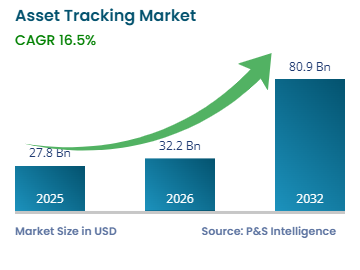
The asset tracking market size was USD 27.8 billion in 2025, and it will grow by 16.5% during 2026-2032 to reach USD 80.9 billion by 2032.
The market is driven by the growing need for continuous visibility into the location, movement, condition, and utilization of equipment, vehicles, inventory, containers, and other high-value assets. The increasing complexity of supply chains and the movement of assets across warehouses, manufacturing facilities, transportation networks, construction sites, healthcare facilities, and field operations are encouraging wider adoption of asset tracking solutions. Technologies such as IoT sensors, RFID, GPS, Bluetooth Low Energy, Real-Time Location Systems (RTLS), and cloud-based platforms enable real-time asset monitoring, improve inventory accuracy, reduce asset loss, and support better utilization of mobile and fixed assets.
Businesses are increasingly using these solutions to monitor asset status, identify underutilized resources, improve maintenance planning, and reduce downtime. According to the United Nations Trade and Development, global maritime trade volumes reached 12,720 million tons in 2024. [SS1] The scale of global freight movement is increasing the need to track containers, equipment, and other assets across international supply chains. Growing investments in connected technologies, logistics infrastructure, industrial automation, and digital asset management are further supporting the adoption of asset tracking solutions across logistics, manufacturing, healthcare, retail, construction, and other asset-intensive industries.
Key Market Insights
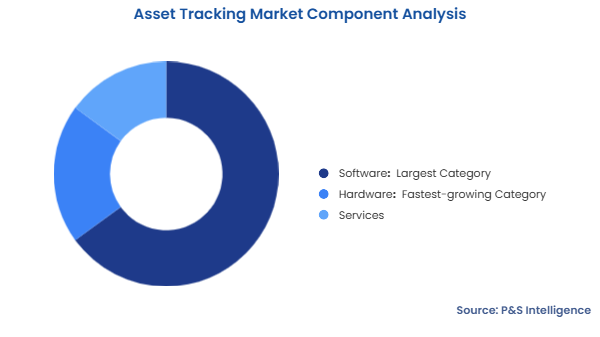
Software is the largest component category, holding a market share of 65.0%, because organizations rely on software platforms to collect, process, and analyze asset data.
Internet of Things is the fastest-growing technology category, registering a CAGR of 16.9%, because businesses increasingly require continuous monitoring of asset location, condition, and utilization.
Logistics and Transportation is the largest end-user category, holding a market share of 25.0%, because the industry depends heavily on real-time visibility of vehicles, cargo, containers, and distribution assets through vehicle tracking systems and related monitoring technologies.
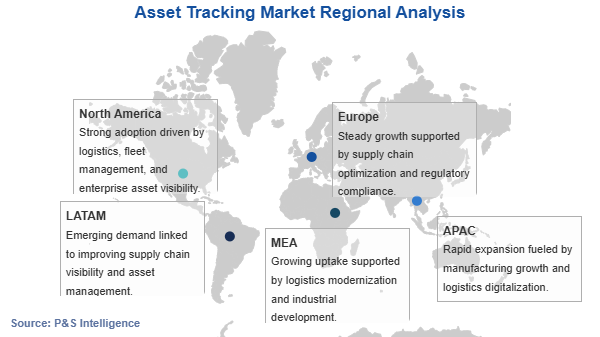
North America holds the largest share of 45.0%, because enterprises across the region have been early adopters of connected asset management technologies and large-scale digital operations.
Asia-Pacific is the fastest-growing region, registering a CAGR of 18.0%, because rapid industrial expansion and large-scale infrastructure development are creating strong demand for asset visibility solutions.
Asset Tracking Market Trends and Drivers
AI-Enabled Predictive Asset Intelligence Is a Major Trend
The asset tracking market is evolving from basic location monitoring toward predictive asset intelligence, with businesses increasingly using artificial intelligence, machine learning, and analytics to understand asset performance, utilization, movement patterns, and operating conditions. These capabilities enable tracking platforms to identify abnormal asset behavior, anticipate maintenance requirements, improve asset allocation, and reduce unexpected downtime. According to the Stanford Institute for Human-Centered Artificial Intelligence, 78% of organizations reported using artificial intelligence in 2024, up from 55% in 2023. In addition, Ericsson reported that total cellular IoT connections reached approximately 4.5 billion at the end of 2025, while total IoT connections reached 22.3 billion. The increasing availability of connected devices and AI-based analytics is allowing businesses to process larger volumes of asset data and move toward proactive asset monitoring, predictive maintenance, and data-driven asset management.
Rising Need for End-to-End Supply Chain Visibility Drives Market
The market is driven by the growing need for end-to-end visibility as supply chains become more complex and involve multiple transportation modes, warehouses, suppliers, distribution centers, and delivery networks. Asset tracking solutions enable businesses to monitor the location and status of vehicles, containers, equipment, inventory, and other assets throughout transportation and storage activities. According to the United Nations Trade and Development, global maritime trade volumes reached 12,720 million tons in 2024, with seaborne trade accounting for around 80% of the volume of international trade in goods. In addition, Airports Council International reported that global air cargo volume reached nearly 127 million metric tonnes in 2024, representing a 9.9% increase from 2023. The increasing scale of maritime and air freight movement is strengthening demand for continuous asset visibility, shipment monitoring, and tracking technologies across global supply chains.
High Deployment and Integration Complexity Limits Market Expansion
The market is restrained by the complexity of deploying and integrating asset tracking solutions with existing technology infrastructure. Businesses operating across multiple facilities often need to connect tracking devices and platforms with enterprise resource planning, warehouse management, transportation management, inventory, and maintenance systems. Differences in legacy systems, connectivity infrastructure, data formats, and deployment environments can increase implementation time and costs. Connectivity limitations can further affect the performance of tracking systems, particularly for assets operating in remote or geographically dispersed locations. According to the International Telecommunication Union, 2.2 billion people remained offline globally in 2025, highlighting the continued connectivity gap across many regions. Limited network availability can restrict real-time asset data transmission and make continuous tracking more difficult, increasing deployment challenges for businesses operating across remote locations.
Expansion of Smart Asset Management Across Emerging Industry Verticals Creates Market Opportunity
The expansion of smart asset management across construction, healthcare, utilities, agriculture, and public infrastructure is creating new opportunities for asset tracking solutions. These industries manage large volumes of equipment, machinery, tools, vehicles, materials, and other assets across multiple locations, increasing the need for accurate asset identification, location monitoring, utilization tracking, and loss prevention. According to the United States Geological Survey, global cement production totaled approximately 4.0 billion metric tons in 2024, reflecting the large scale of construction and infrastructure activity worldwide. The growing use of connected equipment, digital project management, and automated monitoring is creating opportunities for asset tracking solutions that can provide real-time visibility across project sites and distributed operations. Industry-specific tracking platforms can further address requirements such as equipment utilization, maintenance scheduling, inventory control, and asset accountability, supporting broader adoption across emerging asset-intensive sectors.
Asset Tracking Market Segmentation Analysis
Component Analysis
Software is the largest category, holding a market share of 65.0%, as asset tracking platforms are increasingly used to collect, process, visualize, and analyze data generated by connected tracking devices. Software solutions enable businesses to monitor asset locations, review utilization patterns, manage alerts, and integrate tracking data with inventory, warehouse, transportation, and maintenance systems. According to Eurostat, 96.44% of European Union enterprises using paid cloud computing services purchased at least one Software-as-a-Service offering in 2025, indicating the widespread adoption of cloud-based software across business operations.
Hardware is the fastest-growing category, registering a CAGR of 16.8%, driven by the increasing deployment of RFID tags, GPS trackers, IoT sensors, Bluetooth devices, gateways, and other connected tracking equipment. Businesses are expanding hardware installations to obtain continuous visibility into asset location, movement, and condition across warehouses, transportation networks, industrial facilities, and field operations. Improvements in battery life, sensor capabilities, connectivity, and device durability are further supporting the deployment of tracking hardware across a wider range of assets.
The components analysed in this report are:
Software (Largest Category)
Hardware (Fastest-Growing Category)
Services
Technology Analysis
Radio-Frequency Identification is the largest category, holding a market share of 35.0%, due to its widespread use for asset identification, inventory tracking, and automated data capture. RFID enables businesses to identify and monitor multiple assets without requiring direct line-of-sight scanning, making it suitable for warehouses, logistics facilities, manufacturing plants, healthcare facilities, and retail operations. The technology supports high-volume asset identification and reduces manual tracking activities, while its established infrastructure and compatibility with existing inventory and warehouse systems continue to support its adoption.
Internet of Things is the fastest-growing category, registering a CAGR of 16.9%, driven by increasing demand for continuous monitoring of asset location, condition, utilization, and operating status. IoT-enabled sensors can transmit asset data through connected networks to cloud-based platforms, allowing businesses to monitor assets remotely and receive real-time alerts. Ericsson reported approximately 4.5 billion cellular IoT connections at the end of 2025, reflecting the expanding deployment of connected devices across industries.
The technology analysed in this report are:
Radio-Frequency Identification (Largest Category)
Internet of Things (Fastest-Growing Category)
Global Positioning System
Barcode
Bluetooth
Cellular
Others
Asset Type Analysis
Returnable Transport Assets is the largest category, holding a market share of 40.5%, because pallets, crates, containers, and other reusable transport units move repeatedly between manufacturers, warehouses, distributors, and customers. Tracking these assets helps businesses reduce losses, improve asset utilization, monitor circulation, and maintain accurate records across supply chains. More than 650 million EPAL Euro pallets were in circulation in 2024, highlighting the substantial installed base of reusable transport assets that can benefit from tracking and identification technologies. The continuous movement of these assets across multiple locations supports sustained demand for asset tracking solutions.
Equipment and Machinery are the fastest-growing category, registering a CAGR of 17.5%, as businesses increasingly require real-time visibility into high-value equipment used across manufacturing, construction, infrastructure, logistics, and other industrial operations. Tracking solutions enable businesses to monitor equipment location, utilization, movement, and maintenance requirements while helping reduce idle time and unauthorized movement. The increasing deployment of connected machinery and digital maintenance systems is further supporting the adoption of tracking technologies for equipment and machinery.
The asset types analysed in this report are:
Returnable Transport Assets (Largest Category)
Equipment and Machinery (Fastest-Growing Category)
Mobile Assets
Fixed Assets
Others
End User Analysis
Logistics and Transportation is the largest category, holding a market share of 25.0%, as transportation and logistics operations involve continuous movement of vehicles, containers, cargo, equipment, and other mobile assets across warehouses, terminals, distribution centers, and delivery routes. Asset tracking solutions provide real-time visibility into asset location and status, helping businesses improve shipment monitoring, inventory coordination, fleet utilization, and delivery operations. The continued expansion of global freight networks and increasingly complex distribution chains is supporting the adoption of asset tracking technologies across the sector.
E-commerce is the fastest-growing category, registering a CAGR of 17.2%, driven by the expansion of fulfillment networks, warehouses, parcel delivery operations, and last-mile logistics. E-commerce businesses require accurate visibility of inventory, containers, delivery assets, and shipments to support faster order fulfillment and maintain control across distributed logistics networks. According to the International Post Corporation, global postal parcel volumes increased by 4.4% in 2024, reflecting continued growth in parcel movement.
The end users analysed in this report are:
Logistics and Transportation (Largest Category)
E-commerce (Fastest-Growing Category)
Manufacturing
Healthcare
Retail
Aviation
Food and Beverage
Construction
Others
Drive strategic growth with comprehensive market analysis
Asset Tracking Market Regional Analysis
North America Asset Tracking Market Analysis
North America holds the largest share, of 45.0%, supported by its extensive logistics networks, advanced warehousing infrastructure, high adoption of connected technologies, and strong presence of asset-intensive industries. Businesses across logistics, transportation, manufacturing, retail, healthcare, construction, and field services are increasingly using RFID, GPS, IoT, Bluetooth, and cloud-based tracking platforms to monitor equipment, vehicles, inventory, containers, and other high-value assets. According to the U.S. Bureau of Transportation Statistics, freight flows between the U.S. and Canada and Mexico totaled approximately USD 1.59 trillion in 2025, while cross-border freight shipments averaged about USD 4 billion per day. The scale of cross-border freight movement and the high dependence on road, rail, pipeline, air, and maritime transportation increase the need for continuous visibility of assets across regional supply chains. In 2025, trucking accounted for more than USD 1 trillion of U.S. freight flows with Canada and Mexico, further highlighting the importance of tracking vehicles, cargo, containers, and transportation equipment across the region.
U.S. Asset Tracking Market Analysis
The U.S. asset tracking market is supported by extensive logistics networks, large-scale warehousing operations, advanced transportation infrastructure, and widespread adoption of connected technologies. Businesses across logistics, transportation, manufacturing, retail, healthcare, and construction are increasingly using RFID, GPS, IoT, Bluetooth, and cloud-based tracking platforms to monitor vehicles, equipment, inventory, containers, and other assets. According to the U.S. Bureau of Transportation Statistics, freight flows between the U.S. and Canada and Mexico totaled approximately USD 1.6 trillion in 2025, with trucks accounting for around USD 1.0 trillion of this movement. The scale of freight transportation and cross-border movement increases the need for real-time visibility of shipments, vehicles, containers, and transportation equipment. The U.S. Freight Transportation Services Index also reached an all-time high of 139.6 in April 2026, indicating the continued scale of freight activity across the country. Growing investments in supply chain digitization, warehouse automation, fleet management, and connected infrastructure are further supporting demand for asset tracking solutions in the U.S.
Canada Asset Tracking Market Analysis
The Canada asset tracking market is supported by the country’s extensive transportation networks, large geographic area, and strong presence of mining, energy, manufacturing, logistics, and infrastructure activities. Businesses are increasingly using RFID, GPS, IoT, Bluetooth, and cloud-based tracking platforms to monitor vehicles, equipment, machinery, inventory, and other assets operating across distributed and remote locations. According to Statistics Canada, Canadian railways transported 329.2 million tonnes of freight in 2024, representing a 1.1% increase from the previous year and the highest freight volume since 2019. In 2025, total goods moved by rail reached 376.6 million tonnes, while rail traffic to and from Mexico increased by approximately 25%, highlighting the continued scale and diversification of Canada’s freight network. The movement of goods across long transportation corridors and remote operating environments is increasing the need for real-time visibility of vehicles, containers, machinery, and other high-value assets.
Asia-Pacific Asset Tracking Market Analysis
Asia-Pacific has the highest CAGR, of 18.0%, driven by rapid industrialization, expanding manufacturing and logistics activities, growth in e-commerce, and increasing investment in connected technologies across the region. Businesses are increasingly adopting asset tracking solutions to monitor vehicles, equipment, inventory, containers, and other assets across large and geographically dispersed supply chains. According to UN Trade and Development, China remained the world’s leading maritime-freight economy in 2024, with around 670 million metric tons of goods loaded and nearly 3.0 billion metric tons discharged, highlighting the scale of trade and asset movement across the region. Asia-Pacific is also experiencing continued expansion of logistics infrastructure, with regional logistics supply expected to increase from less than 2.5 billion square feet in 2022 to more than 3.0 billion square feet by the end of 2025, representing an increase of approximately 22%. The expansion of manufacturing facilities, warehouses, distribution networks, and cross-border trade is increasing the need for real-time visibility of equipment, inventory, vehicles, and returnable transport assets.
China Asset Tracking Market Analysis
China is the largest asset tracking market in Asia-Pacific, supported by its large manufacturing base, extensive logistics infrastructure, high freight volumes, and growing adoption of connected technologies. Businesses across manufacturing, logistics, retail, transportation, and warehousing are increasingly using asset tracking solutions to monitor equipment, vehicles, inventory, containers, and other assets throughout production and distribution networks. According to the National Bureau of Statistics of China, total freight traffic reached 59.7 billion tons in 2025, increasing by 3.2% from the previous year, while port container throughput reached 354.47 million TEUs, increasing by 6.8%. In addition, China's total social logistics value reached CNY 368.2 trillion in 2025, growing by 5.1%, with logistics demand for industrial goods increasing by 5.3%. The scale of manufacturing, freight transportation, and logistics activity is increasing the need for real-time visibility of equipment, inventory, vehicles, containers, and returnable transport assets across complex supply chains.
India Asset Tracking Market Analysis
India is the fastest-growing asset tracking market in Asia-Pacific, supported by the expansion of logistics infrastructure, organized warehousing, e-commerce, manufacturing, and digital supply chain systems. Businesses are increasingly adopting asset tracking technologies to monitor vehicles, equipment, inventory, containers, and other assets across geographically distributed operations. According to the Press Information Bureau of India, Indian Railways recorded approximately 1,617.38 million tons of originating freight loading during FY 2024–25, representing a 1.68% increase from the previous year, while domestic container loading increased by 19.72%. The growing volume of freight and container movement is increasing the need for real-time visibility of shipments, transportation assets, and logistics equipment. India's digital logistics infrastructure is also strengthening demand for tracking technologies, with the Logistics Data Bank having tracked more than 75 million EXIM containers as of October 2024 and the Unified Logistics Interface Platform facilitating more than 160 crore digital transactions by August 2025.
Europe Asset Tracking Market Analysis
Europe represents a significant asset tracking market, supported by its strong manufacturing base, extensive logistics networks, growing adoption of digital technologies, and increasing need for supply chain visibility and asset traceability. Businesses across manufacturing, logistics, transportation, retail, healthcare, and construction are increasingly using RFID, GPS, IoT, Bluetooth, and cloud-based tracking platforms to monitor equipment, inventory, vehicles, containers, and other assets across distributed operations. According to Eurostat, total road freight transport in the European Union exceeded 13.1 billion tons in 2024, while road freight transport performance reached approximately 1,869 billion tonne-kilometres. Germany recorded the highest road freight volume among EU countries, while Germany, Spain, France, Italy, and Poland together accounted for a significant share of EU road freight activity. The scale of freight movement across European transportation networks is increasing the need for real-time visibility of vehicles, shipments, containers, and other mobile assets. Digital adoption is also strengthening the market, with 52.7% of EU enterprises using paid cloud computing services in 2025, up from 45.2% in 2023, supporting wider deployment of cloud-based asset tracking and management platforms.
The regions and countries analysed in this report are:
North America (Largest Regional Market)
U.S. (Larger Country)
Canada (Faster-Growing Country)
Europe
Germany (Largest Country)
U.K. (Fastest-Growing Country)
France
Italy
Spain
Rest of Europe
Asia-Pacific (Fastest-Growing Regional Market)
China (Largest Country)
India (Fastest-Growing Country)
Japan
South Korea
Australia
Rest of APAC
Latin America
Brazil (Largest Country)
Mexico (Fastest-Growing Country)
Rest of LATAM
Middle East and Africa
Saudi Arabia (Largest Country)
U.A.E. (Fastest-Growing Country)
South Africa
Rest of MEA
Asset Tracking Market Competitive Landscape
The asset tracking market is fragmented, with competition spread across technology providers, specialized tracking solution vendors, software providers, connectivity companies, and industry-focused service providers. The market includes a wide range of tracking technologies, such as RFID, GPS, Bluetooth, IoT sensors, and cloud-based platforms, allowing vendors to serve different asset types, operating environments, and industry requirements. Competition is influenced by tracking accuracy, connectivity, software capabilities, integration with existing systems, scalability, and deployment flexibility. Industry-specific requirements across logistics, manufacturing, healthcare, construction, retail, and transportation also contribute to the presence of specialized providers. In addition, vendors are developing customized solutions that combine hardware, connectivity, and software to address specific asset monitoring and management needs.
Leading Companies in the Asset Tracking Market:
Zebra Technologies Corporation
Verizon Communications Inc.
AT&T Inc.
Trimble Inc.
Samsara Inc.
Qualcomm Technologies Inc.
Honeywell International Inc.
Cisco Systems Inc.
Siemens AG
Geotab Inc.
Ubisense Limited
Asset Panda LLC
Tive Inc.
Actsoft Inc.
GigaTrak
Asset Tracking Market Developments
In March 2026, AT&T Inc. collaborated with Geoforce to provide asset tracking and monitoring capabilities for rugged, non-powered industrial equipment. The collaboration gives AT&T Business customers access to Geoforce's asset intelligence solutions and complements existing vehicle and powered-asset tracking capabilities operating on AT&T's LTE-M network.
In June 2024, Trimble Inc. launched Trimble Unity, an end-to-end asset lifecycle management software suite that enables infrastructure and capital project owners to plan, design, build, operate, and maintain assets through centralized data and connected digital workflows. The suite combines asset management, GIS, field operations, construction, and connected data capabilities, providing greater visibility into assets throughout their lifecycle and strengthening Trimble’s position in asset management and tracking solutions.
In January 2024, Zebra Technologies Corporation introduced the FXR90, an ultra-rugged fixed RFID reader designed to provide real-time visibility and tracking in demanding indoor and outdoor environments. The solution enables businesses to identify and track inventory and assets across warehouses, manufacturing facilities, transportation and logistics operations, and other industrial environments, strengthening Zebra’s RFID portfolio and supporting the adoption of automated asset-tracking solutions.
Frequently Asked Questions About This Report
What does the asset tracking market include?+
It includes hardware, software, and services used to monitor the location, movement, condition, and utilization of physical assets.
What factors are driving demand in the asset tracking market?+
Demand is driven by the need for asset visibility, growing logistics complexity, loss prevention, maintenance planning, and increasing connected-device adoption.
Why is demand for asset tracking solutions increasing?+
Demand is increasing as businesses need real-time visibility of equipment, vehicles, inventory, containers, and other assets across distributed locations.
What are the benefits of asset tracking solutions?+
They improve asset visibility, reduce losses and search time, increase utilization, and support maintenance planning.
What challenges affect asset tracking adoption?+
Key challenges include device and deployment costs, connectivity limitations, data accuracy, system integration, and device durability.
Want a report tailored exactly to your business need?
Leading companies across industries trust us to deliver data-driven insights and innovative solutions for their most critical decisions. From data-driven strategies to actionable insights, we empower the decision-makers who shape industries and define the future. From Fortune 500 companies to innovative startups, we are proud to partner with organisations that drive progress in their industries.
Client Testimonials
Working with P&S Intelligence and their team was an absolute pleasure – their awareness of timelines and commitment to value greatly contributed to our project's success. Eagerly anticipating future collaborations.
McKinsey & Company
India
Unmatched Standards
Our insights into the minutest levels of the markets, including the latest trends and competitive landscape, give you all the answers you need to take your business to new heights
Complete Data Security
We take a cautious approach to protecting your personal and confidential information. Trust is the strongest bond that connects us and our clients, and trust we build by complying with all international and domestic data protection and privacy laws