This Report Provides In-Depth Analysis of the Asia-Pacific Telemedicine Market Report Prepared by P&S Intelligence, Segmented by Type (Tele Hospitals & Clinics, Tele Home), Service (Tele Consulting, Tele Monitoring, Tele Education, Tele Training), Specialty (Dermatology, Gynecology, Neurology, Cardiology, Orthopedics), and Geographical Outlook for the Period of 2021 to 2032
Explore the market potential with our data-driven report
Asia-Pacific Telemedicine Market Outlook
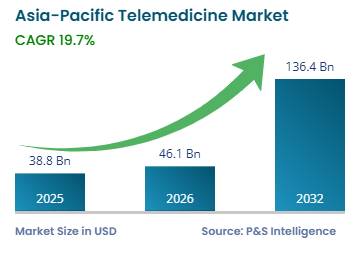
The Asia-Pacific telemedicine market size was USD 38.8 billion in 2025, and it is set to expand at a CAGR of 19.7% during 2026–2032, reaching approximately USD 136.4 billion by 2032. This growth is supported by accelerating integration of teleconsultation platforms, remote patient monitoring devices, and digital diagnostic tools across hospitals, clinics, and home care settings. In 2021, the Association of Southeast Asian Nations (ASEAN) region alone had 36.8 million prevalent cases of cardiovascular disease, creating substantial demand for continuous remote monitoring and chronic disease management.
Key Market Insights
Tele hospitals & clinics hold largest market share, of 70%, due to healthcare institution investment priorities, reimbursement frameworks favoring facility-based care, and physician preference for integrated clinical workflows.
Tele consulting is the largest and fastest-growing category, with 40% share and 19.8% CAGR, respectively, due to fundamental value proposition, broad applicability, and reimbursement model compatibility with traditional fee-for-service payment.
Cardiology is the largest specialty, with 35% share, driven by the rising CVD incidence and mortality, chronic nature of cardiac conditions requiring ongoing monitoring, and established evidence base demonstrating telemedicine efficacy.
Dermatology demonstrates fastest growth, at 20.1% CAGR, due to excellent telemedicine suitability through visual assessment, dermatologist shortage, and improving diagnostic accuracy for skin conditions with AI.
China holds the largest share, of 40%, due to the comprehensive Healthy China 2030 initiative and rapid infrastructure development.
India is the fastest-growing country market, with 20.0% CAGR, as Ayushman Bharat Digital Mission has created millions of unique health accounts, registered thousands of health professionals, and established the infrastructure for nationwide telemedicine adoption.
Government digital health initiatives across China, India, Japan, and South Korea are expanding teleconsultation reimbursement frameworks and 5G-enabled networks. India's e-Sanjeevani platform facilitated over 12 million consultations by FY 2024, demonstrating scalability. Smartphone penetration exceeding 820 million users in India and mobile-first adoption across Indonesia, Thailand, Vietnam, and Philippines facilitates real-time physician-patient communication.
Government Digital Health Initiatives Are Key Trends
Comprehensive government programs including China's Healthy China 2030 initiative establishing over 3,000 internet hospitals, India's Ayushman Bharat Digital Mission creating 730 million digital health accounts, and Japan's 8th National Medical Strategic Plan promoting telemedicine infrastructure provide foundational policy support driving market expansion. These initiatives include telemedicine service reimbursement under national health insurance schemes, regulatory frameworks establishing teleconsultation practice guidelines, and government funding for 5G network deployment specifically targeting healthcare applications. The standardization of telemedicine practice guidelines across major markets reduces regulatory uncertainty while ensuring quality and safety standards building patient and physician trust in remote care delivery.
At HIMSS25 APAC, Southeast Asia (including Malaysia, Singapore) showcased government-backed digital health strategies focusing on national interoperability frameworks, unified electronic medical record systems (EMRs), and integrated digital health infrastructures, signaling public spending aligned with broader health tech adoption. Regional digital health funding (venture capital, corporate investment) remained strong in 2025, with over USD 1.6 billion invested YTD and Q3 2025 funding alone at USD 416 million. India’s national digital health initiative continues to scale, with over 834 million digital IDs issued, 787 million digital health records linked, and extensive integration across healthcare providers.
Thailand launched a national digital health ID as part of its Universal Health Coverage (UHC) upgrade to streamline clinical records and digital services across care settings. Malaysia has budgeted focused health IT financing (e.g., USD 31 million for health IT and Clinic Management Systems) and is pushing smart hospital digitalization. Indonesia is advancing an integrated primary healthcare digital ecosystem targeting full interoperability by 2030. Philippines is prioritizing digital system interoperability and accessibility to improve service delivery.
The Asia-Pacific region faces escalating chronic disease burden with cardiovascular diseases contributing to 60% of 18.6 million global CVD deaths, diabetes prevalence surging across developing nations, and aging populations requiring continuous monitoring. This demographic transition creates sustained demand for remote patient monitoring systems and virtual specialist consultations enabling early intervention. Japan's aging structure with 29% aged 65 or older and China's 250+ million individuals above 60 years demonstrate the scale of elderly care requirements that telemedicine addresses through accessible remote consultation and continuous health tracking across the region.
As per OECD, CVDs accounted for roughly 40% of all deaths in some subregions like the Western Pacific in 2021, and nearly one-quarter of deaths in South-East Asia. In lower- and middle-income APAC countries, the probability of dying prematurely (ages 30–70) from major NCDs including CVD approaches 30% for males and about 20% for females, illustrating the sustained high impact of CVD and related conditions.
In high-income Asia-Pacific countries, such as Japan and Australia, cancer DALYs exceed 5000 per 100 000 population, while less-resourced countries typically show lower but still substantial rates. In the WHO South-East Asia region alone, over 276 million adults had diabetes as of recent estimates, and many remain undiagnosed or unmanaged, contributing to continued mortality and morbidity. Also in this Region, chronic respiratory diseases caused around 1.56 million deaths in 2021, with chronic obstructive pulmonary disease (COPD) accounting for the majority (1.24 million).
Data Privacy Concerns Limiting Adoption Rates
Transmission and storage of sensitive medical information through digital platforms creates substantial data security risks, particularly in markets with fragmented regulatory frameworks for health data protection. Patient concerns regarding unauthorized access to medical records, potential data breaches affecting personal health information, and unclear data ownership frameworks limit adoption rates among privacy-conscious populations. The absence of standardized cybersecurity protocols across healthcare providers, particularly smaller clinics and rural facilities implementing telemedicine for the first time, creates vulnerability to cyberattacks. Regulatory compliance requirements varying significantly across APAC countries increase operational complexity for platforms operating across multiple markets.
India introduced the Digital Personal Data Protection Act, 2023, creating a Data Protection Board to enforce privacy rules. Indonesia’s Personal Data Protection Act requires impact assessments, breach notifications, security safeguards, and appointing Data Protection Officers. Sri Lanka passed its Personal Data Protection Act, 2022, aligning with international norms. Cambodia is drafting its first data protection law modeled on the EU’s GDPR.
Singapore enforces strict consent, purpose limitation, and accountability under its PDPA. Malaysia classifies health data as sensitive, funding health IT upgrades accordingly. The Philippines protects health data under its Data Privacy Act of 2012. Many countries now require breach reporting, impact assessments, explicit consent, and strong security measures, while also regulating cross-border data transfers and holding organizations accountable through penalties.
Artificial intelligence algorithms enabling automated preliminary diagnosis, image analysis for radiology and dermatology applications, and predictive analytics for chronic disease progression create substantial value-addition opportunities for telemedicine platforms. Integration of machine learning models trained on large Asian population datasets improves diagnostic accuracy for conditions prevalent in regional populations while reducing physician workload through automated triage and preliminary assessment. Natural language processing capabilities enabling real-time medical transcription, multilingual patient communication, and clinical note generation address language diversity challenges across Asia-Pacific markets. AI-driven personalized treatment recommendations based on patient history and regional epidemiological patterns enhance telemedicine clinical outcomes beyond traditional remote consultation capabilities.
In Singapore, SingHealth’s Note Buddy transcribes and summarizes doctor-patient consultations, while the National University Health System uses AI to detect post-surgical complications, and Respiree’s 1BioAI‑Acute predicts acute patient deterioration. In Vietnam, VinBrain’s DrAid platform analyzes millions of X-rays to assist radiologists. China’s Tencent AI Medical Innovation System screens for diseases like diabetic retinopathy, lung cancer, and esophageal cancer. In India, AIIMS Patna employs AI-powered devices to detect cancer, heart, and neurological conditions from imaging, and Tamil Nadu runs AI-assisted mobile medical vans to analyze chest X-rays for tuberculosis.
In the Philippines, Philippine General Hospital is trialing AI software like DeepMets for rapid brain tumor detection. Startups such as SigTuple (India) automate blood smear and urine microscopy analysis, and InferVision (China) supports image-based diagnostics. Additionally, in Hong Kong, the Hospital Authority uses AI to analyze thousands of X-rays daily to aid radiologists, demonstrating that AI is being integrated across imaging, pathology, and clinical monitoring to improve diagnostic speed, accuracy, and efficiency.
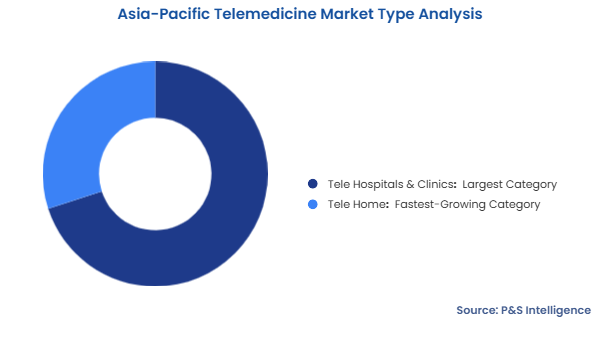
Tele hospitals & clinics hold largest market share, of 70%, due to healthcare institution investment priorities, reimbursement frameworks favoring facility-based care, and physician preference for integrated clinical workflows. Critical applications include telestroke programs enabling rapid specialist consultation for emergency departments and tele-ICU systems providing remote intensivist coverage across multiple facilities.
Tele home demonstrates the fastest growth, at 19.9% CAGR, driven by consumer smartphone adoption, COVID-19 pandemic accelerating acceptance of home-based care, and convenience benefits eliminating travel time. Growth catalysts include expanding internet connectivity reaching rural populations, declining data costs making video consultations affordable, and younger demographics exhibiting higher digital health adoption rates.
The market segments into the following types:
Tele Hospitals & Clinics (Largest Category)
Tele Home (Fastest-Growing Category)
Service Analysis
Tele consulting is the largest and fastest-growing category, with 40% share and 19.8% CAGR, respectively, due to fundamental value proposition addressing physician access barriers, broad applicability across medical specialties, and reimbursement model compatibility with traditional fee-for-service payment. Applications span primary care for acute illnesses, specialist consultations including cardiology, dermatology, and psychiatry, and post-operative follow-up. Tele Monitoring provides continuous surveillance of patient health status through connected devices transmitting vital signs and health data for proactive intervention, particularly valuable for chronic disease management including diabetes glucose monitoring and heart failure symptom surveillance.
The market segments into the following services:
Tele Consulting (Largest and Fastest-Growing Category)
Tele Monitoring
Tele Education
Tele Training
Others
Specialty Analysis
Cardiology is the largest specialty, driven by cardiovascular disease burden as leading cause of mortality across Asia-Pacific, chronic nature of cardiac conditions requiring ongoing monitoring, and established evidence base demonstrating telemedicine efficacy. Technology integration includes remote monitoring of implanted cardiac devices, blood pressure tracking through connected home devices, and electrocardiogram analysis. In addition, AI-powered predictive analytics are increasingly used to identify patients at high risk of cardiac events, virtual consultations enable timely interventions and medication adjustments, and integration with hospital information systems ensures seamless continuity of care across primary, secondary, and tertiary care settings.
Dermatology demonstrates fastest growth, due to excellent telemedicine suitability through visual assessment, dermatologist shortage particularly acute in rural areas, and artificial intelligence algorithms improving diagnostic accuracy for skin conditions. According to Global Burden of Disease estimates for 2021, East Asia alone recorded about 781.9 million new cases of skin and subcutaneous diseases, including dermatitis, infections, psoriasis, acne, and other common conditions.
Additionally, high-income APAC countries, such as Japan and Australia, report some of the highest age-standardized incidence rates of atopic dermatitis at about 475 new cases per 100,000 people. Psoriasis—another key chronic dermatological condition—accounted for approximately 2.8 million new cases in Asia in 2021, representing over half of the global incident cases, with about 22.3 million prevalent cases in the region that year.
The market segments into the following specialties:
Cardiology (Largest Category)
Dermatology (Fastest-Growing Category)
Gynecology
Neurology
Orthopedics
Others
Drive strategic growth with comprehensive market analysis
Asia-Pacific Telemedicine Market Regional Outlook
China Telemedicine Market Outlook
China represents the largest country market for telemedicine in Asia-Pacific, accounting for 40% regional revenue in 2025. This leadership stems from comprehensive Healthy China 2030 initiative and rapid infrastructure development. By 2022, over 3,000 internet hospitals had been established with electronic medical record coverage reaching 90% in tertiary hospitals, according to National Health Authority data, enabling comprehensive digital health integration. China installed more than 4.042 million 5G base stations by Q3 2024, accounting for 66% of global deployments, enabling real-time video consultations and AI-powered triage systems. The dual public-private ecosystem creates unprecedented service scalability for chronic disease management.
India Telemedicine Market Forecast
India is the fastest-growing country market, with 20.0% CAGR, during 2026–2032. Ayushman Bharat Digital Mission created over 730 million unique health accounts as of January 2025 with 500,000+ registered health professionals, establishing foundational digital health infrastructure for nationwide telemedicine adoption. The e-Sanjeevani system comprising both patient-to-doctor and health center-to-specialist modules addresses critical urban-rural healthcare access gap affecting over 65% of India's population. Government-mandated telemedicine practice guidelines establish regulatory clarity while smartphone proliferation exceeding 820 million users with expanding rural connectivity accelerates adoption.
Japan Telemedicine Market Growth
Japan holds significant market position driven by rapidly aging population where approximately 29% are aged 65 or older, with projections reaching 35% by 2040, according to Ministry of Health, Labour and Welfare (MHLW) demographic data. This creates substantial demand for telemedicine solutions enabling chronic disease management and specialist access for elderly patients. Japanese government implemented progressive regulatory reforms including permanent telemedicine coverage under national health insurance and relaxing initial-consultation restrictions. MHLW's 8th National Medical Strategic Plan covering 2024–2030 promotes telemedicine infrastructure to address regional healthcare disparities, though market expansion faces challenges from lower digital health adoption rates among elderly patients.
The countries analyzed in this report include:
China (Largest Country Market)
India (Fastest-Growing Country Market)
Japan
South Korea
Indonesia
Vietnam
Thailand
Singapore
Australia
Rest of APAC
Asia-Pacific Telemedicine Market Share
The Asia-Pacific telemedicine market is fragmented due to the presence of global telemedicine platforms, regional technology companies, healthcare providers developing proprietary solutions, and telecommunications firms leveraging network infrastructure for health services. Competition manifests across technology sophistication with AI-enabled diagnostics and remote monitoring integration, geographic coverage spanning urban-rural divides, service breadth from basic teleconsultation to comprehensive chronic disease management, and strategic partnerships with healthcare institutions, insurance companies, and government digital health initiatives.
Market dynamics vary significantly across countries, with China dominated by domestic platforms operating within strict regulatory frameworks, and India seeing rapid growth from both local startups and international players targeting underserved populations. On the other hand, developed markets like Japan and South Korea are characterized by healthcare institution-led telemedicine adoption integrated with existing hospital networks. Leading global providers including Teladoc Health and Amwell focus on corporate wellness programs and health insurance partnerships, while infrastructure providers like Cisco Systems and GE HealthCare enable telemedicine through telecommunications equipment and connected medical devices.
The Asia-Pacific telemedicine market is witnessing accelerated innovation and strategic activity, reflecting intensifying competition, technology advancement, and expanding adoption across healthcare stakeholders. Recent developments demonstrate major telemedicine platforms expanding geographic presence through acquisitions, technology companies integrating AI capabilities, government initiatives advancing from policy frameworks toward implementation, and consolidation activity as leading platforms acquire specialized capabilities.
Key Players in Asia-Pacific Telemedicine Market:
Koninklijke Philips N.V.
Honeywell International Inc.
Medtronic plc
Cerner Corporation
Cisco Systems Inc.
McKesson Corporation
Teladoc Health Inc.
Aerotel Medical Systems Ltd.
OBS Medical Ltd.
Care innovations LLC
Allscripts Healthcare Solutions Inc.
AMD Global Telemedicine Inc.
BioTelemetry Inc.
Plantronics Inc.
GlobalMedia Group LLC
Asia-Pacific Telemedicine Market News
In January 2025, Teladoc Health Inc. acquired Catapult Health, a virtual preventive care service provider. The move integrated Catapult Health's patient-centric at-home diagnostic testing and clinical support model to enhance Teladoc's preventive care capabilities beyond acute care consultation services.
In January 2025, National Health Authority of India reported Ayushman Bharat Digital Mission achievements with over 730 million Ayushman Bharat Health Accounts created and 500,000+ registered health professionals.
In June 2024, State Council of China issued 2024 Key Tasks for Deepening Medical and Healthcare System Reform, prioritizing cohesive development across medical insurance, healthcare, and pharmaceuticals with specific emphasis on telemedicine contributing to primary-level medical service capacities.
In April 2024, Pharmaceuticals and Medical Devices Agency (PMDA) of Japan expanded the IDATEN system. This facilitates adaptive AI usage through pre-approved improvement plans for ai-based software as medical device, eliminates the need for regulatory re-approval with each AI model update, and addresses key regulatory barrier to AI-powered telemedicine diagnostics adoption.
Frequently Asked Questions About This Report
What was APAC telemedicine market size in 2025?+
In 2025, the telemedicine market in APAC size was USD 38.8 billion.
Which specialty has fastest APAC telemedicine industry growth?+
Dermatology has the highest APAC telemedicine industry CAGR, of 20.1%.
Which country has largest APAC telemedicine market share?+
China is the largest telemedicine market in APAC, with 40% share.
What are the key APAC telemedicine industry drivers?+
The APAC telemedicine industry is driven by accelerating integration of teleconsultation platforms, remote patient monitoring devices, and digital diagnostic tools across hospitals, clinics, and home care settings.
What is the APAC telemedicine market nature?+
The telemedicine market in APAC is fragmented.
Want a report tailored exactly to your business need?
Leading companies across industries trust us to deliver data-driven insights and innovative solutions for their most critical decisions. From data-driven strategies to actionable insights, we empower the decision-makers who shape industries and define the future. From Fortune 500 companies to innovative startups, we are proud to partner with organisations that drive progress in their industries.
Client Testimonials
Working with P&S Intelligence and their team was an absolute pleasure – their awareness of timelines and commitment to value greatly contributed to our project's success. Eagerly anticipating future collaborations.
McKinsey & Company
India
Unmatched Standards
Our insights into the minutest levels of the markets, including the latest trends and competitive landscape, give you all the answers you need to take your business to new heights
Complete Data Security
We take a cautious approach to protecting your personal and confidential information. Trust is the strongest bond that connects us and our clients, and trust we build by complying with all international and domestic data protection and privacy laws
 ounger demographics exhibiting higher digital health adoption rates.