This Report Provides In-Depth Analysis of the Asia-Pacific Smart Manufacturing Market Report Prepared by P&S Intelligence, Segmented by Technology (Distributed Control Systems (DCS), Manufacturing Execution System (MES), Supervisory Control & Data Acquisition (SCADA), Programmable Logic Controller (PLC), Human, Enterprise Resource Planning (ERP), Product Lifecycle Management (PLM)), Component (Industrial Sensors, Industrial Robots, Machine Vision Systems), End-Use Industry (Automotive, Electronics & Semiconductor, Pharmaceutical & Medical Device, Food & Beverage, Chemical & Petrochemical, Oil & Gas, Textile), and Geographical Outlook for the Period of 2021 to 2032
Explore the market potential with our data-driven report
Asia-Pacific Smart Manufacturing Market Analysis
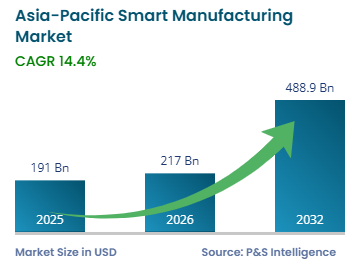
The Asia-Pacific smart manufacturing market size reached USD 191.0 billion in 2025, and it is anticipated to expand at a CAGR of 14.4% during 2026–2032, reaching USD 488.9 billion by 2032. This growth is supported by accelerating adoption of manufacturing execution systems, industrial robotics, and machine vision technologies across automotive, electronics, and pharmaceutical sectors, positioning the region as the global epicenter for Industry 4.0 implementation.
Key Market Insights
Manufacturing execution systems (MES) accounted for the largest share in 2025, of 30%, as manufacturers mandate real-time visibility across globally distributed production facilities.
Machine vision systems are projected to experience the highest CAGR, of 14.6%, as AI-powered image recognition enables fast, automated, and accurate defect detection
The automotive category dominated the market with 30% share, due to high robot density and booming EV production.
The electronics & semiconductor category has the highest CAGR, of 14.8%, driven by semiconductor fabrication facilities demanding sub-micron process control accuracy.
China led the market in 2025 with 40% revenue, sustained by the systematic allocation of state resources toward robotics, semiconductors, and industrial automation development.
India will demonstrate the fastest growth, of 14.5%, propelled by the SAMARTH Udyog Bharat 4.0 initiative.
Government-led industrial policies are fundamentally reshaping competitive dynamics, with China's Made in China 2025 initiative representing a comprehensive mobilization of state resources to advance capabilities in robotics, semiconductors, and advanced automation systems. The U.S.–China Economic and Security Review Commission reported that this multi-stage industrial strategy has reshaped global technology competition through targeted state support in advanced manufacturing sectors.
India's SAMARTH Udyog Bharat 4.0 test beds and South Korea's Smart Factory Initiative are similarly accelerating digital transformation, lowering automation entry barriers through matching grants and demonstration centers. Japan leverages decades of robot density with AI-enabled scheduling systems that address skilled-labor constraints.
Cloud Integration and Platform Ecosystems Are Major Trends
Manufacturing facilities across Asia-Pacific are transitioning from isolated automation cells toward cloud-integrated platform architectures that enable real-time production visibility, predictive maintenance, and cross-facility coordination. Factories deploy edge computing nodes for millisecond-latency process control while transmitting aggregated production data to cloud analytics platforms for pattern recognition, enabling automotive body shops in Thailand to synchronize mixed-model sequencing across distributed lines and semiconductor fabs in Taiwan to optimize lithography tool utilization through federated data analysis.
System integrators increasingly bundle hardware infrastructure with multiyear managed service contracts that shift capital expenditure to operational expense models, accelerating deployment among brownfield installations where legacy equipment requires retrofit integration rather than wholesale replacement. This evolution toward service-centric business models is establishing new technical dependencies on cybersecurity frameworks, API standardization, and edge-to-cloud data orchestration capabilities that differentiate competitive positioning beyond traditional hardware performance specifications.
Rising Labor Costs and Workforce Constraints Drive Market Growth
In Malaysia, government data shows that average monthly wages in the manufacturing sector reached RM 3,460 in April 2025, with total manufacturing wages increasing 2.4% year on year. Across Asia-Pacific, employers budgeted median salary increases of around 5.1% in 2023, reflecting tight labor markets affecting manufacturing among other sectors. Real wages in APAC recorded average growth of about 2.2% in 2024, one of the highest rates globally. In Japan, manufacturing workers have seen some of the strongest gains, with major firms agreeing to average wage increases of around 5%, and some factory workers receiving pay hikes of over 6%, marking the fastest sustained wage growth in decades.
Sustained wage inflation across Asia-Pacific manufacturing hubs is compressing automation payback periods below three years for high-volume production applications, compelling manufacturers to prioritize capital investment in collaborative robotics, machine vision inspection, and autonomous material handling systems. The World Bank reports that locations with greater robot adoption in Vietnam have experienced employment gains of approximately 10% and labor income increases of 5%, demonstrating that productivity improvements from automation generate scale effects offsetting displacement concerns while enabling manufacturers to address skilled-labor shortages without production capacity constraints.
Manufacturing sectors across Indonesia, Malaysia, Philippines, and Thailand have responded by deploying industrial robots for routine welding, assembly, and material transfer operations, with robot density per thousand workers increasing significantly between 2020 and 2024. Rising wages in historically low-cost production bases including Bangladesh and Cambodia are extending automation demand beyond traditional automotive and electronics strongholds into garment manufacturing, food processing, and pharmaceutical packaging operations, where labor intensity previously constrained capital deployment. As demographic transitions accelerate workforce aging in developed Asia-Pacific markets and youth employment shifts toward service sectors in emerging economies, manufacturers are expected to sustain automation capital expenditure growth through 2032 to maintain production competitiveness.
Digital Access Gaps among SMEs Creating Market Opportunities
Small and medium enterprises represent substantial untapped automation potential, with nearly half of SMEs across emerging Asia-Pacific economies reporting difficulty obtaining financing as a major barrier to technology adoption, according to analysis by the Asian Development Bank. This financing constraint limits digitalization progress among enterprises that collectively account for significant manufacturing output but lack capital resources for comprehensive automation infrastructure deployment.
Vendors are responding by developing modular starter kits, bundling sensors, cloud dashboards, and pay-per-use financing, which enables two-week proof-of-concept deployments demonstrating yield improvements without disrupting active production lines. Government initiatives across Malaysia, Singapore, Japan, and India provide matching grants and subsidy programs specifically targeting SME automation adoption, with Malaysia's Industry4WRD fund and Singapore's Digital Transformation Support Pilot Programme collectively subsidizing equipment purchases, workforce training programs, and cross-border research collaborations.
Medium-sized suppliers serving as Tier 1 automotive and electronics component manufacturers face increasing digital integration mandates from original equipment manufacturers, creating pull-through demand for scalable manufacturing execution system subscriptions that expand capabilities as production lines scale. This convergence of technology simplification, flexible financing models, and policy support is progressively lowering automation entry barriers for resource-constrained manufacturers, expanding the addressable market beyond large enterprise installations toward distributed small-scale production facilities across the region.
Manufacturing execution systems (MES) accounted for the largest share in 2025, of 30%, as manufacturers mandate real-time visibility across globally distributed production facilities. MES platforms serve as the digital backbone of plant operations, capturing production data from programmable logic controllers, quality inspection systems, and enterprise resource planning interfaces to provide unified dashboards enabling production schedulers to respond to equipment failures, material shortages, or quality deviations within minutes rather than hours.
Large automotive original equipment manufacturers deploy MES across 15–20 facilities simultaneously to standardize key performance indicator tracking, enforce standardized work procedures, and generate regulatory compliance documentation automatically, eliminating manual record-keeping that previously required dedicated quality assurance personnel. The installed base advantage compounds as manufacturers expand MES deployments incrementally rather than replacing entire systems, creating switching costs that sustain market leadership for established providers.
Human–machine interfaces (HMI) are expected to register the fastest growth during 2026–2032, of 14.7%, propelled by integration of smart camera technologies and artificial intelligence-powered visual interfaces that transform operator interactions from static screen navigation to gesture-based and augmented reality-guided workflows. Next-generation HMI platforms enable technicians wearing augmented reality headsets to receive step-by-step assembly guidance overlaid on physical equipment, reducing training time for complex procedures from weeks to days while minimizing assembly errors that trigger costly rework cycles. The International Energy Agency reports that AI applications could achieve energy savings of approximately 8% by 2035 in light industry manufacturing through optimized equipment operation and predictive control enabled by advanced interface systems.
The market segments into the following technologies:
Manufacturing Execution System (MES) (Largest Category)
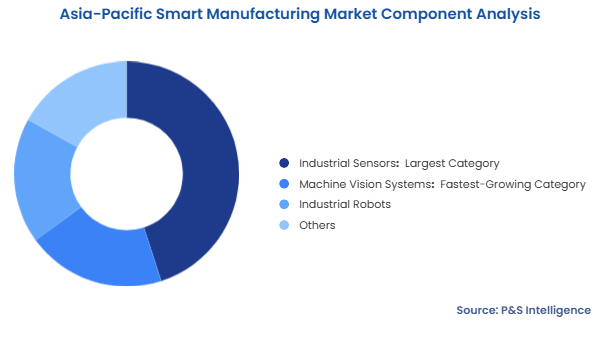
Industrial sensors commanded the largest component share in 2025, of 45%, providing foundational data acquisition capabilities that enable predictive maintenance, process optimization, and quality control across automotive assembly lines, semiconductor fabrication equipment, and pharmaceutical batch production systems. Sensors measuring temperature, pressure, vibration, and flow parameters generate the real-time data streams that machine learning algorithms analyze to predict equipment failures 48-72 hours before breakdown events occur.
This allows maintenance teams to schedule interventions during planned downtime rather than responding to emergency shutdowns that halt entire production lines. The proliferation of wireless sensor networks eliminates costly conduit installation and cable routing that previously limited sensor deployment density, enabling manufacturers to instrument previously unmonitored equipment and gather granular data on asset performance across facilities without disruptive retrofit construction.
Machine vision systems are projected to experience the fastest expansion through 2032, with 14.6% CAGR, as artificial intelligence-powered image recognition capabilities enable automated defect detection at speeds and accuracy levels exceeding human visual inspection. Three-dimensional vision systems deployed in automotive welding operations verify weld bead geometry in real-time, rejecting defective joints before painted body assemblies advance to final assembly stations where rework costs escalate dramatically.
Electronics manufacturers implement inline optical inspection systems that examine printed circuit board solder joints at rates exceeding 100,000 inspections hourly, identifying cold solder joints, bridging defects, and component misalignments that manual inspection would miss at production velocities. China's rapid automation adoption in consumer electronics assembly is expanding machine vision deployment across smartphone manufacturing, laptop computer assembly, and wearable device production where miniaturized components demand sub-millimeter inspection precision.
The market segments into the following components:
Industrial Sensors (Largest Category)
Machine Vision Systems (Fastest-Growing Category)
Industrial Robots
Others
End-Use Industry Analysis
The automotive category dominated the market, sustained by decades of industrial robot deployment establishing the highest robot density among major manufacturing sectors and ongoing electric vehicle production expansion requiring reconfigurable assembly lines supporting mixed-model sequencing. Traditional ICE assembly involves 300–400 discrete fastening operations executed by fixed-position robots optimized for repetitive tasks. Whereas, EV battery pack assembly demands flexible automation capable of handling battery cells from multiple suppliers with varying dimensional tolerances.
China leads global automotive production with approximately 31.3 million vehicles produced in 2024. Japan followed with around 8.2 million vehicles, while India produced about 6.0 million vehicles. South Korea recorded production of roughly 4.1 million vehicles, while Thailand produced approximately 1.5 million vehicles and Indonesia 1.2 million vehicles in 2024.
This creates demand for vision-guided robotic systems and adaptive fixturing that adjusts automatically to component variation. Automotive tier-one suppliers face cascading digital integration mandates from original equipment manufacturers requiring real-time production data sharing, supply chain visibility, and quality traceability documentation, accelerating manufacturing execution system adoption among component manufacturers serving Toyota, Volkswagen, and BYD production networks.
The electronics & semiconductor category is expected to grow the fastest, through 2032, driven by semiconductor fabrication facilities demanding sub-micron process control accuracy. Here, artificial intelligence-based run-to-run optimization algorithms adjust lithography exposure parameters between wafer batches to maintain tight dimensional control. Advanced semiconductor nodes below 7 nanometers require real-time monitoring of thousands of process variables across deposition, etch, and planarization equipment.
Edge computing systems analyze sensor data streams to detect process drift before defective wafers are produced. Consumer electronics assembly operations serving smartphone and tablet computer manufacturers deploy collaborative robots alongside human workers for component insertion, adhesive dispensing, and final testing operations where production volumes fluctuate rapidly based on seasonal demand patterns requiring flexible automation that scales capacity without adding permanent headcount.
The market segments into the following end-use industries:
Drive strategic growth with comprehensive market analysis
Asia-Pacific Smart Manufacturing Market Regional Outlook
China Smart Factory Market Size
China led the market in 2025 with 40% revenue, sustained by the Made in China 2025 initiative that systematically allocated state resources toward robotics, semiconductors, and industrial automation development. The U.S.-China Economic and Security Review Commission reports that China met or exceeded many ambitious global market share and technology development targets across advanced manufacturing sectors through coordinated deployment of government-backed investment funds, manufacturing innovation centers, and strategic acquisition of foreign technology capabilities.
Manufacturing execution systems dominate technology deployment, capturing more than 22% of national investments as automotive OEMs transition electric vehicle production lines to reconfigurable body-in-white systems requiring real-time visibility across distributed facilities. The National Integrated Circuit Industry Investment Fund allocated USD 47.5 billion in 2024 specifically for semiconductor manufacturing automation, reinforcing smart factory infrastructure supporting lithography yield optimization. Provincial-level matching grants compressed automation payback periods below three years for small and medium enterprises, accelerating adoption beyond traditional automotive strongholds into pharmaceutical continuous manufacturing and food processing facilities across Guangdong, Jiangsu, and Zhejiang provinces.
India Smart Factory Market Growth
India will demonstrate the fastest growth, advancing at 14.5% CAGR during 2026–2032, propelled by the SAMARTH Udyog Bharat 4.0 initiative that established demonstration centers lowering entry barriers for automation adoption. India's Ministry of Heavy Industries established 4 Smart Advanced Manufacturing and Rapid Transformation Hub (SAMARTH) Centres providing training for 9,800 individuals and validating plug-and-play automation kits specifically designed for resource-constrained manufacturing environments.
Automotive plants in Tamil Nadu and Maharashtra have embedded digital twin capabilities from commissioning, avoiding retrofitting costs that constrained legacy installations, while pharmaceutical clusters in Hyderabad implemented continuous manufacturing skids meeting international export quality standards. The Centre for Industry 4.0 (C4i4) Lab deployed 10 cluster experience centers under hub-and-spoke architecture, enabling SMEs across Karnataka, Maharashtra, and Gujarat to pilot IoT-enabled predictive maintenance before full-scale implementation. Government-backed Industrial Infrastructure Upgrade Projects allocated dedicated funding for power quality improvements and industrial corridor development integrating logistics nodes with edge computing data centers, addressing infrastructure constraints that previously limited smart manufacturing expansion beyond metropolitan manufacturing zones.
Japan Smart Factory Market Analysis
Japan combined decades-established robot density exceeding 1,000 units per 10,000 manufacturing employees with AI-enhanced scheduling systems addressing skilled-labor constraints through predictive maintenance automation. Japan's Ministry of Economy, Trade and Industry (METI) advanced the Connected Industries framework to achieve Society 5.0 through integration of IoT, artificial intelligence, and big data across manufacturing value chains, emphasizing connection of factory-floor data with problem-solving capabilities developed by seasoned technical workers.
Automotive precision assembly operations deployed collaborative robotics with advanced sensor integration enabling mixed-model sequencing without production line downtime, supporting just-in-time manufacturing efficiency requirements. Semiconductor fabrication facilities in Kyushu implemented edge-AI systems optimizing lithography processes through real-time yield analysis, while electronics manufacturing in Tokyo integrated machine vision inspection systems achieving sub-micron defect detection capabilities. The Cross-ministerial Strategic Innovation Promotion Program coordinated research across manufacturing automation, smart city infrastructure, and digital platform development, facilitating technology transfer from national laboratories to private sector implementation through Innovation Centres supporting Mitsubishi Electric, Fanuc, and Yaskawa Electric advancement of industrial robotics control architectures.
The Asia-Pacific smart manufacturing market exhibits moderate fragmentation, with traditional automation majors maintaining substantial installed-base advantages while specialized regional players and emerging technology vendors target specific functional domains and customer segments. Market structure reflects diverse industrial requirements across automotive body shops demanding high-payload six-axis robotics, semiconductor fabs requiring ultra-precision motion control, and pharmaceutical facilities prioritizing validation-compliant process documentation. Global automation leaders leverage decades of factory-floor presence to upsell subscription analytics that monetize hardware footprints through data platform services, while regional specialists capitalize on proximity advantages and rapid engineering cycles to deliver equipment customized for local compliance standards and language requirements.
Competitive intensity is accelerating around edge analytics, cybersecurity integration, and flexible financing models that enable small and medium enterprise adoption. Chinese vendors including Huawei Technologies and domestic control system providers are targeting mid-market installations with bundled private 5G networking and edge computing platforms offered at aggressive discount pricing, intensifying pressure on established players to differentiate through service capabilities rather than hardware specifications alone.
Leading Companies in Asia-Pacific Smart Manufacturing Market:
In April 2025, Omron Corporation partnered with Cognizant to integrate operational technology equipment portfolios with information technology operational integration consulting services, combining Omron's 200,000 hardware product catalog with Cognizant's enterprise digital transformation capabilities. The collaboration addresses manufacturer demand for unified automation and analytics implementations spanning factory equipment through cloud business intelligence platforms.
In January 2025, Huawei Technologies unveiled an upgraded Intelligent Factory Solution, integrating production networks with artificial intelligence-driven platforms targeting manufacturing optimization across Asia-Pacific facilities. The solution addresses demand for converged operational technology and information technology architectures that enable real-time production data analysis and autonomous decision-making capabilities.
In December 2024, Schaeffler AG acquired Dhruva Automation to strengthen engineering services capabilities across Asia-Pacific markets, expanding regional technical support infrastructure for automotive and industrial automation installations. This acquisition positions Schaeffler to deliver localized integration consulting and commissioning services supporting complex automation deployments.
In August 2024, Cisco Systems Inc. and Rockwell Automation Inc. signed a memorandum of understanding to accelerate digital transformation initiatives across Asia-Pacific, Japan, and Greater China regions through collaborative development of industrial networking solutions. The partnership combines Cisco's networking infrastructure with Rockwell's manufacturing execution platforms to deliver converged edge-to-cloud architectures.
In May 2024, Mitsubishi Electric Corporation invested in Realtime Robotics to integrate multirobot path optimization algorithms into automotive assembly plants, enabling simultaneous coordination of collaborative robots without pre-programmed trajectories. The technology reduces programming time for mixed-model production lines from weeks to hours while eliminating collision risks in dense robotic work cells.
Frequently Asked Questions About This Report
What will be APAC Smart manufacturing market size in 2032?+
In 2032, the smart manufacturing market in APAC will be USD 488.9 billion.
Which technology has fastest APAC Smart manufacturing industry growth?+
HMIs have the highest APAC Smart manufacturing industry CAGR, of 14.7%.
Which country has largest APAC smart manufacturing market share?+
China is the largest smart manufacturing market in APAC, with 40% share.
What are the key APAC smart manufacturing industry drivers?+
The APAC Smart manufacturing industry is driven by accelerating adoption of manufacturing execution systems, industrial robotics, and machine vision technologies across automotive, electronics, and pharmaceutical sectors, positioning the region as the global epicenter for Industry 4.0 implementation.
What is the APAC smart manufacturing market nature?+
The smart manufacturing market in APAC is moderately fragmented.
Want a report tailored exactly to your business need?
Leading companies across industries trust us to deliver data-driven insights and innovative solutions for their most critical decisions. From data-driven strategies to actionable insights, we empower the decision-makers who shape industries and define the future. From Fortune 500 companies to innovative startups, we are proud to partner with organisations that drive progress in their industries.
Client Testimonials
Working with P&S Intelligence and their team was an absolute pleasure – their awareness of timelines and commitment to value greatly contributed to our project's success. Eagerly anticipating future collaborations.
McKinsey & Company
India
Unmatched Standards
Our insights into the minutest levels of the markets, including the latest trends and competitive landscape, give you all the answers you need to take your business to new heights
Complete Data Security
We take a cautious approach to protecting your personal and confidential information. Trust is the strongest bond that connects us and our clients, and trust we build by complying with all international and domestic data protection and privacy laws