Asia-Pacific EV Battery Recycling Market Size Forecast
Key Highlights
| Study Period | 2021 - 2032 |
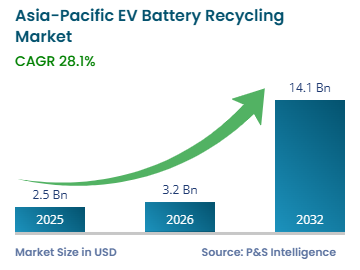
| Market Size in 2025 | USD 2.5 Billion |
| Market Size in 2026 | USD 3.2 Billion |
| Market Size by 2032 | USD 14.1 Billion |
| Projected CAGR | 28.1% |
| Largest Country | China |
| Fastest-Growing Country | India |
| Market Structure | Moderately Consolidated |
Market Size
Explore the market potential with our data-driven report
APAC EV Battery Recycling Market Key Insights
- Lithium-ion batteries accounted for the largest share in 2025, of 45%, and it also has the highest CAGR, of 28.3%.
- Hydrometallurgical processing held the largest share, of 60%, and is expected to demonstrate the fastest growth during 2026–2032, of 28.4%.
- Metals accounted for the largest share in 2025, of 40%, reflecting the economic significance of lithium, cobalt, nickel, manganese, copper, and aluminum extracted from spent batteries.
- Electrolyte is expected to experience the fastest growth during 2026–2032, of 28.6%, driven by emerging technologies for lithium hexafluorophosphate (LiPF6) and organic solvent reclamation from battery electrolyte solutions.
- China held 40% Asia-Pacific market share in 2025, due to comprehensive regulatory frameworks, extensive manufacturing infrastructure, and mandated producer responsibility systems.
Asia-Pacific EV Battery Recycling Market Analysis
The Asia-Pacific EV battery recycling market size was USD 2.5 billion in 2025, which is anticipated to expand at a CAGR of 28.1% during 2026–2032, reaching approximately USD 14.1 billion by 2032. This growth is supported by the accelerating deployment of lithium-ion battery recycling infrastructure across China, India, Japan, and South Korea, positioning the region as the global leader in circular battery economy development. The expansion is reinforced by hydrometallurgical and pyrometallurgical processing facilities that enable recovery rates exceeding 95% for critical materials including lithium, cobalt, nickel, and manganese.
The International Energy Agency (IEA) reports that electric car sales in emerging and developing economies in Asia reached almost 400,000 in 2024, up over 40% from 2023, with China accounting for more than 11 million electric vehicles sold in 2024—representing nearly half of all car sales in the country.
Asia-Pacific EV Battery Recycling Market Trends & Drivers
Hydrometallurgical Process Innovations Are Key Market Trends
Advanced hydrometallurgical processing technologies are transforming battery recycling economics by enabling higher recovery rates with substantially lower energy consumption compared to traditional pyrometallurgical methods. Hydrometallurgy achieves recovery efficiency exceeding 95% for critical metals including lithium, cobalt, nickel, and manganese through chemical leaching processes that reduce energy requirements by approximately 50% relative to virgin material extraction. This technological evolution addresses both economic viability and environmental sustainability constraints that previously limited recycling adoption at commercial scale.
The IEA reports that global recycling capacity reached over 300 GWh/year in 2023, of which more than 80% was located in China, demonstrating concentrated regional investment in advanced processing infrastructure.
Regional operators are deploying nanofiltration membrane technologies, automated sorting systems powered by artificial intelligence, and integrated chemical recovery processes that minimize wastewater generation while maximizing material yield. These process innovations position hydrometallurgy as the dominant recycling methodology through 2032, supported by ongoing research partnerships between battery manufacturers, recycling specialists, and academic institutions focused on direct cathode recycling techniques that preserve material structure for immediate remanufacturing.
Surging Electric Vehicle Penetration Creating Expanding Feedstock Availability
The accelerating deployment of electric vehicles across Asia-Pacific markets is generating unprecedented volumes of end-of-life batteries and manufacturing scrap that create sustained feedstock availability for recycling operations. China alone anticipates annual battery retirements exceeding 357 GWh in 2025, projected to surpass 1,100 GWh by 2030 as the country's first-generation EV fleet reaches end-of-life. This retirement wave reflects the maturation of markets where EV penetration began in 2010–2015, creating reliable battery streams that support facility capacity utilization and economic viability for recycling investments.
In China, with around 11–13 million electric vehicles were sold in 2025, accounting for well over half of global EV sales. India recorded about 100,000 electric car sales in 2024, while South Korea saw a stronger rebound, with EV sales growing by roughly 40–50% in 2024–2025 supported by incentives and new models.
Economic and Social Commission for Asia and the Pacific (ESCAP) emphasized that by 2030, the promise of a truly sustainable ecosystem depends on implementing circular economy principles and capacity-building across the battery lifecycle. Manufacturing scrap from the region's dominant battery production facilities contributes additional feedstock, with production reject rates generating pristine material for immediate reprocessing. The convergence of rising EV sales—particularly in India, Thailand, Indonesia, and Vietnam where electric vehicle adoption surged over 40% in 2024—with aging battery stocks from established markets creates dual feedstock streams that support both near-term capacity expansion and long-term recycling infrastructure investments.
Second-Life Battery Applications Could Restrain Market Growth
The emergence of second-life battery markets for stationary energy storage, renewable energy integration, and grid stabilization applications presents opportunities to extend battery value realization before final material recovery. Retired EV batteries retaining 70–80% of original capacity can be repurposed for less-demanding applications, including residential solar storage, commercial building energy management, and telecommunications backup power, delaying recycling processing costs. This cascade utilization maximizes return on initial battery investment and reduces immediate demand for costly recycling infrastructure.
Growing renewable energy deployment across Asia-Pacific—particularly solar and wind installations requiring energy buffering capabilities—creates substantial demand for cost-effective stationary storage solutions that second-life batteries can fulfill at competitive pricing relative to new battery systems. Manufacturers including Nissan, BYD, and CATL are developing standardized testing protocols, performance classification systems, and warranty frameworks for second-life battery commercialization at scale.
Asia-Pacific EV Battery Recycling Market Segmentation and Category Analysis
Battery Type Analysis
Lithium-ion batteries accounted for the largest share in 2025, of 45%, and it also has the highest CAGR, of 28.3%. This is driven by their high-volume deployment in electric vehicles due to their superior energy density, longer lives, and higher power-to-weight ratio compared to alternative battery chemistries. The category’s market leadership stems from its established manufacturing infrastructure across Asia-Pacific—particularly in China, South Korea, and Japan—which has achieved economies of scale that reduce unit costs by approximately 30% compared to early-generation production. These batteries also benefit from comprehensive supply chain integration spanning cathode material production, cell manufacturing, and pack assembly, creating operational efficiencies that reinforce cost competitiveness and market penetration.
The market segments into the following battery types:
- Lithium-Ion (Largest and Fastest-Growing Category)
- Lead–Acid
- Nickel-based
- Others
Recycling Process Analysis
Hydrometallurgical processing held the largest share, of 60%, and is expected to demonstrate the fastest growth during 2026–2032, of 28.4%, driven by its capability to achieve recovery rates exceeding 95% for target metals while consuming approximately 50% less energy compared to pyrometallurgical methods. This process employs chemical leaching techniques—utilizing sulfuric acid, hydrochloric acid, or organic solvents—that selectively dissolve cathode materials and enable precise separation of lithium, cobalt, nickel, and manganese through subsequent precipitation and purification steps. Hydrometallurgy's growth trajectory reflects technological improvements including nanofiltration membrane systems, automated pH control, and integrated wastewater recycling that minimize environmental impact while maximizing material yield.
The market segments into the following recycling processes:
- Hydrometallurgical (Largest and Fastest-Growing Category)
- Pyrometallurgical
- Physical/Mechanical
Material Recovered Analysis
Metals accounted for the largest share in 2025, of 40%, reflecting the economic significance of lithium, cobalt, nickel, manganese, copper, and aluminum extracted from spent batteries. This category's market lead stems from the high intrinsic value of transition metals—particularly cobalt and nickel, which command prices exceeding USD 30,000 per metric tonne. This combines with established commodity markets and industrial demand that enables immediate monetization of recovered materials. The category also benefits from mature pyrometallurgical and hydrometallurgical processing technologies capable of achieving purity levels exceeding 99% for target elements, meeting specifications required for direct reintegration into battery manufacturing supply chains.
Electrolyte is expected to experience the fastest growth during 2026–2032, of 28.6%, driven by emerging technologies for lithium hexafluorophosphate (LiPF6) and organic solvent reclamation from battery electrolyte solutions. This segment's acceleration reflects technological breakthroughs in membrane separation, vacuum distillation, and chemical regeneration processes that transform electrolyte recovery from waste disposal challenge into value-generation opportunity, particularly as electrolyte costs represent approximately 15% of total battery material expenses.
The market segments into the following materials:
- Metals (Largest Category)
- Lead
- Lithium
- Cobalt
- Nickel
- Manganese
- Copper
- Aluminum
- Others
- Graphite/Carbon
- Electrolyte (Fastest-Growing Category)
- Plastics & Separators
- Others
Service Analysis
Collection & reverse logistics services accounted for the largest share, of 40%, in 2025, reflecting the operational complexity and infrastructure requirements for establishing battery take-back networks, transportation systems, and interim storage facilities that connect dispersed battery retirement points with centralized processing operations. This segment's market leadership stems from the capital-intensive nature of collection infrastructure—including specialized transportation vehicles equipped with fire suppression systems, regional consolidation centers, and digital tracking platforms—that creates barriers to entry and supports sustained market share for established operators with comprehensive network coverage.
Material recovery & refining services are expected to register the fastest growth, of 28.5%, during 2026–2032, propelled by the high value-add nature of chemical processing operations that transform battery scrap into marketable metal compounds and refined materials. This segment benefits from technological innovation in hydrometallurgical processing, direct cathode recycling, and integrated purification systems that achieve premium pricing through superior purity specifications exceeding 99.9% for critical metals, enabling closed-loop integration with battery manufacturing operations that require consistent material quality for production efficiency.
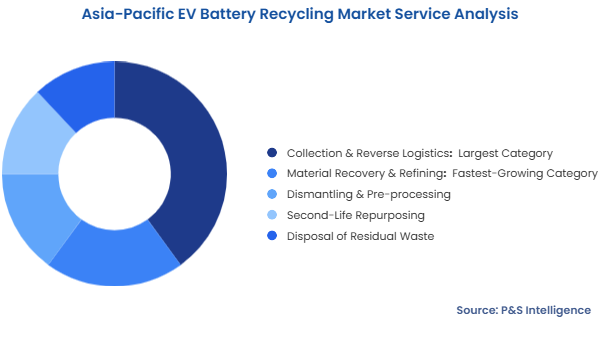
The market segments into the following services:
- Collection & Reverse Logistics (Largest Category)
- Material Recovery & Refining (Fastest-Growing Category)
- Dismantling & Pre-processing
- Second-Life Repurposing
- Disposal of Residual Waste
Drive strategic growth with comprehensive market analysis
Asia-Pacific EV Battery Recycling Market Regional Growth Dynamics
China EV Battery Recycling Market Outlook
China held 40% Asia-Pacific market share in 2024, due to comprehensive regulatory frameworks, extensive manufacturing infrastructure, and mandated producer responsibility systems. The country's position stems from operating over 156 white-listed recycling enterprises approved by the Ministry of Industry and Information Technology, processing capacity exceeding 3.7 million metric tons annually, and integration with more than 70% of global EV battery production facilities. China's Specifications for Comprehensive Utilization of Waste EV Batteries (2024 Edition) establish stringent technical requirements including 90% lithium recovery rates, 98% nickel–cobalt–manganese recovery rates, and mandatory traceability through the National EV Monitoring and Management Platform.
This structural advantage strengthens as annual EV battery retirements are projected to exceed 357 GWh in 2025 and surpass 1,100 GWh by 2030, creating sustained feedstock availability. Major recycling hubs have concentrated in Hubei, Zhejiang, and Guangdong provinces, where GEM Co. Ltd., CATL's BRUNP Recycling subsidiary, and Huayou Cobalt operate integrated recovery facilities. China's trajectory remains robust through 2032, reinforced by the 14th Five-Year Plan's circular economy targets and ongoing investments in hydrometallurgical processing technologies that reduce energy consumption by 50% compared to virgin material extraction.
The IEA reports that China accounts for more than 70% of global EV battery production capacity, establishing regional dominance in lithium-ion battery manufacturing that directly translates to recycling feedstock availability.
India EV Battery Recycling Market Growth
India represents the fastest-growing country market within Asia-Pacific, with 28.2% CAGR, driven by accelerating EV adoption under the FAME II policy, expanding domestic battery manufacturing capacity, and increasing government focus on e-waste management regulations. The market's rapid expansion reflects India's strategic positioning as both a major EV consumer market and an emerging hub for battery production, with many OEMs scaling production volumes. India's Battery Waste Management Rules mandate extended producer responsibility and establish collection targets for end-of-life batteries, creating formal recycling channels that previously did not exist at scale.
The IEA reported that electric car sales in India grew 45% year-on-year in the first quarter of 2025, nearing 35,000 units, reflecting sustained momentum in EV market penetration that directly increases the volume of batteries entering recycling streams. India's recycling infrastructure development is driven by investments by domestic firms in hydrometallurgical facilities with combined capacity exceeding 25,000 metric tonnes annually. The government's PLI scheme for advanced chemistry cells further accelerates market development by incentivizing local battery manufacturing, which creates both production scrap and end-of-life battery streams for recycling.
Japan EV Battery Recycling Market Analysis
Japan maintains an established position in the Asia-Pacific recycling ecosystem, supported by decades of battery manufacturing expertise, mature collection infrastructure, and advanced recycling technologies developed by major automotive and electronics companies. The market's foundation rests on Japan's Sound Material-Cycle Society principles, which prioritize resource recovery and circular economy practices, combined with strong partnerships between automakers including Toyota, Nissan, and Honda and recycling specialists such as Sumitomo Metal Mining and JX Nippon Mining & Metals. Japan's regulatory framework through the Ministry of Economy, Trade and Industry establishes clear battery take-back requirements and processing standards that ensure high recovery rates for cobalt, nickel, and lithium.
Japanese recycling operations emphasize precision dismantling and material separation technologies that achieve recovery efficiency exceeding 95% for target metals while minimizing environmental impact. The country's automotive manufacturers have integrated battery recycling into vehicle lifecycle management, with Nissan operating dedicated facilities that process Leaf EV batteries for both second-life applications and material recovery. Japan's domestic EV penetration, while lower than China's in absolute volumes, generates steady feedstock for recycling operations, supplemented by imported battery scrap from regional markets.
Japan's trajectory through 2032 reflects measured growth as the country transitions its automotive fleet toward electrification under the Green Growth Strategy, which targets carbon neutrality by 2050. This transition will gradually increase battery retirement volumes while Japan maintains technological leadership in recycling process innovation, particularly in developing efficient methods for processing next-generation solid-state batteries that are expected to enter the market in the late 2020s.
The countries analyzed in this report include:
- China (Largest Country Market)
- India (Fastest-Growing Country Market)
- Japan
- South Korea
- Australia
- Thailand
- Indonesia
- Vietnam
- Malaysia
- Singapore
- Rest of APAC
Asia-Pacific EV Battery Recycling Market Share Analysis
The Asia-Pacific EV battery recycling market exhibits moderate concentration, with several established players maintaining significant regional presence through integrated recycling infrastructure, strategic partnerships with automotive manufacturers, and proprietary processing technologies. Market structure reflects the region's dominant position in both EV production and battery manufacturing, creating natural advantages for companies with vertical integration capabilities spanning battery production, vehicle assembly, and end-of-life material recovery. China's regulatory white-listing system, which now includes 156 approved recycling enterprises, shapes competitive dynamics by establishing quality and capacity thresholds that favor larger, technologically advanced operators capable of meeting stringent recovery rate requirements and traceability standards.
Strategic partnerships between automotive manufacturers and recycling operators are reshaping competitive positioning. As battery retirement volumes accelerate through 2032, competitive advantage will increasingly depend on securing stable feedstock supply through manufacturer partnerships, achieving operational efficiency in material recovery processes, and maintaining regulatory compliance across multiple jurisdictions with evolving standards.
Key Players in Asia-Pacific EV Battery Recycling Market:
- GEM Co. Ltd.
- Contemporary Amperex Technology Co. Limited (CATL)
- LG Energy Solution
- Samsung SDI Co. Ltd.
- Neometals Ltd.
- Exide Industries Limited
- GS Yuasa International Ltd.
- Huayou Cobalt Co. Ltd.
- BatX Energies
- Li-Cycle Holdings Corp.
Asia-Pacific EV Battery Recycling Market News
- In July 2025, BatX Energies inaugurated a Li-ion battery recycling facility (HUB‑1) in Uttar Pradesh. It will process used EV batteries to support India’s growing EV ecosystem and reduce import dependence.
- In July 2025, Eco Recycling Ltd. announced plans to set up a 6,000-metric tonnes per annum. Li-ion battery recycling facility near Mumbai (Vasai).
- In June 2025, Maxvolt Energy revealed plans to expand its lithium battery recycling and repurposing operations by establishing a new facility near its manufacturing base in Ghaziabad.
- In June 2025, Chinese battery recycler Ganzhou Energy Metal expanded operations with seven power battery recycling centers across South Korea and Indonesia.
- In February 2025, Mobec Innovation opened its first Li-ion battery recycling plant in Noida, Uttar Pradesh, featuring advanced recovery processes for lithium, cobalt, and nickel.
- In January 2025, Ace Green Recycling finalized a site agreement to build a battery recycling facility in Mundra, Gujarat, with plans to establish 10,000 tonnes per year of LFP battery recycling capacity by 2026.
- In January 2024, Contemporary Amperex Technology Co. Limited (CATL) announced a joint venture with a Chinese utility provider to develop large-scale energy storage systems using second-life EV batteries.
- In August 2023, LG Energy Solution established its first battery recycling joint venture with Huayou Recycling in China to build a pretreatment plant in Nanjing and a post‑processing plant in Quzhou, aimed at recovering key metals for reuse in its own battery supply chain.
- In July 2023, POSCO HY Clean Metal, a joint venture of Posco Holdings, GS Energy, and Huayou Cobalt, completed a secondary EV battery recycling plant in the South Jeolla Province of South Korea. The factory is capable of processing up to 12,000 tonnes of black mass annually, to extract nickel, cobalt, and lithium.