Asia-Pacific Electric Two-Wheeler Market Size & Share Analysis - Trends, Drivers, Competitive Landscape, and Forecasts (2026 - 2032)
This Report Provides In-Depth Analysis of the Asia-Pacific Electric Two-Wheeler Market Report Prepared by P&S Intelligence, Segmented by Product Type (Scooter, Motorcycle, Bicycle), Battery Type (Lithium-Ion, Sealed Lead-Acid (SLA), Nickel-Metal Hydride (NiMH)), Technology (Battery, Plug-in), Range (Less than 50 km, 50, 101, Greater than 150 km), Application (Personal Use, E-Commerce Delivery, Sharing Services), Sales Channel (Offline, Online), and Geographical Outlook for the Period of 2021 to 2032
Asia-Pacific Electric Two-Wheeler Market Size Forecast
Key Highlights
Study Period
2021 - 2032
Market Size in 2025
USD 17.7 Billion
Market Size in 2026
USD 20.2 Billion
Market Size by 2032
USD 47.3 Billion
Projected CAGR
15.1%
Largest Country
China
Fastest-Growing Country
India
Market Structure
Fragmented
Market Size
Explore the market potential with our data-driven report
Asia-Pacific Electric Two-Wheeler Market Future Outlook
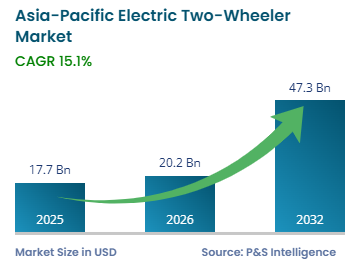
The Asia-Pacific electric two-wheeler market size was USD 17.7 billion for 2025, and it will grow by 15.1% during 2026–2032, to reach USD 47.3 billion by 2032.
The market is driven by the widespread adoption of lithium-ion battery technology, accelerating urbanization across densely populated cities, and government-led electrification incentive programs, which are reducing upfront vehicle costs while expanding charging networks and battery-swapping infrastructure, thereby lowering adoption barriers across urban and peri-urban regions. Electric two-wheelers, spanning scooters, motorcycles, and bicycles, are progressively positioned as cost-competitive, environmentally aligned alternatives to internal combustion engine vehicles across personal mobility and commercial last-mile delivery applications.
Government-led sustainability and electrification initiatives in Australia are targeting urban transport emissions and expanding the micromobility policy framework. Australia Post has deployed electric bikes across its last-mile delivery fleet to reduce urban transport emissions and improve operational efficiency. Strong consumer demand across China, India, and Southeast Asian nations sustains this momentum. Two-wheelers function as the primary mode of private passenger transport across these markets, embedding electric variants into daily mobility patterns as infrastructure matures.
Key Market Insights
The lithium-ion category holds the largest market share, of 60%, in 2025, and it will have the highest CAGR, driven by higher energy density and lower weight, enabling longer range.
The plug-in category holds the larger market share, of 75%, in 2025, and it will have the higher CAGR, of 15.2%, driven by the widespread availability of standard charging outlets across residential and commercial settings, making it the default charging solution.
The 50-100 km category holds the largest market share, of 45%, in 2025, driven by alignment with daily urban and peri-urban commuting needs.
The offline category holds the larger market share, of 70%, in 2025, supported by physical dealerships enabling test rides, financing access, and dependable after-sales service.
China holds the largest market share, of 35%, in 2025, driven by its highly concentrated domestic manufacturing ecosystem.
Asia-Pacific Electric Two-Wheeler Market Trends & Drivers
Lithium-Ion Battery Cost Decline and Energy Density Improvements Are Key Trends
A key trend in the Asia-Pacific electric two-wheeler market is the rapid shift from sealed lead-acid batteries to lithium-ion technology. This transition is being driven by declining battery costs and improving energy density, enabling manufacturers to offer better range across increasingly competitive price segments. As energy density improves, vehicles are now capable of achieving higher range levels that were previously unattainable in mass-market segments, expanding adoption beyond urban short-commute users to peri-urban and rural riders requiring vehicles capable of 100 km or more on a single charge.
The International Energy Agency (IEA) confirms that lithium-ion battery pack prices fell 20% in 2024, marking the largest annual decline since 2017. Low critical mineral prices and intense manufacturing competition concentrated in China produced this cost compression. This reduction in input costs lowers the bill-of-materials for electric two-wheelers, enabling OEMs to extend product portfolios toward 50–100 km and higher-range configurations at more competitive price points. Lithium iron phosphate (LFP) chemistry is gaining traction in mass-market scooters, due to its thermal stability and longer cycle life, making it well-suited for high-frequency daily usage while maintaining a competitive cost profile. As battery performance continues improving and lithium prices stabilize, the transition toward higher-range lithium-ion equipped two-wheelers is expected to accelerate across India, Southeast Asia, and Japan through 2032.
Government Policy Mandates and Purchase Incentives Are Biggest Drivers
Government electrification mandates and structured purchase incentive frameworks across Asia-Pacific are compelling consumers and fleet operators to transition from internal combustion engine two-wheelers to electric alternatives at an accelerating pace. Municipal restrictions on gasoline-powered motorcycles across major Chinese cities, combined with priority and free license plate allocation for electric vehicles, are removing the internal combustion alternative at the regulatory level and reinforcing this structural pressure at the point of consumer acquisition. India’s policy architecture extends beyond demand-side incentives into domestic manufacturing. The government has approved the Production Linked Incentive (PLI) Scheme for Advanced Chemistry Cell (ACC) batteries with an outlay of INR 18,100 crore. This approval is strengthening domestic battery supply chains and reducing dependence on imported cell components.
Japan supports adoption through subsidies covering up to one-third of electric two-wheeler purchase costs. South Korea provides combined central and local government incentives exceeding KRW 3 million per vehicle, reducing upfront acquisition costs for domestic consumers across both markets. Across Southeast Asia, governments are accelerating adoption through targeted subsidies and industrial policies. Indonesia's subsidy framework provides IDR 7 million per electric two-wheeler. The total program allocation of IDR 7 trillion targets 800,000 new electric motorcycles and 200,000 conversions. Eligibility is tied to a minimum 40% local content requirement (TKDN). This conditionality aligns the consumer incentive structure with the development of domestic manufacturing capacity. Moreover, Thailand has introduced EV promotion measures, including excise tax reductions and import duty exemptions. Targeted incentives for locally manufactured electric vehicles extend the policy's reach into the domestic production segment.
E-Commerce Logistics Expansion and Last-Mile Delivery Fleet Electrification Are Biggest Opportunities
The rapid expansion of e-commerce across Asia-Pacific's urban and semi-urban corridors is generating structural demand for electric two-wheelers as the preferred last-mile delivery vehicle. Cost efficiency in high-utilization applications makes electric two-wheelers financially favorable for delivery fleet operators at scale, while alignment with corporate sustainability commitments reinforces adoption decisions at the fleet procurement level. Delivery operators accumulating 80–150 km of daily urban mileage achieve a favorable total cost of ownership versus gasoline alternatives. Lower fuel and maintenance expenditures yield payback periods well under three years in major markets.
Flipkart has committed to transitioning to a 100% electric delivery fleet in India by 2030. Amazon has deployed over 10,000 electric delivery vehicles across Indian logistics operations. These commitments establish the scale of commercial demand for electric two-wheelers in the e-commerce delivery segment. India's high order volumes and dense urban delivery networks reinforce the suitability of two-wheeler-based logistics models, and as charging infrastructure densifies in tier-2 and tier-3 cities alongside the expansion of battery-swapping networks for commercial operators, the addressable market is expected to grow beyond current metropolitan adoption concentrations through the forecast period.
Charging Infrastructure Deficits and Grid Reliability Constraints Are Key Restraints Limiting Adoption in Emerging Markets
Despite strong policy intent, inadequate public charging infrastructure and inconsistent electricity grid reliability in rural and semi-urban areas across Southeast Asia and India's smaller cities constrain electric two-wheeler adoption among consumers who lack home charging access. Riders in dense urban cores with home or workplace charging face manageable barriers, while peri-urban corridors, representing key high-growth areas targeted by next-phase expansion, face sparse public charging availability that generates range anxiety and discourages adoption among riders without reliable charging access. The International Energy Agency (IEA) indicates that continued growth in electric two-wheeler adoption across emerging markets is highly dependent on sustained charging infrastructure expansion and grid reliability improvements.
Australia recorded over 2,500 public EV charging locations as of 2024, including more than 1,000 fast-charging sites. Coverage remains unevenly distributed across regional and rural areas, constraining broader electric vehicle adoption beyond established urban centers. Governments and private operators are responding through battery-swapping network deployment and targeted charging infrastructure grants under schemes such as PM E-DRIVE. Battery-swapping deployment is concentrated in India's commercial two-wheeler segment. Last-mile grid reinforcement in tier-3 cities and rural corridors requires multi-year capital deployment timelines, and while this constraint is expected to moderate through the forecast period, it will persist as a structural adoption barrier into the mid-forecast horizon.
Asia-Pacific Electric Two-Wheeler Market Segmentation Analysis
Product Type Analysis
The scooter category holds the largest market share, of 45%, in 2025, driven by step-through ergonomics and a lightweight platform, which make electric scooters well-suited for short urban commutes across Asia-Pacific's densely populated cities. Affordable entry pricing across Chinese mass-market models extends consumer accessibility across income levels. Established scooter manufacturing ecosystems in China and India reinforce category dominance through production scale advantages and comprehensive retail distribution networks.
The motorcycle category will have the highest CAGR, of 15.3%, driven by rising consumer demand for performance-oriented electric vehicles in India and Southeast Asia, creating a commercially significant addressable market for higher-displacement electric platforms. Expanding product availability from domestic OEMs and Japanese manufacturers is broadening the competitive landscape and increasing purchase options across performance tiers. Government acceptance of higher-speed electric platforms within reformed urban mobility frameworks is removing the regulatory barriers that previously constrained motorcycle electrification.
The product types analyzed in this report are:
Scooter (Largest Category)
Motorcycle (Fastest-Growing Category)
Bicycle
Others
Battery Type Analysis
The lithium-ion category holds the largest market share, of 60%, in 2025, and it will have the highest CAGR, driven by higher energy density and lower pack weight, which extend viable range and reduce vehicle mass relative to sealed lead-acid alternatives. Longer cycle life reduces total battery replacement costs across a vehicle's operating life. Declining pack costs are narrowing the upfront price gap with sealed lead-acid alternatives at mass-market price points. Lithium iron phosphate (LFP) chemistry is the preferred configuration in mass-market scooters, driven by its thermal stability and competitive cost profile relative to alternative lithium chemistries for high-frequency daily use applications. The International Energy Agency (IEA) reports that lithium-ion battery pack prices declined by 20% in 2024.
The battery types analyzed in this report are:
Lithium-Ion (Largest and Fastest-Growing Category)
Sealed Lead-Acid (SLA)
Nickel-Metal Hydride (NiMH)
Technology Analysis
The plug-in category holds the larger market share, of 75%, in 2025, and it will have the higher CAGR, of 15.2%, driven by the widespread availability of standard electrical outlets across residential, commercial, and workplace settings in Asia-Pacific's urban environments, which has established plug-in charging as the default infrastructure for electric two-wheeler adoption. Daily commuters accumulating predictable mileage can complete overnight home charging without dependence on public swapping infrastructure. The proliferation of lithium-ion batteries across new electric two-wheeler platforms reinforces plug-in dominance from the supply side. As lithium-ion adoption continues expanding across mass-market platforms, plug-in technology's structural position is expected to strengthen progressively through the forecast period.
The technologies analyzed in this report are:
Battery
Plug-in (Larger and Faster-Growing Category)
Range Analysis
The 50-100 km category holds the largest market share, of 45%, in 2025, driven by daily commuting requirements across urban and peri-urban markets in China, India, and Southeast Asia that align broadly with this range band. The International Energy Agency (IEA) notes that electric two-wheelers are primarily used for short-distance urban travel, with most daily trips concentrated within limited distance ranges. Vehicles in the 50–100 km bracket predominantly utilize lithium-ion battery packs at competitive price points, supported by a practical balance between battery cost and real-world utility.
The greater than 150 km category will have the highest CAGR, of 15.4%, driven by falling lithium-ion battery costs that are unlocking longer-range variants at price points accessible to mass-market buyers. Peri-urban riders requiring extended range capability are expanding the addressable demand base beyond the urban commute segment. Commercial fleet operators requiring all-day operational range without mid-shift recharging are reinforcing demand at the upper end of the range spectrum.
The ranges analyzed in this report are:
Less than 50 km
50–100 km (Largest Category)
101–150 km
Greater than 150 km (Fastest-Growing Category)
Application Analysis
The personal use category holds the largest market share, of 60%, in 2025, driven by widespread reliance on two-wheelers for daily mobility across densely populated urban regions. Rising fuel costs are increasing the total cost of ownership differential between internal combustion engine two-wheelers and electric alternatives at the point of individual consumer decision-making. Government incentives are reducing upfront acquisition costs and accelerating the replacement cycle toward electric models, while expanding product availability is broadening accessible price points and configuration options across personal buyer segments. Electric two-wheelers are deeply integrated into daily mobility across China, with over 300 million units in operation, including electric scooters and e-bikes.
The e-commerce delivery category will have the highest CAGR, driven by the rapid expansion of e-commerce and quick-commerce platforms across India, China, and Southeast Asia, where delivery operators are aggressively electrifying fleets to reduce fuel costs, comply with urban emission mandates, and access battery-swapping infrastructure enabling continuous operations.
The applications analyzed in this report are:
Personal Use (Largest Category)
E-Commerce Delivery (Fastest-Growing Category)
Sharing Services
Sales Channel Analysis
The offline category holds the larger market share, of 70%, in 2025, supported by physical dealerships enabling test rides, financing access, and dependable after-sales service. Strong dealer networks provide OEMs with a structural distribution advantage, and consumer confidence in India and Southeast Asia is closely tied to service accessibility. Proximity to an authorized service network directly influences purchase decisions across both markets. Bajaj Auto Ltd. has expanded its Chetak electric two-wheeler network to over 390 exclusive experience centers across India.
The online category will have the higher CAGR, driven by direct-to-consumer digital sales strategies adopted by technology-first OEMs, growing consumer familiarity with online vehicle booking platforms, and expanding rural internet penetration enabling digital purchase access in tier-3 and tier-4 markets.
The sales channels analyzed in this report are:
Offline (Larger Category)
Online (Faster-Growing Category)
Drive strategic growth with comprehensive market analysis
Asia-Pacific Electric Two-Wheeler Market Regional Outlook
China Electric Two-Wheeler Market Size
China holds the largest market share, of 35%, in 2025, driven by its highly concentrated domestic manufacturing ecosystem. Decades of accumulated manufacturing scale have given the sector a structural cost advantage that remains unmatched across global markets. Government policies restricting and banning internal combustion engine motorcycles across major cities have systematically removed the competitive alternative at the point of consumer choice. A fully integrated domestic supply chain spanning battery cells, electric motors, and vehicle assembly sustains this structural position from production input through to finished unit.
Mass-market electric scooters provide broad consumer accessibility across income segments. Yadea Group Holdings Ltd. and AIMA Technology Group Co., Ltd. sustain annual production capacities spanning tens of millions of units, establishing the scale infrastructure that underpins China's market leadership. China's regulatory environment continues to reinforce electrification, with the government extending New Energy Vehicle (NEV) purchase tax exemptions through 2027, providing full exemptions of up to CNY 30,000 per vehicle for 2024–2025 and reduced exemptions of CNY 15,000 for 2026–2027. International Energy Agency (IEA) data indicates that China accounted for approximately 78% of global electric two-wheeler sales in 2023, with nearly 6 million units sold. Yadea Group Holdings Ltd. is extending this manufacturing reach internationally through established overseas production operations across Southeast Asian markets.
India Electric Two-Wheeler Market Size
India will have the highest CAGR, of 15.2%, with a high two-wheeler dependency across an urbanizing population that has embedded two-wheelers as the dominant mode of private passenger transport, creating a substantial base for electrification as the vehicle category transitions. A rapidly expanding domestic OEM ecosystem is intensifying competition and broadening product availability across price points. Government incentive programs have established the policy foundation for this electrification transition. The PM E-DRIVE Scheme, launched in September 2024 with an allocation of approximately INR 10,900 crore, is the primary instrument structuring this market shift, with purchase subsidies reducing upfront cost barriers while charging infrastructure expansion and domestic battery manufacturing support address structural adoption constraints.
India is now the world's second-largest electric two-wheeler market by volume. More than 220 OEMs were competing in the market as of 2024, reflecting the depth of commercial commitment to the segment. Ministry of Heavy Industries, Government of India, reports that 1,149,334 electric two-wheelers were sold in India during FY 2024–25. This marks a 21% increase over the 948,561 units sold in the prior financial year. International Energy Agency (IEA) confirms that India's electric two-wheeler market expanded from 180 OEMs in 2023 to 220 OEMs in 2024. The four market leaders collectively held an 80% share of the 1.3 million electric two-wheelers sold in the country that year.
The countries of the market are as follows:
China (Largest Country)
India (Fastest-Growing Country)
Japan
South Korea
Australia
Rest of APAC
Asia-Pacific Electric Two-Wheeler Market Share Analysis
The market is fragmented, with large-scale manufacturers competing alongside numerous regional and emerging players across China, India, Southeast Asia, and Japan. Regulatory frameworks diverge across markets, and distinct compliance thresholds for vehicle specifications and battery standards prevent direct product transfer across borders. Consumer preferences vary by country, and OEMs must adapt product configurations rather than deploying uniform regional portfolio strategies. Price sensitivity differs across income environments, and no single price-point configuration achieves broad regional reach. These structural variations limit the ability of any single manufacturer to achieve regional dominance. China's scale-driven production capacity and India's rapidly expanding OEM ecosystem drive dispersed market share distribution across the two largest country markets. Local and international participants across Southeast Asia and Japan extend competitive fragmentation beyond these markets. As stricter regulatory standards raise compliance thresholds and battery cost advantages accumulate at scale, gradual market consolidation is expected to favor larger, vertically integrated manufacturers operating across multiple markets.
Key Players in the Asia-Pacific Electric Two-Wheeler Market:
Yadea Group Holdings Ltd.
NIU Technologies
Gogoro Inc.
Ola Electric Mobility Pvt. Ltd.
TVS Motor Company Limited
Bajaj Auto Ltd.
Ather Energy Pvt. Ltd.
Hero MotoCorp Ltd. (Vida Electric)
Yamaha Motor Co., Ltd.
AIMA Technology Group Co., Ltd.
Jiangsu Xinri E-Vehicle Co., Ltd.
Vmoto Limited
Indofast Energy
Sunra Electric Vehicle Co., Ltd.
Segway-Ninebot Group
Asia-Pacific Electric Two-Wheeler Market News
In October 2025, Indofast Energy partnered with e-Sprinto to deploy 20,000 electric two-wheelers across India by 2026, integrating Indofast's battery-swapping network with plans to establish 2,750 swap stations serving 150,000 vehicles by March 2026 and scaling to 10,000 swap points across 40 cities within three years.
In April 2024, Ather Energy Pvt. Ltd. launched the Rizta family electric scooter in multiple variants, featuring ranges of approximately 123 km and 160 km, targeting family-oriented urban commuters.
Frequently Asked Questions About This Report
What is the size of the Asia-Pacific electric two-wheeler market?+
The Asia-Pacific electric two-wheeler market was valued at USD 17.7 billion in 2025.
What is the growth rate of the Asia-Pacific electric two-wheeler market?+
The market is growing at a CAGR of 15.1% during the forecast period.
Which country dominates the Asia-Pacific electric two-wheeler market?+
China dominates the Asia-Pacific electric two-wheeler market.
What are the key drivers of the Asia-Pacific electric two-wheeler market?+
Key drivers include government incentives, rising fuel costs, urbanization, and advancements in battery technology.
How is battery swapping influencing the Asia-Pacific electric two-wheeler market?+
Battery swapping is improving convenience and reducing charging time, making electric two-wheelers more practical for commercial users and accelerating adoption across urban markets.
Want a report tailored exactly to your business need?
Leading companies across industries trust us to deliver data-driven insights and innovative solutions for their most critical decisions. From data-driven strategies to actionable insights, we empower the decision-makers who shape industries and define the future. From Fortune 500 companies to innovative startups, we are proud to partner with organisations that drive progress in their industries.
Client Testimonials
Working with P&S Intelligence and their team was an absolute pleasure – their awareness of timelines and commitment to value greatly contributed to our project's success. Eagerly anticipating future collaborations.
McKinsey & Company
India
Unmatched Standards
Our insights into the minutest levels of the markets, including the latest trends and competitive landscape, give you all the answers you need to take your business to new heights
Complete Data Security
We take a cautious approach to protecting your personal and confidential information. Trust is the strongest bond that connects us and our clients, and trust we build by complying with all international and domestic data protection and privacy laws