This Report Provides In-Depth Analysis of the Asia-Pacific E-Commerce Logistics Market Report Prepared by P&S Intelligence, Segmented by Service Type (Transportation, Warehousing & Fulfillment, Value-Added Services), Business Model (B2C, B2B, C2C), Operational Area (Domestic, Cross-border / International), Delivery Speed (Standard (3, Same-Day, Next-Day, Express (>5 days)), Product Category (Fashion & Apparel, Food & Beverage, Groceries, Healthcare & Pharmaceuticals, Beauty & Personal Care, Consumer Electronics, Home Appliances & Furniture, Automotive Parts), and Geographical Outlook for the Period of 2021 to 2032
Explore the market potential with our data-driven report
Asia-Pacific E-Commerce Logistics Market Future Outlook
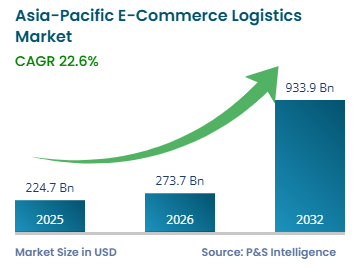
The Asia-Pacific e-commerce logistics market size was USD 224.7 billion in 2025, and it is anticipated to expand at a CAGR of 22.6% during 2026–2032, reaching approximately USD 933.9 billion by 2032.
This growth is supported by the rapid expansion of online retail platforms across China, India, and Southeast Asia, sustained mobile commerce adoption exceeding 60% of digital transactions, and accelerating deployment of automated fulfillment infrastructure including dark stores and micro-warehousing networks designed for sub-24-hour delivery commitments. The State Post Bureau of China announced that parcel deliveries reached 174.5 billion in 2024, representing a 21% year-on-year increase, while courier service revenues rose 13% to RMB 1.4 trillion (USD 191.2 billion), underscoring the massive scale of e-commerce logistics operations concentrated in the region.
Key Market Insights
Warehousing & fulfillment services are expected to demonstrate the fastest growth, at 22.8% CAGR during 2026–2032, driven by quick commerce proliferation.
B2C logistics held 60% market share in 2025, due to the dominance of consumer-facing e-commerce platforms that process billions of orders annually from individual shoppers.
The fashion & apparel category held 25% market share in 2025, benefiting from lightweight and small packaging footprint, high returns, and social commerce integration.
China held approximately 40% Asia-Pacific e-commerce logistics market share in 2025, sustained by a large digital consumer base, comprehensive e-commerce infrastructure, and extensive logistics network.
India represents the fastest-growing country market in the Asia-Pacific, at a CAGR of 23.1%, during 2026–2032, driven by escalating online retail penetration, expanding internet user base, and surging UPI transaction volumes.
Market dynamics reflect intensifying competition between global integrators (DHL, FedEx, UPS), Chinese logistics giants (Cainiao Network, JD Logistics, SF Express), and specialized regional carriers (Ninja Van, J&T Express) alongside emerging food delivery logistics platforms (Zomato, Swiggy) that are reshaping last-mile capabilities in densely populated urban corridors. Cross-border e-commerce is advancing at 26.5% CAGR driven by Regional Comprehensive Economic Partnership (RCEP) tariff reductions, bonded warehouse proliferation, and digital payment infrastructure enabling seamless transactions across 15 member economies.
Mobile-First Commerce and Digital Payment Integration Are Key Trends
Mobile commerce penetration exceeding 60% of digital transactions across Asia-Pacific is fundamentally reshaping logistics infrastructure design, forcing operators to prioritize real-time visibility, micro-fulfillment nodes, and on-demand delivery capabilities that match smartphone-driven purchase immediacy. The Asian Development Bank reports that regional mobile wallet users reached 2.6 billion by 2025, with transaction values climbing to USD 636 billion, enabling logistics providers to settle 34% of sector invoices through digital wallets that reduce checkout friction and accelerate order frequency.
Platform interoperability and QR-code standardization are lowering foreign-exchange friction, encouraging first-time cross-border purchases among the unbanked population in markets like the Philippines where GCash has converted more than half of its active users into international shoppers, while Vietnam's MoMo embeds buy-now-pay-later micro-credit for higher-value imports. This digital payment ubiquity compels carriers to operate sophisticated working-capital management systems handling near-real-time fund splits to merchants, couriers, and platforms simultaneously.
Logistics technology investments in track-and-trace applications, automated notification systems, and API-based platform integration have become competitive differentiators as customers expect parcel-level visibility comparable to ride-hailing services. The convergence of mobile commerce, digital payments, and logistics visibility is establishing new service-level baselines where sub-24-hour delivery becomes standard rather than premium, driving infrastructure decentralization toward urban dark stores and suburban fulfillment centers positioned within 5-10 kilometer radius of dense consumer clusters.
Quick Commerce Expansion and Dark Store Proliferation Drive Market
Consumer demand for 10-minute delivery in urban corridors is driving growth in quick commerce models. This creates the requirement for dense networks of dark stores positioned within a 1–2-kilometer radius of target neighborhoods, fundamentally altering traditional hub-and-spoke logistics architecture. Flipkart, Zepto, Swiggy Instamart, and Blinkit target 5,500 dark store locations by FY26, with Blinkit alone planning 2,000 outlets to enable sub-15-minute delivery across metropolitan markets. Urban dark store demand reached 24 million square feet in 2023 and projects to 37.6 million square feet by 2027, though regulatory compliance remains challenging as only 10–15% of facilities satisfy formal standards exposing operational risks when authorities tighten enforcement.
The micro-fulfillment model requires sophisticated inventory prediction algorithms managing 2,000-3,000 SKUs per location with daily restocking cycles, real-time demand forecasting, and dynamic pricing mechanisms. This balances freshness requirements against waste minimization. Groceries, pharmaceuticals, and personal care products dominate quick commerce baskets. This creates specialized cold-chain and temperature-controlled storage requirements distinct from traditional ambient e-commerce fulfillment. The labor-intensive order picking, packing, and last-mile delivery through electric two-wheelers or bicycles create employment opportunities.
The geographic concentration of dark stores in high-density urban cores escalates real estate costs, with prime micro-fulfillment sites commanding 15–20% premiums over traditional warehouse space, while zoning restrictions and community concerns about traffic congestion limit expansion options in established residential neighborhoods. Success in quick commerce segment requires balancing operational density for unit economics against regulatory compliance, community relations, and sustainable last-mile delivery infrastructure.
Transportation services accounted for 55% of market value in 2025, sustained by the archipelago geography of Indonesia and the Philippines requiring extensive multimodal sea-road-air logistics solutions, established route networks enabling economies of scale, and customer preference for cost-effective standard delivery options where 3–5 day transit times remain acceptable for non-urgent e-commerce orders. The segment benefits from mature infrastructure including comprehensive highway networks, expanding high-speed rail corridors, and modernized port facilities that reduce per-shipment transportation costs through consolidated routing and optimized fleet utilization.
Digital fleet management systems, AI-driven route optimization, and electric light-commercial vehicle adoption are enhancing operational efficiency while reducing fuel expenses and carbon emissions, positioning transportation providers to maintain dominant market share through superior unit economics compared to capital-intensive warehousing alternatives.
Warehousing & fulfillment services are expected to demonstrate the fastest growth, at 22.8% CAGR during 2026–2032, driven by quick commerce proliferation requiring dense dark store networks, automated micro-fulfillment centers enabling sub-24-hour delivery commitments, and cross-border e-commerce expansion necessitating bonded warehouse infrastructure for customs efficiency. The Asian Development Bank indicates that Asia accounts for 61% of global B2C e-commerce sales in 2025, while worldwide online shopping volumes climbed 43.5% since the pandemic. This creates a sustained demand for fulfillment capacity positioned near urban consumer clusters.
Automation investments including mezzanine robotics, automated storage and retrieval systems, and AI-powered inventory management are amortizing capital expenditures over accelerating parcel density, while value-added services such as gift wrapping, product customization, and reverse logistics processing create additional revenue streams beyond basic storage fees.
The market segments into the following service types:
B2C logistics held 60% market share in 2025, reflecting the dominance of consumer-facing e-commerce platforms that process billions of orders annually from individual shoppers purchasing fashion, electronics, beauty products, and household goods. The segment benefits from predictable order patterns, standardized packaging requirements, and established last-mile delivery networks that achieve economies of scale through route density in metropolitan areas.
Checkout digitalization removes cash-on-delivery float complexity, simplifying working capital cycles and enabling automated payment reconciliation that reduces administrative overhead. B2C logistics providers invest heavily in customer-facing technology including real-time tracking applications, delivery preference management, and automated notification systems that meet elevated consumer expectations for visibility and control over shipment status.
Business-to-business (B2B) logistics is projected to register the fastest growth at 22.9% CAGR during 2026–2032, propelled by digital procurement platforms gaining adoption among manufacturing supply chains, RCEP tariff reductions lowering cross-border trade barriers among 15 member economies, and Vietnamese and Thai manufacturers digitizing sourcing processes to access regional supplier networks more efficiently. B2B shipments typically involve larger order volumes, specialized handling requirements, and consolidated delivery schedules.
They differ fundamentally from B2C parcel logistics, creating opportunities for logistics providers offering dedicated account management, customized packaging solutions, and integrated supply chain visibility across procurement-to-delivery workflows. The segment growth reflects broader digital transformation of enterprise operations where legacy manual procurement processes migrate to electronic platforms requiring logistics capabilities supporting just-in-time inventory management, quality inspection services, and documentary compliance for cross-border transactions.
The market segments into the following business models:
B2C (Largest Category)
B2B (Fastest-Growing Category)
C2C
Operational Area Analysis
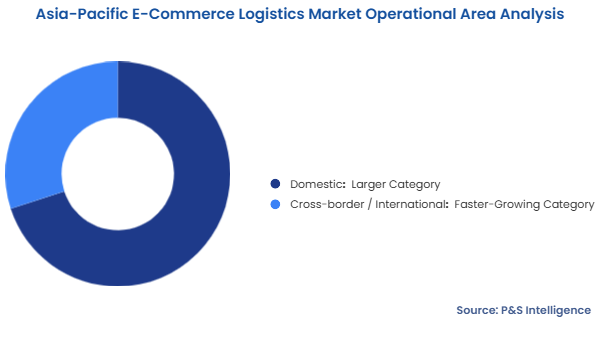
Domestic logistics operations commanded 70% market share in 2025, driven by massive internal consumption within China and India's 1.4-billion populations, mature domestic e-commerce platforms prioritizing local fulfillment to meet next-day delivery expectations, and established distribution networks connecting tier-1 cities with tier-2 and tier-3 markets through hub-and-spoke architectures. Domestic operations benefit from simplified regulatory compliance, absence of customs clearance delays, standardized packaging and labeling requirements, and local language customer service. This reduces operational complexity compared to cross-border transactions. China's State Post Bureau reported 478 million parcels moving domestically each day in 2024, demonstrating the enormous scale of internal logistics flows that dwarf international cross-border volumes.
Cross-border and international logistics are expected to expand at 23.0% CAGR during 2026–2032, accelerated by RCEP tariff reductions averaging 4-8% on Chinese and Korean origin goods lifting trade volumes for electronics and beauty products, bonded warehouse proliferation enabling faster customs clearance with delivery timelines compressed under three days, and digital payment infrastructure facilitating seamless currency conversion across 15 RCEP member economies.
Cainiao Network's "Global 5-Day Delivery" service extending to 14 countries and JD Logistics serving nearly 80 countries demonstrate platform logistics arms establishing international distribution capabilities that were historically limited to global integrators like DHL, FedEx, and UPS. Cross-border segment growth reflects rising consumer appetite for international brands, platform investments in overseas warehouse networks totaling 30 million square meters across China alone, and ASEAN Single Window customs digitalization reducing documentary processing times from days to hours.
The market segments into the following operational areas:
Domestic (Larger Category)
Cross-border / International (Faster-Growing Category)
Delivery Speed Analysis
Standard delivery (3–5 days) accounted for 45% share in 2025, sustained by price-sensitive consumers willing to accept longer transit times for cost savings, consolidated routing enabling lower per-unit transportation expenses, and non-urgent product categories including apparel, home goods, and electronics where immediate fulfillment provides limited incremental value. Standard delivery maintains economic viability through batching orders, optimizing multi-stop routes, and utilizing lower-cost transportation modes including rail and sea freight for inter-regional movements.
This creating margin advantages over premium delivery options requiring dedicated vehicles and express handling. The segment appeals particularly to rural and suburban consumers in tier-2 and tier-3 cities where same-day delivery infrastructure remains underdeveloped and customers demonstrate greater tolerance for extended delivery windows in exchange for broader product selection and competitive pricing.
Same-day delivery is projected to demonstrate the fastest growth during 2026–2032, driven by quick commerce penetration targeting 10-minute delivery promises for groceries and essentials, affluent metropolitan consumers willing to pay premium fees for convenience, and dark store proliferation enabling fulfillment within 1–2-kilometer radius of dense residential clusters.
The service requires sophisticated inventory positioning algorithms predicting demand at micro-geographic levels, electric two-wheeler or bicycle delivery fleets navigating urban congestion, and real-time order routing systems optimizing delivery sequences across multiple simultaneous orders. Same-day delivery economics depend on achieving sufficient order density within compact geographic zones, with successful operators demonstrating 15–20 deliveries per courier per shift compared to 8–12 deliveries for traditional next-day services, though elevated labor costs and premium real estate expenses for urban dark stores compress margins requiring careful market selection and operational discipline.
The market segments into the following delivery speeds:
Standard (3–5 days) (Largest Category)
Same-Day (Fastest-Growing Category)
Next-Day
Express (>5 days)
Product Category Analysis
The fashion & apparel category held largest market share in 2025, benefiting from light weight and small packaging footprint enabling cost-effective transportation, high return rates between 15–20% creating recurring reverse logistics revenue streams, social commerce integration where influencer marketing drives impulse purchases, and fast fashion models requiring rapid inventory turnover and frequent product refreshes.
The segment demonstrates strong mobile commerce penetration with consumers browsing and purchasing through smartphone applications during commute times or leisure moments, while augmented reality try-on features and AI-powered size recommendation algorithms reduce return rates and improve customer satisfaction. Fashion logistics providers invest in specialized handling for delicate fabrics, temperature-controlled storage for certain materials, and efficient reverse logistics processing including quality inspection, repackaging, and inventory restocking that enables returned items to reenter sellable inventory rapidly.
The food & beverage category is expected to register the fastest growth during 2026–2032, propelled by quick commerce expansion targeting 10-minute delivery for groceries and prepared meals, cold-chain infrastructure proliferation supporting temperature-sensitive products including dairy, meat, and frozen goods, and meal kit delivery services gaining traction among urban professionals seeking convenient healthy eating options. Online food and grocery sales are rapidly expanding in Southeast Asia due to mobile-wallet adoption and last-mile delivery innovations.
The industry requires specialized logistics capabilities including refrigerated vehicles, insulated packaging, dynamic route sequencing minimizing transit times for perishable items, and real-time temperature monitoring ensuring cold-chain integrity throughout delivery process. Food logistics faces unique challenges including spoilage risk, stringent food safety regulations, complex demand forecasting for short shelf-life products, and customer sensitivity to delivery timing where delayed arrivals result in product degradation and elevated complaint rates.
The market segments into the following product categories:
Fashion & Apparel (Largest Category)
Food & Beverage (Fastest-Growing Category)
Groceries
Healthcare & Pharmaceuticals
Beauty & Personal Care
Consumer Electronics
Home Appliances & Furniture
Automotive Parts
Others
Drive strategic growth with comprehensive market analysis
China held approximately 40% Asia-Pacific e-commerce logistics market share in 2025, sustained by the world's largest digital consumer base, comprehensive e-commerce infrastructure anchored by Alibaba, JD.com, and Pinduoduo platforms, and extensive logistics networks enabling 478 million daily parcel movements nationwide. The Ministry of Commerce reported that China's online retail sales reached RMB 14 trillion (USD 1.92 trillion) in the first 11 months of 2024, growing by 7.4% year-on-year, with takeaway delivery value surging by 48.2%.
The nation's logistics advancement reflects strategic government investment in transport infrastructure, including the 14th Five-Year Plan's achievement of six major transport targets ahead of schedule by end-2024, expansion of certified civil airports to 263 (22 more than 2020), and construction of a three-tier logistics system linking counties, townships, and villages that has enabled 30% and 34% year-on-year express delivery volume growth in central and western regions respectively.
Cross-border e-commerce value reached RMB 2.63 trillion yuan in 2024, an increase of RMB 1 trillion compared to 2020, facilitated by 297 overseas distribution centers, 333 overseas warehouses, and Silk Road e-commerce partnerships expanding to 36 countries. Cainiao Network's Global 5-Day Delivery service now extends to 14 countries, while JD Logistics serves nearly 80 countries and regions.
India E-Commerce Logistics Market Growth
India represents the fastest-growing country market in the Asia-Pacific, at a CAGR of 23.1%, during 2026–2032. The market is driven by escalating online retail penetration expected to reach 14% of total retail by 2028 (compared to 8% in 2024), expanding internet user base approaching 954.4 million subscribers as of March 2024, and surging UPI transaction volumes, which reached an all-time high of 18.68 billion, valued at INR 2,514,000 crore (USD 294 billion) in May 2025. The Indian e-commerce market size will grow from USD 125.5 billion in 2024 to USD 385.2 billion by 2032.
Government initiatives are reshaping logistics infrastructure through the National Logistics Policy aimed at reducing logistics costs from 14% to 8% of GDP by 2030, PM Gati Shakti multimodal connectivity program improving freight movement efficiency, and Open Network for Digital Commerce (ONDC) democratizing access for smaller logistics providers while reducing platform dependency. Quick commerce volume is experiencing as Flipkart, Amazon India, Zepto, Swiggy Instamart, and Blinkit establish dark store networks targeting 5,500 locations by FY26 to enable 10-minute delivery promises in metropolitan areas.
The sector attracted INR 38,865 crore (USD 4.6 billion) in private equity and venture capital investments during 2024, with hyperlocal and B2C segments leading capital inflows. Tier 2 and Tier 3 cities now account for 41% of e-commerce logistics volumes, reflecting successful digital penetration beyond metropolitan areas and creating demand for distributed fulfillment networks across 734 districts identified with export potential under the Districts as Export Hubs initiative.
The Asia-Pacific e-commerce logistics market demonstrates moderate fragmentation with diverse competitive clusters reflecting regional specialization patterns, platform ownership structures, and service differentiation strategies that prevent dominant concentration by any single provider group. Market structure varies significantly by country, with China exhibiting higher consolidation. While, Southeast Asian markets show greater fragmentation across regional specialists and platform-owned arms competing across overlapping service territories.
Competitive differentiation manifests through multiple dimensions including geographic coverage depth reaching tier-2 and tier-3 cities beyond metropolitan cores, technology platform capabilities enabling real-time visibility and predictive analytics, specialized service offerings such as cold-chain logistics, pharmaceutical handling, or bulky goods delivery, and capital access supporting automation investments that improve unit economics and service consistency. Chinese logistics giants leverage enormous domestic scale enabling 174.5 billion annual parcel volumes that drive procurement advantages, technology development budgets, and infrastructure density impossible for smaller competitors to match.
Regional specialists differentiate through local market knowledge, cultural alignment, and flexible service models accommodating diverse merchant requirements across Southeast Asian archipelago geography. Global integrators maintain competitive positions through international network reach supporting cross-border flows, established corporate relationships with multinational enterprises, and sophisticated customs brokerage capabilities, though face margin pressure in domestic last-mile segments where local specialists operate lower cost structures.
Indian market demonstrates particular dynamism with established players competing against e-commerce platform logistics arms and international entrants seeking to grow. Competitive intensity remains elevated as participants balance growth investments against profitability pressures, with consolidation likely accelerating through 2032 as scale advantages in automation, technology platforms, and network density create widening gaps between leading providers and subscale competitors unable to sustain required capital expenditures.
Major Companies in the Asia-Pacific E-Commerce Logistics Market:
DHL Group
United Parcel Service Inc.
FedEx Corporation
SF Holding Co. Ltd.
China Post Group Corporation
Japan Post Holdings Co. Ltd.
Yamato Holdings Co. Ltd.
Nippon Express Holdings Inc.
Delhivery Limited
JD Logistics Inc.
Alibaba Group Holding Limited
CJ Logistics Corporation
Kerry Logistics Network Limited
Aramex PJSC
Australia Post Corporation
Pos Malaysia Berhad
Kintetsu Group Holdings Co. Ltd.
Grab Holdings Limited
Lalamove Limited
Asia-Pacific E-Commerce Logistics Market News
In May 2025, Delhivery Limited unveiled an automated mega gateway facility in Bhiwandi, India, featuring advanced robotic sorting systems and AI-powered route optimization capable of processing 2 million packages daily.
In April 2025, DSV A/S completed its USD 14.9-billion acquisition of DB Schenker, creating the world's largest freight forwarder with significantly expanded contract-logistics capacity across Asia-Pacific markets. The merger combines DSV's air and sea freight expertise with DB Schenker's extensive warehousing network, enabling comprehensive supply chain solutions for multinational enterprises operating in the region.
In April 2025, CJ Logistics Corporation entered into a partnership with Ninja Van Group to scale cross-border logistics services connecting South Korea with Southeast Asian markets. The collaboration integrates CJ Logistics' Korean fulfillment infrastructure with Ninja Van's last-mile delivery networks across Indonesia, Malaysia, Philippines, Singapore, Thailand, and Vietnam, facilitating rapid expansion of Korean beauty and fashion brands into ASEAN consumer markets.
In March 2025, Singapore Post Limited invested USD 30 million to triple throughput capacity at its e-commerce logistics hub, by installing automated parcel sorting systems, expanding warehouse footprint, and deploying AI-driven inventory management platforms.
In January 2025, FedEx Corporation launched FedEx Surround platform, an AI-based monitoring system delivering near-real-time shipment visibility and predictive analytics to enterprise customers managing complex supply chains, in India.
In August 2024, United Parcel Service Inc. formed a strategic partnership with Ninja Van in Malaysia to serve export-oriented SMEs requiring international shipping solutions. The collaboration combines UPS's global logistics network with Ninja Van's extensive domestic pickup infrastructure, enabling Malaysian manufacturers and e-commerce merchants to access streamlined cross-border fulfillment services without maintaining separate logistics relationships.
Frequently Asked Questions About This Report
Want a report tailored exactly to your business need?
Leading companies across industries trust us to deliver data-driven insights and innovative solutions for their most critical decisions. From data-driven strategies to actionable insights, we empower the decision-makers who shape industries and define the future. From Fortune 500 companies to innovative startups, we are proud to partner with organisations that drive progress in their industries.
Client Testimonials
Working with P&S Intelligence and their team was an absolute pleasure – their awareness of timelines and commitment to value greatly contributed to our project's success. Eagerly anticipating future collaborations.
McKinsey & Company
India
Unmatched Standards
Our insights into the minutest levels of the markets, including the latest trends and competitive landscape, give you all the answers you need to take your business to new heights
Complete Data Security
We take a cautious approach to protecting your personal and confidential information. Trust is the strongest bond that connects us and our clients, and trust we build by complying with all international and domestic data protection and privacy laws