This Report Provides In-Depth Analysis of the Asia-Pacific cloud computing market Report Prepared by P&S Intelligence, Segmented by Deployment Model (Public, Private, Hybrid), Service Type (Infrastructure as Service, Platform as a Service (PaaS), Software as a Service (SaaS)), Organization Size (Large Enterprise, Small and Medium Enterprise), Vertical (BFSI, IT & Telecom, Retail & Consumer Goods, Manufacturing, Healthcare, Education, Energy & Utilities, Media & Entertainment, Government & Public Sector), and Geographical Outlook for the Period of 2021 to 2032
Explore the market potential with our data-driven report
Asia-Pacific cloud computing market Overview
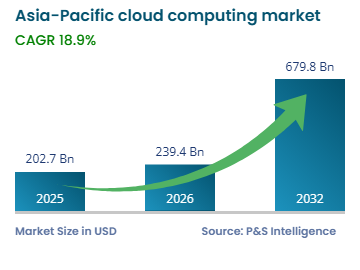
The Asia-Pacific cloud computing market valued USD 202.7 billion in 2025, and it is projected to reach USD 679.8 billion by 2032, demonstrating a compound annual growth rate (CAGR) of 18.9% during 2026–2032.
Growth is underpinned by enterprises accelerating AI and machine learning integration, surging demand for hybrid cloud architectures balancing data sovereignty with flexibility, and government cloud-first mandates converting public-sector budgets into predictable cloud consumption. Hyperscale providers have committed over USD 30 billion collectively in data center investments across APAC metros during 2024-2025, addressing latency requirements and regulatory compliance frameworks proliferating across jurisdictions.
Key Market Insights
Software as a service commanded the largest share, of 65%, in 2025, as it eliminates the requirement for on-premises infrastructure.
Hybrid cloud is projected to demonstrate the fastest growth, at 19.2% CAGR, through 2032, driven by enterprises balancing data sovereignty requirements with operational flexibility.
Large enterprises accounted for the largest share, of 75%, in 2025, reflecting established IT budgets, complex multi-application environments, and requirements for enterprise-grade service-level agreements.
Healthcare is expected to register the fastest growth, at 19.3% CAGR, propelled by telemedicine expansion, AI-driven diagnostics deployment, and electronic health record modernization initiatives.
China leads the APAC cloud computing market with 40% share, in 2025, sustained by state-backed digital transformation mandates, data sovereignty regulations favoring domestic hyperscalers, and aggressive infrastructure investments targeting AI workload capacity.
India represents the fastest-growing APAC cloud market at 19.1% CAGR, propelled by government Digital India programs, expanding startup ecosystem, and booming hyperscaler investments.
Digital transformation initiatives spanning manufacturing modernization, healthcare telemedicine deployment, and financial services digital banking accelerate workload migration from legacy on-premises infrastructure to elastic cloud platforms. The Asia Society Policy Institute indicates that APEC economies have adopted cloud-first or cloud-by-default policies, with public cloud revenues projected to exceed USD 530 billion by 2030 across the region.
Hybrid and Multi-Cloud Architectures Are Major Market Trends
Enterprises are abandoning single-vendor cloud strategies in favor of hybrid and multi-cloud architectures that balance data sovereignty requirements with operational flexibility. Organizations deploy sensitive customer data, regulated financial transactions, and intellectual property on private or localized infrastructure while utilizing public cloud elasticity for development environments, data analytics workloads, and disaster recovery systems.
Hybrid cloud infrastructure is outpacing public cloud growth as enterprises architect workload portability across on-premises data centers, private cloud installations, and public hyperscaler platforms. Communication service providers demonstrate particularly strong hybrid preferences, with 77% favoring hybrid strategies over pure public or private deployments. Telecommunications carriers partner with hyperscalers to deploy 5G-edge computing architectures reducing latency for real-time applications including autonomous vehicles, industrial automation, and augmented reality services.
This structural shift toward vendor diversification reflects enterprise priorities beyond cost optimization alone. Organizations pursue regulatory compliance through localized data residency, workload optimization through best-of-breed platform selection, and operational resilience through redundancy across multiple infrastructure providers. The architectural evolution creates sustained demand for orchestration platforms managing distributed cloud estates, security frameworks spanning heterogeneous environments, and data integration capabilities enabling seamless workload mobility.
Government Cloud-First Mandates Accelerating Enterprise Migration
Government cloud-first policies across Asia-Pacific economies are converting public-sector IT budgets into predictable cloud consumption, eliminating procurement uncertainties that traditionally delayed infrastructure decisions. Asia Society Policy Institute research confirms APEC economies have adopted cloud-first or cloud-by-default policies, with public cloud revenues projected to exceed USD 530 billion by 2030, demonstrating the fiscal scale of mandated migration.
Malaysia's MyGovCloud initiative targets 80% of public-sector data storage on cloud platforms, attracting projected investments exceeding USD 3.4 billion by 2025. Singapore's Government on Commercial Cloud (GCC) framework has onboarded 3,006 government systems while maintaining 99.5% uptime, establishing operational benchmarks for regulated-sector deployments. India's GI Cloud (MeghRaj) provides a national cloud backbone supporting digital public goods delivery, enabling state governments to deploy citizen services without building proprietary infrastructure. Asian Development Bank analysis indicates cloud computing contributed 0.25% to 2.23% of GDP across 11 APAC economies in 2023, with marginal impact amplified significantly in economies implementing cloud-enabling policies and regulatory frameworks.
These mandates favor compliance-ready offerings from providers demonstrating data residency capabilities, security certifications aligned with national frameworks, and sovereign cloud architectures keeping sensitive workloads within jurisdictional boundaries. The policy conversion accelerates vendor time-to-revenue cycles while reducing private-sector adoption friction by normalizing cloud consumption patterns and establishing procurement precedents.
AI Workload Integration Creating Infrastructure Expansion Opportunities
The convergence of cloud computing and artificial intelligence is creating infrastructure expansion opportunities as AI training and inference workloads require GPU-rich instances, high-bandwidth networking, and specialized storage architectures absent from legacy cloud deployments. Enterprises deploying generative AI applications, computer vision systems, natural language processing capabilities, and predictive analytics platforms consume GPU capacity at unprecedented scale.
Hyperscalers are deploying GPU-optimized data centers in tier-2 metropolitan areas beyond traditional coastal technology hubs, addressing power constraints in established markets while capturing emerging demand closer to enterprise customers. Telecommunications operators launch GPU-as-a-Service offerings targeting manufacturing customers requiring computer vision for quality inspection, retailers deploying recommendation engines, and healthcare providers implementing diagnostic imaging analysis.
AI workload demands are reshaping data center architectural design. Facilities incorporate liquid cooling systems managing heat densities exceeding 100 kilowatts per rack, high-density power infrastructure supporting GPU clusters, and dedicated AI networking fabrics enabling parallel processing across thousands of accelerators. Organizations increasingly consume cloud-native AI platforms offering pre-trained models, AutoML capabilities, and managed MLOps pipelines rather than building custom infrastructure, reducing deployment complexity while accelerating time-to-production for AI-powered applications.
Software as a service commanded the largest share, of 65%, in 2025. Enterprises prefer subscription-based application delivery as it eliminates the requirement for on-premises infrastructure. Organizations across retail, banking, education, and healthcare leverage SaaS platforms for customer relationship management, enterprise resource planning, and collaboration tools. This accelerates time-to-market, while reducing IT overhead. Mobile-first business models prevalent across APAC economies favor SaaS deployment patterns enabling rapid provisioning and automatic scaling without capital expenditure.
Infrastructure as a service is expected to register the fastest growth during 2026–2032, at 19.0% CAGR, propelled by accelerating demand for AI workloads requiring GPU-rich instances, high-bandwidth networking, and specialized storage architectures. Enterprises migrating legacy applications, containerizing workloads, and deploying machine learning models require flexible compute and storage resources that IaaS uniquely provides without infrastructure ownership commitments.
The market segments into the following service types:
Infrastructure as a Service (IaaS) (Fastest Growing Category)
Platform as a Service (PaaS)
Software as a Service (SaaS) (Largest Category)
Deployment Model Analysis
Public cloud held the largest share in 2025, of 60%, supported by hyperscaler infrastructure expansion, pay-as-you-go pricing models eliminating capital barriers, and enterprise confidence in provider security capabilities. Mature digital economies including Singapore, Japan, and Australia demonstrate high public cloud penetration, while government cloud-first mandates across Malaysia, New Zealand, and India convert public-sector workloads to commercial cloud platforms, reinforcing public deployment dominance.
Hybrid cloud is projected to demonstrate the fastest growth, at 19.2% CAGR, through 2032, driven by enterprises balancing data sovereignty requirements with operational flexibility. Organizations deploy sensitive workloads on-premises while utilizing public infrastructure for development, testing, analytics, and disaster recovery. Hybrid cloud deployment is gaining popularity as organizations seek cost efficiency and regulatory compliance. It allows enterprises to balance sensitive workloads on private infrastructure while leveraging public cloud scalability for innovation, peak demand, and advanced analytics, supporting performance optimization and business continuity across industries.
The market segments into the following deployment models:
Public (Largest Category)
Private
Hybrid (Fastest Growing Category)
Organization Size Analysis
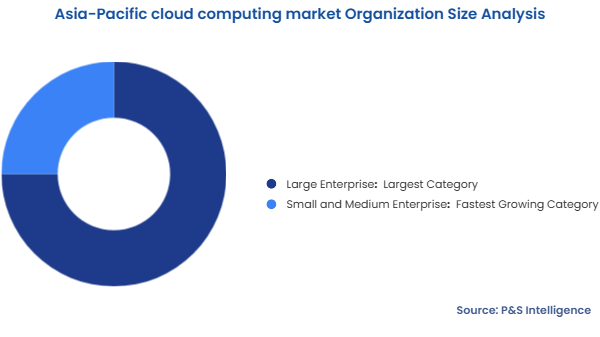
Large enterprises accounted for the largest share, of 75%, in 2025, reflecting established IT budgets, complex multi-application environments, and requirements for enterprise-grade service-level agreements. Organizations operating across multiple APAC markets utilize cloud infrastructure for regional standardization, centralized data analytics, and unified security frameworks. Government regulations favoring large enterprise compliance accelerate adoption among multinational corporations managing distributed operations.
According to research, 97% of Asia Pacific enterprises using public cloud are either using or planning to use multiple cloud infrastructure providers, with 35 % using four or more, showing widespread enterprise cloud reliance. Enterprises are also increasing cloud investment, with a survey finding that around 93% of APAC organizations plan to increase the amount of data they store in public cloud in 2024, driven by transformation initiatives, modernization, security, and operational requirements; 90 % of these organizations expect to increase their cloud storage budgets.
Small and medium enterprises are anticipated to experience the fastest growth during 2026–2032, fueled by subscription pricing eliminating capital expenditure barriers and managed services reducing technical skill requirements. SMEs are a cornerstone of the Asia-Pacific economy, accounting for over 97% of all businesses across the region and nearly 99.8% of enterprises in many Asia-Pacific economies. They employ a massive share of the workforce, providing jobs to around 950 million people, equivalent to roughly 65–70% of total employment, and are responsible for more than 60% of net job creation in several APAC countries.
SMEs contribute around 60% to the GDP in China, 50% in Japan, 45% in Singapore, and over 40% across ASEAN economies on average. Overall, across Asia and the Pacific, SMEs generate close to 40% of national economic output, underscoring their critical role as the primary drivers of employment, entrepreneurship, and economic resilience in the region.
The market segments into the following organization sizes:
Large Enterprise (Largest Category)
Small and Medium Enterprise (Fastest Growing Category)
Vertical Analysis
The BFSI sector dominates the market with 25% share in 2025, driven by digital banking transformation requirements, regulatory compliance demands necessitating resilient infrastructure, and fraud detection systems requiring real-time processing capabilities. Financial institutions deploy cloud platforms for mobile banking applications, payment processing networks, and risk analytics workloads, with data residency regulations encouraging hybrid architectures maintaining local control.
The BFSI sector in APAC is increasingly adopting cloud computing to enhance agility, scalability, and innovation while reducing operational costs. Financial institutions are migrating core banking, customer data platforms, and analytics workloads to cloud environments to support digital services, improve time-to-market, and enable real-time risk management.
The rise of mobile banking, digital payments, and embedded finance is driving demand for flexible, secure cloud infrastructure. Additionally, regulators in many APAC countries now provide clearer frameworks for cloud use in financial services, encouraging cloud-based compliance, disaster recovery, and AI/ML applications. As a result, more banks and insurers are embracing multi-cloud and hybrid cloud strategies tailored to BFSI requirements.
Healthcare is expected to register the fastest growth, at 19.3% CAGR, propelled by telemedicine expansion, AI-driven diagnostics deployment, and electronic health record modernization initiatives. The healthcare sector in APAC is rapidly increasing its use of cloud computing due to rising digital health adoption, cost pressures, and the need for scalable data infrastructure. Hospitals and health systems are moving clinical systems, electronic health records, imaging, and analytics to the cloud to improve interoperability and reduce reliance on expensive on-premise IT. The growth of telemedicine, remote patient monitoring, and AI-driven diagnostics is further accelerating cloud usage, as these applications require flexible computing power and secure data storage. In addition, government-led health digitization programs, expanding private healthcare networks, and stricter data governance frameworks are pushing providers toward hybrid and sovereign cloud models tailored for healthcare needs.
The market segments into the following verticals:
BFSI (Largest Category)
IT & Telecom
Retail & Consumer Goods
Manufacturing (Fastest Growing Category)
Healthcare (Fastest Growing Category)
Education
Energy & Utilities
Media & Entertainment
Government & Public Sector
Others
Drive strategic growth with comprehensive market analysis
China leads the APAC cloud computing market with 40% share, in 2025, sustained by state-backed digital transformation mandates, data sovereignty regulations favoring domestic hyperscalers, and aggressive infrastructure investments targeting AI workload capacity. Government policies including the Eastern Data, Western Computing program redistribute computing workloads from energy-strained coastal provinces to renewable-rich western regions, unlocking over 1,200 Megawatts of additional data center capacity while achieving carbon neutrality objectives.
Alibaba Cloud, Tencent Cloud, and Huawei Cloud dominate the domestic market by offering compliance-ready platforms meeting stringent data localization requirements that foreign providers cannot replicate without sovereign cloud partnerships. Regulatory tightening around data exports and cross-border data transfers introduced in January 2025 reinforces hybrid cloud architectures enabling enterprises to maintain sensitive data domestically while accessing global public cloud elasticity for non-regulated workloads. China's lead will strengthen through 2032 as domestic providers expand internationally while capturing regulated sector spending that foreign hyperscalers cannot contest without localized sovereign partnerships.
India Cloud Computing Market Growth
India represents the fastest-growing APAC cloud market at 19.1% CAGR, propelled by government Digital India programs, startup ecosystem expansion requiring scalable infrastructure, and hyperscaler commitments exceeding USD 15 billion targeting tier-2 metropolitan deployments. Public-sector digitization initiatives including Aadhaar identity infrastructure, Unified Payments Interface (UPI) digital transactions, and MeghRaj government cloud framework normalize cloud consumption patterns across enterprises and government agencies.
SMEs drive disproportionate growth as affordable subscription pricing, managed services abstracting technical complexity, and government subsidy programs reduce adoption barriers. Organizations leverage cloud platforms for e-commerce expansion, digital payment integration, and collaboration tools enabling distributed workforce productivity. India's trajectory positions it to capture increasing regional market share through 2032 as infrastructure investments compress latency, regulatory frameworks mature, and domestic enterprises scale operations nationally and internationally.
Japan Cloud Computing Market Dynamics
Japan is another major market in APAC, characterized by government cloud-by-default mandates requiring agency migrations to certified commercial platforms, corporate legacy system modernization initiatives, and hyperscaler investments targeting AI infrastructure capacity. Japan Ministry of Economy, Trade, and Industry earmarked JPY 72.5 billion (USD 483 million) for five domestic providers building sovereign AI infrastructure, mitigating GPU shortages and reducing foreign cloud dependency that produced a JPY 5.5 trillion digital trade deficit in 2023.
Japan's Digital Agency maintains rigorous certification standards requiring cloud providers to meet approximately 330 benchmark criteria for government workloads. As of June 2025, only Amazon Web Services, Google Cloud, Microsoft Azure, Oracle, and Sakura Internet hold government cloud certifications, creating competitive moats protecting incumbent positions. Tax incentives for green data centers powered by renewable energy extend through 2028, offering up to JPY 5 billion per project and reducing effective tax rates below 10% in several prefectures.
The countries analyzed in this report include:
China (Largest and Fastest-Growing Country Market)
The Asia-Pacific cloud computing market demonstrates moderate consolidation with Google, IBM, and Microsoft capturing a massive share. While, hundreds of regional providers, telecommunications carriers, and specialized vendors serve niche segments and domestic markets. This competitive structure reflects scale economies favoring hyperscale operators balanced against data sovereignty regulations protecting domestic providers and market diversity enabling specialization across industry verticals. Amazon Web Services, Microsoft Azure, and Google Cloud Platform dominate markets outside China through extensive infrastructure networks, comprehensive service portfolios spanning compute, storage, networking, databases, analytics, and AI/ML capabilities, and enterprise relationships established through decades of technology partnerships.
China's domestic market operates distinctly with Alibaba Cloud, Tencent Cloud, and Huawei Cloud dominating infrastructure spending through government procurement preferences and data localization mandates requiring domestic hosting. Additionally, their enterprise relationships span the e-commerce, gaming, telecommunications, and financial services sectors. These platforms expand internationally targeting Chinese multinational corporations, overseas Chinese communities, and cost-sensitive emerging markets where global hyperscalers maintain premium pricing.
Telecommunications carriers leverage network infrastructure assets, enterprise customer relationships, and local market knowledge to capture hybrid cloud deployments, managed services contracts, and edge computing workloads requiring ultra-low latency. These carriers increasingly partner with global hyperscalers rather than building competing public cloud platforms, focusing on value-added services and industry-specific solutions.
Competitive intensity is accelerating as AI workload demands drive infrastructure investments, data sovereignty regulations fragment market access, and enterprises adopt multi-cloud architectures reducing switching costs. Hyperscalers respond through localized data center deployments, sovereign cloud partnerships with domestic operators, and vertical-specific platforms embedding industry compliance frameworks. The competitive landscape will consolidate further among top-tier providers while creating opportunities for specialized vendors serving regulatory niches, industry verticals, and geographic markets requiring localized capabilities.
Asia-Pacific cloud computing Companies:
Amazon.com Inc.
Microsoft Corporation
Alphabet Inc.
Alibaba Group Holding Limited
Tencent Holdings Limited
Huawei Investment & Holding Co. Ltd.
IBM Corporation
Oracle Corporation
SAP SE
Salesforce Inc.
Broadcom Inc.
NTT Corporation
Fujitsu Limited
NEC Corporation
Hitachi Ltd.
Tata Consultancy Services Limited
Baidu Inc.
JD.com Inc.
Asia-Pacific cloud computing market Developments
In July 2025, Alibaba Cloud announced USD 52-billion global infrastructure investment plan spanning three years to expand data center capacity across Southeast Asia, Middle East, Europe, and Americas. The investment targets AI-optimized facilities supporting generative AI workloads and cloud-native application deployments, with new data centers confirmed for Malaysia, Philippines, Thailand, Mexico, Brazil, France, and Netherlands.
In May 2025, Microsoft Corporation opened Indonesia Central cloud region, with planned USD 1.7 billion investment through 2028. The AI-ready facility provides in-country data residency, enhanced security frameworks, and reduced latency for Indonesian enterprises accelerating digital transformation initiatives across banking, telecommunications, and government sectors.
In March 2025, Oracle Corporation launched AI Centre of Excellence in Singapore as regional hub for AI adoption across Southeast Asia. The center brings together AI researchers, technology partners, and enterprise customers to accelerate generative AI implementations, with specialized programs supporting financial services, healthcare, and manufacturing sectors deploying AI-powered automation.
In March 2025, Amazon Web Services confirmed USD 8.2-billion investment to expand Mumbai cloud region capacity and renewable energy integration through 2030. The investment supports generative AI infrastructure requirements, addresses data sovereignty mandates under India's Personal Data Protection Act, and creates approximately 81,300 full-time employment positions across data center supply chain operations.
In January 2025, Microsoft Corporation announced USD 3-billion investment to strengthen cloud and AI capabilities in India representing the company's largest Indian market expansion. The investment includes data center capacity additions, AI skills training for 10 million individuals by 2030, and partnerships with Indian system integrators supporting enterprise cloud migrations across manufacturing, retail, and financial services sectors.
In January 2025, Amazon Web Services launched Asia-Pacific (Thailand) Region with planned USD 5-billion investment, to provide local data center infrastructure for Thai enterprises, government agencies, and educational institutions. The Thailand deployment reduces latency for real-time applications, addresses data residency requirements, and supports growing demand for AI workloads across Southeast Asian markets.
Frequently Asked Questions About This Report
What was APAC cloud computing market size in 2025?+
In 2025, the cloud computing market in APAC size was USD 202.7 billion.
Which service type has largest APAC cloud computing industry share?+
SaaS has the largest APAC cloud computing industry share, of 65%.
Which country has largest APAC cloud computing market share?+
China is the largest cloud computing market in APAC, with 40% share.
What are the key APAC cloud computing industry drivers?+
The APAC cloud computing industry is driven by rapid AI and ML integration, surging demand for hybrid cloud architectures, and government cloud-first mandates.
What is the APAC cloud computing market nature?+
The cloud computing market in APAC is consolidated.
Want a report tailored exactly to your business need?
Leading companies across industries trust us to deliver data-driven insights and innovative solutions for their most critical decisions. From data-driven strategies to actionable insights, we empower the decision-makers who shape industries and define the future. From Fortune 500 companies to innovative startups, we are proud to partner with organisations that drive progress in their industries.
Client Testimonials
Working with P&S Intelligence and their team was an absolute pleasure – their awareness of timelines and commitment to value greatly contributed to our project's success. Eagerly anticipating future collaborations.
McKinsey & Company
India
Unmatched Standards
Our insights into the minutest levels of the markets, including the latest trends and competitive landscape, give you all the answers you need to take your business to new heights
Complete Data Security
We take a cautious approach to protecting your personal and confidential information. Trust is the strongest bond that connects us and our clients, and trust we build by complying with all international and domestic data protection and privacy laws