This Report Provides In-Depth Analysis of the Asia-Pacific Autonomous Delivery Vehicle Market Report Prepared by P&S Intelligence, Segmented by Vehicle Type (Ground Robots, Trucks and Vans, Drones), Offering (Hardware, Software, Services), Range (Short, Long), Application (Retail, Logistics, Food & Beverage, Healthcare & Pharmaceutical), and Geographical Outlook for the Period of 2021 to 2032
Explore the market potential with our data-driven report
APAC Autonomous Delivery Vehicles Market Insights
Ground robots hold largest share, of 60%, driven by established autonomous transportation and technology and operational economics favoring ground-based fleets for high-density urban delivery corridors.
Software has highest CAGR, of 25.4%, supported by the improving navigation accuracy and operational safety, integration of cloud-based fleet management platforms, and recurring revenue with OTA software updates.
The short category has largest, of 75%, driven by the concentration of order volumes in compact areas, integration of smaller battery packs, and operational safety frameworks.
The healthcare & pharmaceutical category will register highest CAGR, of 25.6%, driven by temperature-controlled and time-sensitive delivery requirements and regulatory acceptance of autonomous pharmaceutical delivery.
China held approximately 40% share in 2025, sustained by aggressive government infrastructure investment, mature e-commerce logistics networks, and large-scale commercial deployments by technology and logistics leaders.
India has highest CAGR, of 25.3%, driven by rapid urbanization, expanding internet penetration, and government initiatives enhancing logistics infrastructure and digital connectivity.
Asia-Pacific Autonomous Delivery Vehicle Market Future Outlook
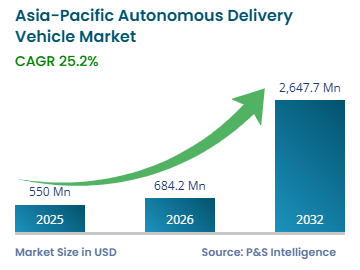
The Asia-Pacific autonomous delivery vehicle market size reached USD 550.0 million in 2025, and it is anticipated to expand at a CAGR of 25.2% during 2026–2032, reaching approximately USD 2,647.7 million by 2032. This growth is supported by the expanding integration of ground delivery robots, aerial drones, and self-driving logistics vehicles for last-mile e-commerce, retail, and food delivery in densely populated urban areas.
The market is driven by accelerating e-commerce growth, persistent labor shortages in logistics, and supportive government policies promoting automation and smart city infrastructure across major Asian economies. China, India, and Japan are deploying autonomous delivery fleets to address urban congestion, reduce operational costs, and maintain service reliability amid rising consumer expectations for same-day fulfillment.
Companies are investing in Level 4 autonomous systems capable of operating without human intervention on public roads and within controlled environments including campuses, residential complexes, and commercial districts. Ground delivery vehicles accounted for the largest share in 2025, while aerial delivery drones are expected to register the fastest growth during the forecast period. Japan's Ministry of Economy, Trade and Industry (METI) released its Future Perspectives on Autonomous Delivery Robots roadmap in February 2025, positioning autonomous delivery robots as a national implementation priority with intensive demonstration tests planned through 2027.
Level 4 Autonomy and Electric Powertrains Are Major Market Trends
Autonomous delivery vehicle implementation across Asia-Pacific is advancing through the deployment of Level 4 autonomy systems capable of operating without human intervention in urban streets, campuses, and controlled logistics zones. Technology providers are integrating advanced sensor arrays combining LiDAR, camera systems, radar, and GPS navigation with AI-based perception algorithms and SLAM capabilities. This enables vehicles to navigate complex urban environments, recognize pedestrians and obstacles, and adapt to dynamic traffic conditions.
Regulatory frameworks are evolving to accommodate higher-speed delivery robots beyond the traditional 6 km/h threshold. Japan has established guidelines for delivery robots capable of operating at speeds greater than 6 km/h under controlled safety parameters. Electric powertrain adoption is accelerating as governments implement emission reduction policies and logistics operators seek fuel cost advantages. The International Energy Agency (IEA) reports that battery electric trucks are approximately 55% more energy-efficient than diesel heavy-duty trucks of the same size. While, direct fuel costs associated with operating battery electric vehicles are almost 70% lower than diesel equivalents in China based on 2024 fuel prices.
The convergence of autonomous navigation with electric propulsion offers reduced noise pollution, enabling nighttime deliveries in residential areas; lower total cost of ownership, and alignment with corporate sustainability commitments among major e-commerce and logistics firms. Market trajectory indicates continued technology refinement through intensive demonstration projects scheduled through 2027 in Japan and ongoing commercial deployments in China. Moreover, manufacturers are targeting 600-kilometer operational ranges, matching or exceeding diesel vehicle capabilities for regional delivery applications.
E-Commerce Expansion and Labor Shortage Drive Market Growth
Explosive e-commerce growth across Asia-Pacific is creating sustained demand for last-mile delivery capacity that exceeds available human workforce supply, particularly in dense urban markets where labor costs rise continuously and driver retention remains challenging. The growth of e-commerce in China and digital payments in India indicate sustained online shopping velocity requiring scalable delivery infrastructure. Same-day and next-day delivery expectations among consumers necessitate frequent, predictable delivery cycles, which autonomous systems can maintain with higher consistency than variable human labor availability.
Acute labor shortages in logistics sectors across developed Asian economies are compelling operators to evaluate automation alternatives. Japan faces particularly severe workforce constraints driven by aging demographics. India's Ministry of Commerce data indicates that the logistics sector employs over 22 million people with expectations for 5% employment growth over five years through skill development and automation initiatives, highlighting the scale of workforce transformation underway.
Cost structures favor autonomous deployment where daily utilization rates justify capital investment. Urban delivery operations achieve high utilization through concentrated delivery density, enabling rapid payback on autonomous vehicle acquisition costs. Due to labor scarcity, rising wages in tier-1 cities, and improving autonomous technology economics, the TCO for autonomous fleets is approaching parity with human-operated delivery in specific urban corridors and campus environments. This trajectory accelerates as fleet operators gain operational experience reducing per-unit costs through economies of scale.
Aging Demographics and Healthcare Logistics Creating Market Potential
Asia-Pacific's rapidly aging populations are generating substantial demand for reliable, frequent delivery services supporting elderly residents with limited mobility, particularly for pharmaceutical distribution, meal delivery, and essential supplies. Over 28% of Japan’s population was aged 65 or older as of 2024. This creates a demand for autonomous delivery solutions capable of navigating residential neighborhoods, apartment complexes, and assisted living facilities with minimal human contact and consistent scheduling. Healthcare logistics requirements including temperature-controlled pharmaceutical distribution and time-sensitive medical supply transport align strongly with autonomous system capabilities for precise route adherence and environmental monitoring.
As per the World Bank, end-to-end supply chain digitalization enables shorten port delays by up to 70% compared to developed countries. Rural and underserved urban areas face persistent challenges in maintaining traditional delivery service economics due to low population density and longer travel distances. Autonomous delivery vehicles offer potential solutions for maintaining service availability in these markets where human driver costs make conventional delivery unprofitable. India's government initiatives to expand digital commerce to rural areas with over 313 million rural internet users create addressable markets for autonomous solutions capable of servicing lower-density areas at sustainable unit economics.
Retail pharmacy chains and healthcare systems are evaluating autonomous delivery to improve medication adherence through reliable, scheduled delivery eliminating patient transportation barriers. The convergence of healthcare access challenges, regulatory acceptance of autonomous delivery for pharmaceutical distribution, and technology maturation is opening dedicated vertical applications where autonomous delivery provides measurable health outcomes improvements beyond pure logistics efficiency.
Ground robots accounted for the largest share of the Asia-Pacific autonomous delivery vehicle market in 2025. This is driven by established deployment infrastructure supporting sidewalk and low-speed road operations, mature Level 4 autonomous technology enabling reliable navigation in controlled environments, and operational economics favoring ground-based fleets for high-density urban delivery corridors.
Japan has legalized autonomous delivery robot operations on public roads from April 2023, China had established dedicated testing zones in over 100 cities by mid-2025, and India is developing guidelines for controlled autonomous vehicle testing. Companies prioritize ground platforms for their ability to carry larger payloads, navigate existing sidewalk and bicycle lane infrastructure without costly airspace management systems, and maintain predictable operating costs through standardized maintenance and charging infrastructure.
Aerial delivery drones are expected to register the fastest growth during the forecast period, at 25.4% CAGR. It is propelled by regulatory approvals expanding operational airspace for commercial drone deliveries, improved battery capabilities extending flight ranges beyond 20 km, and strategic deployments targeting time-sensitive healthcare logistics and remote area accessibility. The World Economic Forum reports that autonomous mobile robots in ground-based logistics and service environments operate in controlled settings with less unpredictability, while advanced air mobility systems including delivery drones can operate in unstructured open environments navigating unpredictable conditions.
The market segments into the following platforms:
Ground Robots (Largest Category)
Trucks and Vans
Drones (Fastest-Growing Category)
Solution Analysis
Hardware held the largest market share in 2025, of 55%, reflecting substantial capital investment requirements for autonomous vehicle manufacturing including sensor arrays, propulsion systems, chassis construction, and battery packs. Physical vehicles represent the primary cost center in autonomous delivery deployments, aided by established supply chains for LiDAR units, cameras, and radar systems and technological maturity enabling large-scale manufacturing. Ground delivery robots typically integrate multiple 360-degree camera systems, solid-state LiDAR sensors, electric powertrains, batteries supporting over 100 km in daily operations, and rugged enclosures for protecting against weather exposure and physical interference.
Software is projected to demonstrate the highest CAGR during 2026–2032, of 25.4%. It is supported by the improving navigation accuracy and operational safety with optimized AI algorithms, centralized control of distributed vehicle networks with cloud-based fleet management platforms, and recurring revenue streams with OTA software updates. AI perception software processes sensor data streams to identify pedestrians, vehicles, and obstacles in milliseconds, while SLAM algorithms maintain centimeter-level positioning accuracy without GPS.
The market segments into the following solutions:
Hardware (Largest Category)
Software (Fastest-Growing Category)
Services
Range Analysis
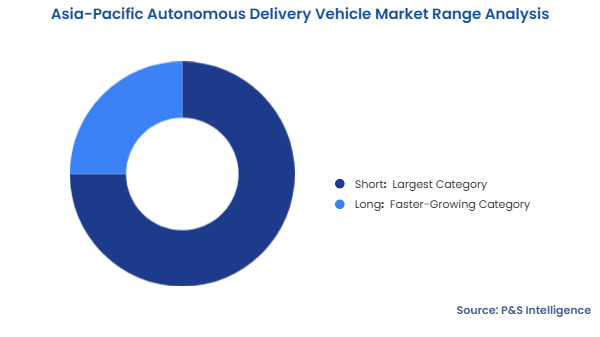
The short category commanded the largest market share in 2025, of 75%. It is driven by the concentration of order volumes in compact areas, integration of smaller battery packs, and operational safety frameworks limiting initial deployments to shorter distances. Short-range vehicles align with last-mile (5–10 km) delivery patterns of fulfillment centers, retail stores, or micro-warehouses, enabling multiple delivery cycles per shift without mid-day recharging requirements. Dense urban areas, including Beijing, Shanghai, Tokyo, Delhi, and Mumbai, generate sufficient delivery demand within compact areas to justify dedicated autonomous fleets serving specific neighborhoods, commercial districts, or campus environments.
The long category will experience the fastest growth through 2032, at 25.5% CAGR, enabled by batteries offering longer operational distances, expanding service areas, and logistics network optimization. Companies are deploying long-range autonomous trucks for regional freight movements from manufacturing facilities to distribution hubs, agricultural zones to urban markets, and port terminals to inland logistics parks. India's National Logistics Policy infrastructure investments under the PM GatiShakti national master plan support autonomous logistics deployment across tier-2 and tier-3 cities, requiring extended operational ranges.
The market segments into the following ranges:
Short (Larger Category)
Long (Faster-Growing Category)
Application Analysis
The retail category held the largest market share in 2025, of 40%. This reflects the growing e-commerce sector, partnerships between autonomous technology providers and major online retail platforms, and consumer acceptance of autonomous delivery for non-perishable merchandise, including apparel, electronics, and household goods. Many major e-commerce operators have integrated autonomous delivery vehicles into last-mile fulfillment networks for residential complexes, office buildings, and designated pickup points. Retail deployment benefits from predictable delivery patterns enabling route optimization, flexible delivery time windows reducing operational constraints, and standardized packaging facilitating automated loading and unloading processes.
The healthcare & pharmaceutical category will register the fastest growth during the forecast period. This is driven by temperature-controlled delivery requirements, time-sensitive delivery mandates, and regulatory acceptance of autonomous delivery for licensed pharmaceutical distribution. Healthcare logistics must maintain 2–8°C temperature ranges for vaccines and biologics, validated and compliant cold-chain documentation, and secure delivery protocols preventing unauthorized access to controlled substances. Aging demographics, expanding chronic disease prevalence, and rural healthcare access challenges favor autonomous pharmaceutical delivery for reliable service.
The market segments into the following applications:
China held approximately 40% Asia-Pacific autonomous delivery vehicle market share in 2025, sustained by aggressive government infrastructure investment, mature e-commerce logistics networks, and large-scale commercial deployments by technology and logistics leaders. The country's growing cross-border e-commerce drives demand for autonomous delivery solutions capable of handling high transaction volumes. China's Ministry of Transport data shows that international air cargo volume reached nearly 9 million tonnes in 2024, up 32.8% over 2020, driven by booming e-commerce.
Major cities, including Beijing, Shanghai, Shenzhen, and Guangzhou, have established dedicated testing zones and regulatory pathways for Level 4autonomous delivery vehicles to operate on public roads. Provincial governments provide subsidies covering up to 60% of vehicle procurement costs, accelerating fleet deployment across express delivery, intracity logistics, and retail fulfillment applications. Over 6,000 autonomous delivery vehicles were operational across China by end of 2024, with companies deploying fleets in over 300 cities serving more than 600 clients across parcel express, fresh food, pharmaceutical, and auto parts sectors.
China's market growth continues with the Made in China 2025 strategy prioritizing automation and AI integration in logistics, expansion of 5G network coverage enabling real-time vehicle connectivity, and sustained venture capital investment in autonomous technology development. The convergence of mature digital payment infrastructure, dense urban populations exceeding 900 million, and sophisticated e-commerce fulfillment requirements drive the market in China.
India Autonomous Delivery Vehicle Market Expansion
India is expected to register the highest CAGR, of 25.3%, driven by rapid urbanization, expanding internet penetration exceeding 1.08 billion users, and government initiatives enhancing logistics infrastructure and digital connectivity. India's Ministry of Commerce reported that cargo movement via inland waterways reached a record 145.5 million tonnes in fiscal 2024–25, reflecting robust logistics sector growth. The National Logistics Policy aims to reduce logistics costs below 10% of GDP by 2030 through digital integration, warehouse capacity expansion, and multimodal transport network development. The Unified Logistics Interface Platform (ULIP) has facilitated over 160 crore digital transactions as of August 2025, streamlining coordination across supply chain stakeholders and creating favorable conditions for autonomous delivery integration.
Major metropolitan areas, including Delhi-NCR, Greater Mumbai, Bangalore, and Hyderabad, are experiencing accelerating e-commerce adoption and delivery demand, driving autonomous ground robot and drone deliveries in campuses, gated communities, and warehouse-to-distribution center transfers. India's growth is supported by favorable demographics with 313 million rural residents now online, sustained FDI inflows for B2C and B2B e-commerce platforms, and expanding digital payment penetration expected to account for 71.7% of total payment volume by 2025. Infrastructure investments under PM GatiShakti Yojna reinforce autonomous logistics viability across tier-2 and tier-3 cities.
Japan Autonomous Delivery Vehicle Market Development
Japan’s market significance is supported by comprehensive regulatory frameworks, aging population, labor shortage, and government-led logistics automation. The country legalized autonomous delivery robot operation on public roads from April 2023 under revised Road Traffic Act provisions, enabling commercial deployments in controlled environments and urban districts. Japan's Ministry of Economy, Trade and Industry (METI) established the Working Group for Discussing the Social Implementation of Autonomous Delivery Robots with Higher Delivery Capability in July 2024.
Tokyo, Osaka, Nagoya, and other major metropolitan areas are conducting field operational tests of Level 4 autonomous delivery vehicles in densely populated commercial districts, residential neighborhoods, and mixed-use developments. Companies are deploying autonomous solutions to address severe labor shortages in transportation sectors and support aging populations requiring convenient delivery access for groceries, pharmaceuticals, and daily necessities. Japan's development is reinforced by establishment of international ISO standards for service robot safety led by METI between 2023 and 2025. High public trust in automation technologies, extensive industrial robot deployment, sophisticated digital infrastructure, and consumer acceptance of contactless delivery models drive autonomous deliveries for healthcare logistics, convenience store replenishment, and elderly support services.
The Asia-Pacific autonomous delivery vehicle market exhibits a moderately concentrated structure with several established technology leaders and logistics incumbents commanding significant deployment scale. Market concentration stems from substantial capital requirements for autonomous hardware and software and extensive real-world testing needed to achieve regulatory approval and operational reliability. Network effects favor early movers who establish relationships with major e-commerce platforms, retail chains, and logistics service providers. This creates barriers for new entrants lacking established commercial partnerships.
Competitive dynamics reflect diverging strategic approaches between pure-play autonomous technology companies focusing on vehicle development and sales versus integrated logistics operators deploying autonomous fleets for internal use. Technology providers emphasize modular platforms supporting multiple vehicle configurations and operational environments. While, integrated operators leverage proprietary delivery data and customer relationships to optimize routing algorithms and deployment strategies.
Strategic partnerships between automotive manufacturers, technology companies, and logistics service providers are reshaping competitive boundaries. Market evolution suggests continued consolidation through acquisitions of specialized technology providers by logistics incumbents seeking to internalize autonomous capabilities, alongside sustained competition from well-funded startups pursuing distinct use cases.
Leading Players in Asia-Pacific Autonomous Delivery Vehicle Market:
In October 2025, JD Logistics announced plans to procure three million robots, one million autonomous vehicles, and 100,000 drones over the next five years to expand its automated logistics network across China.
In October 2025, Meituan's autonomous delivery vehicles completed nearly 5 million orders by end of 2024. The company partnered with Pony.ai to develop automotive-grade domain controllers based on NVIDIA Orin processors enabling higher autonomy levels and easier fleet scaling.
In April 2025, Nuro Inc. raised USD 106 million in funding to support its strategic shift from autonomous delivery robots to licensing its autonomy technology platform to manufacturers and mobility service providers. The pivot enables Nuro to monetize its Level 4 autonomous driving software and AI-based perception systems across broader vehicle applications beyond dedicated delivery pods.
In August 2024, Inceptio Technology delivered 400 autonomous trucks to ZTO Express in China, developed in collaboration with Dongfeng Commercial Vehicle and pre-installed with Inceptio's autonomous driving system.
Frequently Asked Questions About This Report
What was APAC autonomous delivery vehicle market size in 2025?+
In 2025, the autonomous delivery vehicle market in APAC size was USD 550.0 million.
Which vehicle type has largest APAC autonomous delivery vehicle industry share?+
Ground robots have the largest APAC autonomous delivery vehicle industry share, of 60%.
Which country has largest APAC autonomous delivery vehicle market share?+
China is the largest autonomous delivery vehicle market in APAC, with 40% share.
What are the key APAC autonomous delivery vehicle industry drivers?+
The APAC autonomous delivery vehicle industry is driven by integration of ground delivery robots, aerial drones, and self-driving logistics vehicles for last-mile e-commerce, retail, and food delivery in densely populated urban areas.
What is the APAC autonomous delivery vehicle market nature?+
The autonomous delivery vehicle market in APAC is moderately consolidated.
Want a report tailored exactly to your business need?
Leading companies across industries trust us to deliver data-driven insights and innovative solutions for their most critical decisions. From data-driven strategies to actionable insights, we empower the decision-makers who shape industries and define the future. From Fortune 500 companies to innovative startups, we are proud to partner with organisations that drive progress in their industries.
Client Testimonials
Working with P&S Intelligence and their team was an absolute pleasure – their awareness of timelines and commitment to value greatly contributed to our project's success. Eagerly anticipating future collaborations.
McKinsey & Company
India
Unmatched Standards
Our insights into the minutest levels of the markets, including the latest trends and competitive landscape, give you all the answers you need to take your business to new heights
Complete Data Security
We take a cautious approach to protecting your personal and confidential information. Trust is the strongest bond that connects us and our clients, and trust we build by complying with all international and domestic data protection and privacy laws