This Report Provides In-Depth Analysis of the Arc-based Plasma Lighting Market Report Prepared by P&S Intelligence, Segmented by Light Source (Xenon Arc, Metal Halide, Krypton Arc, Mercury Vapor, Deuterium Lamps), Wattage (Below 500 W, 501 to 1500 W, Above 1500 W), Application (UV applications, Searchlight & Spotlight, Solar Simulation and Environmental Testing, Spectroscopy, Medical Lighting, Microscopic Lights), and Geographical Outlook for the Period of 2019 to 2032
Explore the market potential with our data-driven report
Arc-based Plasma Lighting Market Outlook
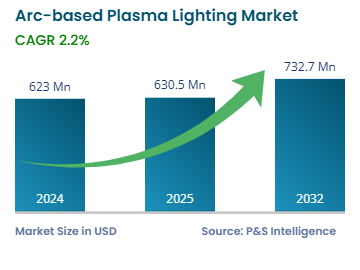
The global arc-based plasma lighting market generated a revenue of USD 623 million in 2024, which is expected to witness a CAGR of 2.2% during 2025–2032, to reach USD 732.7 million by 2032.
This growth can be ascribed to the increasing demand for energy-efficient lighting solutions, advancements in lighting technology, and growing adoption across various industries, such as automotive, street lighting, and commercial sectors. Additionally, the rising focus on sustainability and reduced carbon emissions, coupled with government regulations promoting energy-efficient solutions, is expected to further fuel the market's expansion in the coming years. Arc-based plasma lighting offers superior energy efficiency, longer lifespan, and better performance compared to traditional lighting sources.
These lights are widely used in street lighting, where sodium vapor lamps illuminate over 30% of urban roads globally. Metal halide lamps remain preferred in stadiums and sports arenas for their superior color rendering and brightness. In industrial settings, arc lamps are used in processes like UV curing and photolithography. Additionally, xenon arc lamps support the projection systems in over 90% of traditional cinemas. Their durability, luminous efficacy, and application flexibility continue to make them vital in lighting infrastructure worldwide.
Arc-based Plasma Lighting Market Growth Factors
Growing Demand for High-CRI Lighting in Healthcare Facilities Is Key Trend
One of the key trends in the market is the growing demand for high-color-rendering-index (CRI) lighting in healthcare facilities.
It accurately represents colors, ensuring that healthcare professionals can make precise assessments of patient conditions, especially in areas such as surgery, diagnostics, and patient care.
Arc-based plasma lighting, with its superior color rendering properties and consistency, is increasingly being preferred in hospitals, clinics, and laboratories to enhance visibility and improve the accuracy of medical procedures.
In addition to its excellent CRI, plasma lighting offers higher energy efficiency, longer lifespans, and reduced heat emissions compared to traditional lighting sources.
This makes it an ideal solution for healthcare facilities that require constant, high-quality lighting without the frequent maintenance or replacement needs associated with conventional bulbs.
Proper lighting in healthcare centers enhances patient comfort, supports accurate diagnosis, and reduces staff fatigue.
It also improves infection control by aiding visual cleanliness checks and contributes to patient circadian rhythm regulation, supporting overall healing and mental well-being.
Effective lighting significantly improves the overall patient experience by creating a calm, welcoming atmosphere that reduces anxiety and stress.
Adjustable and natural lighting can help regulate sleep patterns, especially in long-term care.
Soft, glare-free lighting also aids orientation, particularly for elderly patients, enhancing comfort, safety, and emotional well-being during recovery.
Expanding Applications of Plasma Arc Lamps Drive Market
The quintessential market driver is the rising usage of plasma arc lamps across applications that require high-intensity, reliable lighting for their intense brightness, energy efficiency, and long life.
These applications include street lighting, outdoor stadia, automotive headlights, and industrial facilities, where superior illumination is essential.
China’s urban development plans include significant investments in upgrading and expanding arc-based street lighting systems, such as high-pressure sodium and metal halide lamps, to improve energy efficiency and lighting quality in new infrastructure projects.
This involves large-scale deployments in industrial zones and highways, supported by government funding that prioritizes the durability and brightness of arc-based lamps for heavy-duty outdoor applications.
The ability of plasma lamps to deliver bright, clear, and consistent lighting in demanding environments positions them as an ideal alternative to traditional lighting sources.
Moreover, plasma arc lamps are gaining traction in specialized fields such as aerospace, research labs, and entertainment (e.g., film production and concert lighting), where high performance and precision lighting are critical.
Approximately 200 outdoor stadia with a capacity of over 40,000 are used for professional sports and major events globally.
According to the International Organization of Motor Vehicle Manufacturers (OICA), global automotive production in 2024 totaled 92,504,338 units.
With advancements in plasma technology, the lamps are becoming more cost-effective and efficient, making them accessible to a wider range of industries.
Increasing Deployment of LED Lighting Technology Poses Challenges
A key challenge facing the global arc-based plasma lighting market is the increasing deployment of LED lighting technology.
LED lighting has gained significant traction across various sectors due to its remarkable energy efficiency, long lifespan, and declining costs.
LEDs are widely adopted in applications such as residential, commercial, industrial, and street lighting, primarily because they consume up to 90% less energy, have a longer operational life of up to 50,000 hours, and require minimal maintenance compared to alternatives, including plasma arc lamps.
LEDs are also devoid of hazardous materials, such as mercury, enhancing environmental and human safety.
Global LED prices declined from about USD 1.00 per Watt in 2015 to approximately USD 0.30 per Watt in 2024, reflecting a 70% reduction.
As of early 2025, the UJALA scheme in India continues to offer LED bulbs at a subsidized price of INR 70 each.
This is significantly lower than the INR 450–500 before the scheme's launch in 2015.
This price reduction is attributed to factors such as decreased average selling prices (ASPs) of LED chips and components, as well as intensified competition among manufacturers.
As the demand for energy-efficient solutions grows, particularly with the rising global focus on sustainability and reducing carbon emissions, LEDs are seen as the more cost-effective and environmentally friendly option.
Additionally, advancements in LED technology have enabled better color rendering and improved brightness, further diminishing the need for plasma-based lighting in certain sectors.
Urban lighting modernization with LEDs is transforming cities by enhancing safety, reducing energy consumption, and cutting costs.
The Street Lighting National Programme (SLNP), led by Energy Efficiency Services Limited (EESL), has installed over 1.32 crore LED streetlights nationwide.
Additionally, the Delhi government is implementing a Rs 100-crore underground wiring initiative, which includes modern LED streetlighting to improve safety and aesthetics.
The xenon arc lamps category held the largest share in 2024 of 40% and it is projected to grow at the highest CAGR during 2025–2032. This is driven by their increasing application in cinema projection, medical devices, and scientific research. One of the key factors contributing to this growth is the superior light output of xenon arc lamps, which provide bright, intense light and high color temperature, making them ideal for high-end projection systems and imaging equipment.
Additionally, they are widely used in automotive headlights, especially in premium models, due to their ability to deliver a high-quality, focused beam. Moreover, their ability to produce consistent and reliable light in harsh conditions is a significant factor behind their dominance. As the demand for advanced lighting solutions in sectors like entertainment, healthcare, and research continues to rise, xenon arc lamps are expected to remain at the forefront of these industries, fueling market expansion.
During the study, we have analyzed the following light sources in the report:
Xenon Arc (Largest and Fastest-Growing Category)
Metal Halide
Krypton Arc
Mercury Vapor
Deuterium
Wattage Type Analysis
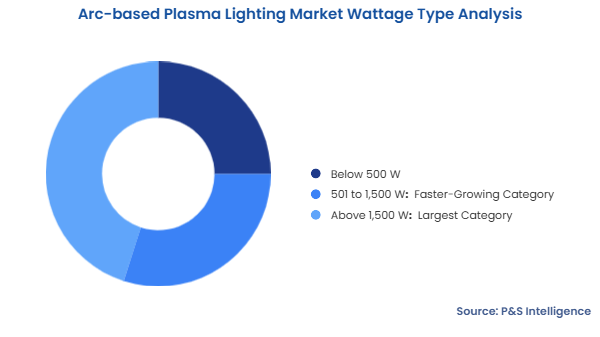
The above 1500 W category holds the largest market share in 2024. This is attributed to the growing demand for high-performance lighting solutions in industries that require powerful, reliable, and consistent light sources. These high-wattage lamps, typically used in applications such as large-scale cinema projection, industrial equipment, and scientific research, provide superior brightness and energy efficiency, which are essential in environments where high-intensity illumination is needed over long periods.
In the entertainment industry, for example, projectors with above 1500 W lamps are critical in delivering high-quality visuals in large venues, such as theaters, auditoriums, and concert halls. Similarly, in the automotive sector, xenon lamps above 1,500 W are utilized for advanced vehicle lighting systems, ensuring optimal visibility and safety. Additionally, these lamps are also commonly employed in medical imaging and laboratory equipment, where precise and powerful lighting is crucial for accurate diagnostics and experiments.
The 501–1500 W category will have the highest CAGR of 2.7% during the forecast period. They are widely used in industrial, commercial, and outdoor applications due to their high brightness and efficiency. Common uses include stadium lighting, large-scale manufacturing facilities, and street lighting. Their strong light output supports safety, productivity, and visibility in expansive environments.
Below are the wattage types analyzed:
Below 500 W
501 to 1,500 W (Faster-Growing Category)
Above 1,500 W (Largest Category)
Application Insights
UV applications accounted for the largest share in 2024 of around 25% driven by the increasing demand for ultraviolet (UV) light in a wide range of industries. UV light has unique properties that make it invaluable in various applications, such as disinfection, curing, and sterilization. Furthermore, UV applications in environmental monitoring, food safety, and industrial cleaning are gaining traction, further bolstering market growth.
In healthcare and water treatment, UV lamps are crucial for sterilizing equipment, purifying water, and eliminating harmful pathogens. As the need for clean and sanitized environments grows globally, particularly in response to the ongoing focus on hygiene and health safety, the demand for UV-based solutions is increasing.
In addition to healthcare, the UV light market is also expanding in the fields of electronics, automotive, and printing. UV curing is commonly used in the printing industry for drying inks and coatings quickly, while UV-based technologies are critical in the production of semiconductors and electronics, where precision and cleanliness are vital.
Solar simulation & environmental testing is the fastest-growing category. Arc-based lamps are essential in solar simulation and environmental testing for their ability to produce intense, stable, and broad-spectrum light closely mimicking natural sunlight. They enable accurate testing of solar panels, materials, and coatings under controlled conditions, ensuring reliability, durability, and performance in real-world environmental exposures.
As of 2024, global installed photovoltaic (PV) capacity surpassed 1,600 GW, according to IRENA. The International Energy Agency (IEA) projects an additional 400–500 GW to be added annually through 2030. Major expansions are led by China, the U.S., and India, driven by policy support and falling solar technology costs.
The following applications are included in the report:
UV applications (Largest Category)
Searchlight & Spotlight
Solar Simulation and Environmental Testing (Faster-Growing Category)
Spectroscopy
Medical Lighting
Microscopic Lights
Others
Drive strategic growth with comprehensive market analysis
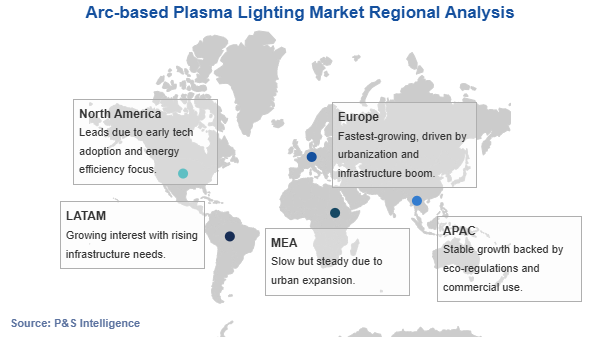
Geographically, North America holds the largest market share of approx. 35% in 2024 driven by advanced technological infrastructure, robust industrial demand, and a strong focus on innovation. The region's well-established presence in sectors such as entertainment, healthcare, automotive, and scientific research significantly contributes to its dominance. In particular, the demand for high-performance lighting systems in cinemas, medical imaging, and laboratory applications is notably high in North America, where xenon arc lamps are widely used for their superior brightness, color quality, and energy efficiency.
The automotive industry in North America also plays a crucial role, with an increasing preference for high-intensity xenon lamps in premium vehicle models for improved headlight performance. According to the Organization Internationale des Constructeurs d'Automobiles (OICA), the United States produced approximately 10.56 million motor vehicles in 2024. Additionally, the growing emphasis on research and development in the region further boosts the adoption of xenon arc lamps in various scientific and technological applications.
APAC will witness the highest CAGR over the forecast period, supported by the region’s booming industrial sectors. China, producing over 27 million vehicles annually, integrates arc-based lamps in automotive manufacturing and medical imaging, supported by its healthcare spending exceeding USD 1 trillion. India’s healthcare sector, with a budget surpassing INR 6.1 lakh crore, increasingly uses arc lighting in surgical and diagnostic applications.
South Korea, where electronics contribute about 40% to GDP, relies on arc-based lighting for precision manufacturing in semiconductor fabs. Japan’s automotive industry, producing around 8 million vehicles yearly, extensively employs arc lamps for premium headlights, collectively driving robust market expansion across APAC.
Further, regions and countries analyzed for this report include:
The global arc-based plasma lighting market is fragmented, characterized by the presence of numerous players across various regions, each contributing to a diverse and competitive landscape. This is primarily due to the wide range of applications for arc-based plasma lighting, which spans industries such as automotive, entertainment, commercial lighting, and scientific research. Different manufacturers offer specialized lighting solutions tailored to specific needs, resulting in a highly varied market with no single dominant player.
While there are some larger players that dominate certain segments, particularly in high-end applications like cinema projection and automotive lighting, the overall market remains fragmented due to its broad and varied use cases. This fragmentation is likely to persist as new technologies and applications emerge in the coming years.
Key Arc-based Plasma Lighting Companies:
ams-OSRAM AG
Excelitas Technologies Corp.
Gavita International B.V.
Hamamatsu Photonics K.K.
Hive Lighting Inc.
Intematix Corporation
LEDVANCE GmbH
MKS Instruments, Inc.
Panasonic Holdings Corporation
Samsung Electronics Co. Ltd.
Signify N.V.
Ushio Inc.
Arc-based Plasma Lighting Market News & Updates
In January 2024, Excelitas Technologies Corp. acquired Noblelight, a provider of specialty lighting systems, including ultraviolet and infrared, from Heraeus Group. These solutions are designed for analytical instrumentation, water treatment, industrial curing, medical and cosmetic therapy, electronics manufacturing, and battery production.
In December 2023, Lumartix introduced a new solar simulator designed for characterization, aging, and stabilization tests, as well as light-soaking and solar simulation functions. The Solixon A-22 simulator supports numerous PV technologies, including thin-film and perovskite.
In August 2023, Hamamatsu Photonics operationalized its new factory at its Toyooka site. It produces electron tube products, such as microfocus X-ray sources.
Want a report tailored exactly to your business need?
Leading companies across industries trust us to deliver data-driven insights and innovative solutions for their most critical decisions. From data-driven strategies to actionable insights, we empower the decision-makers who shape industries and define the future. From Fortune 500 companies to innovative startups, we are proud to partner with organisations that drive progress in their industries.
Client Testimonials
Working with P&S Intelligence and their team was an absolute pleasure – their awareness of timelines and commitment to value greatly contributed to our project's success. Eagerly anticipating future collaborations.
McKinsey & Company
India
Unmatched Standards
Our insights into the minutest levels of the markets, including the latest trends and competitive landscape, give you all the answers you need to take your business to new heights
Complete Data Security
We take a cautious approach to protecting your personal and confidential information. Trust is the strongest bond that connects us and our clients, and trust we build by complying with all international and domestic data protection and privacy laws