This Report Provides In-Depth Analysis of the APAC Cold Chain Market Report Prepared by P&S Intelligence, Segmented by Offering (Hardware, Packaging, Software, Services), Temperature Range (Degree Celsius) (Chilled (2 to 8), Sub-Chilled (Minus 1 to Minus 2), Blast-Frozen (Minus 5 to Minus 18), Frozen (Minus 18 to Minus 25), Deep-Frozen (less than Minus 25)), Application (Fruits & Vegetables, Dairy Products, Fish Meat & Seafood, Processed Food, Pharmaceuticals, Bakery & Confectionery), and Geographical Outlook for the Period of 2021 to 2032
Explore the market potential with our data-driven report
APAC Cold Chain Market Overview
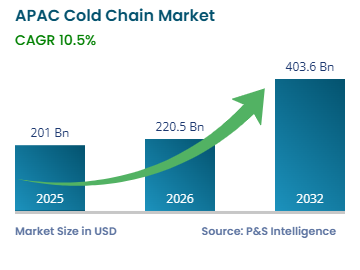
The Asia-Pacific cold chain market valued USD 201.0 billion in 2025, and it is projected to reach USD 403.6 billion by 2032, expanding at a compound annual growth rate of 10.5% during the forecast period (2026–2032). The Asia-Pacific cold chain market is primarily driven by rising demand for fresh and frozen food, expanding pharmaceutical and biotech industries, increasing e-commerce and organized retail, government investments in cold storage infrastructure, and growing consumer awareness of food safety and quality.
Key Market Insights
Hardware accounted for the largest share, of 50%, driven by extensive deployment of temperature monitoring sensors, RFID tracking devices, telematics systems, and refrigeration equipment for immediate visibility during storage and transportation.
The deep-frozen (<–25°C) category has the fastest growth during 2026–2032, of 10.8%, driven by expansion of ultra-low temperature product transportation, cell therapies, advanced biologics, and cryogenic storage requirements for regenerative medicine products.
Fish, meat, & seafood applications held the largest share, of 30%, reflecting high-volume seafood production, trade, and consumption in China, India, and Southeast Asia.
China commands the largest share, of 45%, driven by extensive refrigerated warehouse and sustained government infrastructure investment programs.
India is the fastest-growing country market, at 10.7% CAGR, propelled by Pradhan Mantri Kisan Sampada Yojana infrastructure funding, rising middle-class protein consumption, and e-commerce platform expansion.
China's 14th Five-Year Plan, targeting cold storage capacity expansion; and India's Pradhan Mantri Kisan Sampada Yojana, allocating INR 6,000 crore for 2016–20 and INR 4,600 crore up to March 31, 2026, for refrigerated facilities near agricultural production zones, encourage private sector infrastructure development. Government food safety standards across China, India, Japan, and South Korea are leading to stricter requirements for IoT-enabled tracking systems and adoption of natural refrigerants in commercial refrigeration. This is compelling logistics providers to upgrade facilities and transport fleets to meet evolving regulatory compliance mandates.
APAC Cold Chain Market Trends & Drivers
IoT Integration and Automation Are Major Trends in Regional Cold Chains
Digital transformation and the integration of IoT sensors, cloud-based monitoring platforms, and blockchain technologies for automation enable real-time temperature tracking, automated compliance reporting, and predictive maintenance. Operators are deploying AI-powered analytics to optimize warehouse management and route planning and IoT devices to monitor temperature and humidity throughout storage and transportation. These technological advancements address regulatory compliance by enabling logistics providers to reduce spoilage to below 0.1% in advanced warehouses while cutting energy consumption by 10–12% through intelligent cooling system management.
The shift toward automated storage and retrieval systems, particularly in China and Japan, is compressing labor exposure and improving throughput efficiency across refrigerated facilities. As cold chain requirements intensify for pharmaceutical biologics and premium food products, technology adoption is expected to accelerate from pilot implementations to enterprise-wide integration throughout the forecast period.
E-Commerce Expansion and Urbanization Drive Market Growth
Rapid e-commerce growth and accelerating urbanization across Asia-Pacific are fueling sustained infrastructure investment in temperature-controlled logistics networks to support last-mile delivery of perishable goods. The Asian Development Bank data indicates disposable incomes in the region grew by an average of 5.2% annually between 2018 and 2023, enabling greater consumer spending on chilled and frozen food products delivered through online platforms.
China remains the largest e‑commerce market in the world, accounting for nearly 50% of global retail e‑commerce sales in 2024. As per Japan’s Ministry of Economy, Trade and Industry (METI), B2C e‑commerce sales valued JPY 26.1 trillion in 2024, up from JPY 24.8 trillion in 2023. As per Statistics Korea. cross‑border online purchases reached KRW 6.8 trillion (USD 4.97 billion) in 2023. In India, government sources noted that around 270 million Indians shopped online in 2024. Government infrastructure initiatives including China's cold chain highway program and India's PMKSY scheme are creating enabling conditions for private sector cold chain investment, while organized retail penetration is reinforcing demand for centralized refrigerated warehousing capabilities serving supermarket networks.
Urban populations are projected to reach 2.3 billion across the region, driving demand for quick-commerce delivery models requiring dense networks of dark stores and refrigerated transport capable of sub-30-minute delivery windows. The e-commerce sector in Asia-Pacific is growing, with online grocery sales contributing significantly to cold chain logistics demand as platforms expand from tier-1 cities into tier-2 and tier-3 urban centers. This expansion is compelling logistics providers to establish distributed depot networks, invest in refrigerated last-mile vehicles, and deploy temperature monitoring systems ensuring product integrity throughout delivery cycles.
Focus on Post-Harvest Loss Reduction and Pharmaceutical Distribution Create Opportunities
Addressing food loss through improved cold chain infrastructure represents significant market expansion opportunity, particularly in Southeast Asian markets where inadequate refrigeration contributes to substantial post-harvest waste. The Food and Agriculture Organization (FAO) reports that 526 million tonnes of food in Asia is lost annually—equivalent to 12% of global production.
India, Indonesia, and Vietnam are prioritizing pharmaceutical cold chain infrastructure to support domestic vaccine production and export ambitions, creating demand for specialized ultra-low temperature storage, cryogenic transport capabilities, and blockchain-enabled tracking systems ensuring product integrity for advanced therapies, including CAR-T treatments and mRNA vaccines.
According to Japan’s Ministry of Health, Labour and Welfare, in 2023 the domestic production value of pharmaceuticals was JPY 10,033.2 billion, with exports of JPY 713.1 billion and imports of JPY 3,772.6 billion, as reported in the Pharmaceutical Industry Production Statistics Annual Report. The Ministry of Food and Drug Safety and related government trade sources indicate that South Korea’s finished pharmaceutical goods production reached KRW 28.46 trillion in 2024, reflecting ongoing growth in domestic production.
According to the Indian Brand Equity Foundation (IBEF), India’s pharmaceutical sector was valued at around USD 50 billion in FY 2023–24, reflecting domestic production output and significant export activity in generics and vaccines. India boasts the highest number of USFDA-compliant manufacturing plants outside the United States, along with over 2,000 WHO-GMP certified facilities, exporting to more than 150 countries. The Production-Linked Incentive (PLI) scheme allocates INR 15,000 crore (USD 2.04 billion) from 2020–21 to 2028–29 to enhance manufacturing, attract investment, and promote product diversification. The Strengthening of Pharmaceutical Industry (SPI) initiative provides INR 500 crore (USD 60.6 million) to assist pharmaceutical clusters and MSMEs in improving productivity, quality, and sustainability.
As of May 2025, India contributed 20% of the global of generic medication supply, 55– 60% of UNICEF’s vaccine needs, 99% of WHO’s demand for DPT vaccines, 52% of BCG vaccines, and 45% of measles vaccines. In FY25, India's exports of drugs and pharmaceuticals reached INR 2,59,658 crore (USD 30.38 billion), an increase from INR 2,43,119 crore (USD 27.82 billion) in FY24. Drug formulations and biological product exports, totaled INR 1,96,401 crore (USD 22.92 billion). Foreign Direct Investment (FDI) inflows into the drugs & pharmaceuticals sector from April 2000 to June 2025 amounted to INR 2,10,940 crore (USD 24.62 billion).
Investments targeting farm-level pre-cooling facilities, multi-temperature storage hubs, and refrigerated transport connections can reduce fruit and vegetable losses currently reaching 15–50% in some regional markets, directly improving farmer incomes while enhancing food security. Simultaneously, pharmaceutical cold chain development presents high-growth opportunities driven by biologics manufacturing expansion, vaccine distribution requirements, and regulatory mandates for GDP-compliant temperature control throughout pharmaceutical supply chains.
APAC Cold Chain Market Segmentation Analysis
Offering Analysis
Hardware accounted for the largest share, of 50%, in 2025, driven by extensive deployment of temperature monitoring sensors, RFID tracking devices, telematics systems, and refrigeration equipment for immediate visibility during storage and transportation. Hardware enables real-time data collection on temperature, humidity, and location throughout cold chains, with continuous monitoring essential for maintaining product integrity in pharmaceutical, vaccine, and perishable food applications. Established manufacturing infrastructure and capital intensity of refrigerated warehouse construction and transport fleet acquisition support hardware scalability across diverse environments. Regional expansion of automated storage and retrieval systems, particularly in China and Japan, further drives high-capacity cold chain establishment, requiring substantial equipment investment.
Software is projected to experience the fastest growth during 2026–2032, at 10.6% CAGR. This is fueled by accelerating adoption of cloud-based monitoring systems, predictive analytics applications, and blockchain-enabled traceability solutions to optimize supply chain efficiency. Digital transformation initiatives of logistics providers emphasize software for route optimization, automated compliance reporting, and AI-driven predictive maintenance to reduce operational costs and improve service. Integration of IoT connectivity with advanced analytics enables real-time decision-making, automated alert systems, and comprehensive documentation, supporting regulatory compliance for pharmaceuticals and food products. As cold chain complexity increases with pharmaceutical biologics expansion and e-commerce growth, software investments are rising to enable visibility, automation, and data-driven optimization.
The market segments into the following offerings:
Hardware (Largest Category)
Storage Equipment
Transport Refrigeration Equipment
Monitoring Devices
Packaging
Passive Packaging
Active Packaging
Pallet Shippers & Thermal Covers
Software (Fastest-Growing Category)
Cold Chain Monitoring & Visibility
Temperature Excursion Management
Analytics & Compliance
Services
Installation & Commissioning
Calibration & Validation
Maintenance & Support
System Integration & Consulting
Temperature Range Analysis
The chilled (2°C to 8°C) category commanded the largest market share in 2025, of 45%. It serves extensive requirements for dairy products, fresh produce, meat, seafood, vaccines, and pharmaceutical preparations requiring short-term preservation at controlled refrigeration temperatures. The FAO indicates that fresh produce accounts for a significant portion of daily dietary consumption across Asia-Pacific, making chilled storage and transport essential to reduce post-harvest losses.
According to the Indian Council of Agricultural Research, up to 30% of fruits and vegetables were lost annually in India due to inadequate cold chain infrastructure before recent government interventions, demonstrating chilled segment's critical role in food security and economic efficiency. Chilled infrastructure benefits from broader applicability across multiple food categories, shorter temperature range requirements reducing energy intensity compared to frozen operations, and established logistics networks supporting fresh food distribution to urban consumption centers throughout APAC.
The deep-frozen (<–25°C) category is expected to register the fastest growth during 2026–2032, of 10.8%, driven by expansion of ultra-low temperature pharmaceutical applications including mRNA vaccines, cell therapies, advanced biologics, and cryogenic storage requirements for regenerative medicine products. Pharmaceutical cold chains need specialized capabilities for biologics manufacturing, vaccine distribution, and GDP-compliant temperature control as mandated across APAC. Frozen seafood export growth from Southeast Asian countries and increasing online sale of frozen convenience foods drive this category. Capital investment in blast-freezing facilities, cryogenic transport capabilities, and automated ultra-low temperature storage for pharmaceutical and premium food applications drive the market too.
The market segments into the following temperature ranges:
Chilled (2°C to 8°C) (Largest Category)
Sub-Chilled (−1°C to 2°C)
Blast-Frozen (−5°C to −18°C)
Frozen (−18°C to −25°C)
Deep-Frozen (<−25°C) (Fastest-Growing Category)
Application Analysis
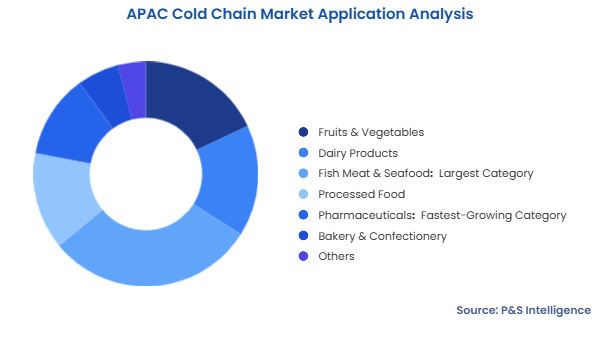
Fish, meat, & seafood applications held the largest share of Asia-Pacific cold chain market in 2025, of 30%, reflecting high-volume seafood production, trade, and consumption in China, India, and Southeast Asia. Regional production advantages in aquaculture, livestock processing, and fishing industries create sustained demand for refrigerated storage near production zones, blast-freezing capabilities for export-oriented products, and temperature-controlled transport connecting coastal processing facilities to inland consumption centers and international export gateways. Established cold chain infrastructure supports traditional protein supply chains, while organized retail penetration requires consistent quality and food safety compliance.
Official FAO data show that per‑capita fish and seafood availability in the Asia region is above the global average of about 20.7 kg per person per year in 2022. India’s per‑capita fish consumption is about 7.8 kg/year, while in the Philippines it is about 34.27 kg/year. In 2023, China produced about 71 million metric tonnes of seafood and imported USD 18.8 billion in worth. India exported approximately 342,534 tonnes of marine products in fiscal 2024–25, worth USD 7.4 billion.
FAO trade data shows that Japan and China were major importers of frozen fish meat in 2023, with values of roughly USD 760 million and USD 182 million, respectively. In live fish exports, China led with USD 408 million, followed by the Philippines at USD 79 million. For meat, FAO reports that India’s official meat output for 2023–24 was about 10.25 million tonnes, including poultry, pig, and cattle.
The pharmaceutical category is projected to demonstrate the fastest growth during 2026–2032, at 10.9% CAGR, propelled by biologics manufacturing expansion, vaccine distribution infrastructure development, and regulatory mandates for GDP-compliant temperature control across pharmaceutical supply chains. The World Health Organization (WHO) emphasizes proper cold chain protocols for vaccine storage, particularly for mRNA vaccines requiring ultra-low temperatures.
According to the World Bank and national health ministries, over 60% of global API production capacity is now concentrated in China and India. This significantly augments regional demand for cold-chain logistics and regulatory-compliant warehousing. India, Indonesia, and Vietnam prioritize pharmaceutical cold chain infrastructure to support vaccine production and export, creating demand for specialized storage (−80°C to 25°C range), cryogenic transport solutions, and blockchain-enabled tracking systems to ensure advanced cell and gene therapies’ integrity. Post-pandemic emphasis on disaster preparedness, booming aging populations, and increasing biologics consumption drive this category. In 2023, there were around 697 million people aged 60 years or older in Asia and the Pacific, according to the UN ESCAP.
The market segments into the following applications:
Fruits & Vegetables
Dairy Products
Fish Meat & Seafood (Largest Category)
Processed Food
Pharmaceuticals (Fastest-Growing Category)
Bakery & Confectionery
Others
Drive strategic growth with comprehensive market analysis
APAC Cold Chain Market Regional Outlook
China Cold Chain Market Growth
China commands the largest share of the Asia-Pacific cold chain market, of 45%, driven by extensive refrigerated warehouse capacity exceeding 200 million cubic meters and sustained government infrastructure investment programs. The National Development and Reform Commission target cold chain coverage to reach 25% of fruit distribution and 45% of meat distribution by 2027. The government allocated CNY 100 billion in 2024 specifically for refrigerated logistics facility development, supporting 700,000 tonnes of additional cold storage capacity coming online in 2025.
China's cold storage capacity expanded at 8% year-over-year in 2023–2024, supported by investment from logistics providers for establishing automated warehouses near major consumption centers. Low-emission refrigerated truck sales tripled during 2023–2024 as operators responded to urban delivery preference for electric and natural gas vehicles. While, major e-commerce platforms have expanded warehouse networks to support same-day and next-day delivery of fresh and frozen products across tier-2 and tier-3 cities.
India Cold Chain Market Expansion
India is the fastest-growing country market, at 10.7% CAGR, propelled by Pradhan Mantri Kisan Sampada Yojana infrastructure funding, rising middle-class protein consumption, and e-commerce platform expansion requiring distributed logistics networks. The Ministry of Food Processing Industries allocated INR 6,520 crore through the PMKSY scheme extending to March 2026, with 395 projects approved and over 300 projects completed as of 2024, directly supporting cold storage construction near agricultural production zones and transportation corridor development.
The Agriculture Infrastructure Fund has sanctioned INR 67,717 crore in loans for cold chain infrastructure development, providing 35–50% subsidy coverage for private-sector cold storage investments. The idea is to enable SMEs to participate in temperature-controlled logistics infrastructure expansion. India's cold storage capacity reached 39.6 million metric tonnes across 8,689 facilities as of August 2024, with capacity additions concentrated in Uttar Pradesh, West Bengal, Gujarat, and Punjab supporting potato, dairy, and horticultural product handling. E-commerce grocery platforms are establishing dark store networks in metropolitan areas, driving demand for multi-temperature storage capabilities and refrigerated last-mile delivery fleets.
In September 2025, India intended to increase pharmaceutical exports to Russia, the Netherlands, and Brazil by 20%a. The Union Budget for 2025–26 allocated INR 1,400 crore (USD 163 million) for the establishment of three major bulk drug parks and INR 5,268 crore (USD 614 million) for the pharmaceutical sector. India is the third-largest producer of APIs, manufacturing over 500 varieties and supplying 57% of the items on the WHO’s prequalified list.
The Department of Pharmaceuticals has launched the PLI scheme for greenfield plants, with a total outlay of INR 6,940 crore (USD 951.27 million) for the fiscal years 2021 to 2030. The government has disbursed INR 604 crore (USD 69.76 million) under the PLI scheme in the first half of fiscal year 2025. In March 2024, 27 greenfield bulk drug parks were inaugurated, while Pradhan Mantri Bhartiya Janaushadhi Pariyojana (PMBJP) achieved sales of INR 1,000 crore (USD 119 million) by October 2024. The PLI scheme and the establishment of Bulk Drug Parks lower costs and attract investments, with USD 353.4 million earmarked for bulk drug production.
Japan Cold Chain Market Outlook
Japan represents a mature cold chain market, characterized by advanced infrastructure, stringent regulatory compliance requirements, and emphasis on pharmaceutical and high-value food applications. The Japan Ministry of Health, Labour and Welfare mandated stricter cold chain compliance standards for biopharmaceutical products in 2024, requiring enhanced temperature monitoring documentation and validation protocols throughout pharmaceutical distribution networks. The government's 2024 Life Sciences Roadmap allocated JPY 2 trillion for healthcare sector digitization programs including cold chain technology upgrades supporting cell and gene therapy commercialization. Japan's aging population, exceeding 30% of the total, drives pharmaceutical cold chain demand, particularly driven by the rising consumption of biologics, which require temperature-controlled distribution infrastructure.
Cold storage capacity dedicated to pharmaceutical applications expanded from 18% to 30% of total capacity during 2020–2024. Japan's cold chain infrastructure increasingly emphasizes cryogenic storage at -196°C and real-time location tracking throughout patient-specific treatment logistics for CAR-T cell therapies. Market growth faces headwinds from population decline, projected at 5% during 2023–2033, though pharmaceutical specialization and leadership in automated warehousing and IoT monitoring systems position Japan as a regional innovation hub. Infrastructure age presents renovation opportunities, with 33% of cold storage facilities exceeding 40 years requiring modernization investments to meet contemporary energy efficiency and monitoring technology standards.
These countries are covered:
China (Largest Category)
Japan
India (Fastest-Growing Category)
South Korea
Australia
Singapore
Indonesia
Thailand
Malaysia
Rest of APAC
APAC Cold Chain Market Share Analysis
The Asia-Pacific cold chain market is moderately fragmented due to the presence of multinational logistics providers, regional specialists, and local operators serving diverse geographies and applications. Fragmentation stems from varying infrastructure maturity, regulatory environments, and customer requirements, ranging from pharmaceutical GDP compliance to agricultural post-harvest handling. Capital intensity required for refrigerated facilities, transport fleets, and monitoring technologies creates modest entry barriers, favoring established players with existing logistics networks. Yet, diverse applications, from seafood exports to vaccine distribution, enable specialization across multiple competitive niches.
Global logistics integrators leverage extensive networks and technology capabilities to serve multinational pharmaceutical and food processing clients requiring standardized cold chain protocols across multiple countries. They compete primarily on reliability, compliance expertise, and integrated service offerings spanning warehousing, transportation, and value-added services, including kitting and quality inspection. Regional cold storage specialists differentiate through local market knowledge, proximity to agricultural production zones or consumption centers, and relationships with domestic food processors and organized retail chains. These regional players often partner with global integrators for international connectivity, while maintaining competitive advantages in understanding local regulatory requirements and customer preferences.
Strategic consolidation activity is gradually increasing market concentration as global players acquire regional capabilities to expand geographic footprint and service portfolios. Simultaneously, investments in IoT monitoring, automated warehousing, and route optimization technologies are creating competitive differentiation beyond traditional price-based competition. Recent infrastructure investments by major operators target pharmaceutical cold chain capabilities, including ultra-low temperature storage and GDP-compliant transport, to capture high-margin biologics and vaccine distribution opportunities.
APAC Cold Chain Manufacturers:
Emerson Electric Co.
Carrier Global Corporation
Daikin Industries Ltd.
Johnson Controls International plc
Liebherr-International Deutschland GmbH
Sonoco Products Company
Pelican BioThermal
va-Q-tec AG
Softbox Systems Ltd.
Cold Chain Technologies Inc.
Honeywell International Inc.
Envirotainer AB
Berlinger & Co. AG
Voltas Ltd.
LG Electronics
Hitachi Ltd.
Mitsubishi Electric Corporation
Midea Group Co. Ltd.
Gree Electric Appliances Inc.
Advansor A/S
Friotherm GmbH
B Medical Systems
Checkpoint Systems Inc.
Avery Dennison Corporation
APAC Cold Chain Market News
In March 2025, Cold Chain Technologies acquired Global Cold Chain Solutions, a provider of passive thermal packaging solutions with established manufacturing operations in Australia and India. This acquisition expands Cold Chain Technologies' APAC manufacturing footprint and strengthens its service capabilities for life sciences customers requiring high-performance thermal assurance solutions across regional pharmaceutical and biologics distribution networks.
In December 2024, Linfox International Pty Ltd. opened a 19,000-square-meter multi-temperature warehouse in Thailand. Featuring 28,000 pallet storage capacity, 34 loading docks, advanced temperature monitoring systems, and automated inventory management, it supports expanded cold chain distribution capabilities for food and pharmaceutical products across Southeast Asia.
In December 2024, YCH Group Limited partnered with Vietnam Post to develop a blockchain-enabled digital logistics marketplace for SMEs, providing enhanced supply chain visibility and transaction transparency across temperature-controlled distribution networks. The collaboration integrates digital tracking technologies for improved cold chain documentation and regulatory compliance during cross-border perishable goods trade.
Frequently Asked Questions About This Report
Want a report tailored exactly to your business need?
Leading companies across industries trust us to deliver data-driven insights and innovative solutions for their most critical decisions. From data-driven strategies to actionable insights, we empower the decision-makers who shape industries and define the future. From Fortune 500 companies to innovative startups, we are proud to partner with organisations that drive progress in their industries.
Client Testimonials
Working with P&S Intelligence and their team was an absolute pleasure – their awareness of timelines and commitment to value greatly contributed to our project's success. Eagerly anticipating future collaborations.
McKinsey & Company
India
Unmatched Standards
Our insights into the minutest levels of the markets, including the latest trends and competitive landscape, give you all the answers you need to take your business to new heights
Complete Data Security
We take a cautious approach to protecting your personal and confidential information. Trust is the strongest bond that connects us and our clients, and trust we build by complying with all international and domestic data protection and privacy laws