Antibody Production Market Size & Opportunities Analysis - Growth Strategies, Competitiveness, and Forecasts (2026 - 2032)
This Report Provides In-Depth Analysis of the Antibody Production Market Report Prepared by P&S Intelligence, Segmented by Product Type (Consumable, Instruments, Software), Process (Downstream Processing, Upstream Processing), Antibody Type (Monoclonal Antibodies, Polyclonal Antibodies), End User (Pharmaceutical and Biotechnology Companies, Research Laboratories, CROs and CDMOs), and Geographical Outlook for the Period of 2019 to 2032
Explore the market potential with our data-driven report
Antibody Production Market Future Outlook
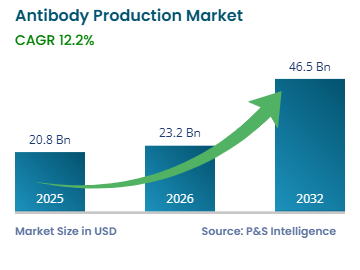
The global antibody production market size will be USD 20.8 billion in 2025, which is predicted to reach USD 46.5 billion by 2032, growing at a CAGR of 12.2% during 2026–2032.
The market expansion is primarily driven by the rising prevalence of chronic diseases, increasing demand for targeted therapies, and advancements in bioprocessing technologies. According to the American Cancer Society, approximately 2 million new cancer cases were projected in the U.S. in 2025. The WHO reports that cancer accounts for nearly 10 million deaths globally in 2020, making it one of the leading causes of death worldwide. This rising disease burden is driving substantial demand for monoclonal antibody-based therapeutics and diagnostics across oncology applications.
Additionally, the increasing incidence of autoimmune diseases is fueling market expansion. Autoimmune conditions such as rheumatoid arthritis, multiple sclerosis, inflammatory bowel disease, and systemic lupus erythematosus continue to grow in prevalence globally, thereby accelerating the adoption of antibody-based biologics as frontline therapies. These biologics offer high specificity, reduced off-target effects, and greater therapeutic efficacy compared to conventional small-molecule drugs, which has further strengthened their clinical acceptance.
Antibody Production Market Dynamics
Technological Advancements in Bioprocessing Are Key Trend
Continuous improvements in upstream and downstream bioprocessing methods are boosting antibody yield, purity, and production efficiency.
The adoption of single-use bioreactors is increasing due to lower risk of contamination, reduced cleaning requirements, and greater flexibility in scaling production.
Continuous bioprocessing is replacing traditional batch processing, resulting in shorter production cycles and cost-effective manufacturing.
The U.S. government launched a biomanufacturing initiative in September 2022, investing over USD 2 billion to expand domestic biomanufacturing capacity and help ensure pandemic preparedness.
Advanced cell line development techniques, including genetic engineering and high-throughput screening, are enabling higher expression levels of antibodies.
Innovations in chromatography resins and purification technologies are improving separation performance, reducing product loss, and enhancing final product quality.
Integration of automation, process analytics, and real-time monitoring tools is improving process control and consistency across production stages.
The growing use of AI and machine learning is supporting predictive biomanufacturing, optimizing cell culture conditions, and reducing experimental errors.
Advancements in filtration and downstream processing systems are reducing bottlenecks, making large-scale production more feasible and reproducible.
Rising Prevalence of Cancer Is a Major Growth Driver
The increasing number of cancer cases worldwide is driving higher demand for monoclonal antibody-based therapies, which are widely used in oncology due to their high specificity and targeted action.
The American Cancer Society further projects that by 2050, the number of cancer cases is expected to reach 35 million annually, representing a substantial increase from current levels.
Monoclonal antibodies are now considered standard treatment options for various cancers, including breast cancer, lung cancer, lymphoma, and colorectal cancer, contributing to increased production requirements.
The rise in cancer incidence has encouraged pharmaceutical and biotechnology companies to expand their research pipelines focused on antibody-based immunotherapies.
Under the Biotechnology Industry Research Assistance Council (BIRAC), the Indian government offers early-stage grants.
The Biotechnology Ignition Grant provides up to INR 50 lakh for proof-of-concept biotech startups, which includes biomanufacturing/bioprocessing themes.
Growing adoption of advanced antibody modalities such as antibody–drug conjugates (ADCs) and bispecific antibodies is further elevating the need for efficient bioprocessing systems.
Increased government and private sector funding for cancer research and biologics development is supporting large-scale manufacturing capacity.
Antibody Production Market Segmentation Analysis
Product Type Analysis
The consumables category holds the larger share in the antibody production market in 2025, of approximately 60%. This dominance is attributed to the recurring nature of consumables usage throughout production cycles and their critical role in ensuring product quality and consistency. Consumables encompass media, buffers, reagents, chromatography resins and columns, and filtration consumables that are essential for cell culture, antibody purification, and quality control processes.
The instruments segment is witnessing the fastest growth during 2026–2032, with a projected CAGR of approximately 12.4%. This growth is driven by increasing investments in large-scale manufacturing infrastructure and the adoption of advanced automation technologies. Bioreactors, chromatography systems, and filtration systems represent substantial capital investments that enable manufacturers to scale production capacity and improve process efficiency. The development of next-generation single-use bioreactors and integrated continuous manufacturing platforms is particularly driving instrument segment expansion as companies seek to enhance flexibility and reduce cross-contamination risks.
These product types are covered:
Consumables (Largest Category)
Media
Buffers & Reagents
Chromatography Resins and Columns
Filtration Consumables and Accessories
Instruments (Fastest-Growing Category)
Bioreactors
Chromatography Systems
Filtration Systems
Software
Process Insights
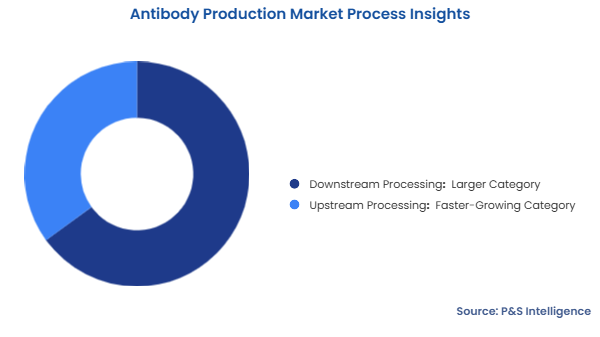
The downstream segment holds the larger share in the antibody production market in 2025, of approximately 65%. Downstream processing is critical for ensuring antibody purity, safety, efficacy, and identity, making it indispensable in both therapeutic and diagnostic applications. This segment encompasses purification, separation, concentration, and formulation steps that transform crude cell culture harvest into high-purity antibody products suitable for clinical use.
The dominance of downstream processing reflects the stringent regulatory requirements for biologic purity and the complex nature of antibody purification. Advanced technologies, including affinity chromatography, ion exchange chromatography, hydrophobic interaction chromatography, and membrane filtration, are extensively used to achieve target purity levels exceeding 99%. Regulatory agencies require comprehensive validation of downstream processes, driving continuous investment in advanced purification technologies and analytical capabilities.
The upstream segment is experiencing the faster growth during the forecast period, with a CAGR of approximately 12.5%. This acceleration is driven by significant investments in cell line development, bioreactor technology, and culture media optimization. In April 2023, Cytiva launched the X-platform single-use bioreactors designed to increase process efficiency in upstream bioprocessing operations. These innovations enable higher productivity, reduced production timelines, and improved product consistency, making upstream processing increasingly critical for competitive advantage in antibody production.
These processes are covered:
Downstream Processing (Larger Category)
Upstream Processing (Faster-Growing Category)
Type Analysis
The monoclonal antibodies segment holds the larger share in the antibody production market in 2025, of approximately 85%, and it is expected to have the highest CAGR over the forecast period. This is attributed to the high specificity and reproducibility of monoclonal antibodies, which makes them ideal for therapeutic applications across multiple disease indications. Monoclonal antibodies offer precise targeting of disease-specific antigens, enabling more effective treatments with reduced off-target effects compared to traditional small-molecule drugs.
The expanding applications of monoclonal antibodies across oncology, autoimmune diseases, infectious diseases, and other therapeutic areas are driving substantial research and development investments. The development of next-generation antibody formats, including bispecific antibodies, antibody-drug conjugates, and immune checkpoint inhibitors, is further expanding the therapeutic potential of monoclonal antibodies. In March 2023, Eli Lily announced an investment of approximately USD 1 billion in a monoclonal antibody manufacturing facility in Ireland, demonstrating the significant commercial opportunity in this segment.
These antibody types are covered:
Monoclonal Antibodies (Larger and Faster-Growing Category)
Humanized
Murine
Chimeric
Polyclonal Antibodies
End User Analysis
The pharmaceutical & biotechnology companies segment held the larger share in the antibody production market in 2025, reflecting the substantial internal antibody production capabilities of major biopharmaceutical firms. These companies maintain extensive in-house manufacturing infrastructure to support their antibody therapeutic pipelines and commercial products. The segment includes both large pharmaceutical companies with integrated biologics capabilities and specialized biotechnology firms focused exclusively on antibody development and production.
The CROs and CDMOs segment is experiencing the fastest growth during 2026–2032. This acceleration is driven by increasing outsourcing of antibody production by pharmaceutical and biotechnology companies seeking to reduce capital expenditure, access specialized expertise, and enhance manufacturing flexibility. Contract organizations offer end-to-end services from cell line development through commercial manufacturing, enabling clients to accelerate development timelines and focus resources on core competencies.
These end users are covered:
Pharmaceutical and Biotechnology Companies (Largest Category)
Research Laboratories
CROs and CDMOs (Fastest-Growing Category)
Drive strategic growth with comprehensive market analysis
Antibody Production Market Regional Outlook
North America Antibody Production Market Size
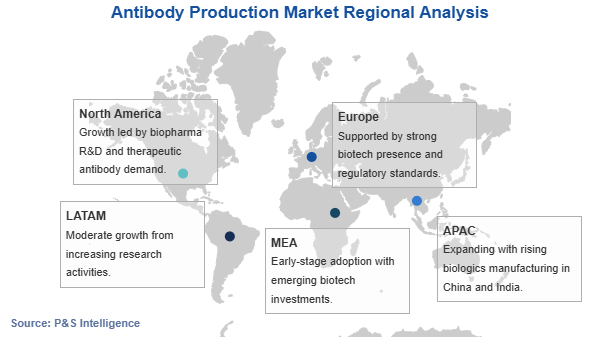
North America holds the largest share in the global antibody production market in 2025, accounting for approximately 40% of total market revenue. This regional dominance is driven by the presence of leading biopharmaceutical companies, robust research and development infrastructure, and substantial government funding for biomedical research. The region benefits from a well-established regulatory framework, advanced healthcare infrastructure, and high adoption rates of innovative antibody therapeutics across clinical settings.
U.S. Antibody Production Market Size
The U.S. represents the largest country market within North America, driven by the concentration of major pharmaceutical and biotechnology companies, including Amgen, Regeneron, AbbVie, and Genentech. According to the American Cancer Society, over 2 million new cancer cases are projected in the U.S. in 2025, creating substantial demand for antibody-based oncology treatments. Government initiatives supporting biopharmaceutical innovation further strengthen North America's market position. The NIH maintains substantial funding programs for antibody research, including initiatives focused on infectious disease countermeasures and precision medicine applications. The region's strong intellectual property protections, availability of venture capital funding, and concentration of world-class research institutions create a favorable ecosystem for antibody innovation and commercialization throughout the forecast period.
Asia-Pacific Antibody Production Market Forecast
Asia-Pacific is projected to be the fastest-growing region during 2026–2032, with a CAGR exceeding 15 percent. This acceleration is driven by rapidly expanding pharmaceutical and biotechnology sectors, increasing healthcare expenditure, and growing burden of chronic diseases across the region. China, Japan, India, and South Korea are making substantial investments in biomanufacturing infrastructure and developing local antibody production capabilities to meet domestic demand and capture export opportunities.
The region benefits from cost-competitive manufacturing environments, large patient populations, and supportive government policies promoting biotechnology sector development. China has emerged as a major hub for antibody production, with numerous domestic companies developing biosimilar and novel antibody therapeutics for both local and international markets. The United Nations Population Fund projects that one in four individuals in Asia-Pacific will be over 60 years of age by 2050, creating substantial long-term demand for antibody-based treatments for age-related conditions, including cancer and autoimmune diseases.
The regions and countries analyzed in this report are:
North America (Largest Regional Market)
U.S. (Larger and Faster-Growing Country Market)
Canada
Europe
Germany (Largest Country Market)
U.K. (Fastest-Growing Country Market)
France
Italy
Spain
Rest of Europe
Asia-Pacific (Fastest-Growing Regional Market)
Japan
China (Largest Country Market)
India (Fastest-Growing Country Market)
South Korea
Australia
Rest of APAC
Latin America
Brazil (Largest Country Market)
Mexico (Fastest-Growing Country Market)
Rest of LATAM
Middle East and Africa
Saudi Arabia (Largest Country Market)
South Africa
U.A.E. (Fastest-Growing Country Market)
Rest of MEA
Antibody Production Market Share
The global antibody production market is slightly fragmented, with numerous established players alongside emerging biotechnology companies and contract manufacturing organizations. The market features both vertically integrated pharmaceutical companies with comprehensive in-house capabilities and specialized firms focused on specific segments of the antibody production value chain. Competition is characterized by continuous technological innovation, strategic partnerships, capacity expansions, and investments in next-generation manufacturing platforms. Leading companies compete based on technological capabilities, manufacturing capacity, regulatory expertise, product portfolio breadth, and geographic presence. The presence of both large multinational corporations and agile biotechnology startups creates a dynamic competitive environment with continuous innovation in antibody engineering, bioprocessing technologies, and therapeutic applications.
Major players are pursuing various strategies to strengthen market positions, including investments in single-use technologies, continuous manufacturing capabilities, and artificial intelligence-enabled process optimization. Strategic collaborations between pharmaceutical companies and contract manufacturers are increasingly common, enabling capacity expansion while managing capital requirements. The development of platform technologies that can be applied across multiple antibody products provides competitive advantages through economies of scale and accelerated development timelines. In April 2025, the NIH officially launched a Phase 2 human challenge trial for an investigational monoclonal antibody designed to reduce dengue virus symptoms, highlighting continued government support for antibody therapeutic development.
Key Antibody Production Companies:
Thermo Fisher Scientific
Merck KGaA
Danaher Corporation
Sartorius Stedim Biotech
Lonza Group
GenScript
Abcam
Bio-Rad Laboratories
Wuxi Biologics
AGC Biologics
Charles River Laboratories
Creative Biolabs
Antibody Production Market News
In March 2025, Taiho Pharmaceutical Co. Ltd. announced a definitive agreement to acquire Araris Biotech AG, a Swiss biotechnology company developing next-generation antibody-drug conjugates, for approximately USD 400 million, to expand its oncology pipeline with advanced ADC drug discovery technology platforms.
In January 2025, ImmunoPrecise Antibodies Ltd. launched a new category of GLP-1 therapies, created using artificial intelligence via its proprietary LENSai platform, designed for diabetes and obesity treatment with enhanced effectiveness, safety, and extended therapy longevity.
In January 2025, Star Therapeutics announced that the U.S. FDA has granted Fast Track designation to VGA039 for von Willebrand disease.
In April 2023, Cytiva launched the X-platform single-use bioreactors designed to increase process efficiency in upstream bioprocessing operations, supporting production of cell and gene therapies, protein-based drugs, including monoclonal antibodies, and viral vectors.
Want a report tailored exactly to your business need?
Leading companies across industries trust us to deliver data-driven insights and innovative solutions for their most critical decisions. From data-driven strategies to actionable insights, we empower the decision-makers who shape industries and define the future. From Fortune 500 companies to innovative startups, we are proud to partner with organisations that drive progress in their industries.
Client Testimonials
Working with P&S Intelligence and their team was an absolute pleasure – their awareness of timelines and commitment to value greatly contributed to our project's success. Eagerly anticipating future collaborations.
McKinsey & Company
India
Unmatched Standards
Our insights into the minutest levels of the markets, including the latest trends and competitive landscape, give you all the answers you need to take your business to new heights
Complete Data Security
We take a cautious approach to protecting your personal and confidential information. Trust is the strongest bond that connects us and our clients, and trust we build by complying with all international and domestic data protection and privacy laws