This Report Provides In-Depth Analysis of the Anti-Drone Market Report Prepared by P&S Intelligence, Segmented by Platform (Ground-based, Handheld, UAV-based), Technology (Electronic, Laser, Traditional Kinetics), End Use (Military and Defense, Commercial, Government), Application (Detection and Tracking, Interdiction), and Geographical Outlook for the Period of 2019 to 2032
Explore the market potential with our data-driven report
Anti-Drone Market Future Outlook
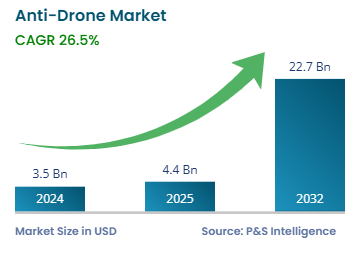
The global anti-drone market size was USD 3.5 billion in 2024, and it will grow by 26.5% during 2025–2032, to reach USD 22.7 billion by 2032.
The market growth is driven by the increasing security issues regarding the misuse of unmanned aerial vehicles, easy availability of cost-effective consumer drones for illegal surveillance and targeted attacks, and rising incidence of aerial intrusion at military bases, workshops, and government buildings. For instance, in December 2024, the Wright-Patterson Air Force Base of the USAF in Ohio closed its airspace for 4 hours after suspected drone sightings on December 17, 2024.
Additionally, the usage of small and low-altitude drones, such as in the ongoing Russia–Ukraine conflict and the recent India–Pakistan hostilities, is leading defense departments around the world to invest more than ever in anti-drone systems.
Governments in different countries, including the U.S., France, India, and Israel, have introduced regulations to allow the military sector to use various techniques, such as jamming, to neutralize illegal drones. The U.S. has given the FAA and DHS guidelines under the Preventing Emerging Threats Act to perform and manage counter-UAV operations.
Anti-Drone Market Growth Factors
AI-Powered Multi-Sensor Detection Is Key Trend
The rising usage of AI-powered integrated sensor systems to detect, identify, and assess current drone threats is a key trend in the market.
These systems combine RF analyzers, IR, EO, radar, and acoustic sensors with AI to analyze drone behavior, identify threats, and automatically activate the defense system.
Drones regularly enter restricted civilian and military areas, which is why there is a rising need to detect and neutralize them.
Armed forces are using advanced AI-integrated drones in war zones and high-security places, such as airports, power plants, and stadiums to follow strict security rules.
According to reports, around 30% of the new drones have autonomous or semi-autonomous capabilities, and 60 countries use AI for military services.
This rising adoption of smart drone technologies is driving organizations and governments to use smart anti-drone systems for defense.
According to the SIPRI, the global military budget reached USD 2,443 billion in 2023, increasing by 6.8% from the previous year, highlighting the rising investments in anti-drone systems.
Weaponization of Autonomous Drones Drives Demand for Smarter Counter-UAV Systems
The increasing use of autonomous drones as weapons is a key driver for the market.
They are able to carry out precision strikes by using navigation and AI systems.
Kamikaze UAVs can fly pre-programmed missions, withstand jamming, and avoid radar detection without human control.
The recent India–Pakistan clash and the Russia–Ukraine war showed a major push from traditional wars to autonomous drone systems.
Russia launched more than 440 drones and 32 missiles overnight on Ukraine in June 2025, including Shahed-136 kamikaze drones, to overpower Ukraine’s defense systems.
Ukraine fought back with Bukovel-AD electronic warfare systems and physical methods, such as net guns and shotguns.
Moreover, in May 2024, Russia launched more than 285 Lancet loitering drones, highlighting the move toward precision autonomous weaponry.
In 2024, a drone strike by Houthis (Samad-3) and Hezbollah (Mirsad-1) caused multiple Israeli deaths, showing weaknesses in Israel's air defense system.
This led Israel to use multiple anti-drone defenses, including the Iron Dome and radar-linked interceptor drones.
In May 2025, during Operation Sindoor, Pakistan launched 800–1,000 drones on India over four days, more than 600 of which were neutralized by India’s air defense.
India used indigenous surveillance drones and Israeli Harop loitering munitions, and Pakistan reportedly used over 350 Turkish Bayraktar TB2 and YIHA drones.
Countries are improving anti-drone systems such as using nets, jammers, guns, and lasers, and advanced technologies, such as satellites, AI, and automatic drones, to detect and neutralize threats.
Anti-Drone Market Segmentation Analysis
Platform Type Analysis
The ground-based category held the largest market share, of 75%, in 2024 because of its ability to provide extensive protection using integrated jammers and counter-drone effectors. These types are widely used at military bases, airports, and essential infrastructure in mobile and fixed setups.
The hand-held category will have the highest CAGR, of 27.5%, due to its convenience, fast deployment, and suitability for short-range urban and boundary threats. They are widely used by law enforcement officials, security teams, and border forces.
The platform types analyzed in this report are:
Ground-based (Largest Category)
Hand-held (Fastest-Growing Category)
UAV-based
Technology Analysis
The electronics category held the largest market share, of 60%, in 2024 due to their non-destructive nature and flexibility in civilian areas. The spoofing, radar detection, and advanced sensor technologies are widely used in military and urban areas.
The laser category will have the highest CAGR, of 27%, due to its high accuracy, minimal collateral damage, and ability to scale up deployment. They use focused energy beams to destroy drones by overheating essential parts, such as wings and circuits. They are widely used to stop small and fast drones in civilian and military areas, including airports and battlefields.
The technologies analyzed in this report are:
Electronic (Largest Category)
Laser (Fastest-Growing Category)
Traditional Kinetics
End Use Analysis
The military and defense category held the largest market share, of 55%, in 2024 due to the growing risk of drone attacks on military bases, border areas, and critical assets. The military requires authoritative and smart counter-UAV systems to protect infrastructure and the population. Governments are investing in various technologies as a modern defense system, which drives demand for anti-drone solutions. In May 2024, the U.S. Department of Defense issued a USD 190-million contract to develop and install advanced counter-drone systems.
The commercial category will have the highest CAGR, of 27.2%, due to the rising safety concerns at places such as factories, stadiums, and public events. As commercial drones are widely used for surveillance, deliveries, and filming, the need to prevent unsafe drone activity increases the demand for commercial anti-drone systems.
The end uses analyzed in this report are:
Military and Defense (Largest Category)
Commercial (Fastest-Growing Category)
Government
Application Analysis
The detection and tracking category held the largest market share, of 60% in 2024, because it is the first line of defense in neutralizing drone threats. Cameras and acoustic sensors find and track drones early and protect various government buildings and other sensitive areas.
The interdiction category will have the highest CAGR, of 26.8%, due to its direct need to disable drones, especially when utilized for spying, smuggling, and attacks. As drones are increasingly being used for illegal and unauthorized activities, governments and companies are investing in these systems to improve safety and security.
The applications analyzed in this report are:
Detection and Tracking (Larger Category)
Interdiction (Faster-Growing Category)
Drive strategic growth with comprehensive market analysis
Anti-Drone Market Regional Growth Dynamics
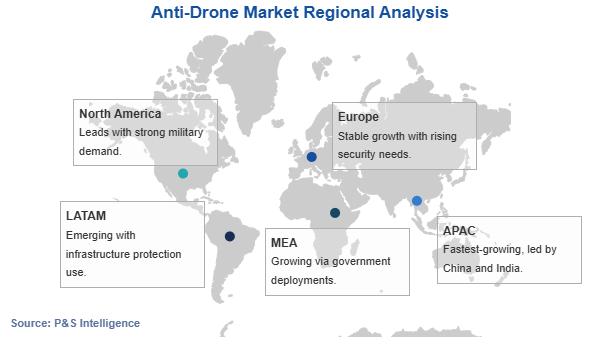
North America region held the largest market share, of 45%, in 2024 due to the region’s high investments in military and defense, growing national security concerns, early usage of advanced counter-UAV technologies, and presence of major contractors, such as Lockheed Martin. The strict regulations for drone security at key facilities, including power plants, also propel the market. Moreover, the U.S. is the largest military spender in the world and also the one involved in the most conflicts directly or indirectly, which drives the demand for anti-drone systems. Additionally, the U.S. government has launched several initiatives and implemented rules to boost airspace safety.
Asia-Pacific will have the highest CAGR, of 28.2%, during the forecast period, due to the growing defense budget of India, China, and South Korea, increasing border tension, rising drone usage in warfare, and high investments in anti-drone technologies. India is innovating counter-drone solutions under the Make in India initiative and through collaborations between the DRDO and private defense startups. They use jamming, radar, and lasers to detect and disable drones. The government is also encouraging local defense manufacturers and exporters to ensure self-reliance.
The geographical breakdown of the market is as follows:
North America (Largest Regional Market)
U.S. (Largest and Fastest-Growing Country)
Canada
Europe
Russia
U.K. (Largest Country)
France
Italy
Germany (Fastest-Growing Country)
Rest of Europe
Asia-Pacific (Fastest-Growing Regional Market)
China (Largest Country)
India (Fastest-Growing Country)
Japan
South Korea
Australia
Rest of APAC
Latin America
Brazil (Largest Country )
Mexico (Fastest-Growing Country)
Rest of LATAM
Middle East and Africa
Saudi Arabia (Largest Country )
South Africa
U.A.E. (Fastest-Growing Country)
Rest of MEA
Anti-Drone Market Competitive Landscape
The market is fragmented because many countries have large companies as well as emerging ones. Each player provides varied technologies, such as radars, jammers, and AI-based systems. Moreover, different countries have different rules, security needs, and setups, which is why they use these systems in different ways. As a result, no single company dominates the market, and it remains highly competitive.
Key Anti-Drone Companies:
Dedrone Holdings, Inc.
DroneShield
Raytheon Technologies
Lockheed Martin
Thales Group
Leonardo S.p.A.
Northrop Grumman
Elbit Systems
Anduril Industries
SRC Inc
Blighter Surveillance Systems
Saab AB
Anti-Drone Market News & Updates
In May 2025, Lockheed Martin Corporation and Red Hat Inc. partnered to boost swarm autonomy on Skunk Works’s Indago 4 UAV, allowing swift software enhancements and battlefield adaptability.
In December 2024, Anduril Industries Inc. and OpenAI Inc. collaborated to add advanced tools to anti-drone systems to understand the situation properly and respond to threats effectively.
In August 2024, Mahindra Group and Sentrycs Ltd. collaborated to create and provide anti-drone systems in India for military and public use. This collaboration aimed to share technologies and create radiofrequency anti-drone solutions.
In June 2024, Rheinmetall AG and Anduril Industries Inc. signed an MoU at Eurosatory to co-develop multi-layered C-sUAS systems in Europe.
Want a report tailored exactly to your business need?
Leading companies across industries trust us to deliver data-driven insights and innovative solutions for their most critical decisions. From data-driven strategies to actionable insights, we empower the decision-makers who shape industries and define the future. From Fortune 500 companies to innovative startups, we are proud to partner with organisations that drive progress in their industries.
Client Testimonials
Working with P&S Intelligence and their team was an absolute pleasure – their awareness of timelines and commitment to value greatly contributed to our project's success. Eagerly anticipating future collaborations.
McKinsey & Company
India
Unmatched Standards
Our insights into the minutest levels of the markets, including the latest trends and competitive landscape, give you all the answers you need to take your business to new heights
Complete Data Security
We take a cautious approach to protecting your personal and confidential information. Trust is the strongest bond that connects us and our clients, and trust we build by complying with all international and domestic data protection and privacy laws