This Report Provides In-Depth Analysis of the Anime Market Report Prepared by P&S Intelligence, Segmented by Type (Merchandising, Internet Distribution, TV, Movie, Video, Music, Live Entertainment, Pachinko), Genre (Action & Adventure, Sci-Fi & Fantasy, Romance & Drama, Sports), Age Group (Young Adults (18, Kids (6, Teenagers (13, Adults (30+)), Gender (Male, Female), and Geographical Outlook for the Period of 2021 to 2032
Explore the market potential with our data-driven report
Anime Market Key Insights
Merchandising accounted for the largest revenue share, of 30%, in 2025.
Sci-fi & fantasy are the fastest-growing category, at a CAGR of approximately 9.7%.
Young adults accounted for the largest share, of 45%, in 2025.
Females are the fastest-growing category over 2026–2032, at a CAGR of approximately 9.3%.
Asia-Pacific accounted for the largest regional share, of 40%, in 2025.
North America is the fastest-growing region over 2026–2032, at a CAGR of approximately 9.9%.
Anime Market Future Outlook
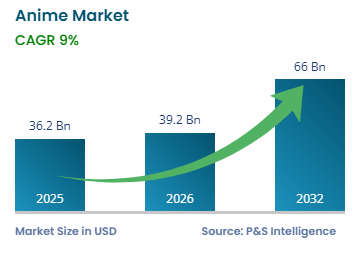
The global anime market stood at USD 36.2 billion in 2025 and is projected to reach USD 66.0 billion by 2032, expanding at a compound annual growth rate of 9.0% over 2026–2032. This growth is driven by the rapid proliferation of subscription-based streaming platforms, escalating global demand for merchandising tied to franchise intellectual property, and the mainstreaming of Japanese animation as a dominant form of digital entertainment across diverse demographics worldwide.
Subscription-based streaming platforms have accelerated international distribution, while merchandising tied to franchise intellectual property has emerged as a structurally significant revenue layer. Japanese animation has crossed into mainstream digital entertainment across diverse demographics worldwide. Japan's revised Cool Japan initiative targets JPY 20 trillion (USD 131.4 billion) in overseas content sales by 2033, embedding export-led growth as a policy priority. The Association of Japanese Animations (AJA) reports that anime-related international events now span 160 events across 50 countries, reflecting fan engagement that extends well beyond streaming consumption.
Anime Market Emerging Trends and Growth Drivers
Streaming and Cross-Media Franchises Are Trending
Streaming platforms are displacing traditional broadcast television as the primary distribution channel, unlocking new revenue streams through cross-media franchise monetization. Platforms including Crunchyroll, Netflix, and Amazon Prime Video have adopted simultaneous global release models, deploying new episodes in Japan and internationally on the same day. Piracy rates have fallen, audience engagement has deepened, and casual viewers are converting into paying subscribers and merchandise buyers at an accelerating rate. Netflix reported in July 2025 that over 50% of its global members watched anime in 2024, with titles appearing in the Top 10 rankings of 33 countries. This positions anime as a core content pillar for major streaming services rather than a niche category. A successful franchise now generates revenue across streaming licensing, theatrical releases, collectible merchandise, mobile gaming, and live events, reshaping studio revenue structures and intensifying investment in high-production-value properties capable of sustaining multi-format commercial exploitation.
Rising Global Fan Engagement and Gen Z Adoption Fuel Market Growth
Entrenchment of anime consumption within Gen Z and millennial demographics across North America, Europe, and emerging markets is the primary driver of anime market growth. A survey published in early 2024 found that 42% of American Gen Z consumers watch anime weekly. This generational shift in entertainment preference is translating directly into sustained merchandise spending, subscription growth, and theatrical attendance. TikTok, Instagram, and YouTube are accelerating anime discovery and community formation, driving viewership on streaming platforms and fueling downstream demand for merchandise, conventions, and experiential events. Major corporations including Bandai Namco, Uniqlo, and Adidas have established dedicated anime collaboration pipelines, while e-commerce platforms have expanded global merchandise accessibility. As Gen Z ages into higher-income brackets, per-capita spending on anime-related products and experiences is expected to accelerate.
Untapped Emerging Markets and Female Audiences Create New Growth Pathways
Emerging markets across South and Southeast Asia, Latin America, and the Middle East & Africa remain substantially underpenetrated relative to their demographic potential. The International Telecommunication Union reports continued expansion in internet adoption, with low-income countries recording growth of approximately 8.5% in 2024, supported by steady increases in mobile broadband connectivity. This expanding connectivity base is directly widening the addressable audience for streaming-based anime consumption. Female viewership and merchandise spending represent a rapidly expanding segment that studios and distributors have yet to develop fully. Romance, fantasy, and cross-demographic titles are demonstrating consistent viewership growth among female audiences, with studios developing dedicated merchandise lines and convention programming targeting this demographic.
High Production Costs and Animator Constraints Limit Market Growth
Chronic mismatch between accelerating global content demand and the limited production capacity of Japan's animation studio ecosystem is the primary restraint on anime market growth. Producing a 30-minute anime episode can involve large production teams and extended timelines, with some industry estimates placing costs at around JPY 20 million (approximately USD 140,000) per episode, creating capacity constraints as content demand rises. At the same time, animator compensation in Japan remains structurally low, with industry surveys by the Japan Animation Creators Association indicating that entry-level and freelance animators often earn the equivalent of less than USD 10 per hour, contributing to talent attrition and limiting new workforce entry. Industry data shows that 20.9% of anime production companies experienced revenue declines in 2024 despite record industry-wide growth, and 41.8% remained flat. The benefits of global demand expansion are concentrated among large studios, while small and mid-sized firms face intensifying cost pressure. AI-assisted animation tools are emerging as a partial mitigation, but adoption remains contested, with studios, creators, and rights holders actively debating ethical frameworks for generative AI use in production. This restraint is expected to persist through the medium term, constraining supply-side capacity even as demand continues to expand globally.
Anime Market Segmentation and Category Analysis
Type Analysis
Merchandising accounted for the largest revenue share, of 30%, in 2025. Anime fans treat physical and digital merchandise — including collectibles, action figures, apparel, limited-edition items, and home décor — as tangible expressions of franchise loyalty, cementing category dominance through repeat and emotionally driven purchasing. Unlike subscription-based streaming revenue, which is capped by subscriber pricing, merchandise spending is price-inelastic among dedicated fans. Major corporations including Bandai Namco Holdings Inc. and Uniqlo have established dedicated anime merchandise pipelines, while e-commerce platforms including Amazon and Rakuten have expanded global accessibility. The Association of Japanese Animations (AJA) confirms that overseas anime revenues, heavily weighted toward merchandise and licensing, are rising year-on-year.
Internet distribution is the fastest-growing segment over 2026–2032, at a CAGR of approximately 9.5%. Subscription-based streaming platforms have fundamentally restructured how anime reaches global audiences. Crunchyroll’s simultaneous global release model and growing anime investments by Netflix have accelerated streaming adoption, with Netflix generating approximately USD 2.07 billion in anime-related revenue in 2023, while regional platforms across South and Southeast Asia extend this momentum into underpenetrated markets. The International Telecommunication Union (ITU) reported that global internet users surpassed 5.4 billion in 2023. This expanding user base directly widens the addressable audience for digital anime consumption.
Netflix leads among global streaming platforms with 301 million paid subscribers. Amazon Prime Video follows with more than 200 million and Disney+ with 127–150 million. Tencent Video holds approximately 115 million paid subscribers and iQIYI 101 million. Paramount+ is at 77.5 million and Hulu's at 55 million.
The market segments into the following types:
Merchandising (Largest Category)
Internet Distribution (Fastest-Growing Category)
TV
Movie
Video
Music
Live Entertainment
Pachinko
Genre Analysis
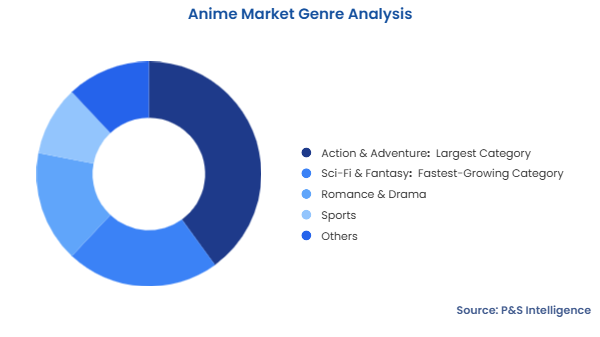
Action and adventure accounted for the largest share, of 40%, in 2025. The genre's cross-demographic appeal and dominance among the highest-grossing franchise titles globally underpin this position. Dragon Ball, One Piece, Demon Slayer, Jujutsu Kaisen, and Attack on Titan generate billions annually in combined streaming, theatrical, and merchandise revenues. Broad age-group appeal and high franchise extensibility allow studios to sustain revenue across decades through sequels, films, and spin-off merchandise. The Japan Ministry of Economy, Trade and Industry (METI) has identified action and adventure franchises as central pillars of Japan's cultural export strategy, with policy support encompassing international co-production incentives and theatrical distribution facilitation.
Sci-fi and fantasy are the fastest-growing genres from 2026–2032. Surging global appetite for isekai and dark fantasy titles, led by Chainsaw Man and Frieren: Beyond Journey's End, is driving this trajectory. Steins;Gate and Fullmetal Alchemist: Brotherhood have demonstrated that complex narratives blending speculative science and mythological frameworks with character-driven storytelling sustain long-term audience loyalty. Streaming platforms have expanded accessibility for these titles into markets where theatrical and physical distribution infrastructure remains limited.
The market segments into the following genres:
Action & Adventure (Largest Category)
Sci-Fi & Fantasy (Fastest-Growing Category)
Romance & Drama
Sports
Others
Target Demographic Analysis
Young adults accounted for the largest share, of 45%, in 2025. Gen Z and older millennials were raised during anime's global streaming expansion, creating deep franchise loyalty that has carried into adulthood. Their transition into earning adulthood has unlocked discretionary spending across streaming subscriptions, premium merchandise, theatrical tickets, and convention attendance. Crunchyroll, Netflix, and Amazon Prime have structured their content strategies around this cohort, commissioning mature-themed, visually ambitious titles including Chainsaw Man, Vinland Saga, and Frieren that sustain premium subscription tier retention.
The kids segment is the fastest-growing end-user category over 2026–2032, at a CAGR of approximately 9.4%. Family-friendly anime catalogs expanding on streaming platforms and the structural longevity of franchise IP targeting younger audiences are driving this growth. Emerging markets with relatively younger population structures continue to support demand for children-focused content, particularly in Asia. Doraemon and Pokémon have demonstrated the commercial durability of franchise IP built on relatable characters and humor, with both properties sustaining merchandise, gaming, and theatrical revenue across multiple decades and geographies.
The market segments into the following target demographics:
Young Adults (18–29) (Largest Category)
Kids (6–12) (Fastest-Growing Category)
Teenagers (13–17)
Adults (30+)
Gender Analysis
Males accounted for the largest share, of 60%, in 2025. Action, sports, and science fiction content targets male demographics through shonen and seinen publishing traditions, establishing structural genre dominance that predates the streaming era. Males account for the highest absolute spending volumes across merchandising, particularly action figures, model kits, and gaming tie-ins. The concentration of the highest-grossing franchise titles within these genres — Dragon Ball, One Piece, Naruto, and Jujutsu Kaisen — reinforces this position across both viewership and merchandise revenue.
Females are the fastest-growing demographic over 2026–2032. Expanding commercial success of romance, fantasy, and cross-demographic titles is driving female viewership growth, alongside studios' growing recognition of female fans as an underserved high-value segment. Frieren: Beyond Journey's End and A Sign of Affection have demonstrated strong female engagement on streaming platforms, while merchandise lines targeting female audiences are expanding across both domestic and international markets.
The market segments into the following genders:
Male (Largest Category)
Female (Fastest-Growing Category)
Others
Drive strategic growth with comprehensive market analysis
Anime Market Geographical Analysis
Asia-Pacific Anime Market Overview
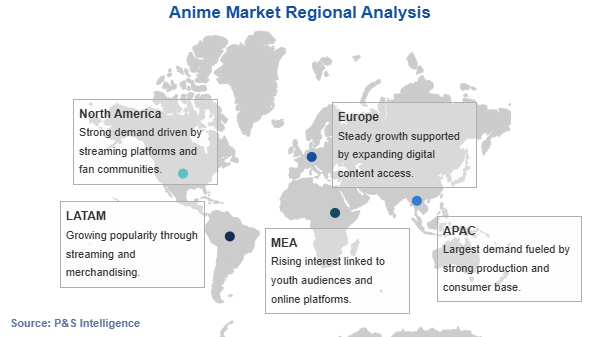
Asia-Pacific accounted for the largest regional share, of 40%, in 2025. Japan's position as the world's primary anime production hub, China's fast-growing consumer base, and deeply embedded cultural consumption of animation across the region collectively underpin this dominance. Asia-Pacific's dominance is expected to strengthen as Chinese production capacity scales, Southeast Asian markets deepen streaming penetration, and Japanese studios accelerate global co-production partnerships.
Japan Anime Market Dynamics
Japan is the largest country market globally. An unrivaled concentration of production infrastructure, decades of franchise IP accumulation, and a deeply embedded domestic consumption culture spanning all demographic cohorts underpin this position. Japan hosts over 500 animation studios, with a significant concentration in Tokyo, producing content across diverse genres and formats for both domestic broadcast and international licensing. India is the fastest-growing country market within the region. The production committee system, in which studios, publishers, music labels, and merchandisers co-finance productions in exchange for revenue-sharing rights across multiple formats, creates a highly efficient multi-stream monetization model that maximizes returns from each title.
China Anime Market Trends
China is the second largest country market within the Asia-Pacific. A population of over 1.4 billion with a rapidly expanding youth cohort increasingly consuming anime through domestic streaming platforms including iQIYI, Bilibili, and Tencent Video underpins this trajectory. The Chinese government's sustained investment in domestic animation — known as donghua — complements Japanese anime imports. Bilibili, which hosts one of the largest licensed anime libraries outside Japan, reported over 100 million monthly active users engaging with anime content as of 2024.
The National Bureau of Statistics of China reported that the country’s cultural industry revenues grew by approximately 7% year-on-year in 2024, with digital content and animation identified as key growth contributors. Cross-border licensing agreements between Japanese studios and Chinese platforms are proliferating, creating a dual revenue model where Japanese IP generates licensing fees while Chinese platforms invest in original co-productions.
India Anime Market Prospects
India is the fastest-growing country within-Asia Pacific, underpinned by a population exceeding 1.4 billion with a large youth demographic, accelerating mobile broadband penetration, and demonstrated appetite for Japanese animation content across regional language audiences. The Indian anime market has transitioned from a niche subculture concentrated among urban English-speaking consumers to a mass-market entertainment category. Dubbed content availability in Hindi, Tamil, Telugu, and other regional languages across Crunchyroll, Netflix, and JioCinema Premium has driven this transition. JioCinema Premium's launch of simulcast anime content in May 2024 signals that major domestic streaming platforms now treat anime as a mainstream content priority rather than a supplementary catalog addition.
The Federation of Indian Chambers of Commerce and Industry (FICCI) reported in March 2024 that India is expected to contribute nearly 60% of the global growth in anime interest, reflecting its large and rapidly expanding viewer base. Compelling storylines and high-quality visual production are driving this demand among a youth demographic actively seeking alternatives to domestic entertainment formats. Regional language dubbing libraries are deepening and domestic streaming platforms are increasing anime content investment.
North America Anime Market Growth
North America is the fastest-growing regional market globally over 2026–2032, at a CAGR of 9.9%. Rapid mainstreaming of anime consumption among Gen Z and millennial demographics in the United States and Canada is driving this growth. North America's market growth is expected to accelerate further as theatrical anime releases normalize event-style cinema consumption of anime franchises. Demon Slayer: Infinity Castle crossed USD 600 million in global box office revenue in 2025, highlighting the strong international commercial performance of anime films.
Anime consumption in the United States is sustained by a mature streaming infrastructure, a dense convention ecosystem, and a robust merchandising culture centered on franchise titles including Demon Slayer, Jujutsu Kaisen, and One Piece. Canada is the fastest-growing country market within North America, with high broadband penetration, multicultural demographic composition, and growing anime convention activity collectively driving expansion.
U.S. Anime Market Growth
Entrenchment of anime consumption among Gen Z and millennial demographics, who represent the most commercially active fanbase outside Japan, is the primary driver of the United States market. A mature streaming infrastructure and a dense convention ecosystem — including Anime Expo, Otakon, and Anime NYC — generate substantial merchandise and experiential revenue annually. Crunchyroll, Netflix, Hulu, and Amazon Prime Video collectively offer thousands of licensed titles with simultaneous release windows.
Anime films consistently ranked in the top 5 during release weekends in 2024, reflecting the mainstreaming of anime in U.S. cinema. Frequent theatrical anime releases, expanding anime-themed retail and experiential venues, and deepening co-production partnerships between U.S.-based streaming platforms and Japanese studios seeking to maximize international IP value are collectively shaping the U.S. market.
Europe Anime Market Analysis
Longstanding fan communities in France and Germany, increasing streaming platform penetration across Southern and Eastern Europe, and growing localization investment from Japanese studios and global distributors are driving Europe's market. Continued localization investment, expansion of dubbed content libraries, and penetration of anime streaming into Central and Eastern European markets currently underserved by dedicated platforms are sustaining this momentum. Eurostat data shows that over 90% of EU households had internet access in 2023, with penetration ranging from 91% in rural areas to 95% in urban regions, providing the digital infrastructure foundation for streaming-led anime consumption growth across the continent.
Germany is the largest market within Europe. A strong physical media culture, high-quality collector edition demand, and major conventions such as DoKomi attracting tens of thousands of attendees annually underpin this position. Netflix data from 2025 identified Germany as a leading European viewership hub, with high engagement for Monster and Vinland Saga. The United Kingdom is the fastest-growing market in Europe, with a young, digitally native population and growing theatrical distribution of anime films through major cinema chains driving this trajectory.
The regions and countries analyzed in this report include:
North America (Fastest-Growing Region)
U.S. (Largest Country Market)
Canada (Fastest-Growing Country Market)
Europe
Germany (Largest Country Market)
U.K. (Fastest-Growing Country Market)
France
Italy
Spain
Rest of Europe
Asia-Pacific (Largest Region)
China
India (Fastest-Growing Country Market)
Japan (Largest Country Market)
South Korea
Australia
Rest of APAC
Latin America
Brazil (Largest Country Market)
Mexico (Fastest-Growing Country Market)
Rest of LATAM
Middle East & Africa
Saudi Arabia (Largest Country Market)
U.A.E. (Fastest-Growing Country Market)
South Africa
Rest of MEA
Anime Market Competitive Landscape
The global anime market exhibits a moderately fragmented competitive structure, segmented across production studios concentrated primarily in Japan that create original intellectual property, and distribution and licensing platforms — increasingly dominated by global streaming companies — that monetize that IP across international markets. No single entity commands a dominant share of the combined production-plus-distribution market. Value chain bifurcation means Japan-based studios and U.S.-based streaming platforms operate in complementary rather than directly competing roles.
Within the production layer, a tiered structure has emerged in which a small number of large studios command disproportionate access to high-value franchise titles and premium streaming commissions, while hundreds of smaller studios compete for lower-margin subcontracting and secondary IP work.
Competitive differentiation among production studios operates primarily through IP ownership, visual production quality, and genre specialization. The competitive landscape is evolving toward greater vertical integration as streaming platforms increasingly co-produce original anime titles rather than simply licensing existing content, and as Japanese studios pursue direct-to-consumer digital distribution to capture a larger share of the value generated by their IP internationally.
Leading Players in the Anime Market:
Toei Animation Co. Ltd.
Studio Ghibli Inc.
Kyoto Animation Co. Ltd.
Production I.G Inc.
Pierrot Co. Ltd.
Sunrise Inc.
BONES INC.
MAPPA Co. Ltd.
Aniplex Inc.
Crunchyroll LLC
VIZ Media LLC
Bandai Namco Holdings Inc.
Madhouse Inc.
Ufotable Inc.
A-1 Pictures Inc.
CloverWorks Inc.
TMS Entertainment Co. Ltd.
Kadokawa Corporation
Shogakukan-Shueisha Productions Co. Ltd.
Toho Co. Ltd.
Anime Market News & Updates
In March 2025, Aniplex Inc. and Crunchyroll LLC launched Hayate Inc., a joint production venture to produce original anime content exclusively for Crunchyroll's global subscriber base. This enables vertically integrated IP development from production through distribution, reducing dependence on third-party licensing arrangements.
In January 2025, Crunchyroll LLC announced at Sony Group Corporation's CES press conference the forthcoming launch of Crunchyroll Manga, a new digital manga application available as a premium subscriber add-on on iOS and Android. This launch extends Crunchyroll's content ecosystem beyond streaming into manga reading, increasing subscriber engagement and retention.
In December 2024, Sony Group Corporation invested approximately USD 320 million (around JPY 50 billion) in Kadokawa Corporation, increasing its stake to around 10% and becoming the largest shareholder, as part of a strategic capital and business alliance to expand collaboration in content creation and global IP development.
In October 2024, Toho Co. Ltd. acquired GKIDS, a North American distributor of Studio Ghibli Inc. films, for an undisclosed sum. The move gives Toho direct control over U.S. theatrical and home video distribution of Studio Ghibli's full catalog.
Frequently Asked Questions About This Report
What will be the anime market 2032 size?+
In 2032, the market for anime will value USD 66.0 billion.
Which type leads the anime industry?+
Merchandising dominates the anime industry with 30% revenue.
Which is the largest region in the anime market?+
Asia-Pacific is the largest market for anime, with 40% share.
What are the key anime industry drivers?+
The global anime industry is driven by proliferation of subscription-based streaming platforms, escalating demand for merchandising, and mainstreaming of Japanese animation as a form of digital entertainment.
What is the anime market nature?+
The market for anime is moderately fragmented.
Want a report tailored exactly to your business need?
Leading companies across industries trust us to deliver data-driven insights and innovative solutions for their most critical decisions. From data-driven strategies to actionable insights, we empower the decision-makers who shape industries and define the future. From Fortune 500 companies to innovative startups, we are proud to partner with organisations that drive progress in their industries.
Client Testimonials
Working with P&S Intelligence and their team was an absolute pleasure – their awareness of timelines and commitment to value greatly contributed to our project's success. Eagerly anticipating future collaborations.
McKinsey & Company
India
Unmatched Standards
Our insights into the minutest levels of the markets, including the latest trends and competitive landscape, give you all the answers you need to take your business to new heights
Complete Data Security
We take a cautious approach to protecting your personal and confidential information. Trust is the strongest bond that connects us and our clients, and trust we build by complying with all international and domestic data protection and privacy laws