Explore the market potential with our data-driven report
Amine-Based Epoxy Hardeners Market Outlook
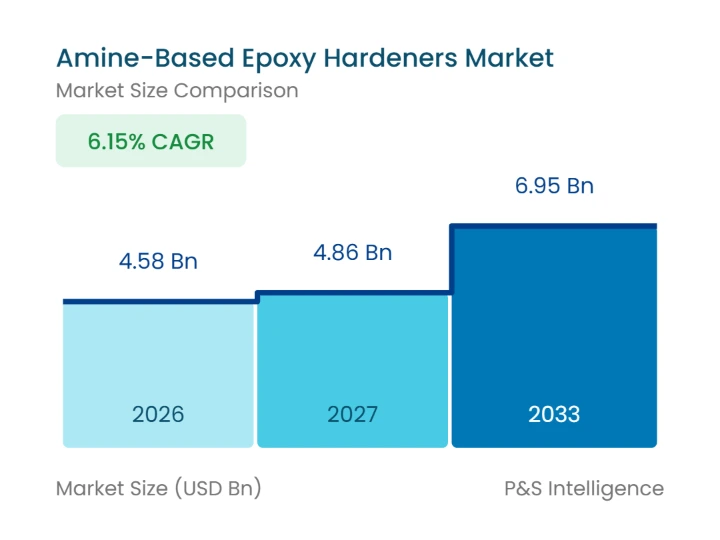
The global amine-based epoxy hardeners market size is estimated at USD 4.58 Billion in 2026 and is projected to reach USD 4.86 Billion in 2027. Revenue is expected to climb to USD 6.95 Billion by 2033, advancing at a CAGR of 6.15% during 2027-2033. Coating formulators, flooring contractors, wind blade fabricators, and adhesive makers buy these curing agents because the hardener, more than the resin, sets cure speed, the coldest workable job-site temperature, and the solvent a product needs. Once approved, a coating system tends to stay specified for years, which keeps qualified hardener grades in steady demand.
Owners of corroding steel and concrete, from shipyards and bridge authorities to tank farms and chemical plants, place the largest share of hardener orders, because amine-cured epoxy primers and linings are a standard barrier coat on these assets. The cost of leaving them unprotected is large. NACE International, now part of AMPP, estimated the global cost of corrosion at USD 2.5 trillion a year, equal to 3.4% of world GDP on a 2013 basis. Asset owners therefore budget repainting and relining as planned maintenance, which gives hardener producers a demand base less exposed to swings in new construction.
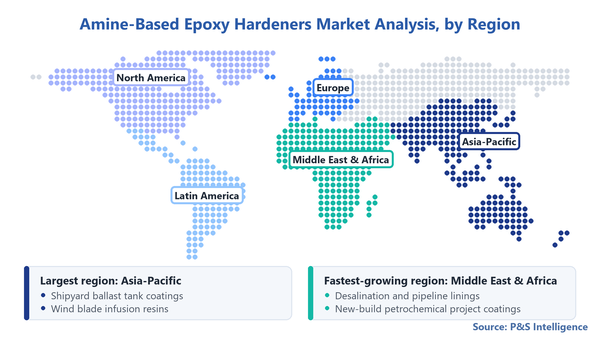
Asia-Pacific held 44.8% of amine-based epoxy hardeners market revenue in 2026, supported by shipbuilding in China and South Korea, wind blade production in China and India, and infrastructure and factory construction across Southeast Asia. Middle East & Africa is set to grow fastest, at a 7.1% CAGR during 2027-2033, as Saudi Arabia, the U.A.E., and Qatar build desalination, petrochemical, and transport assets that are coated and lined from new. For suppliers, Asian demand is broad and recurring, while Gulf demand tends to arrive in project-sized orders tied to construction awards.
Key market insights
By product type, polyamides & polyamidoamines held 29.5% in 2026, while polyetheramines are expected to grow at a 7.8% CAGR during 2027-2033.
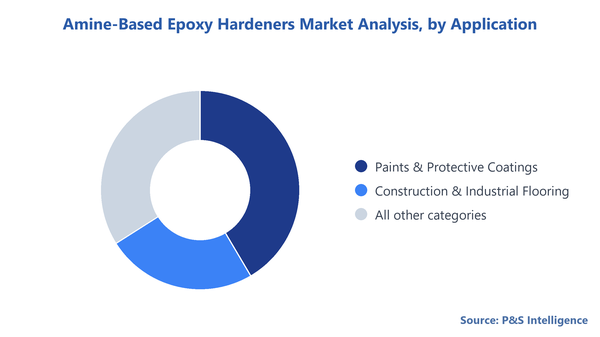
By application, paints & protective coatings held 41.5% in 2026, while wind energy & composites is projected to expand at a 7.9% CAGR during 2027-2033.
By end-use industry, building, civil infrastructure & flooring held 33.0% in 2026, while wind energy & clean power generation is set to rise at an 8.1% CAGR during 2027-2033.
By formulation type, solvent-free liquid systems (100% solids) held 52.0% in 2026, while waterborne & water-dispersible amine systems are expected to advance at an 8.25% CAGR during 2027-2033.
By geography, Asia-Pacific held 44.8% in 2026, while Middle East & Africa is set to post a 7.1% CAGR during 2027-2033.
Tighter emission limits are reshaping hardener chemistry toward solvent-free systems
Coating and flooring formulators are rebuilding recipes around hardeners that cure without solvent, contain no added benzyl alcohol or alkylphenol accelerators, and still reach working hardness overnight. One of the main sources of pressure is air-quality limits on what a finished floor or maintenance coating may emit. A solvent-free epoxy needs a hardener that is thin and reactive on its own, so reformulation moves spending toward modified cycloaliphatic amines, amine adducts, and polyetheramine blends, which sell at higher prices than commodity ethyleneamines. Each reformulated product line also restarts qualification, which opens a window for a competing hardener supplier.
In Southern California, Rule 1113 of the South Coast Air Quality Management District caps floor coatings at 50 g/L of VOC and industrial maintenance coatings at 100 g/L, levels that leave little room for solvent-borne epoxy. Formulators selling into those categories have to use 100% solids or waterborne curing agents, and some then sell the compliant version more widely to avoid running parallel formulations. Hardener producers with a broad range of low-viscosity, low-emission grades are better positioned to win these reformulation projects.
Long-life marine coating rules are driving steady hardener demand at shipyards
Shipyards and the marine coating companies that supply them are among the most consistent buyers of amine curing agents, because a newbuild's ballast tanks, cargo holds, and underwater hull areas receive multi-coat epoxy systems before delivery. Ballast-tank systems must pass pre-qualification testing before a yard can apply them, so the hardener inside an approved system stays fixed for as long as that approval is used. Each new vessel therefore becomes a predictable order for the polyamide, polyamidoamine, and cycloaliphatic grades in those systems.
Under the IMO performance standard for protective coatings, adopted as Resolution MSC.215(82), coatings in dedicated seawater ballast tanks carry a 15-year target useful life, and the standard calls for epoxy-based systems at a nominal dry film thickness of 320 microns. The long target life is meant to reduce tank recoating during a ship's service, which ties ballast-tank hardener volume more closely to newbuild output than to repair work. Hardener producers already inside approved ballast-tank systems hold a durable position, since a substitute grade would require the coating system to be retested.
Faster wind capacity additions are opening a larger outlet for infusion-grade hardeners
Wind turbine blade makers buy low-viscosity amine hardeners in bulk for vacuum infusion, where resin must flow through long glass or carbon fiber layups before it gels. Polyetheramines and cycloaliphatic amines such as isophorone diamine are widely used in these systems because they extend open time while keeping the glass transition temperature a blade needs in service. Each blade is a large, one-time pour of resin, so hardener volume rises with the number and length of blades produced. Longer offshore blades also raise the resin needed per turbine.
The Global Wind Energy Council counted a record 165 GW of new wind capacity installed worldwide in 2025, up 40% on 2024, including 9.3 GW offshore. That figure measures grid-connected turbines, not hardener purchases, but the blades on those turbines were molded months earlier and each consumed infusion resin. Suppliers able to deliver certified infusion systems close to blade plants in China, India, and Europe are better positioned to capture this volume, while a slowdown in turbine orders would hit the same suppliers quickly.
Feedstock-driven price increases are constraining formulator margins
Hardener prices move with oil, gas, and freight, because most amine curing agents are built from petrochemical intermediates such as ethylene oxide, ammonia, acetone, and xylene. Flooring contractors and coating formulators often price work on fixed bids, which leaves them exposed when a hardener price rises between the quote and the application. When increases stick, formulators can delay inventory purchases or move lower-specification jobs to cheaper polyamide or Mannich-base grades, which slows value growth for premium hardeners.
BASF raised its North American prices for Baxxodur EC 301, EC 303, and EC 310 curing agents by USD 0.12 per pound, and for the ethyleneamines EDA and DETA by USD 0.15 per pound, effective April 6, 2026, citing higher logistics and raw material feedstock costs. Increases of this kind reach formulators as soon as existing contracts allow. Producers integrated back into amine intermediates can absorb part of such swings, while non-integrated formulators carry more of the margin pressure until their own price lists reset.
Segmentation Outlook
Product Type
Polyamides & polyamidoamines accounted for 29.5% of amine-based epoxy hardeners market revenue in 2026. Marine and maintenance coating formulators buy them for anti-corrosion primers because the fatty-acid backbone wets imperfectly cleaned steel, forms flexible films, and allows long pot life on large spray jobs. Dimer fatty acids and ethyleneamines are widely traded, which typically keeps these grades cheaper than cycloaliphatic alternatives. Aromatic amines hold a far smaller position, partly because the European Chemicals Agency placed 4,4'-diaminodiphenylmethane on the REACH authorization list with a sunset date of August 21, 2014.
Polyetheramines are expected to post the fastest growth among product types, at a 7.8% CAGR during 2027-2033. Their low viscosity and flexible polyether chain suit wind blade infusion and toughened structural adhesives. The same traits help in crack-resistant floors and filament-wound pressure vessels, and formulators that cut solvent and benzyl alcohol from coatings use polyetheramines to keep viscosity low without diluents. For buyers, this growth concentrates purchasing on a narrower set of grades, so supply security tends to weigh more heavily in hardener selection.
Application
Paints & protective coatings represented 41.5% of revenue in 2026, the largest application. Ship hulls, bridges, tanks, and pipelines receive epoxy primers or linings, and each repaint cycle brings a new hardener purchase. Coating systems for these assets are often approved by owners and classification societies as complete packages, so formulators keep buying the same qualified curing agent across many projects. UNCTAD puts the world fleet's carrying capacity at 2.5 billion dead weight tons as of January 1, 2026, up 85 million in a year, so both the existing fleet and each year's additions need protective coats.
Wind energy & composites is projected to grow fastest among applications, at a 7.9% CAGR over 2027-2033. Blade production is the core of this demand, joined by filament-wound pressure vessels for compressed gas and hydrogen and by resin transfer molding of automotive parts, where fast-curing amine systems shorten cycle times. Composite fabricators specify narrow viscosity and cure windows, which favors higher-value specialty grades over commodity amines. Hardener suppliers with application laboratories near blade and pressure-vessel plants can shorten the qualification work that these fabricators require.
Copyright P&S Intelligence. Reuse requires attribution under CC BY 4.0.
End-Use Industry
Building, civil infrastructure & flooring held 33.0% of 2026 revenue, the largest end use. Contractors apply amine-cured epoxy in self-leveling floors for warehouses, food plants, and hospitals, in moisture barriers beneath finished flooring, in crack-injection resins, and in chemical anchors for rebar and bolts. Much of this work involves renovation and repair, which helps demand hold up when new building starts slow. Flooring buyers also weigh cure speed heavily, since a floor that returns to service a day earlier saves the owner a day of lost operation.
Wind energy & clean power generation is set to expand fastest among end uses, at an 8.1% CAGR during 2027-2033. Blade manufacturing is likely the main source of this demand, with smaller volumes going to nacelle covers, tower and foundation coatings, and the epoxy insulation in transformers and switchgear that connect new capacity to the grid. A single wind farm order can commit a blade plant for months, so hardener demand from this sector tends to arrive in large, scheduled call-offs. That pattern can favor suppliers able to hold dedicated stock close to the plant.
Formulation Type
Solvent-free liquid systems (100% solids) held 52.0% of 2026 revenue, the largest formulation type. Flooring contractors, tank-lining contractors, and marine applicators prefer them because a solvent-free coat builds full thickness in one pass, avoids trapped solvent, and complies with strict emission caps without a separate product line. Solvent-free systems also cut drying time between coats, which shortens shutdowns at plants and tank farms. Hardener makers selling into this segment compete on viscosity, pot life, and blush resistance, since the hardener must do the work that solvent once did.
Waterborne & water-dispersible amine systems are expected to deliver the quickest growth, at an 8.25% CAGR during 2027-2033. Painting contractors working in occupied buildings, schools, and food plants want epoxy primers and wall coatings with little odor and water cleanup, which solvent-free systems cannot always offer at thin film builds. As waterborne amine dispersions and emulsified adducts improve in corrosion and chemical resistance, they can compete for more primer and concrete-sealer jobs. This gives specialty producers with emulsification know-how an opening that commodity amine makers often find harder to enter.
The following segments are analysed in this report.
Product Type
Polyamides & Polyamidoamines
Cycloaliphatic Amines
Aliphatic Amines & Adducts
Polyetheramines
Phenalkamines & Mannich Bases
Aromatic & Araliphatic Amines
Application
Paints & Protective Coatings
Construction & Industrial Flooring
Wind Energy & Composites
Adhesives & Sealants
Electrical & Electronics Encapsulation
End-Use Industry
Building, Civil Infrastructure & Flooring
Marine & Industrial Offshore / Plant Maintenance
Wind Energy & Clean Power Generation
Automotive & Commercial Transportation
Aerospace & Defense
Electrical & Electronics Hardware
Formulation Type
Solvent-Free Liquid Systems (100% Solids)
Solvent-Borne Systems
Waterborne & Water-Dispersible Amine Systems
Geographical Outlook
Asia-Pacific amine-based epoxy hardeners market outlook
Asia-Pacific held 44.8% of global revenue in 2026. China is the region's largest market, with the world's biggest shipbuilding base, the largest wind turbine installation base, and a deep pool of domestic coating formulators. Data from China's Ministry of Industry and Information Technology show the country's shipyards completed 53.69 million deadweight tons in 2025, up 11.4% from the previous year and equal to 56.1% of global output. Each completed hull carries ballast-tank, cargo-hold, and underwater epoxy systems applied in the yard, which places a large, recurring share of marine hardener demand in China.
South Korea and Japan add demand from shipyards and electronics encapsulation, and Japan also hosts production of specialty amines such as MXDA and 1,3-BAC. India and Southeast Asia buy mainly for highways, metro rail, industrial floors, and water infrastructure, where cost-competitive polyamide and modified aliphatic grades are widely used. Asia-Pacific's position looks set to strengthen through 2033, since shipbuilding orders, blade plants, and new factory floors keep adding coated surface area. Hardener producers with plants inside the region are better positioned to meet yard schedules and short delivery windows.
Middle East & Africa amine-based epoxy hardeners market growth
Middle East & Africa is projected to record the fastest regional growth, at a 7.1% CAGR during 2027-2033. Saudi Arabia anchors much of this new-build demand, as its desalination plants, water transmission lines, petrochemical complexes, and large urban projects specify epoxy linings and protective coatings from the first day of service. According to Saudi Arabia's National Transformation Program, the Kingdom's desalinated water production capacity exceeded 16 million cubic meters per day in 2025, up from 6.2 million in 2022. The figure measures water output, not coating volume, yet each new plant and pipeline adds lined steel and concrete.
Heat, salt-laden air, and aggressive soils in the Gulf corrode steel and concrete quickly, so asset owners tend to specify thick, chemically resistant systems built on cycloaliphatic, polyamide, and phenalkamine hardeners. Gulf project awards arrive in large packages, so hardener demand can jump when a desalination or petrochemical project moves into construction and pause when awards slip. South Africa, Egypt, and Morocco add demand from mining, ports, and industrial maintenance. Suppliers with regional blending sites or distribution partners in the Gulf are better positioned to serve schedule-driven orders that leave little time for imports.
Copyright P&S Intelligence. Reuse requires attribution under CC BY 4.0.
Europe market analysis
Europe contributes a mature, replacement-led share of global revenue, and its growth trails the global pace. Most hardener demand comes from maintaining existing assets, such as refurbishing industrial and commercial floors, recoating bridges and storage tanks, and relining chemical plants. As per the European Commission, about 85% of EU buildings were built before 2000, which puts renovation, more than new construction, at the center of regional flooring and coating demand. That mix tends to support steady volumes but limits the step-changes that new industrial capacity brings elsewhere.
European formulators also tend to buy higher-value grades, because chemical-safety rules and low-emission building labels push them toward cycloaliphatic, araliphatic, and modified hardeners. Offshore wind adds a further outlet, with blade, tower, and foundation plants in Denmark, Germany, and Spain buying infusion and coating grades. Germany, the Netherlands, and the Nordic countries are likely to remain the core of regional demand. Producers with local application laboratories are better positioned to support the reformulation work that European regulations prompt.
Latin America market analysis
Latin America holds a smaller share of global revenue, with demand concentrated in Brazil and Mexico. Brazil's offshore oil sector is the most distinctive buyer group, since floating production units, subsea equipment, and coastal terminals need epoxy coatings that resist seawater and hydrocarbons. Brazil's National Agency of Petroleum, Natural Gas and Biofuels (ANP) recorded average oil output of 3.77 million barrels per day in 2025, a national annual record. Offshore operators keep maintenance coating work steady on existing platforms, although much of the first-fit coating on new units is applied at yards outside the region.
Mexico's demand comes more from manufacturing, as automotive and appliance plants serving North American supply chains buy epoxy adhesives, primers, and factory floor systems. Across the region, currency swings and the fact that much of the amine supply is imported make hardener pricing less predictable than in North America or Europe, which tends to favor suppliers that hold local stock through distributors. Mining and pipeline infrastructure in Chile and Colombia adds smaller, specification-driven volumes for chemical-resistant linings.
North America market analysis
North America accounts for a large, maintenance-driven share of global revenue, with the U.S. at its core. State transportation departments, utilities, and industrial plant owners spend steadily on recoating and repairing aging steel and concrete, which keeps protective coating and crack-injection demand stable. Figures from the Federal Highway Administration put 41,148 of the 624,939 bridges in the national inventory in poor condition as of August 2026. Rehabilitation of such structures commonly uses epoxy primers, deck overlays, and injection resins, which ties part of hardener demand to highway funding cycles.
Air-quality rules in California, and in other states that follow similar models, push formulators toward solvent-free and waterborne systems, which favors higher-value hardener grades. Construction of data centers, warehouses, and pharmaceutical plants adds demand for high-performance floors and moisture barriers, while Canada contributes through mining, oil sands, and pipeline maintenance. Hardener makers with U.S. production are better positioned to serve contractors that need fast delivery and local technical support.
The following geographies are analysed in this report.
Competition in the amine-based epoxy hardeners market runs on two layers with different economics. Basic amines such as ethyleneamines, isophorone diamine, meta-xylenediamine, and polyetheramines come from a relatively small group of producers, because each needs large, capital-intensive plants tied to ethylene oxide, ammonia, acetone, or xylene chains. Formulated curing agents, the adducts and blends that coating and flooring companies buy, are far more open, since regional formulators can buy intermediates and compete on technical service and speed. This two-layer structure looks stable, although integrated producers continue to add formulated grades to capture more value per ton.
Integrated multinationals form the first group. Evonik Industries AG and BASF SE make isophorone diamine, BASF SE and Huntsman Corporation make polyetheramines, and all three sell branded formulated hardeners, competing on portfolio breadth and application support. Olin Corporation and Westlake Corporation pair curing agents with their own epoxy resins, offering matched resin and hardener systems. A second group competes on specific chemistries, including Mitsubishi Gas Chemical Company, Inc. in MXDA and 1,3-BAC, Cardolite Corporation in cashew-derived phenalkamines, and Nouryon and Tosoh Corporation in ethyleneamines.
For buyers, price and supply risk is concentrated mainly at the intermediate layer. A shutdown or price increase at one ethyleneamine or MXDA plant can ripple through many formulated products, while switching to a different formulated hardener means retesting the coating or composite system. Qualification costs, more than list prices, shape most supplier changes, so formulators that qualify a second grade early carry less exposure when intermediate supply tightens. Matched resin and hardener systems can shorten this step, because one round of testing covers both components.
Top Amine-Based Epoxy Hardeners Manufacturers:
Evonik Industries AG
Huntsman Corporation
BASF SE
Olin Corporation
Westlake Corporation
Mitsubishi Gas Chemical Company Inc.
Nouryon
Cardolite Corporation
Kukdo Chemical Co., Ltd.
Aditya Birla Chemicals (Advanced Materials)
Atul Ltd
Tosoh Corporation
Recent Developments in the Market
In June 2026, Olin Corporation and Huntsman Corporation agreed to an all-stock merger of equals, with Huntsman shareholders set to receive 0.5476 Olin shares per share and closing expected in the first half of 2027. The combined OlinHuntsman Corporation would hold Olin's epoxy resins and curing agents alongside Huntsman's polyetheramine and formulated hardener lines.
In April 2026, Evonik Industries AG introduced Ancamine 2875, a modified polyamine curing agent for moisture vapor barrier floor coatings that is certified to ASTM F3010 and reaches under 0.1 perms at coating thicknesses as low as 12 mils. The grade, formulated without alkylphenol accelerators, targets flooring contractors for whom moisture failures carry technical and financial risk.
In February 2026, Mitsubishi Gas Chemical Company Inc. decided to discontinue construction of its 25,000 MTA meta-xylenediamine plant at Botlek in Rotterdam, citing schedule delays, higher construction costs, and intensifying competition. The decision is likely to leave European formulators of MXDA-based hardeners dependent on supply from outside the region.
In February 2026, Westlake Corporation extended the Westlake Epoxy distribution relationship with Brenntag SE to South and West India, covering the EPON, EPIKOTE, EPIKURE, and EPI-REZ product lines for coatings, adhesives, and construction. The agreement gives Indian formulators local access to EPIKURE curing agents through a distributor with regional technical capability.
Last Updated: November 2026
Frequently Asked Questions About This Report
How big is the amine-based epoxy hardeners market?+
The global amine-based epoxy hardeners market size is estimated at USD 4.58 Billion in 2026 and is projected to reach USD 4.86 Billion in 2027.
Which region holds the largest share of the amine-based epoxy hardeners market?+
Asia-Pacific held 44.8% of global revenue in 2026. China is the region's largest market, with the world's biggest shipbuilding base, the largest wind turbine installation base, and a deep pool of domestic coating formulators.
Which region is growing fastest in the amine-based epoxy hardeners market?+
Middle East & Africa is set to grow fastest, at a 7.1% CAGR during 2027-2033, as Saudi Arabia, the U.A.E., and Qatar build desalination, petrochemical, and transport assets that are coated and lined from new.
Which application uses the most amine epoxy hardeners?+
Paints & Protective Coatings represented 41.5% of revenue in 2026, the largest application. Ship hulls, bridges, tanks, and pipelines receive epoxy primers or linings, and each repaint cycle brings a new hardener purchase.
Which type of amine curing agent is growing fastest?+
Polyetheramines are expected to post the fastest growth among product types, at a 7.8% CAGR during 2027-2033. Their low viscosity and flexible polyether chain suit wind blade infusion and toughened structural adhesives.
Who are the key companies in the amine-based epoxy hardeners market?+
Evonik Industries AG and BASF SE make isophorone diamine, BASF SE and Huntsman Corporation make polyetheramines, and all three sell branded formulated hardeners, competing on portfolio breadth and application support.
Want a report tailored exactly to your business need?
Leading companies across industries trust us to deliver data-driven insights and innovative solutions for their most critical decisions. From data-driven strategies to actionable insights, we empower the decision-makers who shape industries and define the future. From Fortune 500 companies to innovative startups, we are proud to partner with organisations that drive progress in their industries.
Client Testimonials
Working with P&S Intelligence and their team was an absolute pleasure – their awareness of timelines and commitment to value greatly contributed to our project's success. Eagerly anticipating future collaborations.
McKinsey & Company
India
Unmatched Standards
Our insights into the minutest levels of the markets, including the latest trends and competitive landscape, give you all the answers you need to take your business to new heights
Complete Data Security
We take a cautious approach to protecting your personal and confidential information. Trust is the strongest bond that connects us and our clients, and trust we build by complying with all international and domestic data protection and privacy laws