Air Brake System Market Size & Opportunities Analysis - Growth Strategies, Competitiveness, and Forecasts (2025 - 2032)
This Report Provides In-Depth Analysis of the Air Brake System Market Report Prepared by P&S Intelligence, Segmented by Vehicle Type (Trucks, Semi-Trailer Tractors, Buses), Type (Drum, Disc), and Geographical Outlook for the Period of 2019 to 2032
Explore the market potential with our data-driven report
Air Brake System Market Outlook
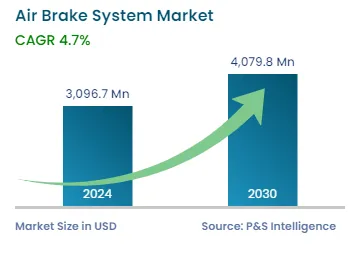
The air brake system market size was USD 4.7 billion in 2024, and it will grow by 3.3% during 2025–2032, to reach USD 6.0 billion by 2032.
The rapid urbanization and industrialization, combined with a rising population, are leading to the initiation of building & construction activities on a mass scale. This, in turn, creates a high demand for the transportation of raw material by trucks, trailers, and semi-trailer tractors, all of which employ this braking technology. The market is experiencing significant growth due to the expanding e-commerce and logistics sectors, which have increased the demand for freight transportation and heavy-duty vehicles. According to the OICA, the number of commercial vehicles produced globally in 2023 was 26,413,029, demonstrating the substantial market base for air brake systems.
Air brake systems are used to slow down or stop vehicles efficiently and safely. They are designed for precise control and use compressed air, which mitigates the chances of brake fade and enables the simultaneous application of the brakes across multiple wheels. This way, the technology improves stability and control during the process. They are used in pieces of machinery other than automobiles as well. Construction and mining activities are surging around the world due to the increasing population. Several kinds of equipment used in both these sectors use air brakes because they are effective even in dusty or muddy conditions and can handle the high braking loads common in these applications.
They also find usage in large agricultural equipment, such as tractors and combines. Food is crucial for humans; thus, agricultural activities continue rising in scale, in turn, leading to an increase in the demand for air brakes for a range of farming machines.
This is itself a response to the high road traffic accident incidence, which continues to increase. The WHO says that the number of road traffic deaths every year is around 1.2 million, mostly people aged 5–29 years. Thus, governments globally are implementing rules and regulations regarding the safety of people and the driver. Many countries have placed utmost importance on the maximum load-carrying capacities and mandated the installation of air brakes in heavy-duty vehicles. Furthermore, governments worldwide are implementing stricter regulations regarding vehicle safety standards and load-carrying capacities, mandating the installation of air brake systems in commercial vehicles above certain weight thresholds.
Moreover, the integration of advanced technologies such as Electronic Braking Systems (EBS), Anti-lock Braking Systems (ABS), and Electronic Stability Control (ESC) is enhancing the market appeal of modern air brake systems. These technological advancements not only improve vehicle safety but also contribute to better fuel efficiency and reduced maintenance costs, making them attractive to fleet operators and commercial vehicle manufacturers.
Air Brake System Market Emerging Trends
Technological Advancements Are Key Trends Enhancing System Capabilities
The air brake system market is witnessing significant technological innovation, with manufacturers developing advanced electronic control systems that improve braking performance and vehicle safety.
The integration of sensors, microprocessors, and connectivity features is transforming traditional pneumatic brake systems into intelligent safety platforms capable of predictive maintenance and real-time performance optimization.
Electronic braking systems represent a major advancement, combining traditional air brake reliability with electronic precision and control.
These systems enable faster brake response times, improved braking distribution, and integration with other vehicle safety systems such as collision avoidance and lane departure warning systems.
The Society of Automotive Engineers has established new standards for connected brake systems that enable vehicle-to-vehicle communication for enhanced safety coordination.
Manufacturers are also focusing on weight reduction and energy efficiency improvements in air brake systems.
Advanced materials and optimized designs are reducing system weight while maintaining or improving performance, contributing to better fuel economy and payload capacity for commercial vehicles.
The development of regenerative braking integration for electric and hybrid commercial vehicles is opening new market opportunities as the transportation industry transitions toward electrification.
Fleet operators are increasingly recognizing the operational advantages of air brake systems, including their fail-safe design, consistent performance under heavy loads, and lower maintenance requirements compared to hydraulic alternatives.
Advanced onboard diagnostics continuously monitor air brake components and alert operators of issues, such as air leaks, worn brake pads, or compressor faults, before they cause failures.
Air brakes are increasingly being linked to ADAS features, such as autonomous emergency braking, adaptive cruise control, and hill-start assist, enabling semi-autonomous braking responses.
As per studies, global ADAS spending will cross USD 156.4 billion by 2032.
Rising Commercial Vehicle Production and Stringent Safety Regulations Are Biggest Drivers
The surge in commercial vehicle production and increasingly stringent government safety standards mandating the use of advanced braking systems serve as the key drivers for the air brake system market expansion.
The rapid urbanization and industrialization, particularly in developing regions, such as Asia-Pacific, have created a substantial demand for goods transportation and public transit systems.
The growth of e-commerce platforms has fundamentally transformed logistics and transportation requirements, necessitating expanded fleets of delivery trucks and heavy-duty vehicles.
Major logistics companies are investing heavily in fleet expansion to meet growing consumer demands for faster deliveries and broader distribution networks.
This trend is particularly pronounced in markets such as China and India, where rapid economic development has accelerated commercial vehicle adoption.
The Asian Development Bank estimates that the Asia-Pacific will require USD 26 trillion in infrastructure investment between 2016 and 2030, much of which should go into transportation infrastructure, which relies on commercial vehicles.
Fleet operators are increasingly recognizing the operational advantages of air brake systems, including their fail-safe design, consistent performance under heavy loads, and lower maintenance requirements compared to hydraulic alternatives.
The ability of air brake systems to provide auxiliary functions such as powering air suspension, horns, and other pneumatic accessories further enhances their value proposition for commercial vehicle operators.
The European Union has established rigorous vehicle safety standards, namely UNECE Regulation No. 13, which requires commercial vehicles to meet specific stopping distance requirements and incorporate advanced safety features, such as electronic stability control.
In Europe, ESC is estimated to prevent approximately 3,000 fatalities (–14%) and 50,000 serious injuries (–6%) annually, underscoring its effectiveness.
The regulatory framework continues to evolve, with new requirements for autonomous emergency braking and other safety features that integrate with air brake systems.
Similar regulatory trends are emerging in developing markets, where governments are recognizing the importance of vehicle safety in reducing traffic fatalities and economic losses.
Countries such as India have implemented new regulations regarding axle load capacities and mandatory safety equipment, driving increased adoption of air brake systems in their commercial vehicle fleets.
Air Brake System Market Segmentation and Category Analysis
Vehicle Type Analysis
The trucks category held the largest market share, of around 75%, in 2024, and it will have the highest CAGR due to the extensive usage of air brakes in rigid-body and heavy-duty trucks. These vehicles are widely used to transport goods across long distances, which is why they require robust and reliable braking systems. The trucks can carry a wide variety of goods; they have to travel everywhere, whether it is on highways, state highways, city roads, or mountains, with a lot of cargo. Owing to this much weight, they require high braking efficiency in order to prevent road accidents and ensure the safety of other vehicles, pedestrians, and drivers. Air brakes are good at handling such needs and, in turn, reducing the risk of the loss of life and valuable cargo due to accidents.
Additionally, trucks are frequently used to tow trailers and other heavy loads. Air brake systems are perfectly designed for trailer applications as they provide synchronized braking across the entire vehicle combination, thus ensuring stable and optimum braking performance. As per DHL, road freight volume is expected to grow from 6.4 trillion tonne-kilometers in 2010 to 30 trillion tonne-kilometers by 2050.
The vehicle types analyzed in this report are:
Trucks (Largest and Fastest-Growing Category)
Heavy-duty
Light-duty
Semi-Trailer Tractors
Buses
Type Analysis
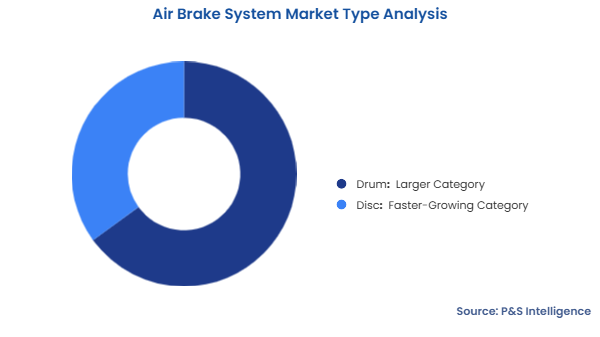
The drum category held the larger market share, of about 65%, in 2024, reflecting the widespread adoption of drum brake technology in commercial vehicles due to cost-effectiveness and established manufacturing infrastructure. Drum brakes are particularly prevalent in developing markets where cost considerations significantly influence purchasing decisions. They are widely used in Asia-Pacific and North America, with 85–90% of the heavy-duty vehicles in these regions integrated with these systems.
The established presence of drum brakes is supported by extensive service networks and technician familiarity, reducing maintenance complexity and costs for fleet operators. Additionally, drum brakes provide adequate performance for most commercial vehicle applications while offering lower initial purchase prices compared to disc brake alternatives.
The disc category will have the higher CAGR, of 3.7%, driven by the increasing focus on vehicle safety and performance optimization. Disc brakes offer superior heat dissipation, shorter stopping distances, and reduced brake fade compared to drum alternatives, making them increasingly attractive for high-performance commercial vehicle applications. The growing adoption of disc brakes is particularly notable in Europe, where stringent regulations on maximum vehicle stopping distances are driving market transformation.
The shift toward disc brake technology is accelerated by fleet operators' recognition of total cost of ownership benefits, including reduced maintenance requirements and improved operational efficiency. Despite higher initial costs, disc brakes offer longer service life and better performance consistency, resulting in lower lifecycle costs for many commercial vehicle applications.
The types analyzed in this report are:
Drum (Larger Category)
Disc (Faster-Growing Category)
Drive strategic growth with comprehensive market analysis
Air Brake System Market Regional Growth Dynamics
Asia-Pacific Air Brake System Market Size
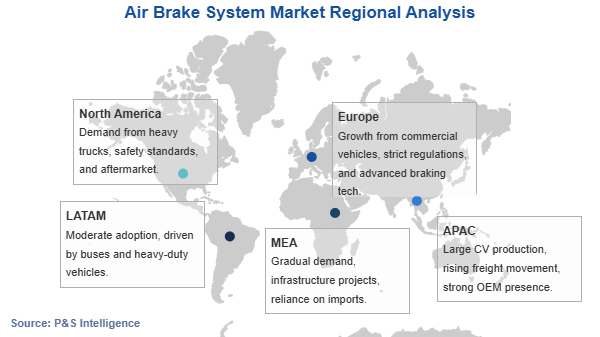
Asia-Pacific held the largest market share, of approx. 45%, in 2024, and it will have the highest CAGR. This is because it is home to some of the world’s largest automotive manufacturers, such as Tata Motors, Ashok Leyland, Zheng Zou Yutong, Toyota, and Xiamen Kinglong. This has made China, India, and Japan three of the most-prominent automotive markets in the world. Further, Asia-Pacific accounts for over 60% of the global commercial vehicle production. China alone produced over 3 million commercial vehicles in 2023. The Asian Development Bank projects that the region will require massive infrastructure investments, exceeding USD 26 trillion, by 2030.
Moreover, the rapid industrialization and infrastructure development have resulted in the expansion of the logistics & transportation sector, which requires commercial vehicles to a wide extent in order to meet the surging demand for goods supply.
India Air Brake System Market Size
India is expected to be the fastest-growing market in Asia-Pacific due to the rampant infrastructure development as a result of the fast urbanization. Manufacturers are investing heavily in advanced air brake systems to ease driving on difficult terrain and help overcome the tough braking circumstances drivers are subject too. This will also help large fleet owners in complying with the safety regulations implemented by governments to save lives, by decreasing the number of road accidents.
India’s total road length is approximately 6,700,000 km, making it the largest road network in the world. Moreover, the Ministry of Road Transport and Highways page (MoRTH) indicates that over 60% of total goods traffic is transported via road.
North America Air Brake System Market Size
North America is another significant market due to the stringent road safety regulations and the presence of prominent HCV manufacturers in the region, such as Freightliner Trucks, Kenworth Truck Company, Daimler Trucks, and Caterpillar Inc. Moreover, there have been many advancements in the regional automotive industry in recent years, such as electronic controls, ABS, and stability control, which have made air brake systems more popular among commercial vehicle manufacturers. Furthermore, there are stringent regulations and safety standards for commercial vehicles, including for braking systems, in the continent.
Air brakes help manufacturers in complying with these regulations and reducing the likelihood of road accidents. The Federal Motor Carrier Safety Administration recorded substantial commercial vehicle activity, emphasizing the critical importance of reliable braking systems for road safety. The region's focus on technological advancement and early adoption of electronic braking systems positions North America as a key market for premium air brake technologies.
The dominance of North America is further supported by the presence of major air brake system manufacturers and suppliers, including established companies that have developed comprehensive distribution networks and service capabilities. The region's emphasis on vehicle safety and regulatory compliance ensures continued demand for advanced air brake technologies, particularly systems incorporating electronic controls and integration with other vehicle safety systems. There are over 14 million registered trucks in the U.S., including both single-unit and combination trucks.
Europe Air Brake System Market Size
Europe represents a significant market for air brake systems, driven by stringent safety regulations and the presence of major commercial vehicle manufacturers. The European Automobile Manufacturers' Association (ACEA) reported that commercial vehicle registrations in the EU reached 1.8 million units in 2023, representing a stable market for brake system suppliers. The European Union's Green Deal and emission reduction targets are driving the adoption of electric and hybrid commercial vehicles, which require specialized air brake systems designed for regenerative braking integration. This transition is creating opportunities for advanced brake system technologies that can optimize energy recovery while maintaining safety performance.
Germany Air Brake System Market Size
Germany leads the European market due to its robust automotive manufacturing sector and extensive logistics networks. Key initiatives include the enforcement of Euro VI emission standards, promoting cleaner engines that integrate with modern braking technologies; and strict safety regulations by the Federal Motor Transport Authority (KBA) for air brake testing and vehicle inspections.
The geographical breakdown of the market is as follows:
North America
U.S. (Larger and Faster-Growing Country)
Canada
Europe
Germany (Larger and Faster-Growing Country)
U.K.
France
Italy
Spain
Rest of Europe
Asia-Pacific (Largest and Fastest-Growing Region)
China (Largest Country)
India (Fastest-Growing Country)
Japan
South Korea
Australia
Rest of APAC
Latin America
Brazil (Larger and Faster-Growing Country)
Mexico
Rest of LATAM
Middle East and Africa
Saudi Arabia (Fastest-Growing Country)
South Africa (Largest Country)
U.A.E.
Rest of MEA
Air Brake System Market Share
The market is semi-consolidated due to the presence of several established players and numerous smaller regional manufacturers. The market structure reflects a combination of large multinational corporations with comprehensive product portfolios and specialized companies focusing on specific market segments or geographic regions. Additionally, the competitive intensity varies by region and application segment, with higher concentration in technologically advanced markets and greater fragmentation in price-sensitive developing markets.
Top Air Brake System Manufucturers:
Knorr-Bremse AG
Minda Nabtesco Automotive Pvt. Ltd.
Haldex Europe SAS
ZF Friedrichshafen AG
SORL Auto Parts Inc.
Meritor Inc.
Brakes India Limited
Airmaster Brake Systems
Yumak Air Brake Systems
Continental AG
Wabtec Corporation
Bendix Commercial Vehicle Systems LLC
Air Brake System Market News & Updates
In January 2023, Brakes India Private Limited launched motor-on-drum brakes, iron castings, and other advanced components for commercial vehicles, focusing on enhancing performance and reliability for the growing electric vehicle market.
In April 2023, Knorr-Bremse AG announced the launch of its commercial vehicle aftermarket brand Knorr-Bremse Truck Services in South America, expanding service capabilities and parts availability for the growing regional market.
In June 2023, Tevva Motors Limited, an electric vehicle manufacturer based in the U.K., partnered with ZF Friedrichshafen AG to develop a regenerative braking system for a 7.5-tonne battery-electric truck, integrating electronic brake systems with regenerative and compressed-air brake technologies.
Want a report tailored exactly to your business need?
Leading companies across industries trust us to deliver data-driven insights and innovative solutions for their most critical decisions. From data-driven strategies to actionable insights, we empower the decision-makers who shape industries and define the future. From Fortune 500 companies to innovative startups, we are proud to partner with organisations that drive progress in their industries.
Client Testimonials
Working with P&S Intelligence and their team was an absolute pleasure – their awareness of timelines and commitment to value greatly contributed to our project's success. Eagerly anticipating future collaborations.
McKinsey & Company
India
Unmatched Standards
Our insights into the minutest levels of the markets, including the latest trends and competitive landscape, give you all the answers you need to take your business to new heights
Complete Data Security
We take a cautious approach to protecting your personal and confidential information. Trust is the strongest bond that connects us and our clients, and trust we build by complying with all international and domestic data protection and privacy laws